When it comes to constructing a strong story, which will keep the reader engaged – there are several principles you can follow.
It’s important to know and understand your audience. Consideration should always be given to who will be reading your content, prior to creating it.
Creating a storyboard before writing will give the creator a great sense of where they’re starting and ending. Seeing the big picture while working out the details is always helpful.
Emotion, emotion, emotion! Be sure to evoke emotion with descriptive language. Make your reader laugh and cry!
Protagonists give the reader a hero or interest character to identify with. In my experience, I always feel more connected to literature or a movie which has a character I can relate to.
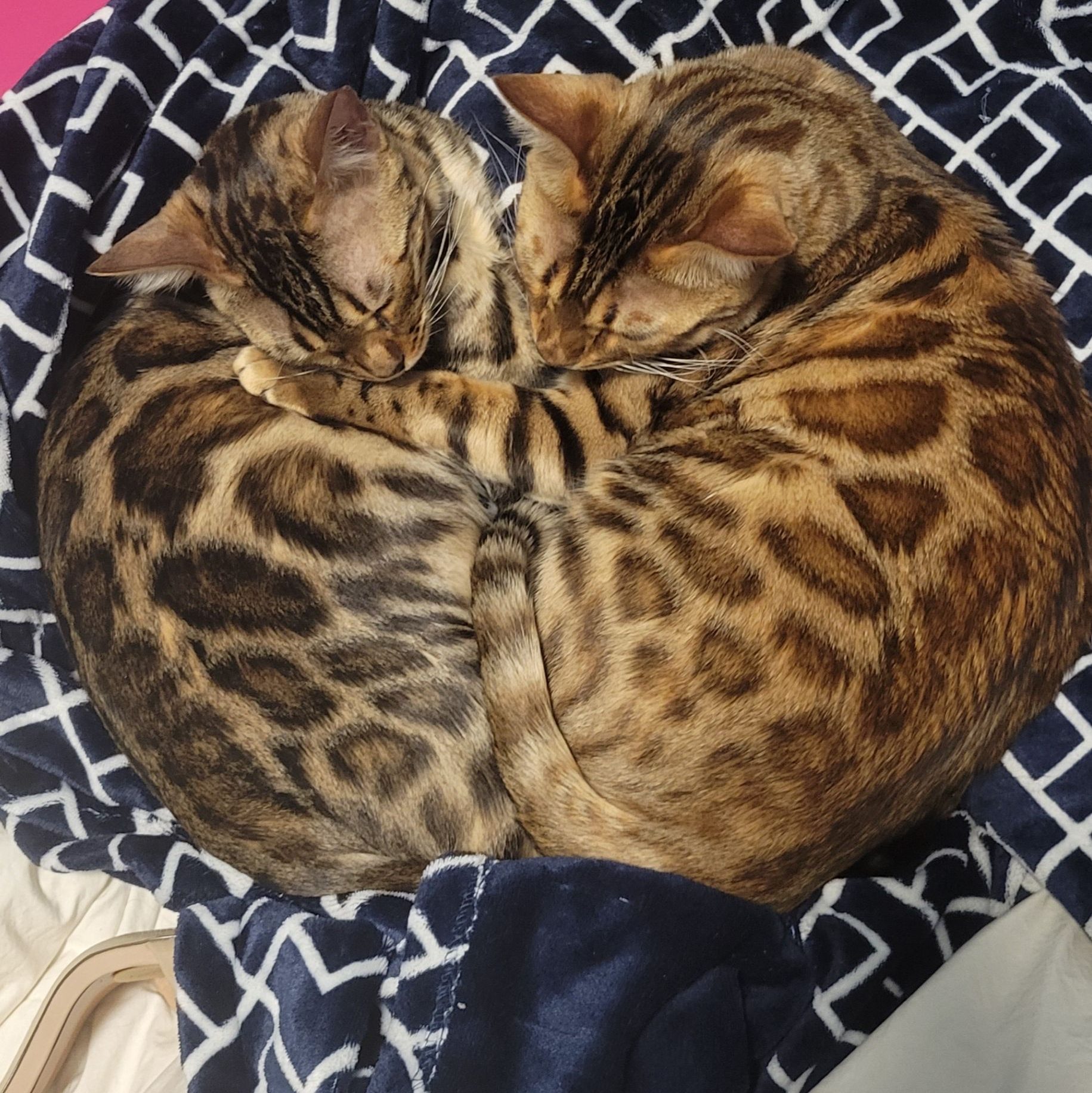
Hi everyone, it’s Odin and Olive, we are Brooklynn’s cats. We have taken over her computer today to tell you a little bit about us.
Starting at the beginning the Lammers Family adopted us in 2021 from Chinook Arch Bengal where we left our Mother, Father and siblings to go to a new home in Chestermere, AB. When we got to our new home we were put into the basement where we had food, water, toys and a HUGE cat tree just for us. It was scary at first but the more we saw our new family the less scary it became. In the past two years we have grown and started to develop our own fursonalities, I (Odin) have become quite vocal about my wants and my favorite place in our house is the pantry and if I persistent enough I will almost always get my way,( Mom has a soft spot for us and always makes sure that we get our treaties). Olive on the other hand is a much more quiet when she wants to be, but she is demanding but not when it comes to treats, Brooklynn has become Olives person and she is the thing that she wants. I (Olive) have made it clear to everyone that I have a favorite and I ain’t shy to tell you, Brooklynn and I have developed a morning routine that includes me being an alarm clock, getting brushed and brushing myself, crying to be picked up, and then by being carried up the stairs by Brooklynn to go get breakfast, when mom gets back from the gym it is my time to exercise on my cat wheel where you have to watch me closely so that I know I am doing a good job.
Olive on Left, Odin on Right
Some of our favorite activity whenever it is nice out we like to go outside and burn off the access energy we had from the day, we get to play chase together and lay in the nice warm sun on sunny days and play in the snow on snow days. After all that running around the fireplace is our next stop, no matter the weather outside we will be sitting on the ledge of the fireplace soaking up the heat from the fire or the sun. They make jokes that Olives favorite show is the fireplace and I think that we would both agree that it is our favorite spot, right in front of the big window letting all the sunlight in. Our family does anything to make sure we are happy and healthy and we couldn’t be happier with our furever family.
This week in EXSM 3989 we learned about the power of visual storytelling, and let me tell you, people in the fields of science and heritage have been doing this data sharing thing wrong for a very long time!
I wish that instead of teaching students how to calculate the radiocarbon date of organic material from the Holocene/Pleistocene transition in ARKY 101 I had taught them how to illustrate and visually express archaeological findings to ensure people outside of the field of heritage understand WTF they were saying and as a result, actually CARED…
It is really no wonder academics go nuts over a pretty map or a visually entertaining power point presentation when attending a talk that is more boring than watching paint dry. In fact, I am no longer shocked that people do not care about or read articles in the newspaper about the newest archaeological find, or why archaeological science and protecting heritage matters. It’s sad but if we cannot learn to communicate with others about why what we do actually matters, then maybe we too should go the way of the Pleistocene/Early Holocene Megafauna … (become extinct).
” if a scientific claim is presented in pure words or numbers, 68% of people will believe that the information is accurate and truthful. But if you put a simple graph with the claim, the number rises to 97%.”
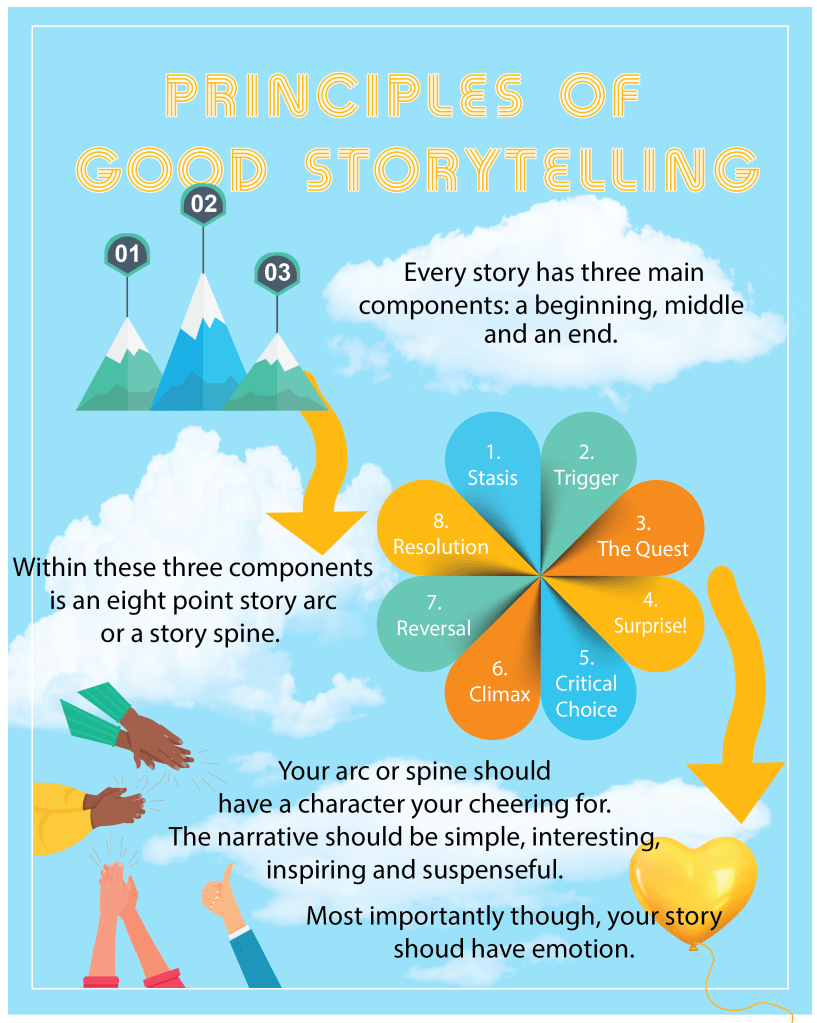
So when we were tasked this week to make an infographic on a topic we had learned about in the course (I chose the ‘Principles of Storytelling’), I WAS SUPER PUMPED! I wanted to learn this amazing skill! I wanted to visually seduce everyone into loving boring ass archaeology data by learning first how to do it by telling people how to write a good story! I felt like this was my new calling in life and I was going to blow everyone away!
But then my mother and father in law showed up a day early to our house as a surprise … so instead of knocking this assignment out of the park, I focused on the visuals, made the infographic pretty, bright and colorful. I focused less on mining the data to highlight the core principles of good story telling and rather, I took the key points I wrote down and used what I thought was the core principles and summarized them.
I hope you all enjoy it, but I know it could be better!
Please note: My mother and father in law have now returned to their own home and I am back, better and more focused than ever on becoming AMAZING at using visual data to tell stories rather than using words!
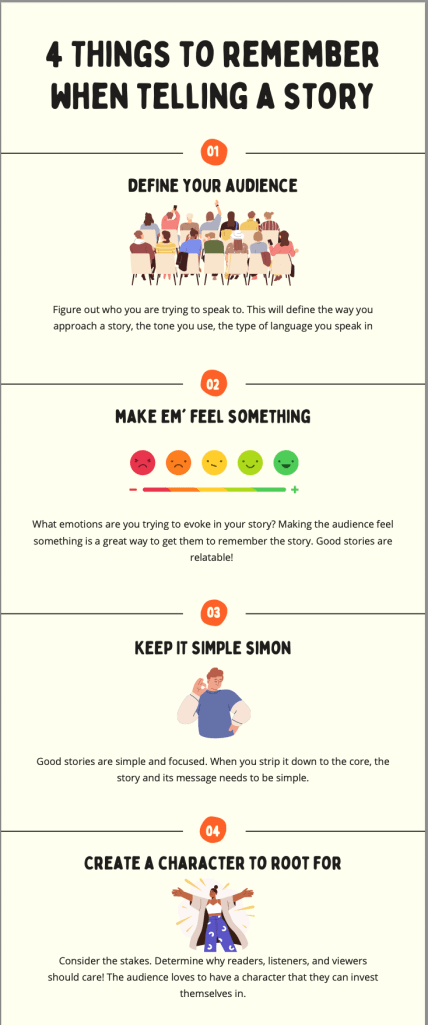
All good stories have a beginning, middle, and end. Great stories make sure that they cover off a wee bit more than that. Check out this infographic below for 4 tips to remember when telling a story!
Thinking you could use a bit more advice before you venture into the world of storytelling? Check out this post for some great tips!
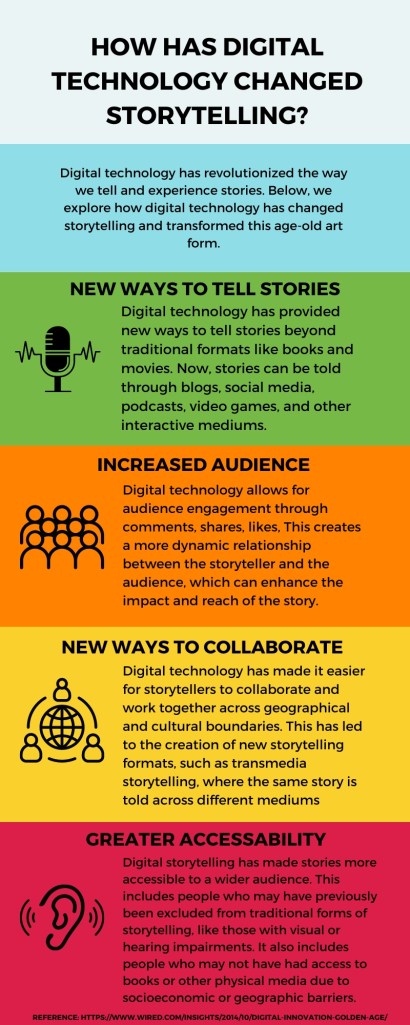
Storytelling has come a long way since the days of ink and paper. With the advancement of digital technology, we have seen an explosion of new ways to tell stories. From interactive websites to immersive virtual reality experiences, digital technology has opened up a world of possibilities for storytellers.
One of the biggest advantages of digital technology is the increased audience it can reach. Social media platforms like Facebook, Twitter and Instagram provide a massive audience for stories to be shared and discovered. This increased exposure has created new opportunities for storytellers to connect with fans and build communities around their work.
Collaboration is another area where digital technology has had a significant impact. Online tools like Google Docs have made it easier than ever for writers, artists and other creative professionals to work together on projects from different locations. This has led to the emergence of new collaborative storytelling formats such as webcomics and podcasts
Digital technology has made storytelling more accessible than ever before. With the rise of ebooks and audiobooks, readers can now access stories from anywhere in the world with just a few clicks. This has opened up new opportunities for writers to reach audiences who might not have been able to access their work otherwise.
The impact of digital technology on storytelling has been enormous, providing new ways to tell stories, increasing audience reach, fostering collaboration and making storytelling more accessible to everyone. As technology continues to evolve, it’s exciting to think about what new storytelling possibilities lie ahead.
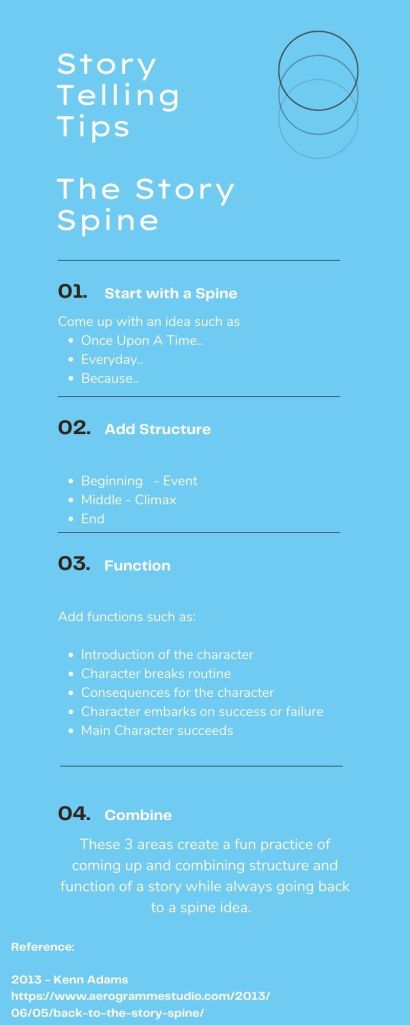
I have made an info graphic explaining this theory in a few short steps which can be found below. In his blog post Kenn writes about ideas we can use to practice story ideas. Something that is so hard to do is practice creativity. Creativity isn’t something you always know what you are looking for. Unlike a sport or a recipe there are certain parameters to what you are practicing. Kenn gives us some parameters to how to practice creativity.
Kenn writes
The Story Spine is not the story, it’s the spine. It’s nothing but the bare-boned structure upon which the story is built. And, that’s what makes it such a powerful tool. It allows you, as a writer, to look at your story at its structural core and to ensure that the basic building blocks are all in the right place.
All are used to serve each other and craft ideas. They are used to try and come up with story ideas in order to ultimately make an entire story. I think the idea is brilliant and as I shared earlier, I believe it gives us tools to make a great story.
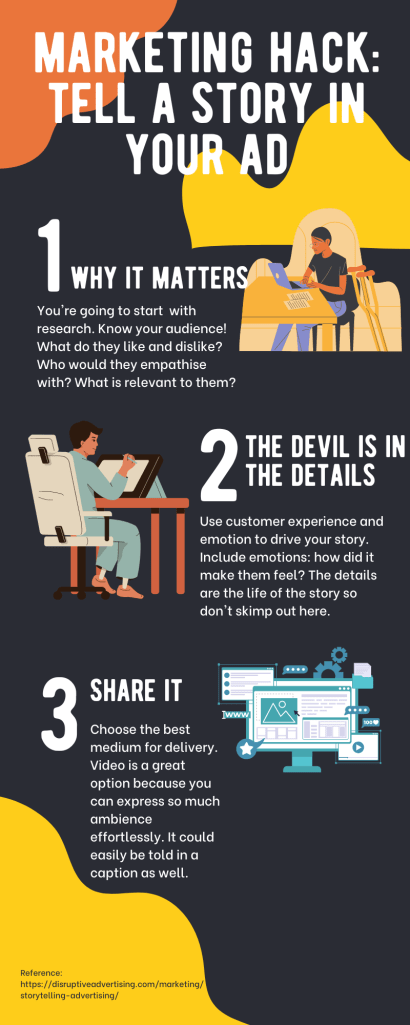
We are driven by stories. Marketers have always known that word of mouth is the most effective type of marketing. Everyone knows this. So the question we ask is : “how can we control that”? The closest we can get is by using storytelling in our ads. Telling a story connects with the emotions of the customer, making them feel like the pitch is coming from a friend.
Storytelling isn’t always a natural talent everyone possesses, some of us have to take the time to learn how to tell a great story. This blog post and infographic will be a starting point for you on your journey of learning how to be a better storyteller for your brand online.
When telling a story, you need to make sure that you have a clear beginning, middle and end. No one wants to listen to a story where they don’t understand who the characters are or if you’ve left out how they ended up in a difficult situation or if you fail to mention what they did to resolve their dilemma.
You’ll want to follow the storytelling principles of a story spine.(Once upon a time..) At first you want to start the story off by building the scene and introducing who the characters are. (And Every Day..) This is when you’ll introduce the character’s conflict or challenge they’re facing and subtly hinting at what might be the big change. (Until One Day…) Then, the big event that changes everything and pushes the character to do something drastic. (And Because of This…) Which moves into the part of the story where the character evolves and faces the challenge ahead of them. (Until finally…) The climax of the story happens where the character either fails or succeeds in their mission. (And, ever since then…) This concludes the story and tells the audience what the new routine is.
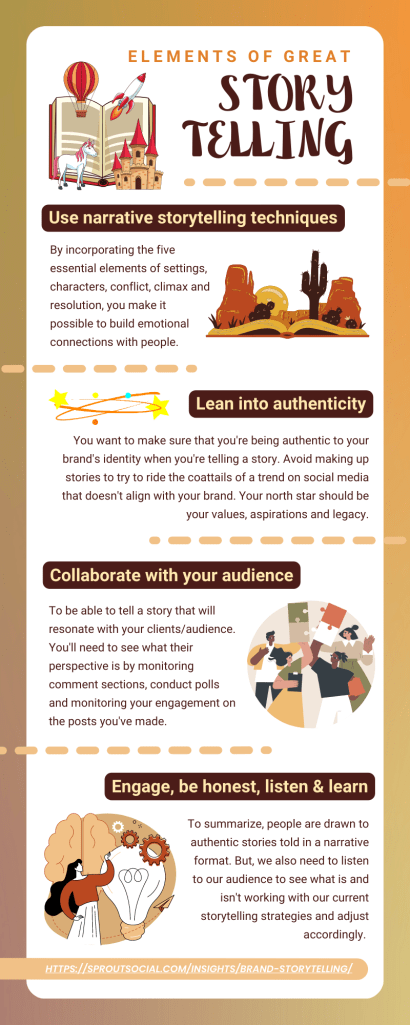
Be Authentic
When you’re telling your story, you want to be authentic. That way you’re ensuring you’re drawing the right people to your brand and demonstrates the integrity of your brand. Your values and aspirations should not be swayed based on current trends. Only participate if you know the message with remain true to who you are and how you want other’s to receive your message.
Listen to your audience
But, with that, you also want to make sure you’re telling stories your viewers can relate to and resonate with. Clients want to know that you care about their values and their needs so here’s a few ways different things you can do:
Monitor your comment section and listen to what your clients are saying about their experience with you and don’t hesitate to ask for their feedback.
Create interactive polls to help your engage with your clients and gain insight on what they want to see.
Watching for other methods of engagement such as posts about your organization or comments on other posts about your organization.
If you’re a writer, marketer, or anyone who needs to craft compelling stories, then the Story Spine is a tool you should know about. The Story Spine is a simple yet powerful framework for developing narratives that engage your audience and leave a lasting impression.
The Story Spine was first introduced by Kenn Adams, a storyteller and improvisational theater artist. The framework consists of 8 key components, but the infographic focuses on the 5 Key Elements that are essential for crafting compelling stories.
By using these 5 Key Elements of the Story Spine, you can craft powerful narratives that captivate your audience and deliver a satisfying experience. Whether you’re writing a novel, a screenplay, or a marketing campaign, these elements can help you create a story that resonates with your audience.
To summarize, the Story Spine is a simple yet powerful framework for developing compelling stories. By focusing on the 5 Key Elements, you can create narratives that engage your audience, create tension, and leave a lasting impression. Try using the Story Spine in your next project and see how it can help you craft a story that resonates with your audience.
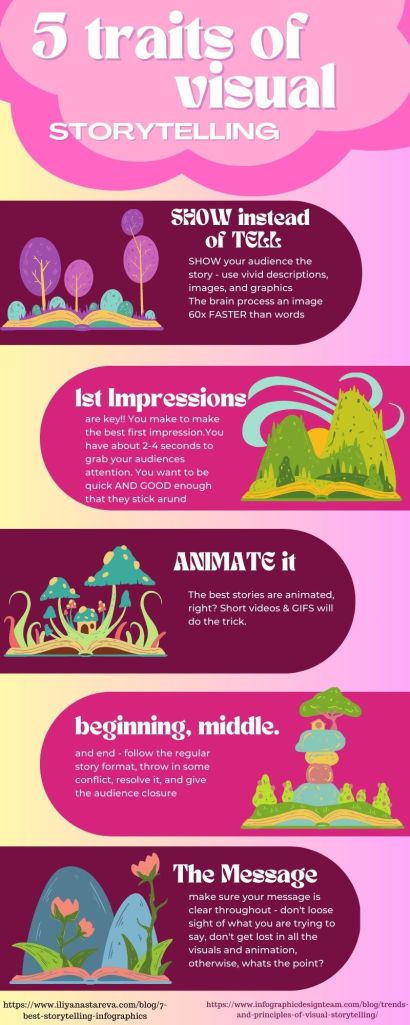
Visual Storytelling is so important to get right. The majority of your audience is seeing you on social media – it is vital to make a thoughtful impact through the use of visuals. Here are a few key key traits of visual storytelling to consider:



 EXSM 3989 - Digital Storytelling Class Blog