Warning: Spoilers for Denis Villeneuve’s Arrival (2016)
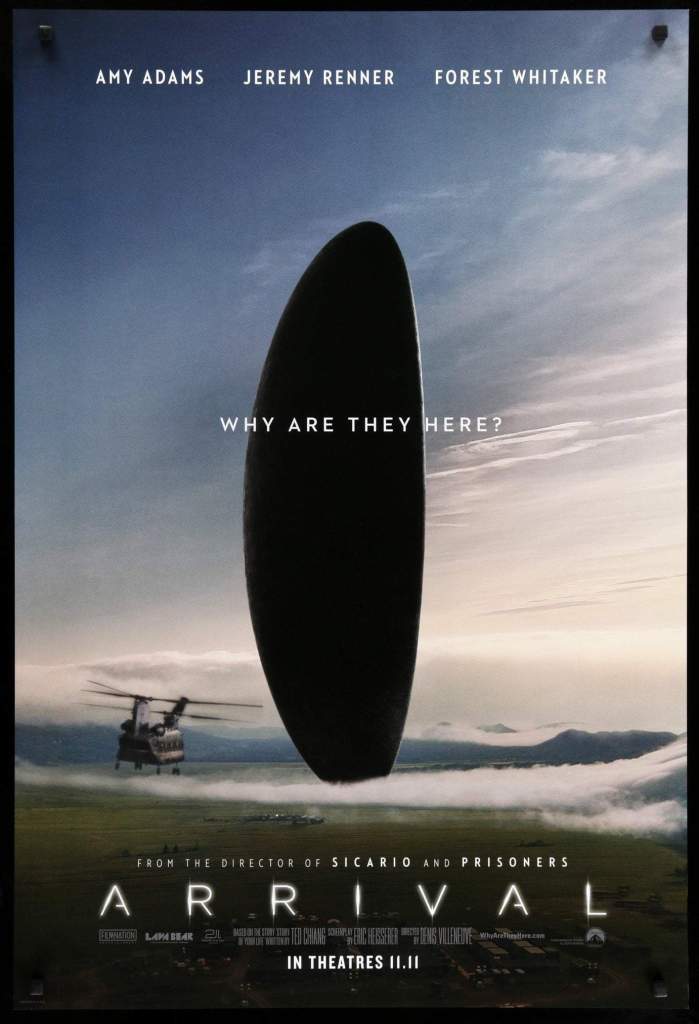
I don’t think I was expecting anything more than a fun movie-going experience when I first went to watch Denis Villeneuve’s film Arrival in theatres, but I wasn’t expecting to get chills from watching the interactions of the human scientists making first contact with aliens. The film’s imagery and storytelling have stuck with me and have led me to rewatch the film many times since that first experience.
Why is it so effective?
For the second week of my course Digital Storytelling, we looked into the essential elements of good storytelling. This goes beyond just what makes a good film or even a digital story, but taps into the core of how people make communicate meaningfully. I would like to apply this lens to my favourite film, Arrival, to explore makes it so memorable.
The Story Spine
In his blog post, Back to the Story Spine, Kenn Adams discusses the narrative technique of the story spine—a kind of barebones outline that allows us to pare a story to its “structural core”. When applying this technique to Arrival, we can see how tight the film’s focus is on the protagonist, Louise Banks.
| Once upon a time… | There was a linguist named Louise who was incredibly skilled with translating unfamiliar languages. |
| Every day… | She taught at her university, settled in her routine. |
| But, one day… | The appearance of alien ships sent a military team to collect Louise, in the hopes that she could use her skills to find out what the aliens wanted. |
| Because of that… | Louise studied the aliens closely, and began to suspect they didn’t mean any harm. |
| Because of that… | She learned to perceive time the way the aliens did. |
| Until finally… | Louise was able to use her foresight to stop a war among the humans, and the aliens left her with the key to their language. |
| And, ever since then… | Louise became an expert on the alien language, while needing to continue her life while perceiving time in a non-human way. |
While the spine misses the flavour and details of a story, this device is useful for showing us the essence of a plot. And, despite being about non-linear time, the core of Arrival tightly follows Louise’s personal, linear journey as she learns to speak like the aliens, the Heptapods. But, of course, there is much more to the story that sparks the imagination. What are the elements that make Arrival an effective story?
The Four I-s
Writers and marketing experts, responding to the short attention spans of a digital audience, argue that good storytelling distills a plot to its essentials. For example, a quick Google search for Pixar’s Rules of Storytelling reveals that the universally-loved studio follows the same guidelines to create powerful movies.
Social analyst and communications expert Ashley Fell, in her 2017 TEDX Talk on storytelling in the digital era, explains that memorable stories exhibit the 4 I’s.

Interest: Stories hold our attention through stakes. Cyriaque Lamar, quoting Emma Coats’ 22 Rules of Pixar, asks us to “give a reason to root for the character” and to consider “what happens if they don’t succeed”. In Arrival, we not only fear the motivations of the Heptapods, but also the outbreak of a global war as a result of misunderstanding the aliens’ words.
Instruct: Deeper than simply featuring a lesson, a story needs to have meaning. Pixar’s rule #22, echoing the ideas behind Kenn Adam’s story spine, asks “What’s the essence of your story?” Arrival is really about humans learning to connect to others despite cultural divide, arguing that we cannot survive without communication.
Involve: Stories should involve us by asking us to engage our empathy. Pixar Rule #15 asks writers to put themselves into the shoes of their characters, adding that “honestly lends credibility to unbelievable situations.” Arrival succeeds by having the characters react viscerally and believably to meeting the aliens for the first time. The fear and awe are clear on their faces when entering an unknown spaceship—as is the nausea from being inside a ship with variable gravity.
Inspire: Finally, Pixar prompts its writers to ask what inspires them: “What’s the belief burning within you that your story feeds off of? That’s the heart of it.” Fell compares powerful stories to the experience of watching the shape, colour, and movement of a campfire. Just how a flame draws us in, a story should be visual, whether these are real images or vibrant prose that triggers our imagination.
And here, Arrival has truly impactful visuals, only enhanced by its music. A giant form floating above a flat field; creatures occupying the uncanny space between sea creature and a human hand; Louise reaching to touch her palm to a transparent wall, fingertip inches away from the trails of ink that make up the Heptapod’s language. Despite being a simple story at its core, these images are why Arrival has continued to inspire me.
What does story mean to us?

When I was in the theatre, I couldn’t articulate all these reasons that Arrival really meant something to me. Even now, equipped with Fell’s “4 I-s of storytelling” and Pixar’s “22 Rules”, I still feel that some spark is missing when talking about why this story inspired me to study science fiction and deeply influenced my own writing. Yet I think these rules still come close to evoking that spark. The powerful visuals, deeply human characters, and underlying message of collaboration make up the true colour and motion of Arrival’s flames.
 EXSM 3989 - Digital Storytelling Class Blog
One reply on “Arrival Changed my Life”
[…] part of the course, I wrote this blog post on my class blog about how the film Arrival deeply influenced my writing and SF research. Please […]
LikeLike