Creating an engaging and impactful story isn’t always easy, whether in analog or digital format, but keeping these four points in mind can help you to formulate a plan and execute your story successfully!
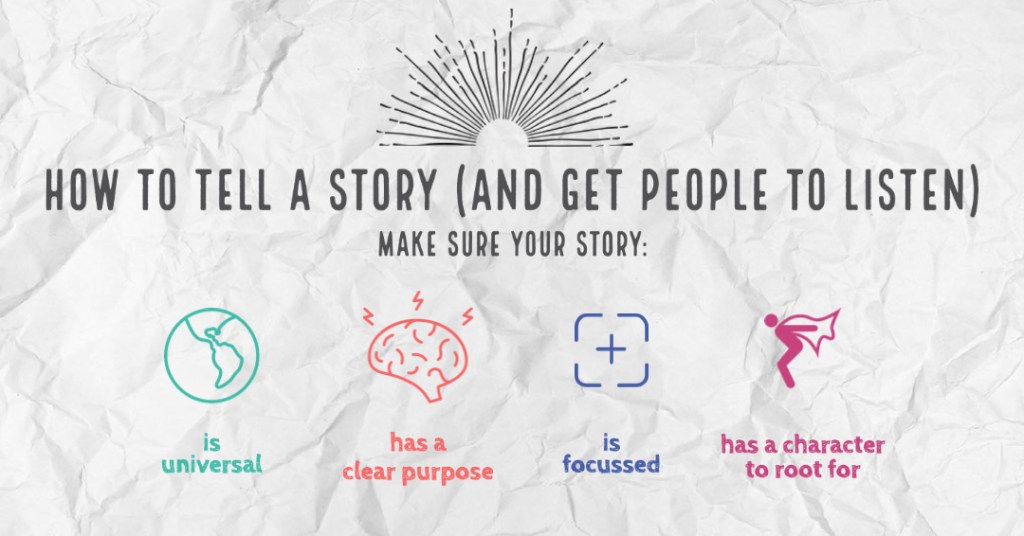
Creating an engaging and impactful story isn’t always easy, whether in analog or digital format, but keeping these four points in mind can help you to formulate a plan and execute your story successfully!
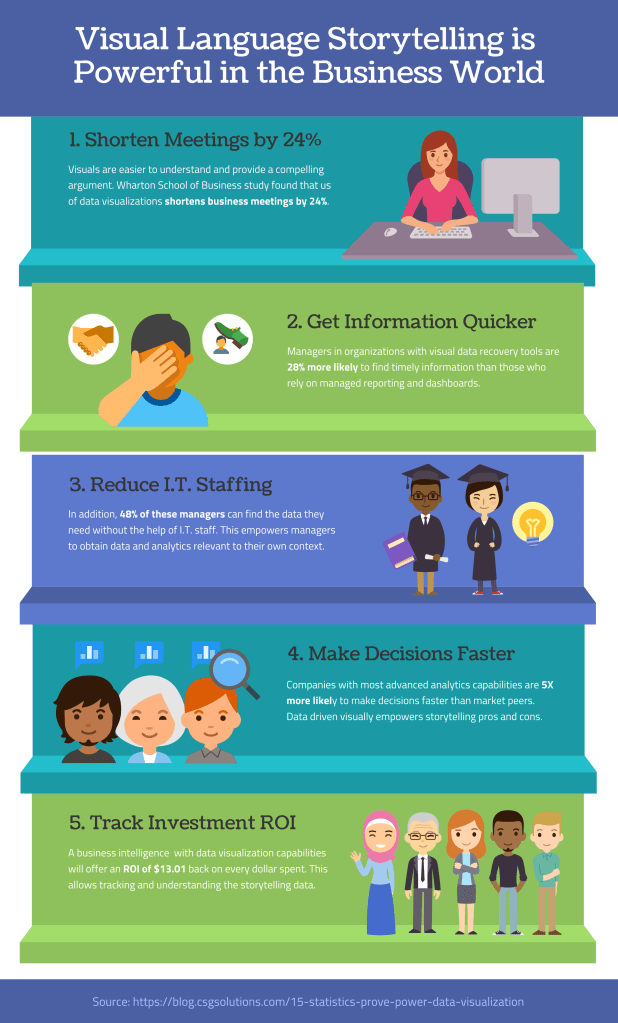
Visual language makes data easier to understand because our human brains process visuals 60,000 times faster than they do text. Science has known since 1921 that “a picture tells a thousand words.” Therefore, it makes sense that applying visual language storytelling in the business world will yield powerful results to help companies grow better.
The story arc for my infographic is based on a blog about data visualization tools. My infographic shows how businesses are empowered through data storytelling to grow revenues and concurrently reduce their investments of time, human resources, and dollars in operational processes.
The first step, or beginning, is to use visual data storytelling to free up staff hours by reducing time in meetings because the visuals are more quickly understood (1). The middle of the story arc is empowering managers to get real-time information directly through visual language driven platforms (2); this will reduce I.T. time on manually sourcing lagging data (3); management will be empowered with confidence of real-time data to make decisions faster (4). At the end, investment in tools for data visualization storytelling to inform business operations will have a positive return on investment (ROI) by a trackable dollar amount of reduced overhead (5).
One of my biggest takeaways is the importance of playing to our brain’s strengths so to speak. Not only does the human brain process visuals 60,000 times faster than it does text, but 90% of the information that is transmitted to the brain is visual. For all types of education or information transmission, whether in the business or personal context, we should first think about how we can use visual storytelling. And of course, the most effective solutions will involve digital. As we move forward, the opportunities for digital storytelling will be unlimited.
For my live-tweet, I chose the latest episode of Bob’s Burgers recently added on Disney+. As I said in my thread, it’s a show my family has watched since the pandemic lockdowns last year. I opened up with a casual call to read along to grab reader interest, establish the tone of my writing, and inform people what my thread would be about. I also included a thematically appropriate gif at the end for additional visual appeal.
It was challenging trying to actively use storytelling techniques during a live-tweet. It was important to provide active commentary that wasn’t just summarizing what was on the screen but also a story of how my family watches the show together. Ideally, during a live-tweet of a show or film, others are following along. At the same time, a live-tweet thread should provide enough engagement that a reader would want to follow along even without being able to watch.
To better achieve this, I tried to follow some of the storytelling principles we’ve learned to encourage engagement and the advice found in the articles by Gary Vaynerchuk and Nick Reese. I mixed “passion with practicality” by not being overly concerned with the episode plot summary and instead putting snippets of my live experience into my story. Structure was provided by my introduction where I also established the setting of it being a family watch after dinner. It continued with the body of my thread where I provided brief summaries with commentary and visual interest of supporting gifs. Then I established an ending with closing tweets describing what happened with my family after the show was over and one thanking the reader for joining us.
If I were to do this again, I would pick a longer show or film in order to give myself time to provide better commentary not only of what was happening onscreen but of what was going on in my head or my home. It would also give me more time to be aware of my writing and search for any interest-grabbing accompanying images or video. Overall, this was a great way to practice storytelling techniques and allow my family to be part of the experience.
It’s new, it’s thrilling, it’s sexy…it’s Monday RUN day! Documenting my first run of the week, this live tweet thread is a real-time account of the lead up to, and actual experience of, a non-runner’s lunch run.
Despite the mundane topic, I wanted this thread to be relatable, suspenseful, and emotive, in order to create a compelling story. Who doesn’t dread exercise!? Will she make it through the run!? What’s going to happen next!? I crafted this thread along the lines of a thriller story like the ones we saw in our required readings; I wanted there to be some tension and suspense about what would happen next, but I also used humour to relate to readers, elicit emotion, and acknowledge the absurdity of turning such an ordinary activity into a topic worthy of being shared as a story.
Using short sentences and writing how you speak lends to the authenticity of the live tweet, and it is effective in pulling the audience into the story, enticing them to keep reading. The pacing of short stories such as this one is essential to keeping readers engaged and invested in the events that are unfolding…it’s more like listening to a friend recounting an exciting incident than reading any type of literature! My story has a clear beginning (introducing the topic, telling the audience what to expect and creating anticipation with the first tweet), middle (the highs and lows of the run experience, as well as the tension created throughout), and end (completion of the run) and resolves with the protagonist having grown and changed in some way (professional runner, ready to tackle a marathon). I kept to the basic structure of the 8-point Story Arc, although with a Twitter story, I feel it’s unnecessary to introduce your protagonist and establish “stasis”. You can assume that your audience is roughly on the same page as you and jump right into the “trigger” or event that launches your story, subsequently taking them through the thrilling steps of your adventure.
Writing in this way is exciting and can be very expressive – the creativity that emerges when you are limited by word count and format is fascinating. As a writer, you must be able to very quickly reel your audience in and get them on your level – their limited point of view allows them to experience the event as you are, right now, in the moment. Short-snippet storytelling is an extremely distilled way to share your perspective on something, making it a very relatable and engaging way to connect with your audience.
My live-tweet story is Big Timber’s Season 2: Episode 1 “Ready to Begin.” My story has 12 tweets; hashtags are #BigTimber and #EXSM3989. This episode is streaming in Stack TV, but I pretended it was a live TV show. As I was watching it for the first time, it felt like a live story to me.
This is the continuing documentary of everyday life (stasis) of Vancouver Island entrepreneur Ken Wenstob and his family who own and run Wenstob Timber Resources. As this episode begins, we learn it is springtime, but the snow has not melted on the mountain where Wenstob Resources has their new logging claim. The weather, a trigger beyond their control, makes it too dangerous to try to get their massive equipment up the mountain. Then there is a second trigger. Ken, our protagonist, learns that he has been fined $1M by the government for leaving logs on the mountain last year when the logging season shut down early due to forest fires and then snow and he could not get the logs out. He has only 16 weeks to pay this fine or his operations will be shut down. And so, Ken begins his quest to find another source of cedar logs to fill the spring orders coming into the mill.
As we move into the middle of the story, there are surprises. Ken decides to enlist a couple of his old boats to beachcomb for huge cedar logs on the beaches. These logs are free to take but very had to get to due to remote locations. There are more surprises as Ken’s team works on the boat strategy to access the logs. First, there is Seacrest, a very old landing barge that has two powerful diesel motors but only one will start. The mechanic works hard and finally it starts. Second, the digital engine of a new boat carrying the crew will not start. The mechanic does not know this type of motor, but he does figure it out while patience between the workers has worn very thin. The third surprise is the tide is going out and they are losing opportunity to begin yarding logs.
But Ken’s critical choice is that he never thinks of giving up on anything. He calls in a reinforcement, his cousin who comes via his own boat, to help the team start yarding the logs. This is the climax. Ken’s cousin brings expertise and equipment which pushes the rest of the crew to get to the site and start logging. They try to pull the huge logs off the beach without cutting them which would give them highest value per log. But, another surprise, none of their pulling equipment can withstand the pressure. So, ultimately, they are forced to cut the logs into pieces to yard them.
As the episode ends, there are major changes (reversals) for the entire team. Ken, the protagonist, has created a new stasis (resolution), to get the cedar logs he needs for his mill to make boards and generate revenues to pay his $1M fine. Instead of using logging trucks on mountain roads to log his claim, he uses barges on the ocean to yard free cedar logs from the beach. This episode is a perfect story arc.
Live tweeting is a new experience for me. It was challenging to absorb the information and write posts that quickly without losing the ongoing storyline. I was very busy for the full 45 minutes of the episode, a few minutes before, and a few minutes after. Thank goodness for the commercials that gave me a minute or two to catch up. I had prepared some images in advance that I used as I tweeted. Rereading my tweets today, I think there is an engaging story arc that has clear structure and purpose; that generates feelings and emotions; that is simple; and that gives us a character, Ken Wenstob, to root for. I also think there’s room for me to improve. Next time I will work to make the tweets shorter and remember Gary Vaynerchuk’s hack that I’m documenting, not creating. #BigTimber is a Canadian documentary. The storyline is as large as Ken Wenstob’s life.
Most people are familiar with the hit Broadway musical Hairspray and the 2007 film adaptation starring Nikki Blonsky, Zac Efron and John Travolta. Fewer are familiar with the original 1988 film it was based on. Directed by cult film icon and “Ru Paul’s Drag Race” guest John Waters, the film stars Rikki Lake, Jerry Stiller and frequent Waters’ collaborator Divine.
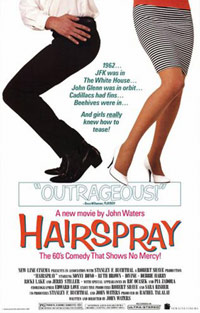
The basics of the plot, about a plus-sized teen named Tracy Turnblad who becomes a dancer on a local program called The Corny Collins Show, fits well into Ken Adams’ story spine breakdown:
Every day, Tracy watches a dance show after school and practices her dance moves.
But one day, she tries out for an open spot for featured dancers and becomes one of the most popular on the show.
Because of that, Tracy is nominated for the show’s talent pageant and begins a relationship with a dancer she has a crush on.
Because of that, she angers her rival, the rich mean girl Amber, who bullies Tracy.
Then, Tracy learns more about racial segregation of the show that keeps Black dancers from participating.
Because of that, Tracy begins to speak out against injustice as part of her pageant platform and challenges the status-quo of the show.
Then, a riot over integration breaks out at a live show taping and Tracy gets arrested.
Because of that, Tracy is banned from the pageant and her friends and family help her fight back and crash the pageant live on-air.
Until finally, Tracy is crowned the winner, and the hosts announce that The Corny Collins Show is officially integrated.
Of course, this simple summary doesn’t include all the fantastic details and side stories that made this film so appealing to me when I first saw it as a preteen. As a plus-sized girl, it was refreshing to see a larger girl written to be accepting of and confident in herself, a universal theme that would meet the standards of the Pixar storytelling model. Tracy is unashamed of her body and pursues the affections of the leading man without any hesitation or reservation. When Amber, her mean girl rival with conventional looks, criticizes Tracy’s body, Tracy holds her own and impresses the judges for dance council with her answers and poise while Amber is sent home and suspended from the show for her bullying. The people who criticize Tracy are presented in a poor light while the movie shows her moving on and becoming successful without changing her appearance to suit others.

In a Twitter thread recounted by the Gizmodo article, “The 22 rules of storytelling according to Pixar,” storyboard artist Emma Coats wrote that a character should be admired for “trying more than for success.” In Hairspray, Tracy uses her popularity to speak out against injustice for others and not just for herself. She speaks up for her friends who are not allowed to dance and joins a protest against segregation over being on an episode. She is admirable in her convictions and even her hairstyles are a metaphor for Tracy’s journey and the changing times as she goes from popular tall and ratted styles to the more modern sleek styles of the latter part of the tremulant 1960s.
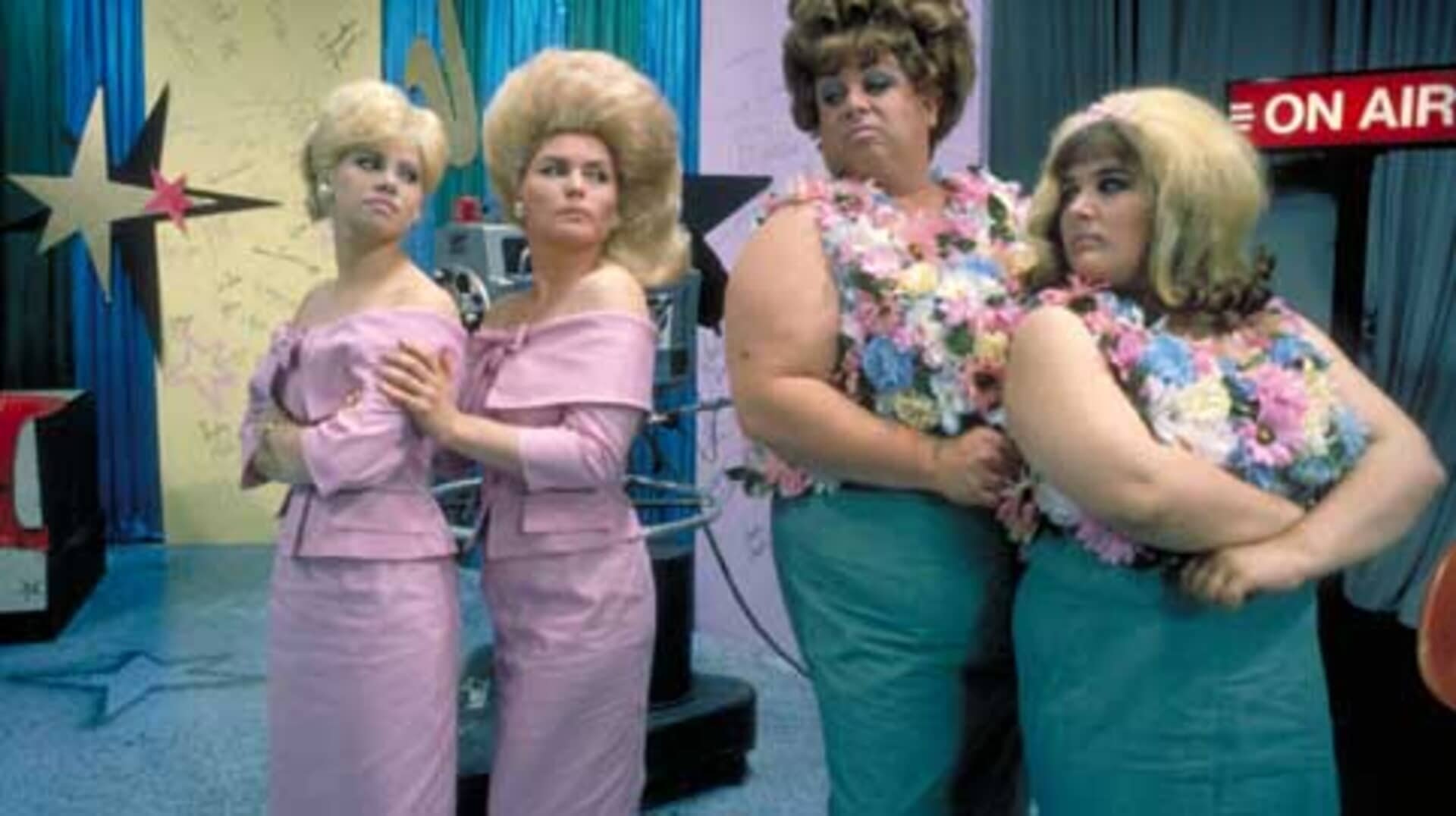
The outrageous fashion and exaggerated takes on popular hairstyles of the 60s give it the eye-catching appeal that allows you to instantly recall the feel and setting of the film. The story is told with a visual flair and an over-the-top aesthetic characteristic to John Waters’ direction. Though not digital elements, they are an example of how visuals make an impact and help us to remember a story, as discussed by Ashley Fell’s Ted Talk on digital storytelling.
Even though it is, as critic Pauline Kael noted in her New Yorker review, more of a parody of a teen comedy and not as sincere as its musical counterpart, the 1988 Hairspray is still full of heart and endearing in its universal messages of acceptance and social justice. It deserves to be remembered as much as its musical adaptation and enjoyed as an introduction to John Waters’ wild film canon.

Rebecca, by Daphne DuMaurier, was recommended to me by a friend over ten years ago when I young, wild and free, and it’s still the best book I’ve read as an adult. It has the dark feel of Gothic, Bronte-esque literature with a more modern setting – a truly emotional thriller with themes that are as relevant now as they were when the book was written in 1938.
As all good stories are, Rebecca is universal – it follows a young woman who feels herself to be inadequate, plain, slow-witted, unremarkable, and out of place…not to assume that everyone feels this way, but I think that most of us have been there at some point in our lives. We all have deep-rooted fears about our worth and how we compare to others, and because of this, I connected deeply with the main character and felt like I understood her discomfort and insecurity throughout the novel. Because the story is related to the reader entirely by the main character’s narration, you become tangled up in her mind, feelings, and suspicions, and we question the events going on around her as she does. She is the character that we root for, because we are her; we have become unavoidably entwined with who she is and what she feels. We want her to succeed because we are connected to her. As the story unfolds, it becomes more and more evident that it is her well-being that is at stake, and even her life at one dark point. The mental turmoil that threatens the main character is dangerously relatable – we want her to make it through the story because we fear her failure deep within ourselves.
Rebecca does an excellent job of connecting the reader to both the story and the main character (whose first name we never learn, which perhaps helps to further this link) as well as laying out the purpose of the novel very early on. Despite the feelings of not knowing as we read, of being purposefully kept in the dark, we understand almost from the very beginning that the narrator needs to uncover the mystery of Rebecca and ultimately be free of her. She needs to know the truth that is being kept from her, which I think is another universal theme in the story.
The narrative takes us through the basic story spine; we are introduced to the main character and her mundane routine, but one day she meets Maxim DeWinter, which leads to a series of events spanning the novel, climaxing in uncovering the truth about Rebecca as well as Maxim’s true feelings about her, and ending with the destruction of the DeWinter estate, Manderley, and the couple’s relocation abroad. Rebecca has all the components of a good, solid story, but beyond that it is all the more engaging because of the depth with which we connect to the main character. The mystery of the story, too, entices you to keep reading, because like the unnamed narrator, you are constantly guessing at what is really going on, wanting to understand, and unsure of everything. I think that these two elements together, the reader’s connection to the narrator as well as the mystery, allow you to engage with the story in a very emotional and meaningful way.
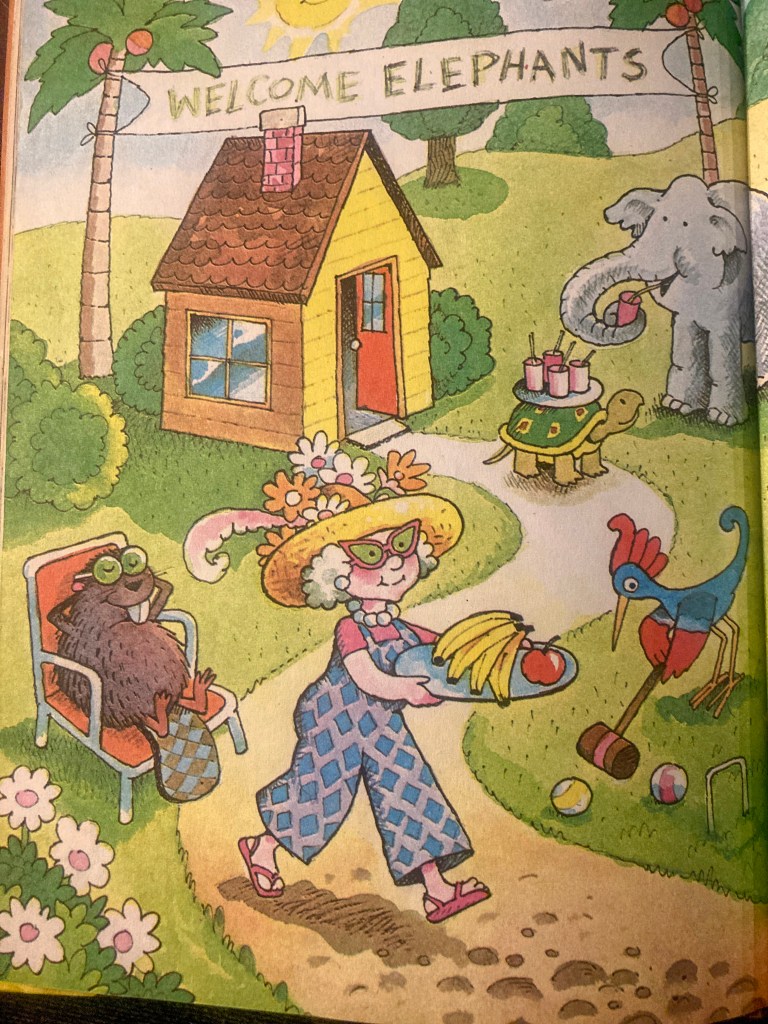
One of my favourite stories is a children’s book called But No Elephants written by Jerry Smath. The book is about grandma Tildy, living alone doing all the work to maintain her cottage. One day a pushy salesman comes to the door selling pets. The old lady comes across as ‘fine, “I’ll buy what you’re selling as long as it’s not an elephant”.

Each time she gets a new pet and the pet provides a welcome addition to her home by contributing in some way. A bird provides music, a beaver helps chop wood. Eventually the weather is changing, and the poor salesman is standing outside looking sad. He has one last animal to sell, and it is the one thing she didn’t want.
The story is laid out to introduce a pattern of the grandmother getting an animal and having another contributing member to her household. It then goes through her conflict. The salesperson leaves the elephant behind. She is now living with an elephant because her and the other animals feel bad that the elephant is freezing outside. The animals and Grandma Tildy are now living in a cramped cottage where the story reaches its climax and are wondering how they will make it through the winter and food becomes scarce due to the elephant’s enormous appetite.
The story pleasantly reveals in its resolution, how the elephant, feeling like a burden, discovers that his perceived flaw of being too big, can be of benefit. It just takes some thinking outside the box to discover how the elephant can be a contributing member while also saving the day.
Pixar before Pixar
Through the 22 rules of story telling according to Pixar lens, this story was easily relatable, you could both put yourself in the position of being the grandmother who was being pushed into doing something she didn’t want to do, and the elephant who was left with Grandma Tildy, not wanted, and feeling like a failure without even being given a chance.
It had a clear direction that was apparent through the whole story with the line grandma said to the salesman each time “But no elephants” that acted as foreshadowing. Ultimately having you root for the elephant who did not have a choice in being there.
The story spine
This story was a perfect example of a story spine
Once upon a time The story set with Grandma Tildy
Everyday she worked hard
But one day an animal salesman came
Because of that, she bought animal after animal
Until she ended up with an elephant she didn’t want
And, ever since then, she didn’t have to work so hard, had lots of animal friends and elephants were welcome.

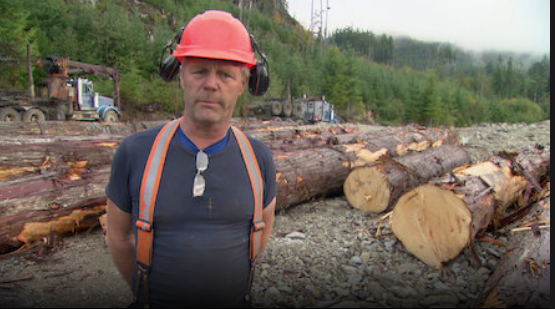
I recently binge watched Season 1 of “Big Timber”. The series is produced on the Canadian History channel and featured on Netflix. It’s the story of the Wenstob Family from Wenstob Timber Resources which is the last independently owned sawmill on Vancouver Island. The family business is headquartered in Sooke, BC. This engaging series depicts the universal theme of the heroic individual leading his team through immense obstacles that they continually overcome. The audience is drawn into the emotions of real-world experiences as the team pushes their human and equipment limitations to the limit to get dangerous jobs done.
The story spine is evident. Each episode has clear structure and purpose. Meet Ken Wenstob, logger, and sawmill owner, who is a larger than life opinionated force to be reckoned with. Every day his sawmill produces the best possible quality lumber from timber he and his team harvest from his claim that is far away up Vancouver Island on a mountain. In each episode, Ken the protagonist, is seriously challenged by an unforeseen antagonist. His team must keep the logs coming down the mountain, so that Wenstob sawmill survives. Every episode is a nail biter.

The challenges are so amazing the viewer must watch just to see how there can possibly be a solution. Ken and his family struggle against a wide range of antagonists including:
The episodes are simple and focused. We want Ken, the main character, to succeed. It’s admirable what he chooses to do and amazing that he always succeeds! Ken is driven by fear of his business not surviving if he does not find or create solutions to get 200 loads of logs out of their logging claim before winter comes and their claim expires. But, after they embark upon dangerous and often unimaginable solutions, Ken and his team always experience success or partial resolutions that keep them moving forward with new routines and solutions.
At the end of Season 1, the team achieves 220 loads of logs or 10% more than the required goal for the winter. There is a team celebration lunch on the mountainside. Although it was a very challenging year, Ken announces he has purchased another claim for the next year.

The “Big Timber” story breathes strong storytelling principles, is inherently visual, and is best suited for a visual digital medium. In addition to enjoying the interactions of the Wenstob team, I am continuously drawn in by the spectacular landscape colors, pictures, and movements of the immense equipment in the forests. The visuals of logging equipment and the operations team cutting the giant trees on the mountains are breath-taking.
According to Ashley Fell, science confirms we process visuals 60,000 times faster in the brain than text. Story visuals from these episodes kept popping into my mind the next few days after I viewed them. This series really connected with my heart. I found it so interesting I could not stop watching; it instructed me about the disappearing entrepreneurial lifestyle around logging on Vancouver Island; I became very involved with the characters’ stories; and I was truly inspired by the courage of Ken, the protagonist.
I am ready and waiting for Season 2! This amazing story of one person’s undefeatable will and leadership must continue to be told.

A title housed on my bookshelf that routinely gets dusted off and re-read for its resonant storytelling is the autobiography “Tranny: Confession of Punk Rock’s Most Infamous Anarchist” by Laura Jane Grace.
Key to its success is one of the most recurringly cited elements of the craft: the main character. Tranny is the first-hand account of Laura Jane Grace’s intertwined experience as a transgender woman and punk artist as lead singer of Against Me. Her story is a raw and vulnerable account that pits her against both the industry she hails from, as well as prominent narratives of the transgender experience in the LGBTQ+ community. Examples of this include the title of the book itself which is a usurping of common slang used against the community, or how she candidly recounts feelings of regret as her sex reassignment transition takes a harrowing toll on her body.
But it is this honesty, and willingness to admit her own complexities and confusions, and stand in her own strength that keeps the reader drawn. As narrator and main character, Grace highlights many of the rules of storytelling noted by Emma Coats and many others: she is lauded for trying over succeeding, she is honest to herself and her audience, she holds and upholds her opinions regardless of controversy, and her story is one of high stakes at every turn.
Not only does Grace demonstrate her strength as a character in the story, but it is important to note she also stands strong as the narrator. Throughout the book, Grace maintains her own viewpoint as simply one individual that is transgender; never does she claim to be an expert on the topic or seek to speak universally on the subject or the experience. By staying true to her own story, beliefs and values and remaining authentic without overreaching her perspective, I think she personifies one of the key factors of engaging with storytelling as identified by Megan Wenzl.
What makes Grace story particularly unique is her incorporation of multi-modal media, an important element of experiential storytelling as identified in The Medium Changes the Approach. Of course, the book is mainly comprised of its own text, but weaved throughout are old journal notes, annotations of her lyrical discography, and old interviews. For instance, the book references a seminal Rolling Stone magazine article that in many ways served as Grace’s public coming out; however Grace criticizes the interview for misrepresenting her intent and being transphobic in its misgendering of her and its hyper-focus on her femininity or “passing” as a woman.
This multi-modal approach brings new life into the book, as well as into some of Grace’s older work. For example, in the previously released track “The Ocean” Grace (formerly known at the time as Thomas Gable) sings, “And if I could have chosen, I would have been born a woman/ My mother once told me she would have named me Laura/ I’d grow up to be strong and beautiful like her/ One day, I’d find an honest man to make my husband.” Previous thought would have viewed this as merely fantasizing or daydreaming of alternative lives and characters, but new revelations of Grace’s gender identity offer it new meaning. Additionally, the book was published alongside the release of the album Transgender Dysphoria Blues, making them profound accompaniments for each other.
Lastly, Grace’s use of the Storyspine is dynamic and well-played. Although it features the standard beginning-introduction, middle-conflict, and end-resolution of all great stories, as an autobiography it also features several cycles of this order while acknowledging that many more will continue in her future; the ending of the book is simply that: the ending of the book, not of Grace’s story. Furthermore, my favorite part of this piece is that the story’s central tenant is based around her journey of healing and self-acceptance and not her coming out or transition as transgender. It goes Beyond the 5Ws to ask what the story is not about, and how is it fair to the ideas or individuals it represents?
I can wax poetic all day about Laura Jane Grace as an artist and as an individual, but her storytelling is best done and well done all on her own.
 EXSM 3989 - Digital Storytelling Class Blog