Categories
Uncategorized

Balloons, Wizardry, and a Villain Oh My!

Photo by Padli Pradana on Pexels.com

If you loved princesses, magic and balloons as a child of the 90’s then The Balloon Tree was likely on your bookshelf. The children’s storybook written and illustrated by Phoebe Gillman the author widely known for her popular children’s book Jillian Jiggs, also created a story that engaged children with a princess in peril, a villain and a wizard that comes to her rescue with a spell.

Rather than give a synopsis, the following outline of the book will be conveyed using the method of the story spine structure created in 1991 by Kenn Adams, detailing the main elements of the story. The story spine to The Balloon Tree is as follows:

Once upon a time there was a princess, Leona, who lived in a hilltop kingdom with her father the king.

Every day, the happy princess loved to sing, dance, and play with balloon which the castle was always full of.

But one day, an invitation arrived for the King summoning him and his knights to a Royal Tournament.

Because of that, the evil Archduke was put in charge of the kingdom.

Because of that, the Archduke ordered all the balloons in the kingdom to be destroyed and the princess be locked in her room.

Because of that, Leona escaped her room via a secret passageway and asked the wizard for help in creating more balloons to signal her father home.

Because of that, the wizard gave Leona a spell for the tree in the garden to produce more balloons.

Because of that, Leona searched the kingdom for a balloon to cast the spell, and was triumphant.

Because of that, balloons started sprouting from the tree filling the lands with balloons.

Until finally, the king saw a balloon at the edge of the forest and rushed home to rescue his daughter and townspeople from the Archduke.

And ever since then, the townspeople have been joyous and the Archduke has been in the dungeon blowing up balloons.

Much like a Disney movie the main character lived in a kingdom far, far away and was in distress. However, this story resonated with me not only due to my love of balloons as a child, but that the main character was a young girl. Unlike many movies and tales whose protagonist was an adult, Leona was a child who was very brave and able to be her own heroine. No knight or prince came to her rescue as often depicted in stories. A cleaver little boy did help her in time of need, and the wizard provided her a solution, but she was able to fulfill her mission of signaling her father by her own tenacity. “If the premise or character is relatable than the reader will be attached to the story due to the emotional tie” stated Social Media Strategist Linda Hoang in her lecture for Digital Storytelling and following Pixar artist Emma Coats rules 1 & 4 of storytelling. As a young child I was connected to the princesses character wanting to be savvy problem-solver, but also dependent on others for assistance. I was unaware of the term ‘girl power’ as I read this story for the first time in my grade two classroom, retrieving the book from a bin in the “read to self” corner of the room. However, I certainly retained the sense of empowerment and checked the book out of the library to continue reading it at home until my parents purchased me a copy which I have since gifted to my cousins children. This book has become an enduring favourite in their household as well. It entangles the concepts of courage, guidance and teamwork to achieve freedom. If you would like to add a copy to your children’s literary collection it can be purchased via Amazon or Chapters/Indigo.

Categories
Uncategorized

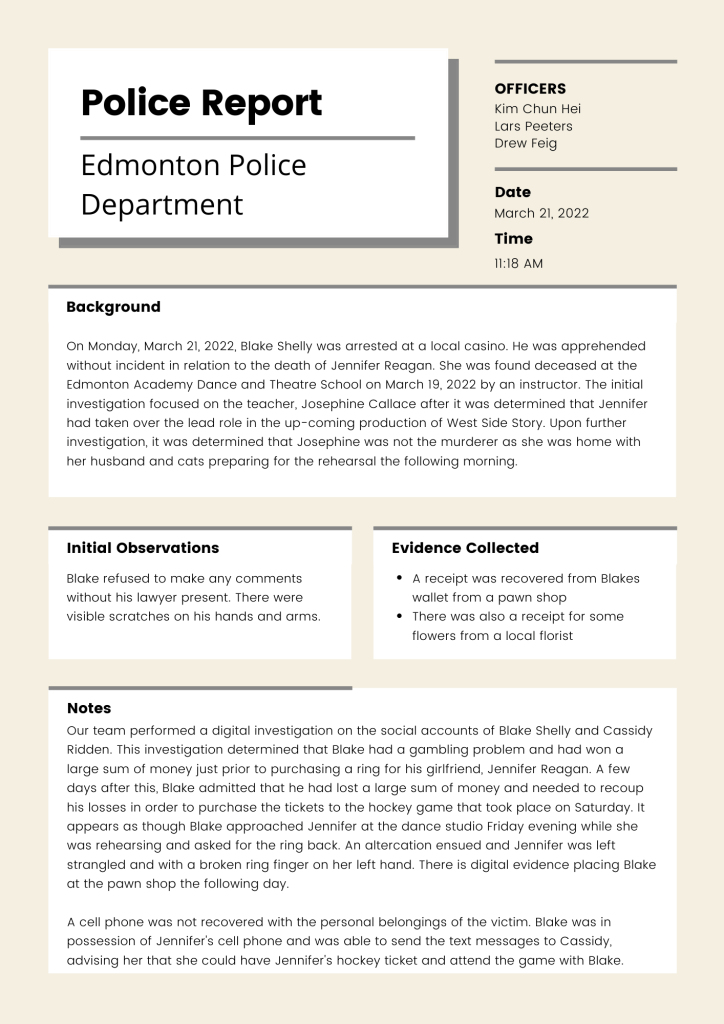
A Multi-Media Murder Mystery: Part 2

Final Police Report

Evidence

The End

How did you do? Were you able to solve the crime by analyzing the social accounts of the suspects? If you enjoyed this experience, please let me know in the comments.

Categories
Uncategorized

A Multi-Media Murder Mystery: Part 1

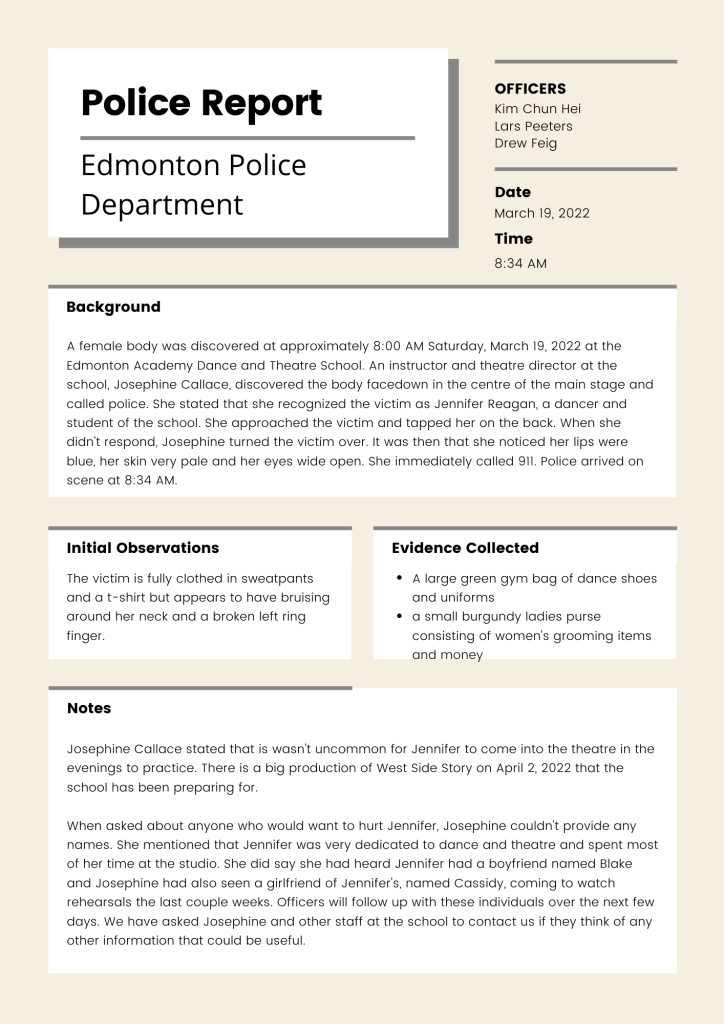
Initial Police Report

Evidence

Suspects to Investigate

Part 2

Think you’ve solved the crime? Check your answer with A Multi-Media Murder Mystery: Part 2

Categories
Uncategorized

The 4 I’s you need to know for optimal storytelling

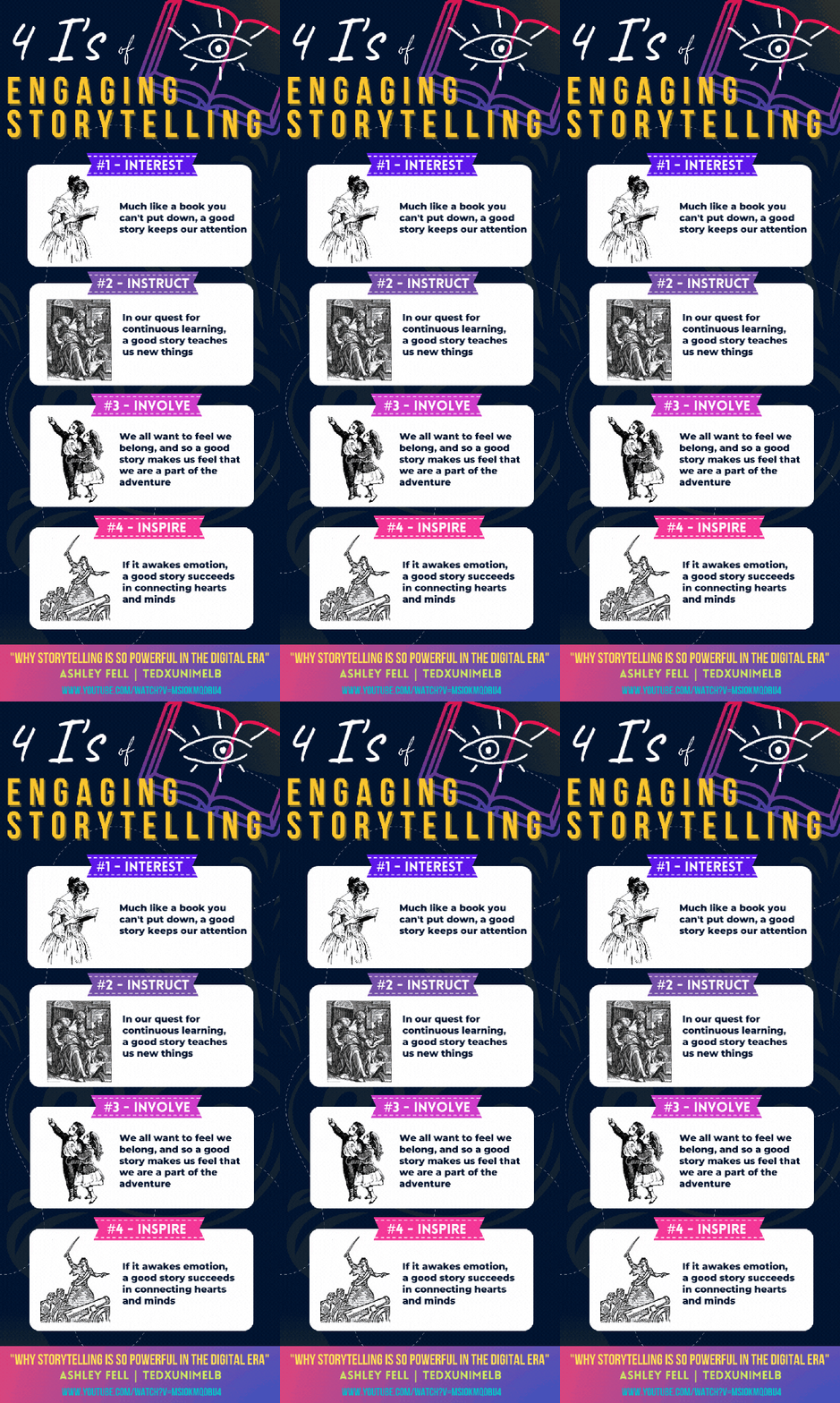
In her TEDxUniMelb Talk “Why storytelling is so powerful in the digital era,” communications specialist Ashley Fell explains that in this evolving digital era characterized as the “great screen age,” visual storytelling has become more important than ever.

As screen-time increases and attention spans decrease, it is becoming vital to appeal to the visual mind. In fact, our brain responds to, and processes visuals, a whopping 60,000 times faster than text. Because of this, Fell argues that the way to effectively communicate a message or information which can be productively processed by the brain is to use principles of good storytelling.

For Fell, an engaging story, no matter what the medium, includes the four I’s – good stories create interest, they also instruct, involve and inspire us.

Let’s take a closer look at each:

  1. Interest – a good story succeeds at maintaining our attention, such as through a good story arc with a rise in tension. We become invested in the action and want to know what happens, how the tension is resolved.
  2. Instruct – for a story to have meaning, there has to be some sort of value for the listener which can present itself in the form of a ‘how to,’ ‘lesson learned’ or moral of the story each of which provide a teachable moment that will often be what the audience will remember when the story ends.
  3. Involve – making someone feel they are a part of the story gives them a stake in the story itself. Thus, the audience goes from a passive, listening role to an active, participatory one.  
  4. Inspire – when a story can create an emotional response from the listener, it succeeds in being more relatable and thus memorable. This is what Fell describes as connecting our minds and hearts. People probably won’t remember your words but they will remember the emotion those words brought out.

“[A good story] connects not just with the eyes of the head but with the eyes of the heart.”

– Ashley Fell, TEDxUniMelb

In closing, remember that stories are visual even without the use of pictures, so choose not only your visuals but your words wisely!

Categories
Uncategorized

Storytelling For Your Brand

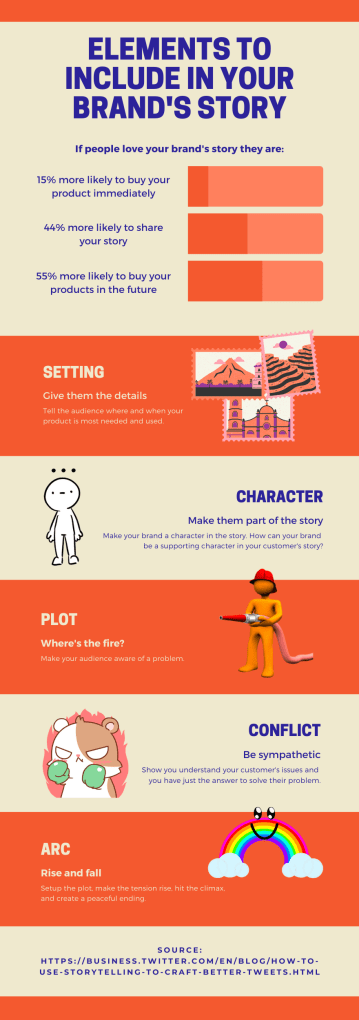
Storytelling for your brand is key to developing a relationship with your audience and potential customers. The emotions you portray and the image you establish in the mind of your audience affects their perception of your brand and products, and their decision to purchase. But how do you tell your brand’s story and create these emotions? There are five elements that should be included in your story.

Setting

This is your opportunity to set up the story and explain to the audience what your products do, when they are used and most needed and any features they have. This part of the story is really like a show and tell, where the audience gets to see the products in all their glory.

Character

Think of your product as a character in the story you are trying to tell but your audience is the main character. How does your product support the main character? How does it fit in to the main character’s story? Shifting our thinking, to how our product plays a role in the life of a customer, will help develop the remaining elements in your story.

Plot

Customers need a reason to spend their hard-earned money. Set up a problem or issue that is common among your brand’s customers. Maybe your customers didn’t even know this was a problem. But guess what? You have the answer.

Conflict

Now that we have a problem, show that you understand your customer and their needs. Create a fire and make your product the hero. This is an opportunity to show your product in action and how it can be the hero in your customers’ story.

Arc

The arc in a story creates a rise in tension, a climax and an ending. The arc adds the drama to the story and helps develop the emotion and feeling in the story. Every part of the arc is equally important to creating a story that customers become emotionally invested in. The setup, the plot, the rise of conflict, the climax and the ending, together, equally, create a memorable story that will be associated with your products and your brand.

Memorable stories with emotion and a great arc are key to engaging with your customers and creating new customers. Great brand stories drive conversions. If people love your brand’s story, they are 55% more likely to buy your products in the future, 44% more likely to share your brand’s story and 15% more likely to buy immediately. Make sure to consider all the elements when you’re creating your brand’s story. Create a setting, make your product a character, find a problem, be the hero and present it in an arc to your audience. Now, go tell your story!

Looking for more social media marketing tips, follow me at focuspocus.ca

Categories
Uncategorized

A Monster Mini Golf Sunday

I remember when I was younger and I was excited about the Family Day long weekend because it meant no school or it meant time and a half pay if I had to work. I was missing the entire point of the holiday which was created in 1990 by Premier Don Getty for two reasons: to celebrate the family unit, and to lead the war on drugs. So, in my efforts to be a good citizen, I asked my family if they wanted to go out and have fun as a family. This is where the lesson is. As you will see, the idea that something will be fun and what is actually fun are so very different. Of course, there are many factors that play into the “having of fun”. Some of these include: the activity, the demographics of the people partaking in the fun, and the time of day the fun occurs. During all this “fun” I was live tweeting the events as they were folding.

Beginning

After I convinced my husband and five-year-old son that it would be a good idea for us to do something for Family Day, we had to find something, safe, age appropriate and available. While all the ideas put forward were fantastic ideas, especially the all-inclusive vacation my husband suggested, we ended up going back and forth between bowling, mini golf and swimming. The deciding factor was the amount of effort required for the activity. This final factor led us to mini golf.

Middle

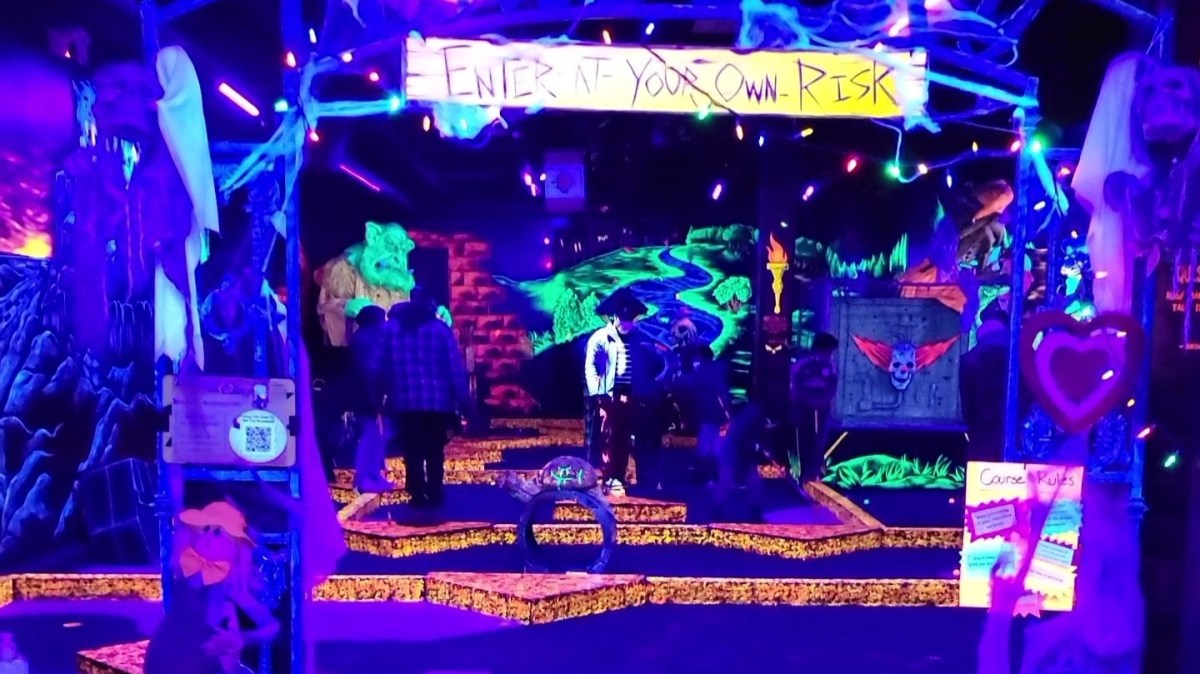
If you haven’t been to Monster Mini Golf in Edmonton, check it out! The entire place is glow in the dark. It includes an arcade, live DJ and 18 holes of mini golf with moving monsters. We were given our clubs and balls and set off to hole number one. Not so bad! This is going to be so much fun! Until about hole four, then reality set in. My husband and I both looked at each other knowing exactly what the other was thinking…yes, we were only on hole four and had another 14 holes remaining.

As we are making our way through the course, it becomes apparent that no one showed our son how to play mini golf. I think he may have even been using the club backwards at some points. No one was really “playing” anymore. I think we were in the “let’s get this over with and get the hell out of here” stage. That’s when, we weren’t paying attention, and our son decided to drive the ball instead of putting. Well, that ball went flying! It bounced off a fake tombstone, jumped the glowing barricade, narrowly missing the head of a girl waiting to putt on the next hole, hit the wall behind her and landed by her feet. I notice my husband, who seen the entire event occur, do what husbands do. He casually walked away trying to act like he didn’t see the whole the thing. I send our son over to apologize while receiving dagger stares from the girl’s parents. Thankfully, no one was injured, and we reluctantly continued on.

End

Around hole 13 was when it got tough. At this point we were really debating the necessity of actually finishing the game but I’m always trying to teach my son that he needs to finish what he starts and there were really only five more holes. So, when we got to the last hole, it felt so good, almost like we were free. Don’t get me wrong, looking back, it was a fun evening with the family, would it have been better with a group of friends? Probably. Would it have been better in the evening with a babysitter? Probably. Would have been better with some pre-game cocktails? Probably. But will I do it again? Probably!

Live Tweets

In the live Tweets, I did my best to create a timeline of the events by mentioning which hole we were on. I was able to take some video and pictures throughout the experience which I included in the tweets to help give more context to the post and create a feeling. The posts were also short and concise, written how I would speak and included only the relevant details. I tried to make the posts relatable to anyone with young kids.

Storytelling Principles

Great Stories Are Universal

The mini golf story I was telling on Twitter would be relatable to many people with young children. They can relate to the pressure of trying to plan a family outing, the anxiety of a new activity with a young child and the relief when the activity is over.

Good Stories Have Structure

I set up my Twitter story to have a beginning, middle and an end. In the beginning, I introduce the situation and the characters. In the middle, there is tension and surprise. And at the end there is relief.

Good Stories Are Simple And Focused

This story was documenting events as they unfolded. It was simple since the subject matter was easy to understand. The story had an arc which kept it focused.

Good Stories Give you a Character to Root For

With the audience being parents, I would hope that they were rooting for me and my husband. I hope they would relate to the story and understand the predicament and challenges we were facing.

What family activities have you planned? Were they a success? Would you do them again? Let me know in the comments.

Categories
Uncategorized

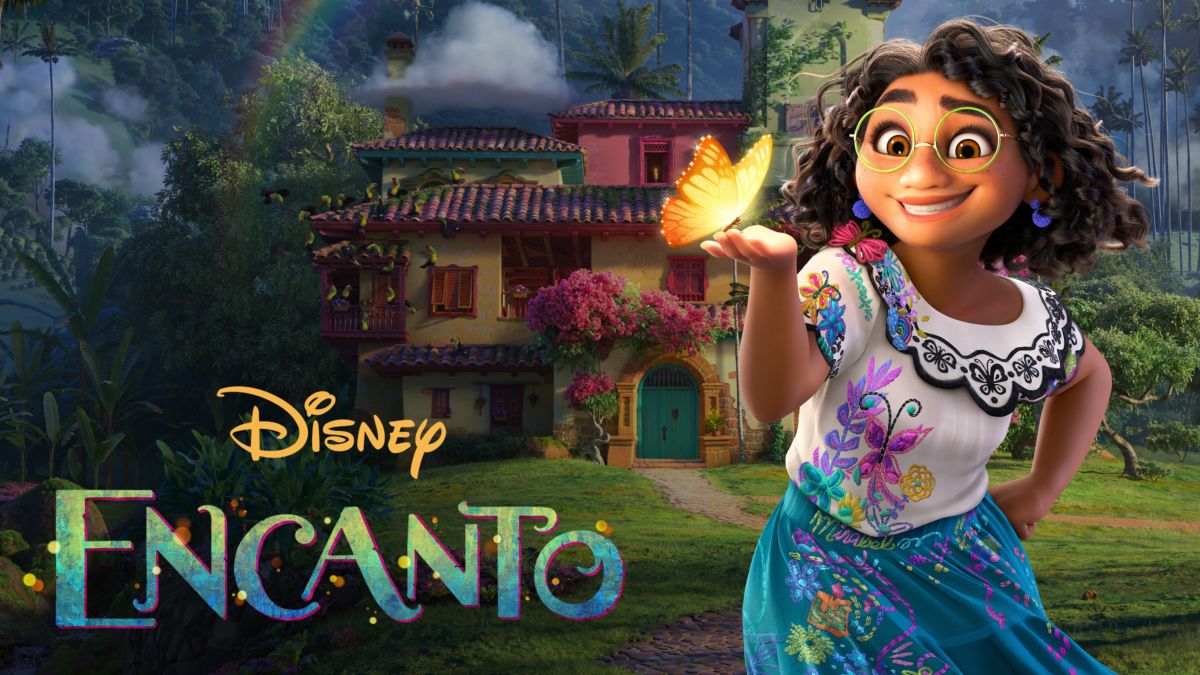
Encanto is Pure Magic

Christmas Day 2021 was different.

Originally I was supposed to be lounging by a pool sipping on a margarita but when the Prime Minister announced that leisure travel wasn’t recommended, my plans changed. The trip was a gift to myself and my husband so we had no gifts to exchange nor did we have family nearby to create new plans with. It was a very disappointing change of pace and I needed comfort.

To cheer myself up on the blustery cold festive day, I decided to stream this “Encanto” movie everyone was raving about and I was not disappointed! At one point, I had the blankets pulled up to hide as tears streamed down my face. I was emotionally invested, toes were tapping to the tunes and I found a new favourite movie.

Encanto is a beautiful movie! The narrative isn’t a typical love story or a complicated romance but it does follow a good story spine as illustrated below:

Beginning:Introduced to the main character, Mirabel, and learn that she does not have a gift like the rest of her family members do
The Event:As her younger cousin is going for his gift ceremony, the house starts to crack.
Middle:Mirabel goes on a journey to try to heal the house by uncovering an old family curse brought on by Bruno (who no one talks about)
The Climax:The matriarch of the family founds out what Mirabel has been up to and the magic of the house ends, with the house in rambles.
End:Mirabel is able to mend the connection with matriarch of the family and in turn, magic is returned to the home through help of others.

It’s also filled with a wonderful narrative about:

  • People finding themselves and their role within the family
  • Relatable in the way characters are portrayed
  • Culture of the family
  • Normal struggles that many people have in reality (eg. older sibling feeling the weight on her shoulders, the beautiful sister feeling like she has to always be perfect.
  • Those sorts of feelings.

Relatability:

As a middle child and someone who became a bit of a “black sheep”, I really relate to the main character Mirabel. The feeling of a lack in belonging even though you know inside that you have potential for greatness. I also appreciate that isn’t a knight in shining armour who “rescues” her from the problems so Mirabel has to face the conflict and find resolutions by meaningful conversations with her family (including Bruno).

Story Writing Magic:

Yes, the house and characters are magical but the true magic is in the story writing and song lyric writing!

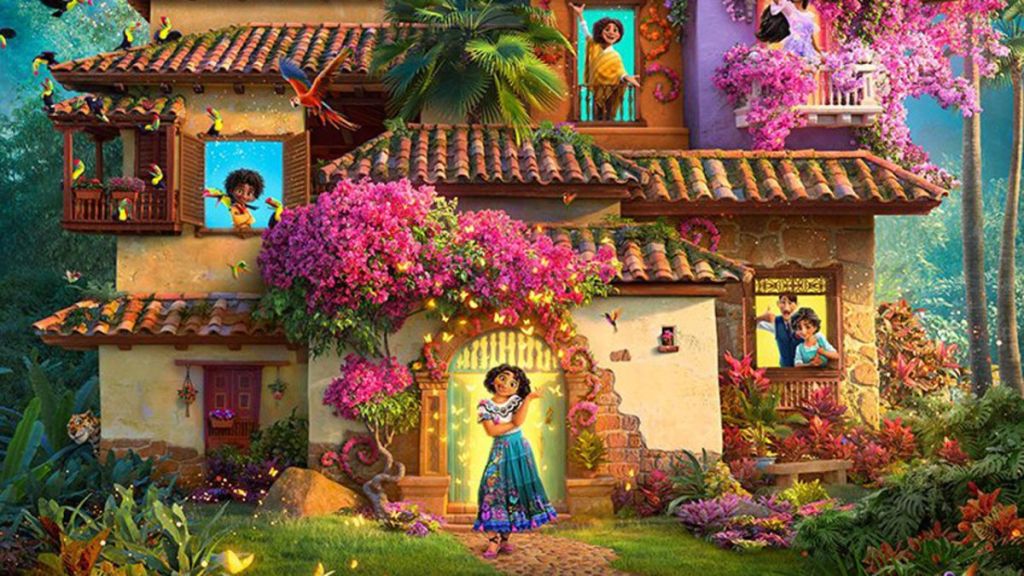
The tale is spun using the typical story spine with the main character Mirabel finding her way in her family as the person who doesn’t belong. She doesn’t have a gift like the rest of her family members and when she starts investigating, bad things start to happen and she is criticized by her grandmother for not behaving. Mirabel follows her heart, starts to ask questions and as she gleans clarity, the magical house falls apart completely. But in the falling apart, relationships are healed through honesty and connection. The family is able to put the house back together with the help of the non-magical townsfolk and the magic of Mirabel.

Copyright: Disney.com

The story is also supported through wonderful musical numbers written in a way to compliment the story and foreshadow conflict with other characters and explain emotions. Each song is filled with upbeat tempos and repeating words that instantly stick in your mind.

Review:

I recently rewatched the movie again and the emotional connection was even stronger. I still felt the same connection to the characters and I noticed even more nuances in the story watching it again.

There is true magic in sharing a story that connections millions of people across the world! Whether it touches their soul, pulls at their heart strings or helps little girls see themselves, it’s a beautiful accomplishment.

Encanto is going on my movie shelf to stay and revisit again and again!

Categories
Uncategorized

“You’re not thinking fourth-dimensionally”: A Study in Storytelling

For a certain sci-fi fandom, words such as “DeLorean,” “gigawatt,” “88 MPH” and “flux capacitor” can only mean one thing: the BACK TO THE FUTURE trilogy. The adventures of Marty and Doc as time-tourists, told through three original motion pictures, have been one of my favourite stories since childhood.

When released, the first Back to the Future (BTTF) movie was an immense success becoming the highest grossing film of 1985. Two sequels were soon added, and since then the trilogy has inspired a theme park ride, cartoon series, merchandise and, most recently, a musical.

What makes this science fiction story a timeless classic for countless adoring fans, myself included? Let’s examine some of the basic storytelling principles at work in BTTF.

The Driving 88 MPH Question

For starters, the plot’s genesis was a simple question from co-creator Bob Gale: if he and his dad attended high school together, would they have been friends? For Alison MacAdam, having a question that drives the story is key at the beginning of the creative process. In her article “Beyond the 5 W’s: What should you ask before starting a story?,” she explains that this question provides the storyteller with a mission. From Gale’s initial question, a great story was born.

If we break BTTF’s story down to its Story Spine, a tool described by Kenn Adams in his article “Back to the Story Spine,” it would read something like this:

  1. Once upon a time, there was a typical American teenager named Marty McFly who was friends with an eccentric scientist named Emmett L. “Doc” Brown.
  2. But one day, Marty gets sent to the past (November 5, 1955 to be exact) in Doc’s time machine.
  3. Because of that, he must locate 1955 Doc to help him get back to the present.
  4. Because of that, he runs into his future parents setting off a chain reaction that puts his very existence in danger.
  5. Because of that, he must first work to make things right so that his parents fall in love before he can get back to the future.
  6. Until finally, Doc helps him successfully return to his life in 1985 (which is somewhat altered because of his adventures in 1955).
  7. Ever since then, cue the sequels!

Nobody calls me chicken: the endearing protagonist

At its most basic, the BTTF story is not only simple and focused, but it also provides an endearing character to root for in the form of Marty McFly. These fundamental elements are described in the article “The 22 rules of storytelling, according to Pixar,” in particular rule #16 which stipulates that the audience needs a reason to cheer on the protagonist who has the odds stacked against them when the stakes are high.

To quote the U.S. National Film Registry (of which BTTF is an inductee), Marty “must not only find a way home, but also teach his father how to become a man, repair the space/time continuum and save his family from being erased from existence. All this, while fighting off the advances of his then-teenaged mother,” oh, and not to mention do it all with enough time left to be in the DeLorean going 88 MPH precisely as the Clock Tower is struck by lightning. With so much high-stakes drama, the audience must hang on for a wild ride!

Whoa, this is heavy: the universal space/time continuum conundrum

BTTF’s story succeeds and resonates with audiences because it addresses an ageless and universal issue: time travel. Whether a trip to the past or the future, who among us, from school-aged children to NASA scientists, hasn’t at some point pondered this fundamental question?

For myself, this fascination with time travel has gone hand-in-hand with my love of history and longing to magically travel through time to witness historic moments in the making (and hopefully return unscathed to the present!).

In the end, there are many elements that make this story memorable to audiences. Certain images from BTTF, like those mentioned in the opening paragraph – as well as others such as Mr. Fusion, hover conversion and hoverboard – have become iconic, leaving indelible impressions upon our imagination.

But perhaps most compellingly, the lasting message from these movies is one of optimism: you control our own destiny. As Doc so eloquently puts it in BTTF III: “Your future hasn’t been written yet. No one’s has. Your future is whatever you make it, so make it a good one!”

Your kids are gonna love it: a touch of nostalgia

To end on a personal note, the BTTF trilogy is not only a great story but, from a nostalgic and emotional perspective, it will forever live in my heart because of the cherished memories I have of spending time with my family watching these films together. The number of movies we agree on as a family is few and far between, but BTTF has always been, and will always be, a story that units us and one we all love – Great Scott!

The creators of BTTF imagined license plates of the future (2015) to be barcodes.

If you put your mind to it, you can accomplish anything.

– George McFly

If you love all things BTTF, be sure to check out the official site:

~ OUTATIME / The End ~

Categories
Uncategorized

Country Music Stories: Coat of Many Colours

One of the best storytellers is Dolly Parton. Yup, you read that correctly! What makes her songs so good are the stories she’s able to tell. Her song, “Coat of Many Colours”, released in 1971, is a perfect example of storytelling through music. Even if you are not a fan of old country music, I’m talking about the original country music, you must admit most of the songs of this genre fit all the parameters for a great story. Great stories are universal. Great stories resonate with the audience by being relatable or emotional. Great stories have structure and purpose but are simple and focused at the core, and great stories have good characters, particularly a character the audience wants to see succeed. So, let me show you why “Coat of Many Colours” is truly a great story!

Great stories are universal, relatable, or emotional

Country music has evolved over the years and has become a mixture of many types of music, but it originated in the deep south among the poor working-class trying to survive off the land. Country music stories, like all other good stories, are relatable or emotional. “Coat of Many Colours” is a song about adversity and love, both relatable emotions. In this story, the little girl has a loving family and although she is teased for being poor, she doesn’t feel poor because of the love she gets from her mom. Most of us have felt love from a parent or guardian, most of us were probably teased at some point in our life. The descriptions Dolly uses in her story evoke emotion in the listener because they have been in a similar situation and, through the story, they relive those emotions helping them feel the story.

Great stories have structure and purpose but are simple and focused at the core

While “Coat of Many Colours is told through music, it still has structure and a purpose. Dolly starts by describing how their family was gifted a box of rags and because they were poor and fall was coming, her mother used the box of rags to make her a coat. Dolly watched her mother make this coat and put her love into it. She was very proud of her coat and while their family didn’t have money, she felt rich wearing this coat made with her mother’s love. At school, she was teased by the other kids because of her coat made of rags and for being poor. At the end of the song, Dolly tells the listener how she dealt with the bullies. The ending reveals the purpose of this story. We see a little girl unphased by the teasing, full of love from her family and proud of where she comes from. This story has a structure, a clear beginning, a middle, and an end. There are also events throughout the story that create difficulty for the character and in the end, we see the resolution.

This isn’t a long song. Dolly’s stories are simple and focused while still including details that draw in the listener and paint a picture for them. The music that accompanies the stories also helps to shape the mood and emotions that go with them.

Great stories have good characters

The main character in “Coat of Many Colours” is a sweet innocent little girl. She explains that she knew her family was poor but never felt poor because of the love she always received. Her innocence didn’t allow any of the adult stresses to bother her. She is a character you feel for at the beginning of the story because of her situation. You then feel for her again when she is teased. But, in the end, you feel proud of her for how she handles herself and for what she can see despite her family’s financial situation. She is a great character that is endearing and lovable.

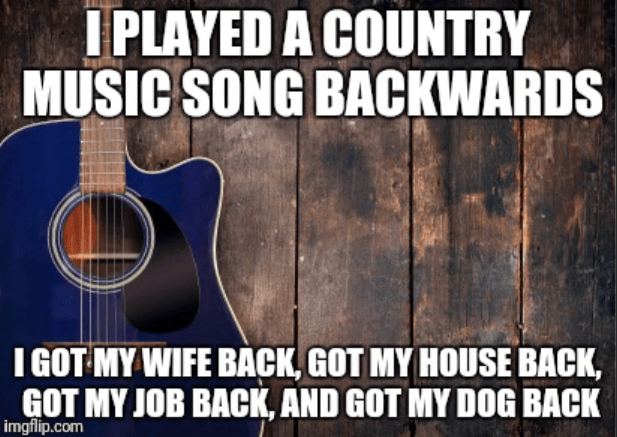
While music isn’t necessarily the first medium you think about when you think about a good story, country music has always been based on telling stories and many of the songs of this genre tell great stories. Examining “Coat of Many Colours”, the storyline is relatable and evokes emotion which is enhanced through the music. Although the song is short, it is focused and follows a structure. Lastly, it has a great character that we can easily fall in love with. Using the principles of great storytelling, Dolly Parton’s “Coat of Many Colours” is truly a great story.

What is your favorite country music story? Let me know in the comments.

Categories
Uncategorized

My foray into photography

In 2019, I started a community map project. I had sought the help of a friend who does beautiful photography to take pictures for the map. That year was a busy time for him and we kept rebooking. Before long I was running out of time.

I had planned sessions with the Community Leagues and the Castle Downs Recreation Society to add key places to the map and set up a few sessions in the YMCA lobby to catch community members and get a wider perspective of which routes they would like to see for walking. I was given large maps I could draw on, sticker and worksheets to sort out the information I was receiving. After looking through all the suggestions, I was able to take the most popular ideas.

Black and white photo of maps partly unrolled.

These are the large maps provided that I was able to use for consultations

I had a lot of the other work for the project already together, the write ups on the communities were done with the help of other community members, paths and significant points of interest were discussed through community engagements and now all that was really left were the photos. I needed to get all the pieces to the city who were putting it together quickly as they were looking at closing the project soon.

This is when I “forever” borrowed my sweetheart’s DSLR camera. My friend had made sure to inform me of what to set the camera on to get photos that had a large enough file to use for printing and my sweetheart quickly ran me through the basics of how to use his DSLR. Off I went with my fingers crossed.

It took me a few different days to go around the community and take the pictures I was looking for. At the time I was experiencing foot issues that limited the amount of time I felt comfortable on my feet. So I would head out after work, walk for a bit, drive to another area and sit for a bit before walking again. I took hundreds of photos in each spot, playing with the settings on the camera until something showed up in the little preview window that seemed clear.

I would arrive home as the sun went down, download the photos and start playing around with them. Out of all the photos, only a few of them were of decent quality. I picked the best and began playing with the exposure, vibrancy, and saturation. When I submitted the photos along with the rest of the project, the person who I had spoken to complimented the photos and was happy to see they were saved in a high enough resolution that they would be suitable for printing in this project. I was ecstatic. This fueled me to pick up the camera on a regular basis and improve my skill.

Looking back, seeing where I have come with my photo taking skills over the last few years, I am excited to see how much clearer my photos have become and how much better I have gotten with the manual setting. It’s amazing how much you can learn from doing.

Follow my Instagram @jen_annau to see my favourite shots and find out some of the stories behind the pics.

A dried autumn leaf next to a rock on a frozen lake
Autumn Leaf on Frozen Lake
Design a site like this with WordPress.com
Get started