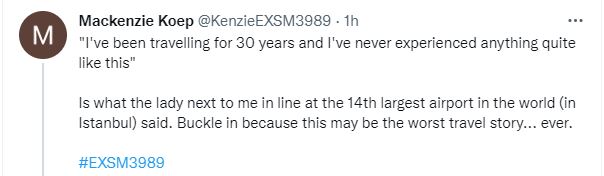
My live-tweet storytelling takes readers on a journey through the worst travel day I ever had – and don’t just take it from me, the lady next to me who had been travelling for 30 years agreed.
I lived in Turkey at the time and was just trying to visit my dad in Helsinki for a nice trip and the airline said ‘lol, bet’.
In all seriousness, it took me over 26 hours to get from my apartment in Ankara to a hotel room in Istanbul (a mere one-hour flight) with roller coaster turns along the way. Interested? Check it out here:
Storytelling Principles Used
I used various different writing techniques to help keep my writing suspenseful for this story. 1. This story was told entirely from my point of view. I had no clue when the number of lines would end or when I would get out there. Readers also experienced this as I did 2. I used different style and form, some portions where I make exclamations like ‘I was DONE’ helps get across the frustration and strain of the whole incident without getting to descriptive. The formatting and capitalization did that work for me 3. I left a number of my tweets on a mini ‘cliff hanger’ that encouraged readers to go to the next part to figure out just how the story could have gotten worse.
I also used some common themes of my experience to help tell the story better, including relatability (I’m sure we all have a horrible travel story in some capacity), emotion and authenticity. This is how I would have told the story verbally to someone sitting next to me.
I also tried to include paragraph breaks at the end of sentences to keep the content uncluttered and more appealing to read.
Overall this experience was horrible, especially considering I was a pretty new traveler at the time. But, I got through it and I hope you will too! Thanks 🙂
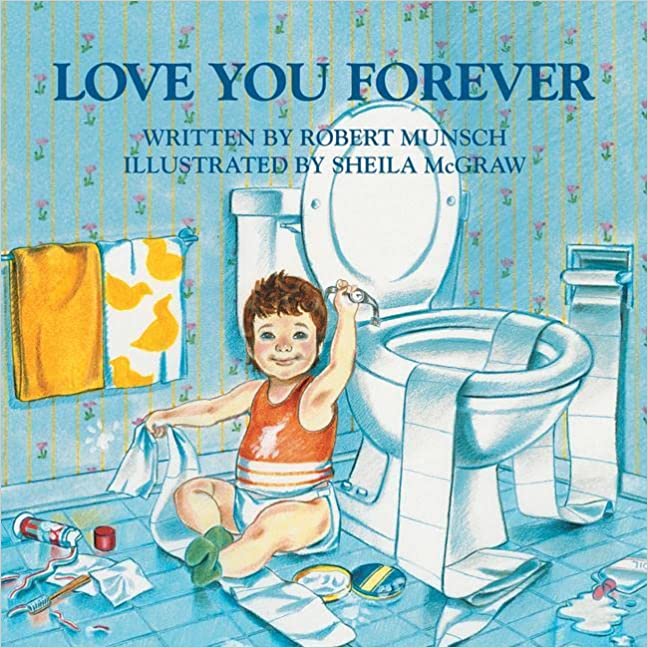
I will never forget the first time I read, Love You Forever, a 1986 children’s book written by Robert Munsch and illustrated by Sheila McGraw. While the book has been in circulation for over 30 years, I encountered it for the first time just a few years ago when I became a new mom. I still remember the feeling of disbelief as the book I thought would be a light read with cute pictures had unexpectedly moved me to tears.
The story is centered around a mother who sings a lullaby to her sleeping son during various stages of his life. As you watch the son grow, you see the mother go through the many challenges of raising a child, but despite all the struggles she comes back to her son at night to express her unconditional love, even as she becomes weak and approaches her final days.
What I loved about the book
The book stood out to me in many ways and while it is considered a children’s book, I would argue it is more so a book that provides many lessons for parents or caregivers. It triggered an emotional connection for me as a mother as I identified with the hardships of the mother in the story, especially the moments when she wanted to sell her son to the zoo! However, at the same time it depicts how a mother’s love is resilient and while you test her in many ways, she somehow continues to love you through and through.
Reading this story also allowed me to reflect upon my own relationship with my mother and the many ways I pushed her patience while growing up. The story moves you to appreciate loved ones in your life a little more and truly value the time you have with them as we go through the circle of life.
Why it is good at storytelling
This book is particularly good at story telling because it covers all the four I’s that are needed to create an engaging story as indicated by Ashley Fell in “Why storytelling is so powerful in the digital era”. The story captured my interest and maintained my attention throughout the book as we moved through each stage of the boy’s life. It instructs us by providing me with meaningful reflections on my own relationships with my son and my mother. It involved me as I could identify with the character in the story and saw myself in the mother. Finally, it inspired me by encouraging me to cherish time with loved ones and recognize that there will always be hardships throughout life but no matter what you do, you have people that will always be there.
Many feel that Love You Forever is a divisive book. Some like me think it is a beautiful story of motherhood and the circle of life, while others hate it and incite ridicule that it is okay for an old woman to sneak into her adult son’s room and pick him up. Whatever the case, for a children’s book, it is an engaging story that brings out emotions and leaves you deep in thought. and would make the perfect gift for an expecting parent.
“The flower that blooms in adversity is the most rare and beautiful of all”
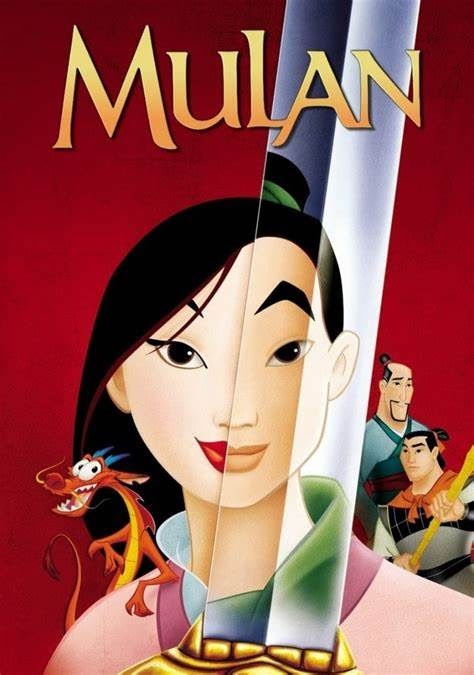
Mulan is an animated Disney movie from 1998 based on the Chinese legend of Hua Mulan. In the story Mulan leaves home to take her father’s place in the army during the Hun invasion. The movie follows her path from being an outcast to becoming a strong warrior who eventually saves the Emperor and China.
Why I love Mulan as a Story
I’ve loved this story since I was a child, it had the perfect combination of action, drama, romance and suspense especially for an animated film. Additionally, Mulan was one of the first female-lead Disney movies that wasn’t a princess and made the lead character a regular person that didn’t include a traditional Disney version of ‘femininity’ and happily ever after.
Mulan & the Four Principles of Good Storytelling: Universal
As a story, Mulan hits every single point of Pixar’s four principles of good storytelling and incorporate a number of its 22 rules of storytelling. The first point, “great stories are universal” applies because many of us have struggled with being an outcast, trying to fit in or facing adversity to better yourself. We can also all relate to the reasoning why Mulan chose to risk her life and potentially bring dishonour to her family: the love of her father and being worried for his wellbeing and wanting to make her family proud. These themes are universal among many people in society and helps the audience connect to this story.
Mulan & the Four Principles of Good Storytelling: Clear Structure and Purpose
Mulan also has a very clear structure and purpose as the audience can easily follow along the different steps of her journey to get to the final. The structure, based on Helping Writers Become Authors website would (generally) be:
Mulan fails at the matchmaker
Mulan takes her father’s place in the army
The Huns challenge the Chinese army
Mulan retrieves the arrow at the camp
The Chinese army is attacked
Mulan is discovered as a woman and let go of the army
The Huns kidnap the emperor
Mulan kills the Hun leader
Mulan returns to her family with honour as a hero.
Mulan & the Four Principles of Good Storytelling: Simple & Focused
Mulan as a story is also very simple and focused, while many elements are going on the primary focus is Mulan finding herself and growing into a warrior who honours their family. By keeping this focus, we feel even more connected to the character and root for them even more because we know what they are working towards.
Mulan & the Four Principles of Good Storytelling: Give a Character to Root for
Finally, the last principle of good storytelling, Mulan is absolutely a character to root for. Through her rejection at the matchmaker to her going through base camp and getting stronger and initially being rejected by the other soldiers we all want to see her succeed and bring honour to her family. They showed not only her highs and lows but also how she got from her lowest to her highest.
The Meaning, Magic & Moral of Oliver Jeffers’ “How To Catch A Star” to a girl who loved stars very, very much
A story that has stayed with me for close to 17 years is the children’s picture book “How to Catch a Star” by Oliver Jeffers.
In my experience, stories imprint on us due to a) the quality of the story/author/storyteller, b) the emotion or moral the story elicits AND c) timing. We hear stories or songs and see pictures or video differently at different times in our lives because of the emotion, the nostalgia, the memories and the connection we feel to the story or characters in those moments. The story/words/dialogue don’t change between repeat listening, reading or viewing, but our experiences have.
In 2006 two important things had changed for me. I had moved from my high school English classroom to the library, where I become the librarian for a K-Gr.12 school of 800 students in Winnipeg, and my first child had just turned two.
These two events created the perfect work/home life scenario. I was exploring new authors and illustrators, reading Caldecott winning picture books, and finding new series and characters that had emerged between the time of me being a kid and learning to read in the 1980’s, to me having a kid who was starting to understand the concept of reading, books, and bedtime stories. I came home with armloads every night for him and I to discover. We found “How to Catch a Star” and I was hooked – so much so that two years later when his sister arrived and took up residence in the “nursery” his “big boy room” was inspired by the book.
“How to Catch a Star” was written and illustrated by Oliver Jeffers. Jeffers’ illustration style is recognized for it’s unique and instantly identifiable use of minimalism, mixed media and open space composition. It is simultaneously simplistic and bold – holding the reader’s attention but not distracting or overstimulating the reader from the protagonist’s simple but important quest.
The protagonist is a young boy. He is only ever referred to a “the boy”, making him both a real character but also a blank canvass in which the reader can imagine “childhood” conceptually.
What do we know about the boy? Very little. He was a boy. And he loved stars very much. He loved stars so much he decided to try and catch a star of his very own.
Who wouldn’t want a star of their very own?
It is the boy’s undeniable innocence but complete rationale that makes him so endearing. He knows catching a star will be hard so he makes a plan to get up at dawn, when the star will be most tired from shining all night long, making it easier to catch. But the star disappears on him. So he patiently waits all day, weighing his options “that didn’t work” and reformulating his plan in a textbook example of “because of that…” described in Ken Adams’ story spine structure. The only hint that the boy is imagining this all in his head and not serious in his quest is when he remembers he can’t take his rocketship up to the star because it ran out of gas when he flew to the moon last week. But he is patient and persistent and purposeful. And we want him to succeed, even though we know he won’t.. As with Pixar’s 1st of 22 rules, we admire him for trying, despite knowing success is impossible.
And then he sees a star in the water. And through Jeffers’ illustration we see it too – and it’s oddly emotional. We are startled it never occurred to us to look anywhere but the sky. We are excited for the boy. Hopeful that his wonder and belief in all things possible is reaffirmed. Sad because we know that he will not catch this star either. But his quest continues. He is still just a little boy who loves stars very much, walking up and down the sand waiting for his star to wash up on shore. So we let him believe. There’s no harm.
But then, with a magic normally reserved for Hallmark Christmas movies, there it is!! A star laying on the beach! His star. A star of his very own…
And we are happy for him. We smile gently behind his back at his lack of understanding, his naivete, his childlike belief in the impossible. Let him believe he caught a star.
But he doesn’t care. His wish came true and his quest was a success. He has a star of his very own. He smiles back. He knows what many of us have forgotten – if we don’t set lofty goals because they seem impossible, if we don’t try a different strategy because we failed, if we don’t look for the answers to our prayers in ways other than we expected or demanded, we will always miss the magic that happens everyday all around us.
During the infamous “COVID” shutdown, confined to our homes, many books, movies, and TV series were consumed. My favorite movie, The Princess Bride, was my go-to. With both hands and feet, I cannot count the number of times I have watched The Princess Bride. It is a timeless classic that has held up with the warmth and coziness that envelops you even as Fred Savage is enveloped in his blanket, waiting for Peter Falk to read his story. This story has become iconic for its characters and its movie quotes. As an example, my husband and I were asked to officiate a wedding, and the bride wanted The Princess Bride’s marriage speech recited during the ceremony.
The Princess Bride movie was adapted from a 1973 novel written by William Goldman. In the opening scene, you see a young boy, played by Fred Savage, home from school and playing video games. His grandfather comes into his room to keep him company for the day. In his hand is a book that he would like to read to his grandson, who rolls his eyes at the idea.
The grandfather is persistent and reads the story of a farmhand named Westley. Westley works on the farm where the beautiful Buttercup lives with her family in the fictional kingdom of Florin. Whenever Buttercup tells the farmhand Westley to do something, he always obliges with an “As you wish.” The two eventually fall in love. Westley aspires to do more than just be a farmhand for Buttercup and leaves to make his fortune on the sea. The Dread Pirate Roberts attacked his ship. Westley is presumed dead, leaving Buttercup devastated.
Through a series of events, Buttercup has been forced into an arranged marriage with Florin’s Prince Humperdinck, but she is still in love with “her Westley.” Before the wedding can take place, three outlaws, Vizzini, Fezzik and Inigo Montoya kidnap Buttercup. However, an unknown masked man in black follows them.
The man in black confronts the outlaws and, one by one, he defeats the three. He flees with Buttercup, and she assumes he is the Dread Pirate Roberts. Buttercup’s anger at the Dread Pirate Roberts ignites as she believes he is responsible for “her Westley’s” death. The two tussle and she pushes him down into a gorge. As he rolls down, he shouts, “As You Wish!” Buttercup recognizes Westley, and follows him. They are reunited for a short time before Prince Humperdinck recaptures Buttercup and throws Westley into the Pit of Despair.
Through events, Westley is reacquainted with Fezzik and Inigo Montoya. They set out to rescue his true love Buttercup, from the evil Prince Humperdinck.
Woven into the narrative are the conversations between the grandfather and grandson. The grandson was taken by the story and the events sparked his imagination. At the end of the movie, the boy eagerly asks his grandfather to read the story again the next day. The grandfather responds with “As you wish.” (The Princess Bride (film), n.d.)
The Princess Bride, released in the fall of 1987, is an old yet modern-day fairy-tale brimming with action, romance, and comedy told through a sweet relationship between a grandfather and grandson. This story told through the medium of film captured my heart and imagination as the grandfather sat down to engage the grandson in a story. This struck a personal memory in my childhood as it reminded me of my grandparent watching over me when I was sick. I would hear stories of my grandparents coming to Canada and making their way to Alberta. In its own way, my grandparent’s story had action, some comedy, and a bit of romance.
In listening to the TED Talk – Why Storytelling is so Powerful in the Digital Era by Ashley Fell, she states that “a good story has a character that you can identify with.” I could identify with the young boy at home from school listening to a story told to him by his grandparent. The story piqued my interest from the very start, as the grandfather was very strategic in arousing the grandson’s interest in the story. I wanted, like the grandson, to see what the story was about. I wanted to keep watching. The story carried the premise of good over evil. Would the underdog Westley triumph over the evil Prince Humperdinck and how would that happen? As the movie played out and jumped from the story in action to the story being told by the grandfather, or rather the grandfather stating that the “story may be too much” and the young boy crying out that he wanted to hear more. It involved me as the viewer, and I wanted to continue to the end.
In conclusion, through the inspiration of justice triumphing, Westley, Buttercup, Fezzik, and Inigo Montoya ride off on white horses. Ashley Fell stated in her TED Talk, the story did not just connect with the eyes of my brain but it fully connected with the eyes of my heart.
The story I am about to tell begins with one’s worst fears coming to fruition. The nightmares you think are sealed into the realms of the dreaming world when abruptly leak into the waking moments can leave you tensed, torn and terrified. Summer of 2021, when the world was trying to recover from the tragedy of the pandemic, the Universe was getting ready to jolt me out of my comfort zone. My mortal fears have always been made of the inability to choose and control the events in my life! I am a person who is dreadfully resistant to the idea of change. And I mean any change. A new couch that I thought would go well with the décor when actually placed in the living room can make me ruefully question my life decisions.
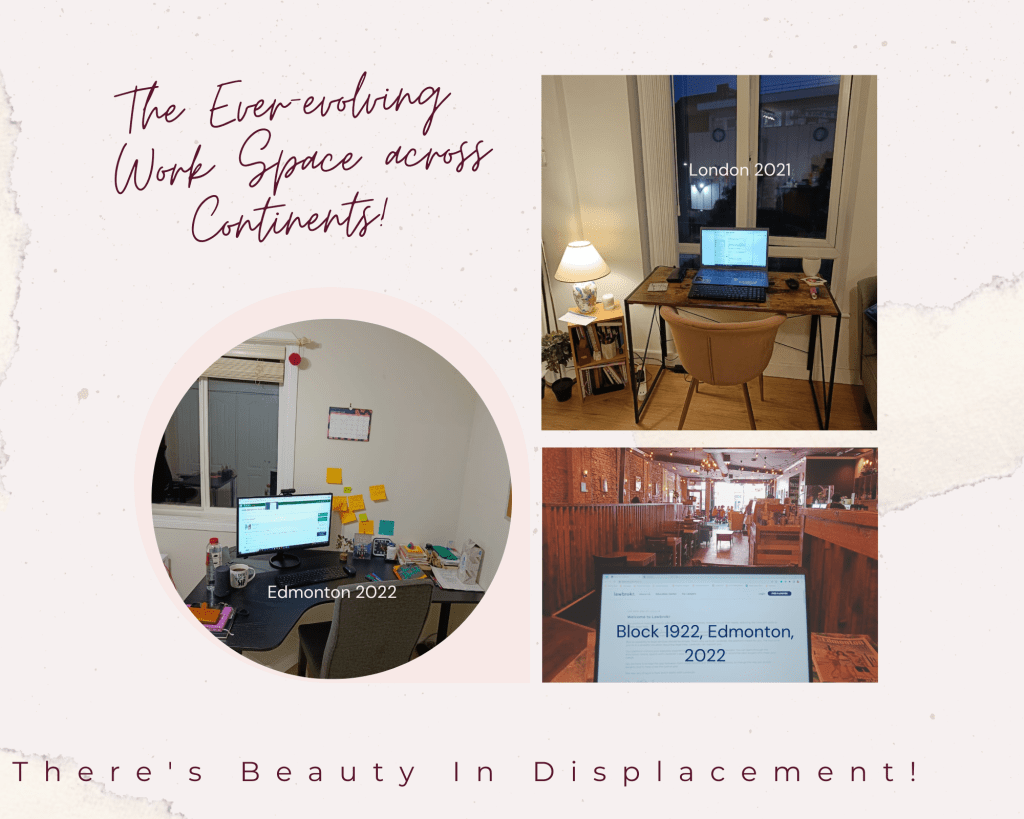
The change that was staring me in the eye this time was colossal! Circumstances were leading to the inevitable reality of giving up my London apartment, one that I pieced together bit by bit. One that was my constant and one I hoped to keep even when everything else would change. But this was not to be. And just like that, my home became Flat 8!
The following months after I packed away my home was challenging, one that was filled with grieving, anger and, at times lack of spiritual connection that I had never felt before. Everything seemed like a test that would eventually lead to another massive failure. How does one explain grieving, especially if it’s not a dear one that you are mourning but a way of life and space that was sacred? With a bruised ego and a broken heart, I decided to move away from the UK. Perhaps new meanings of home or hope lay elsewhere. The process of healing, like tragedies, has a way of finding you without warning. Edmonton, Alberta, was like a breath of fresh air.
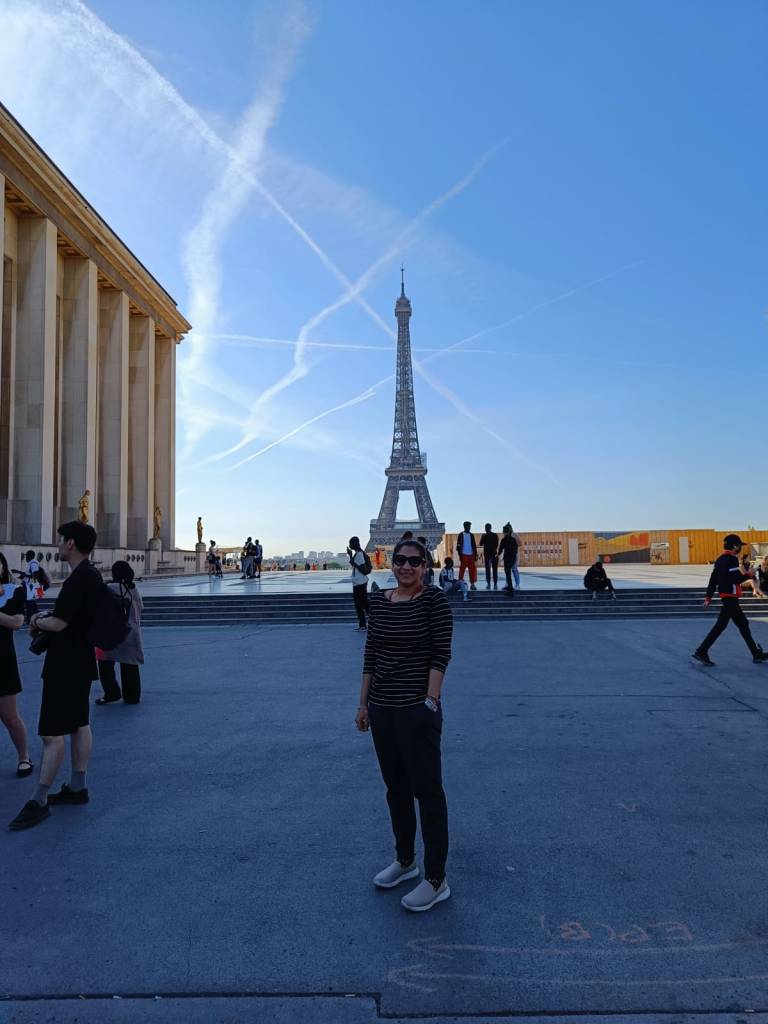
Someone like me, who rigidly prefers to stay on track and cannot fathom the idea of a detour while travelling to Canada via Paris, decided to make the most of a six-hour layover. I still have to pinch myself over it!
I knew something had to shift inside of me to breathe again. So, there I was, throwing caution to the wind, standing next to the Eiffel Tower, gleefully reminding myself that the choices of the living must remain in living and preferably in the present.
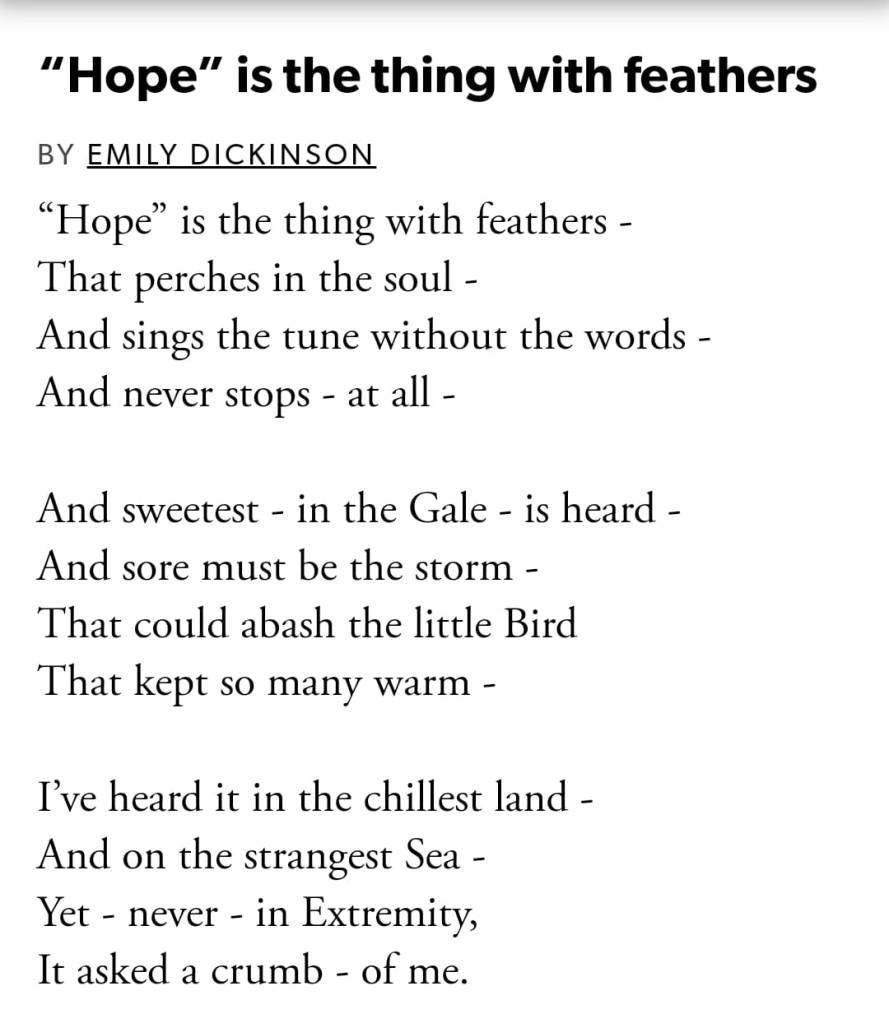
There could be myriad ways my story could have ended. One that began with displacement could have ended in me pirouetting around my fractured heart, engulfed in self-pity. Instead, my story ends with hope. No matter where I land, I must never give up on Hope because Hope is the thing with feathers bound to carry you to beauty and beyond!
This week, while learning about distributed stories and Multiplatform Storytelling I was reminded of the distributed story I have been finding during the last few years.
I first found it in a converted newsrack dispenser: after solving a riddle to unlock the box, I was rewarded with a treasure trove of more stories hidden inside.
Let me explain. It was a geocache.
Have you tried #Geocaching? I first heard of it from a friend’s IG post. While they were exploring the east coast with their kids, locals taught them how to follow clues & coordinates on their phones to locate caches. Each one is a piece of a bigger story…
In short, “Geocaching is a real-world, outdoor treasure hunting game using GPS-enabled devices. Navigate to a specific set of GPS coordinates and then attempt to find the geocache (container) hidden at that location.”1
But, what does the container look like?
What do you do when you find it?
There are simple and not-so-simple answers to both of these questions.
Under bridges, you might find trolls, you might find caches, or maybe both. So many stories! (Screenshot from Geocaching.com)
Usually, you just find the hidden box (there are ratings for size so you know if you are looking for something large, regular size, or little micros) and then sign the log as proof that you were there. The logbook inside could be considered a type of story spread across time and authors. Many people may have found it before, or you may be the very first finder!
The Logbook is a story
Sometimes the finders will write a message along with their name on the paper or the digital logbook about what the conditions were like on the day they found it, who they were with, why they were in the area, or a hint to help you locate the cache. Some days there may have been multiple finders, or there might have been long periods of time when no one could locate the container or it was hidden under snow. If you find a few geocaches in the same neighbourhood you may even see some names repeated, these people have added to the same story as you, but in a different order, and in a different time.
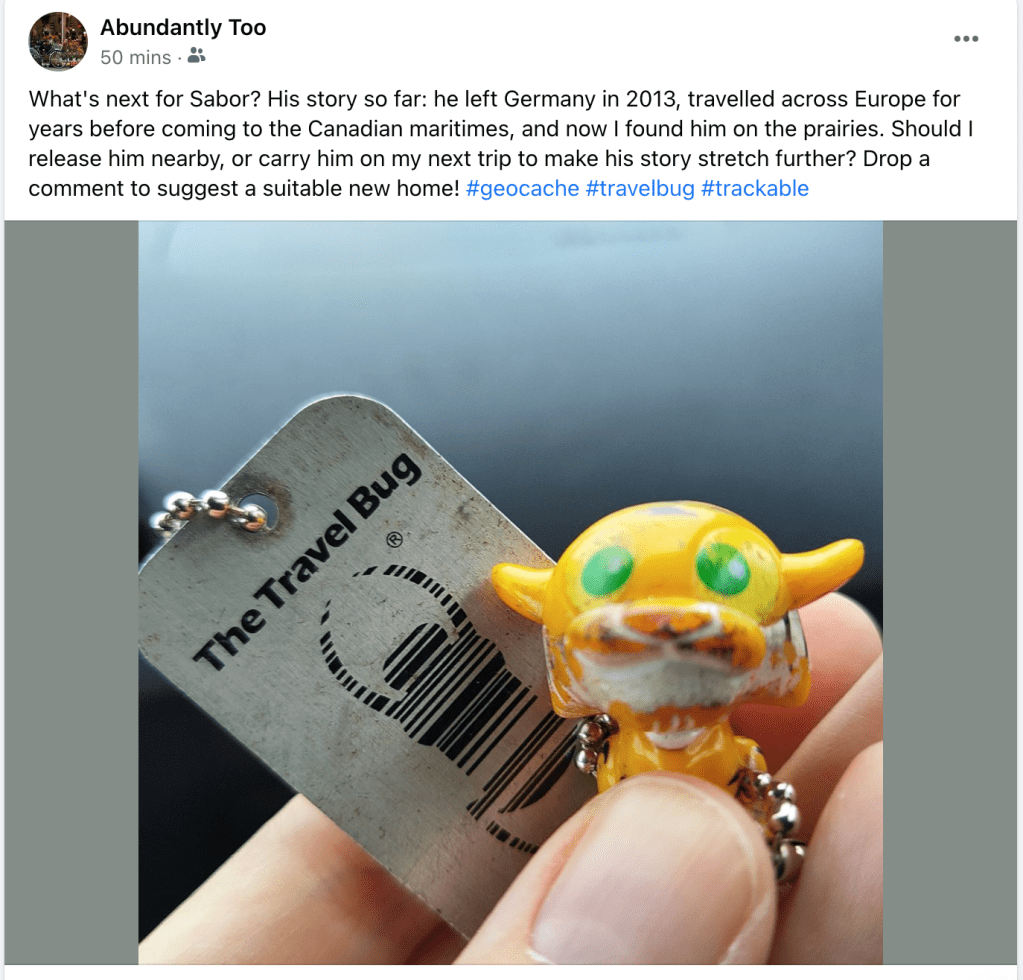
Then there are Travel Bugs like this little guy with his own travel tale.
Caches are stories distributed across every country and continent, with logs by thousands and thousands of different ‘authors’, across more than 20 years (ever since May 2000 when the first geocache was placed). And their story doesn’t even stop there.
Stories within Stories (Literally)
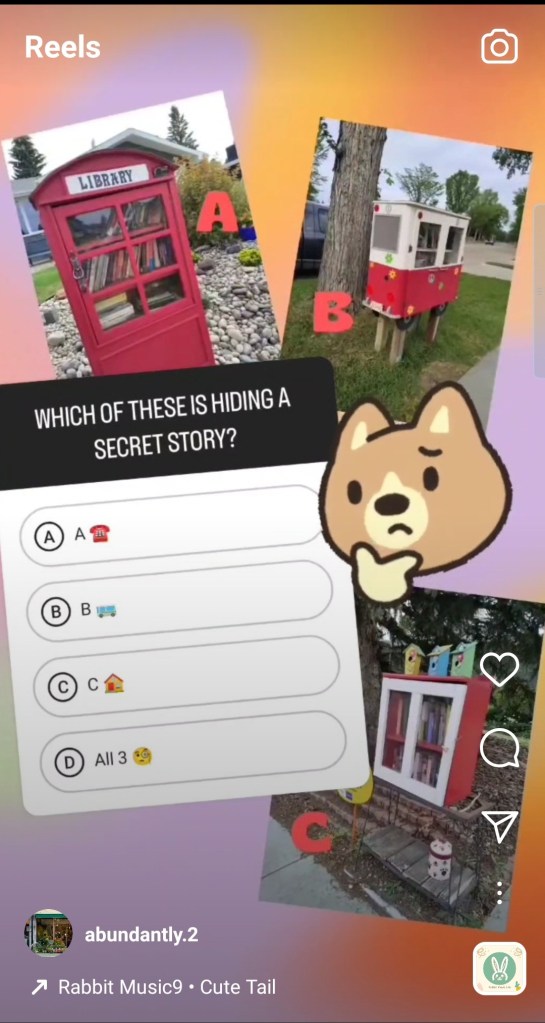
The physical caches can be very tricky, even when you are at the correct location you might not spot them. Is it actually a branch or rock, or a camoflauged hiding place? Is it a novel inside that Little Free Library, or is it a locked book safe or magnetic container?
This video about Little Free Libraries in New York shows that you may have a similar story hiding close to you.
Not to be limited to the ‘little free’ type of library, I have also found a cache in an actual municipal library. The clue was the Dewey Decimal number for the book and shelf, of course.
A few years ago I was inspired to read the novel “I Am a Cat” by Natsume Soseki after visiting Japan and finding a cache under this cat statue where the author’s home was originally located.
Original home of author Natusme Soseki, in Bunkyo, Tokyo, Japan with geocache cleverly hidden near the 2 cat statues
It was another example of distributed storytelling as I was physically in the setting of the book more than 100 years after it was written, signing my name to the log at the monument, then reading the full novel later and reliving the same neighbourhood through the eyes of author Soseki.
There are also ‘Other’ cache types – of which I can only scratch the surface. These include virtual caches, EarthCaches (going physically to a special geological location and answering questions to prove you were there), letterboxes, puzzle/mystery caches, gadget geocaches, events, GPS games, and multi-stage caches (like WherigoTM Caches or Lab caches), and more.
The Puzzle or Mystery caches are very interactive – before you can even get the location you need to solve a puzzle. It might be in code, rely on finding clues in the area, or involve finding hidden code in the web page of the cache itself – then deciphering how that relates to GPS coordinates. Those logbooks tend to be shorter when you’ve found them, but there is definitely a story inside about the people putting in the effort to add their names to the list.
Most recently, the story has been extended beyond the earth and its ocean and into even more rare territory. In 2008, one of the first space tourists hid a geocache in a locker on the International Space Station. In 2021, the Perseverance Rover landed on Mars with a geocaching trackable that could be logged by non-astronauts if they found the code on the images that were sent back to earth.
Can you find it?
The instructions and list of the 79,889 people (and counting) who have found it so far are here.
Then, you will have to look through NASA’s raw image files here to find it.
Look for a ‘selfie’ of the Rover.
Don’t get distracted by the hundreds of thousands of Mars vista and rock pics!
When you start looking around, will you find some of these stories or caches near you? When you do, will you just read and experience the story, thinking about who was there before, or will you add your name and be led into a new world of storytelling?
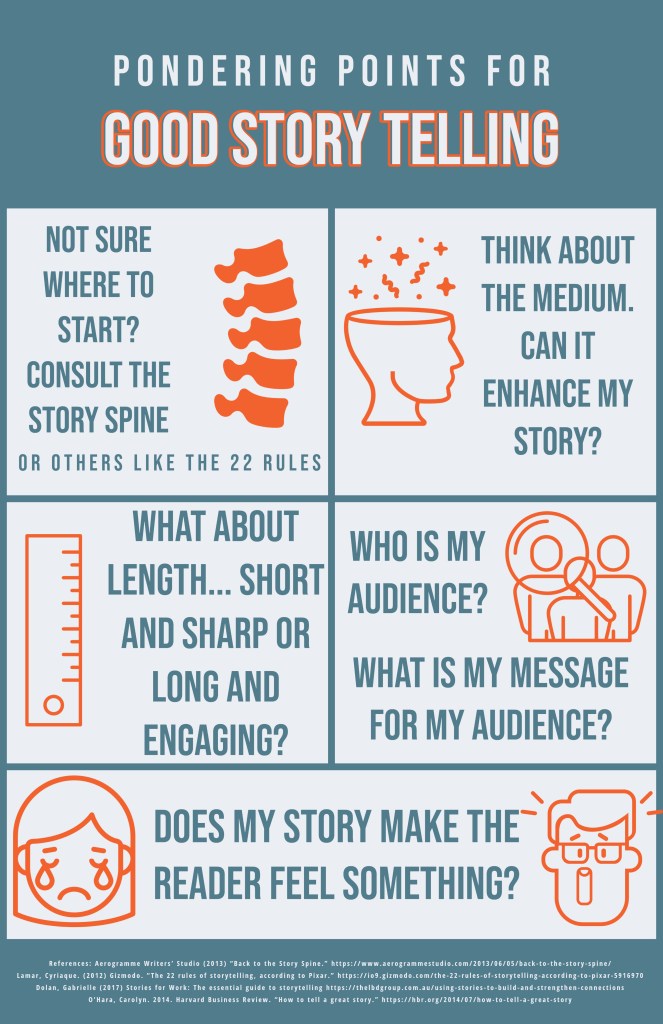
If like me you are new to the nuances of the art of storytelling… it can be an overwhelming experience to suddenly start telling a story! You’ve heard about the idea of good storytelling…. but what does it mean? What should I think about?
Thinking about storytelling can be overwhelming!
People are natural storytellers… supposedly! Somedays I don’t feel like a natural storyteller… Purportedly that is what separates us from the animals (can we ever be sure animals aren’t storytellers???). I digress, but what we do know is there are certain core components, key considerations, or as I call them pondering points that can help create a good story!
There are lots of pondering points to help us along the way…. whilst we might not need to know the scientific detail of why our brains like stories… (Its true and Harvard says so and why here: Why Your Brain Loves Good Storytelling) but we can use the their academic findings to help us as storytellers. There are also plenty of quality opinion and experience pieces from really competent (and incredibly popular) storytellers like Pixar or even medium providers like Twitter than can help us in our quest for good storytelling!
Anyways I condensed my top pondering points from some excellent references into the handy infographic below to help you to start storytelling!
When thinking about how to tell a good story, there can be a lot to remember. Good stories have a clear structure – a beginning, middle and end. Good stories answer the 5 Ws: Who, What, When, Where, Why. Good stories have a purpose, a conflict, a character, the list goes on and on…
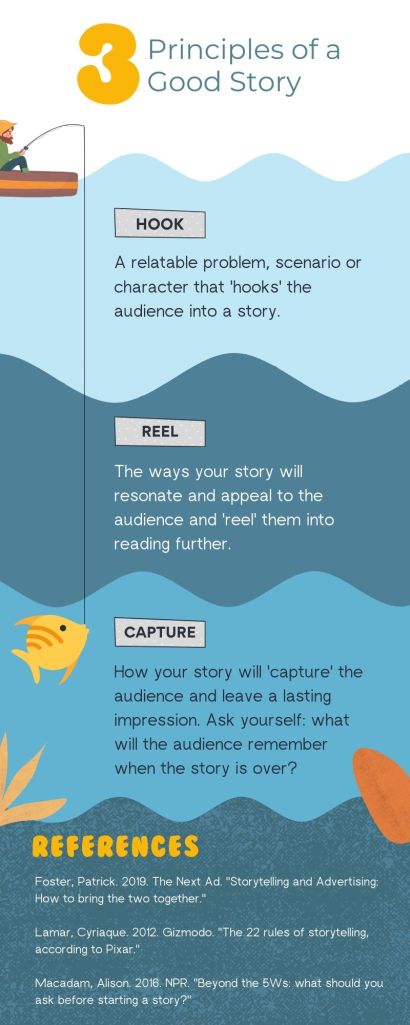
But knowing how to tell a good story can be as simple as knowing how to fish. All you have to do is remember these 3 principles: hook, reel, and capture.
3 Principles of a Good Story
Hook
We live in a world where access to information is quick and attention spans are short, so every good story must have a hook to attract your audience.
In some stories, the hook is a character to root for. As Emma Coats shares in The 22 rules of storytelling, according to Pixar, characters are the heart of many good stories because they give an audience someone to admire and challenge so they have a “reason to root for the character”.
After you’ve hooked their attention, you need to reel your audience in so that they stay engaged with your story.
Alison MacAdam in Beyond the 5 W’s recommends asking these questions when developing your story:
How can you illustrate it in a way that’s interesting?
[Is there] an emotional or intellectual thread that can run throughout the story?
Are there ear- or eye-grabbing ways to attract the audience?
Whether it’s adding emotional elements to resonate with your audience or captivating visuals to catch their eyes, find ways to keep your audience engaged while they read your story.
Capture
Good stories capture an audience and leave a lasting memory. Patrick Foster in Storytelling And Advertising: How To Bring The Two Together states that a good story is “a compelling story; one that reaches the heart of the consumer and evokes a feeling or a memory.”
When a good story is told, audiences remember and often act.
If your story introduces a problem-solving product to a target audience, telling a good story can mean that the audience remembers your brand and even purchases your product.
Let’s Go Fishing
Telling a good story is hard work, which can also be said about fishing. But if you remember the 3 simple principles of hook, reel, and capture, your work becomes a little bit easier.
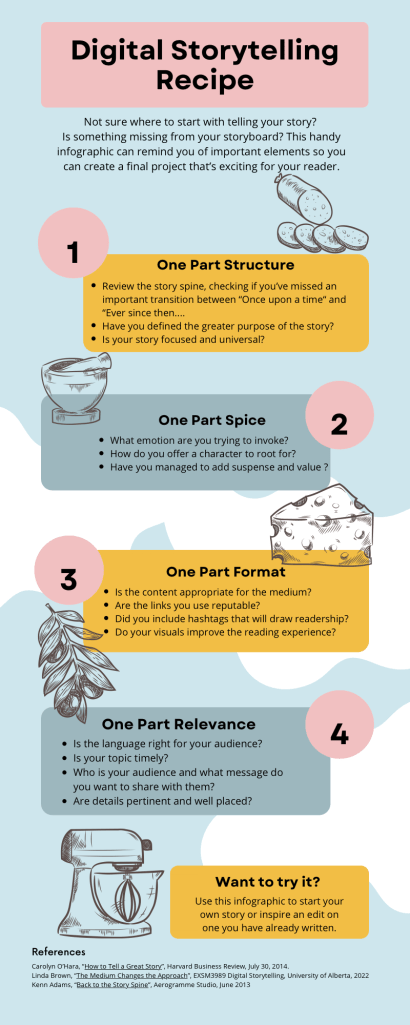
It happens to the best of us. We re-read our digital story and can feel something is missing. Or, worse yet, we have a momentary block about where to start. Sound familiar?
If so, you can refer to this infographic. Much like a recipe, missing a key storytelling ingredient can make the final product feel flat. And of course, adding too much of a good thing can make the creation inedible.
While reviewing it, I hope something stands out and gives you an “ah-ha” moment.
Let’s look a bit deeper…
For example, pre-defining how you add value for the reader can give you confidence that the reader will walk away remembering the lesson or emotion you offered. Adding suspense can be as simple as inserting imagery that suggests there could be something hidden, or playing with dramatic irony where the reader learns something that’s hidden from the character.
And where is this going to be read, anyway?
Sometimes writers can get so excited to share their message, they fail to consider how to alter the message for the medium. Could your visual be stronger for Instagram? Maybe you should change it to a video or GIF for Facebook? Did you polish the wording to appeal to your professional contacts on LinkedIn?
Keep writing, regardless if you feel stuck or unsatisfied with what you wrote. By reviewing what you’ve written with the ideas offered here, you will stir up some great creations.






 EXSM 3989 - Digital Storytelling Class Blog