Categories
Uncategorized

Film: Mulan (1998)

“The flower that blooms in adversity is the most rare and beautiful of all”

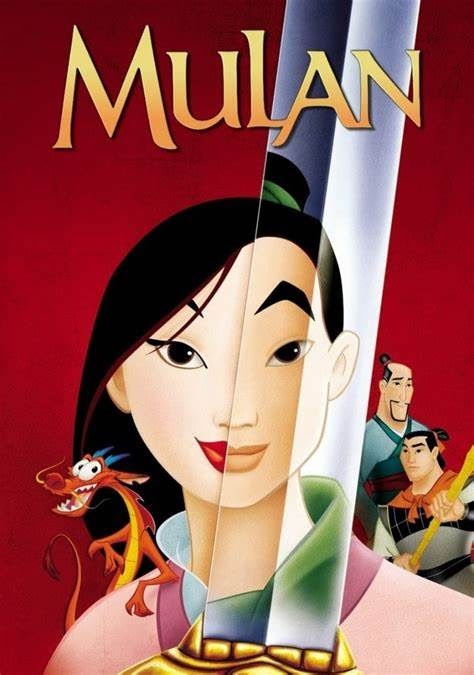
Mulan is an animated Disney movie from 1998 based on the Chinese legend of Hua Mulan. In the story Mulan leaves home to take her father’s place in the army during the Hun invasion. The movie follows her path from being an outcast to becoming a strong warrior who eventually saves the Emperor and China.

Why I love Mulan as a Story

I’ve loved this story since I was a child, it had the perfect combination of action, drama, romance and suspense especially for an animated film. Additionally, Mulan was one of the first female-lead Disney movies that wasn’t a princess and made the lead character a regular person that didn’t include a traditional Disney version of ‘femininity’ and happily ever after.

Mulan & the Four Principles of Good Storytelling: Universal

As a story, Mulan hits every single point of Pixar’s four principles of good storytelling and incorporate a number of its 22 rules of storytelling. The first point, “great stories are universal” applies because many of us have struggled with being an outcast, trying to fit in or facing adversity to better yourself. We can also all relate to the reasoning why Mulan chose to risk her life and potentially bring dishonour to her family: the love of her father and being worried for his wellbeing and wanting to make her family proud. These themes are universal among many people in society and helps the audience connect to this story.

Mulan & the Four Principles of Good Storytelling: Clear Structure and Purpose

Mulan also has a very clear structure and purpose as the audience can easily follow along the different steps of her journey to get to the final. The structure, based on Helping Writers Become Authors website would (generally) be:

  • Mulan fails at the matchmaker
  • Mulan takes her father’s place in the army
  • The Huns challenge the Chinese army
  • Mulan retrieves the arrow at the camp
  • The Chinese army is attacked
  • Mulan is discovered as a woman and let go of the army
  • The Huns kidnap the emperor
  • Mulan kills the Hun leader
  • Mulan returns to her family with honour as a hero.

Mulan & the Four Principles of Good Storytelling: Simple & Focused

Mulan as a story is also very simple and focused, while many elements are going on the primary focus is Mulan finding herself and growing into a warrior who honours their family. By keeping this focus, we feel even more connected to the character and root for them even more because we know what they are working towards.

Mulan & the Four Principles of Good Storytelling: Give a Character to Root for

Finally, the last principle of good storytelling, Mulan is absolutely a character to root for. Through her rejection at the matchmaker to her going through base camp and getting stronger and initially being rejected by the other soldiers we all want to see her succeed and bring honour to her family. They showed not only her highs and lows but also how she got from her lowest to her highest.
Categories
Uncategorized

Film: The Princess Bride

by: Brenda G. Smith

During the infamous “COVID” shutdown, confined to our homes, many books, movies, and TV series were consumed. My favorite movie, The Princess Bride, was my go-to. With both hands and feet, I cannot count the number of times I have watched The Princess Bride. It is a timeless classic that has held up with the warmth and coziness that envelops you even as Fred Savage is enveloped in his blanket, waiting for Peter Falk to read his story. This story has become iconic for its characters and its movie quotes. As an example, my husband and I were asked to officiate a wedding, and the bride wanted The Princess Bride’s marriage speech recited during the ceremony.

The Princess Bride movie was adapted from a 1973 novel written by William Goldman. In the opening scene, you see a young boy, played by Fred Savage, home from school and playing video games. His grandfather comes into his room to keep him company for the day. In his hand is a book that he would like to read to his grandson, who rolls his eyes at the idea.

The grandfather is persistent and reads the story of a farmhand named Westley. Westley works on the farm where the beautiful Buttercup lives with her family in the fictional kingdom of Florin. Whenever Buttercup tells the farmhand Westley to do something, he always obliges with an “As you wish.” The two eventually fall in love. Westley aspires to do more than just be a farmhand for Buttercup and leaves to make his fortune on the sea. The Dread Pirate Roberts attacked his ship. Westley is presumed dead, leaving Buttercup devastated.

Through a series of events, Buttercup has been forced into an arranged marriage with Florin’s Prince Humperdinck, but she is still in love with “her Westley.” Before the wedding can take place, three outlaws, Vizzini, Fezzik and Inigo Montoya kidnap Buttercup. However, an unknown masked man in black follows them.

The man in black confronts the outlaws and, one by one, he defeats the three. He flees with Buttercup, and she assumes he is the Dread Pirate Roberts. Buttercup’s anger at the Dread Pirate Roberts ignites as she believes he is responsible for “her Westley’s” death. The two tussle and she pushes him down into a gorge. As he rolls down, he shouts, “As You Wish!” Buttercup recognizes Westley, and follows him. They are reunited for a short time before Prince Humperdinck recaptures Buttercup and throws Westley into the Pit of Despair.

Through events, Westley is reacquainted with Fezzik and Inigo Montoya. They set out to rescue his true love Buttercup, from the evil Prince Humperdinck.

Woven into the narrative are the conversations between the grandfather and grandson. The grandson was taken by the story and the events sparked his imagination. At the end of the movie, the boy eagerly asks his grandfather to read the story again the next day. The grandfather responds with “As you wish.” (The Princess Bride (film), n.d.)

The Princess Bride, released in the fall of 1987, is an old yet modern-day fairy-tale brimming with action, romance, and comedy told through a sweet relationship between a grandfather and grandson. This story told through the medium of film captured my heart and imagination as the grandfather sat down to engage the grandson in a story. This struck a personal memory in my childhood as it reminded me of my grandparent watching over me when I was sick. I would hear stories of my grandparents coming to Canada and making their way to Alberta. In its own way, my grandparent’s story had action, some comedy, and a bit of romance.

In listening to the TED Talk – Why Storytelling is so Powerful in the Digital Era by Ashley Fell, she states that “a good story has a character that you can identify with.” I could identify with the young boy at home from school listening to a story told to him by his grandparent. The story piqued my interest from the very start, as the grandfather was very strategic in arousing the grandson’s interest in the story. I wanted, like the grandson, to see what the story was about. I wanted to keep watching. The story carried the premise of good over evil. Would the underdog Westley triumph over the evil Prince Humperdinck and how would that happen? As the movie played out and jumped from the story in action to the story being told by the grandfather, or rather the grandfather stating that the “story may be too much” and the young boy crying out that he wanted to hear more. It involved me as the viewer, and I wanted to continue to the end.

In conclusion, through the inspiration of justice triumphing, Westley, Buttercup, Fezzik, and Inigo Montoya ride off on white horses. Ashley Fell stated in her TED Talk, the story did not just connect with the eyes of my brain but it fully connected with the eyes of my heart.

Categories
Uncategorized

“Here’s looking at you, kid.”

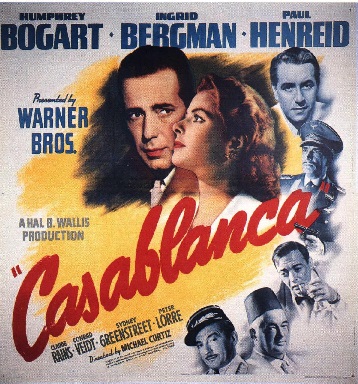
Describing one of my favourites, Casablanca (1942).

Why is Casablanca one of my favourite stories?

The classic Casablanca line

Aside from often quoted lines and wonderful music score, the location of Casablanca provides a visually engaging backdrop. The setting against the complicated geo-political backdrop of World War 2, adds struggle – a key story component according to O’Hara (2014) – to the compelling 3 act structure.

The Story in 3 Acts

The Story Spine method helps convey the key moments. However, Casablanca is highly complex, explores multiple character arcs and has numerous twists, which is why the film is so enduring!

Act 1 – Setting the scene

Once upon a time, as people flee German occupied Europe desperate to reach safe-havens, they pass through Vichy controlled Casablanca.

Every day, cynical Rick manages ‘Rick’s Cafe Americian’, a popular Casablanca casino, which is known for it’s music. This song is one of the reasons I love this film!

Play it again Sam” is never said in Casablanca!

Act 2 – all about the girl?

But one day, Victor and his wife Ilsa walk into Rick’s Cafe seeking help.

“Of all the gin joints in all the towns in the world, she walks into mine.”

Rick Blaine (played by Humphrey Bogart)

Because of that, Rick is conflicted, as he sticks his neck out for nobody. Through flashbacks we explore his history… we start to understand Rick’s jaded attitude…

Because of that, despite Isla’s pleas Rick won’t hand over the papers he has acquired that the couple need to escape. Victor is subsequently arrested at an underground resistance meeting. Rick still loves her???

Because of that, Rick tells the local Vichy French police chief, Captain Louis Renault, that he wants to leave Casablanca with Ilsa. Rick suggests the police release Victor and create a trap. If the police can detain Victor attempting an escape, he will face harsher punishment and Renault can win favour with the local German Commander. A cunning plan

Until finally, Rick double-crosses Renault, forcing him to phone his officers sending them away. Unbeknownst to Rick, Renault calls the German Commander, who tries to stop the plane, but is shot by Rick. Ilsa and Victor to escape on a plane bound for Lisbon. Which was Rick’s plan all along… Plot twist!

Character motives and pasts are explored in flashbacks and call backs throughout the film.

Act 3 – Spoiler! He doesn’t get the girl…

And ever since then, Renault doesn’t arrest Rick nor stop the plane, but suggests he and Rick escape Casablanca and join the French resistance! Rick’s jaded outlook fades as he returns back to his idealist ways.

“Louis, I think this is the beginning of a beautiful friendship.” 

Rick Blaine (played by Humphrey Bogart)

Bonus – Unsolved mystery

Rick’s past is alluded to, but we never find out why he can’t go home to America… Leaving an unanswered question divides critics, some feel it leaves the consumer empty whilst others feel it’s important to be left wanting more. I quite like that we are left with the mystery….

Categories
Uncategorized

Hairspray (1988)

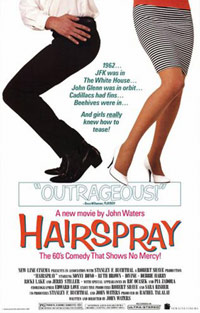
Most people are familiar with the hit Broadway musical Hairspray and the 2007 film adaptation starring Nikki Blonsky, Zac Efron and John Travolta. Fewer are familiar with the original 1988 film it was based on. Directed by cult film icon and “Ru Paul’s Drag Race” guest John Waters, the film stars Rikki Lake, Jerry Stiller and frequent Waters’ collaborator Divine.

Source: Wikipedia

The basics of the plot, about a plus-sized teen named Tracy Turnblad who becomes a dancer on a local program called The Corny Collins Show, fits well into Ken Adams’ story spine breakdown:

Every day, Tracy watches a dance show after school and practices her dance moves.

But one day, she tries out for an open spot for featured dancers and becomes one of the most popular on the show.

Because of that, Tracy is nominated for the show’s talent pageant and begins a relationship with a dancer she has a crush on.

Because of that, she angers her rival, the rich mean girl Amber, who bullies Tracy.

Then, Tracy learns more about racial segregation of the show that keeps Black dancers from participating.

Because of that, Tracy begins to speak out against injustice as part of her pageant platform and challenges the status-quo of the show.

Then, a riot over integration breaks out at a live show taping and Tracy gets arrested.

Because of that, Tracy is banned from the pageant and her friends and family help her fight back and crash the pageant live on-air.

Until finally, Tracy is crowned the winner, and the hosts announce that The Corny Collins Show is officially integrated.

Of course, this simple summary doesn’t include all the fantastic details and side stories that made this film so appealing to me when I first saw it as a preteen. As a plus-sized girl, it was refreshing to see a larger girl written to be accepting of and confident in herself, a universal theme that would meet the standards of the Pixar storytelling model. Tracy is unashamed of her body and pursues the affections of the leading man without any hesitation or reservation. When Amber, her mean girl rival with conventional looks, criticizes Tracy’s body, Tracy holds her own and impresses the judges for dance council with her answers and poise while Amber is sent home and suspended from the show for her bullying. The people who criticize Tracy are presented in a poor light while the movie shows her moving on and becoming successful without changing her appearance to suit others.

Source: Filmfed.com

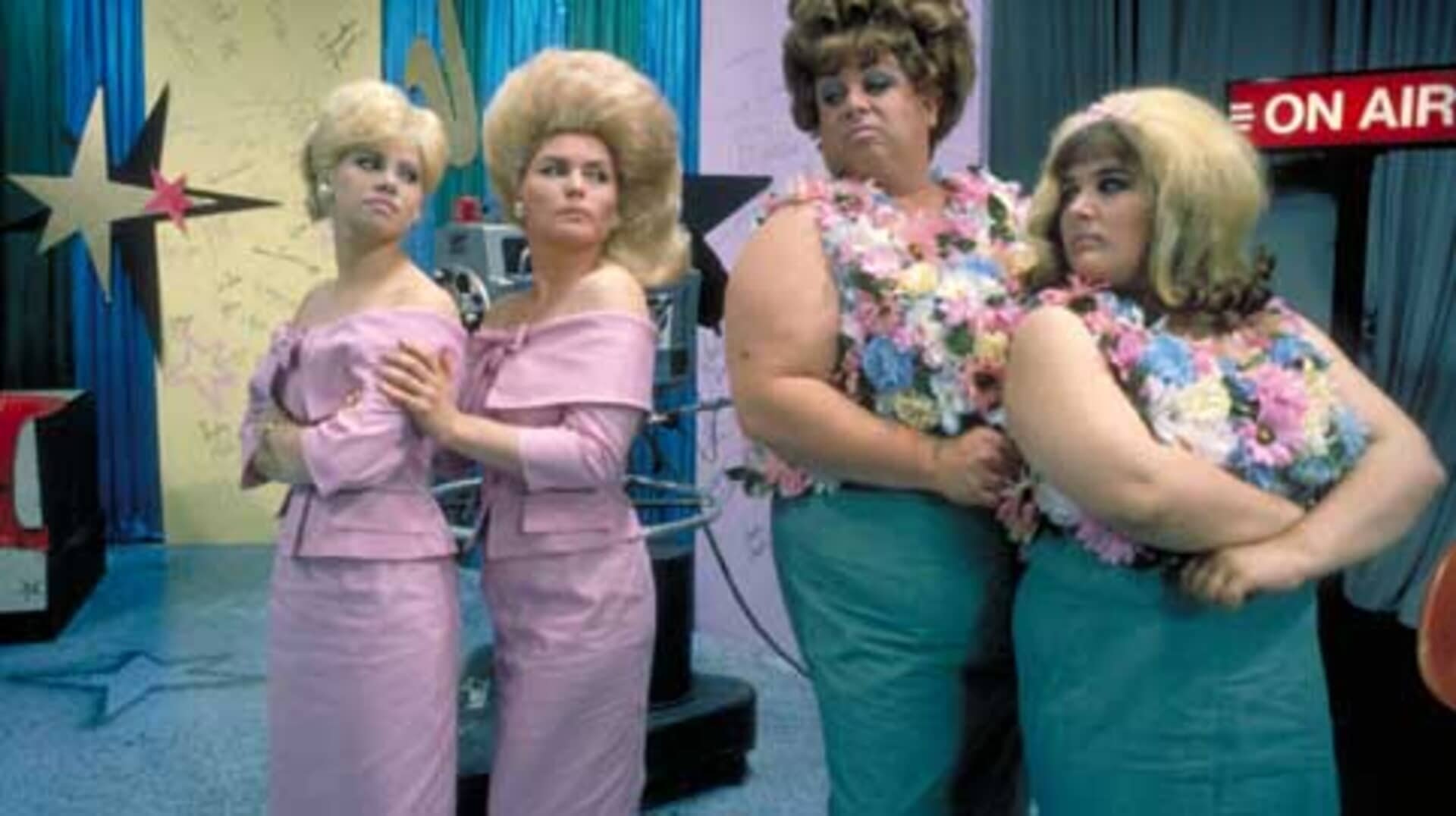
In a Twitter thread recounted by the Gizmodo article, “The 22 rules of storytelling according to Pixar,” storyboard artist Emma Coats wrote that a character should be admired for “trying more than for success.” In Hairspray, Tracy uses her popularity to speak out against injustice for others and not just for herself. She speaks up for her friends who are not allowed to dance and joins a protest against segregation over being on an episode. She is admirable in her convictions and even her hairstyles are a metaphor for Tracy’s journey and the changing times as she goes from popular tall and ratted styles to the more modern sleek styles of the latter part of the tremulant 1960s.

Source: Warner Bros

The outrageous fashion and exaggerated takes on popular hairstyles of the 60s give it the eye-catching appeal that allows you to instantly recall the feel and setting of the film. The story is told with a visual flair and an over-the-top aesthetic characteristic to John Waters’ direction. Though not digital elements, they are an example of how visuals make an impact and help us to remember a story, as discussed by Ashley Fell’s Ted Talk on digital storytelling.

Even though it is, as critic Pauline Kael noted in her New Yorker review, more of a parody of a teen comedy and not as sincere as its musical counterpart, the 1988 Hairspray is still full of heart and endearing in its universal messages of acceptance and social justice. It deserves to be remembered as much as its musical adaptation and enjoyed as an introduction to John Waters’ wild film canon.

Source: Pinterest

Design a site like this with WordPress.com
Get started