I think we can all agree, we’ve gotten to the last TV episode of the night of our favourite show, it’s getting late and boom, cliffhanger! You couldn’t possibly watch one more episode…. right?
While we all KNOW there are cliffhangers and suspenseful writing keeps us on our feet, I’ve never thought about the important aspects of what goes into properly creating suspense in stories.
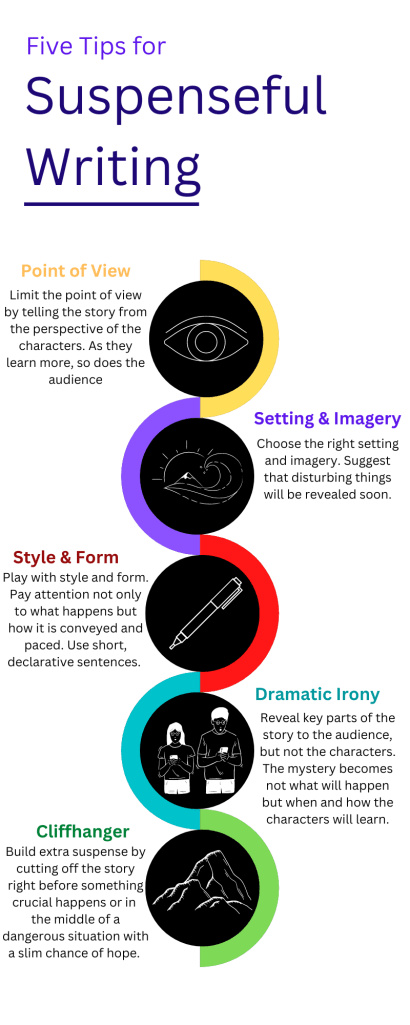
While the included tips help suspenseful storytelling, it is also important to include relatability, build up of tension and suspense, emotion, authenticity and urgency.
Limit the point of view by telling the story from the perspective of the characters. As they learn more, so does the audience
Setting & Imagery
Choose the right setting and imagery. Suggest that disturbing things will be revealed soon.
Style & Form
Play with style and form. Pay attention not only to what happens but how it is conveyed and paced. Use short, declarative sentences.
Dramatic Irony
Reveal key parts of the story to the audience, but not the characters. The mystery becomes not what will happen but when and how the characters will learn.
Cliffhanger
Build extra suspense by cutting off the story right before something crucial happens or in the middle of a dangerous situation with a slim chance of hope.
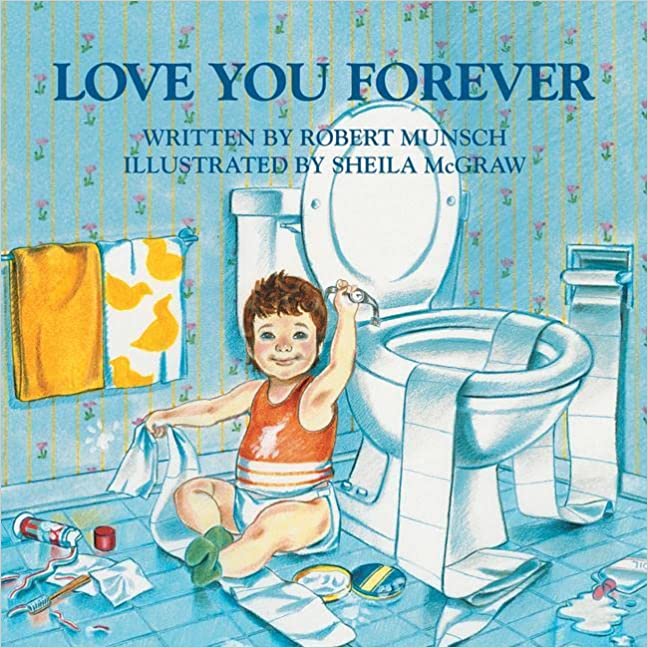
I will never forget the first time I read, Love You Forever, a 1986 children’s book written by Robert Munsch and illustrated by Sheila McGraw. While the book has been in circulation for over 30 years, I encountered it for the first time just a few years ago when I became a new mom. I still remember the feeling of disbelief as the book I thought would be a light read with cute pictures had unexpectedly moved me to tears.
The story is centered around a mother who sings a lullaby to her sleeping son during various stages of his life. As you watch the son grow, you see the mother go through the many challenges of raising a child, but despite all the struggles she comes back to her son at night to express her unconditional love, even as she becomes weak and approaches her final days.
What I loved about the book
The book stood out to me in many ways and while it is considered a children’s book, I would argue it is more so a book that provides many lessons for parents or caregivers. It triggered an emotional connection for me as a mother as I identified with the hardships of the mother in the story, especially the moments when she wanted to sell her son to the zoo! However, at the same time it depicts how a mother’s love is resilient and while you test her in many ways, she somehow continues to love you through and through.
Reading this story also allowed me to reflect upon my own relationship with my mother and the many ways I pushed her patience while growing up. The story moves you to appreciate loved ones in your life a little more and truly value the time you have with them as we go through the circle of life.
Why it is good at storytelling
This book is particularly good at story telling because it covers all the four I’s that are needed to create an engaging story as indicated by Ashley Fell in “Why storytelling is so powerful in the digital era”. The story captured my interest and maintained my attention throughout the book as we moved through each stage of the boy’s life. It instructs us by providing me with meaningful reflections on my own relationships with my son and my mother. It involved me as I could identify with the character in the story and saw myself in the mother. Finally, it inspired me by encouraging me to cherish time with loved ones and recognize that there will always be hardships throughout life but no matter what you do, you have people that will always be there.
Many feel that Love You Forever is a divisive book. Some like me think it is a beautiful story of motherhood and the circle of life, while others hate it and incite ridicule that it is okay for an old woman to sneak into her adult son’s room and pick him up. Whatever the case, for a children’s book, it is an engaging story that brings out emotions and leaves you deep in thought. and would make the perfect gift for an expecting parent.
“I am a common man with common thoughts, and I’ve led a common life. There are no monuments dedicated to me and my name will soon be forgotten, but I’ve loved another with all my heart and soul, and to me, this has always been enough.“
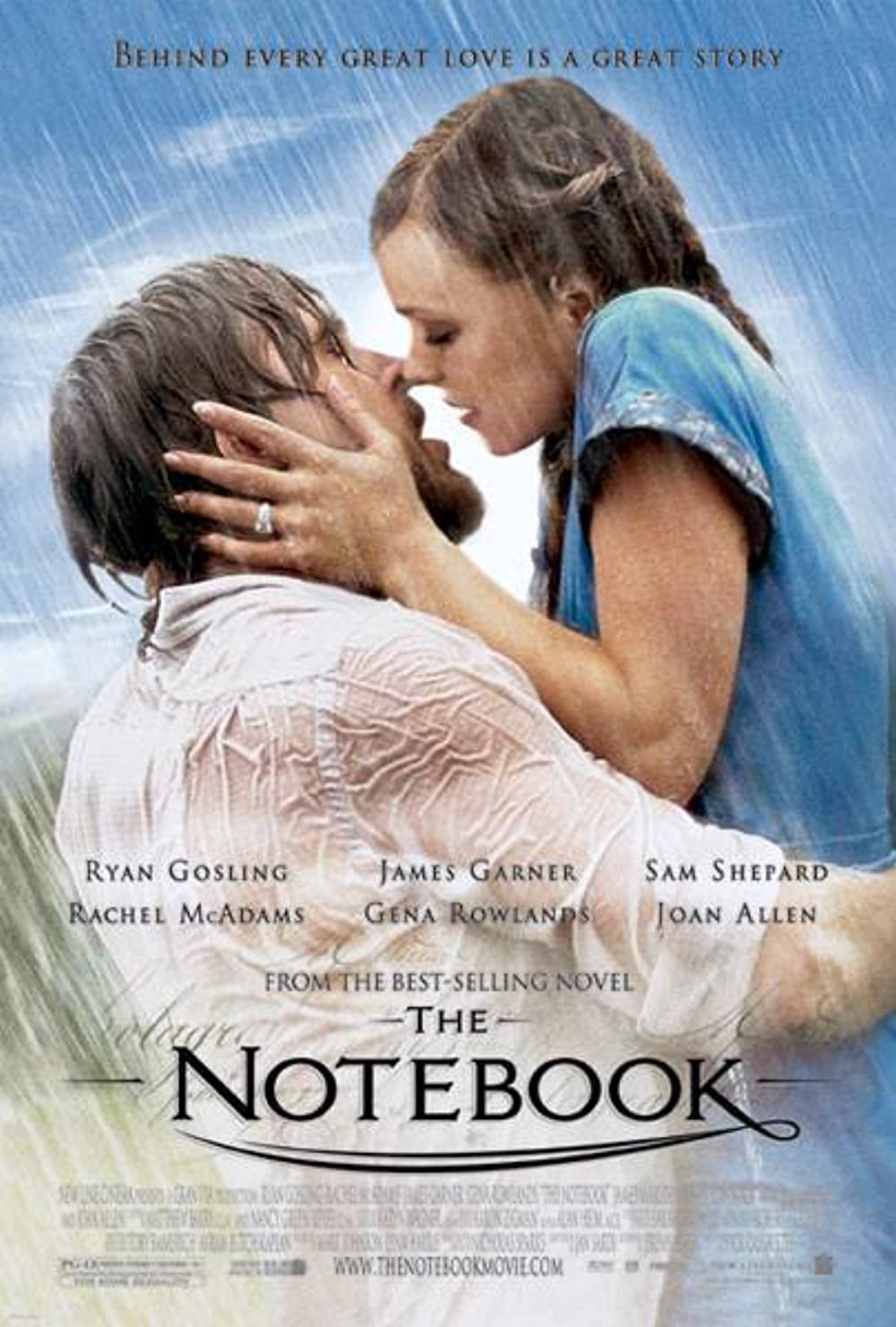
This beautifully written love story begins with this poignant statement, narrated by the renowned James Garner. It immediately tells the viewer that they are in for a heartfelt story that is sure to evoke emotion. As any good story should begin, it grabs your interest and you want to know more about this man and his true love. His comment that he’s just a common man, makes him genuine and relatable right off the bat. The tag line at the top of the above photo says “Behind every great love is a great story”, and lets you know there’s more to learn.
I chose this movie because the first time I saw it I immediately fell in love with it, and yes, I have seen it countless times! If you like sappy romance and aren’t afraid to cry, then this movie is sure to make your top 10! It was originally a novel that was written by Nicholas Sparks and was inspired by his wife’s grandparents who were married for over 60 years. The movie goes back and forth between present day and the past and explores the young relationship between Noah, played by Ryan Gossling and his sweetheart Allie, played by Rachel McAdams.
The movie is relatable as it describes a young hopeful romance and first love and the careless joy that goes along with it. Weaving back and forth between James Garner reading from a journal to his companion played by Gena Rowlands and tells the story of young Allie and Noah. She is captivated and wants to know more about them. It stirs up memories and emotions and she is passionate to know how this love story ends. The author has kept the audience intrigued and wondering too. There’s a tenderness between the two friends and you can’t help but be drawn into the narrative he is describing. Creating hope that everything works out for the young lovers. However, the story doesn’t end there though and it takes a few twists and turns as their romance doesn’t go as expected. After years apart, the two meet up again and are faced with a difficult decision . All good stories have a point of conflict and this one lays their relationship on the line once and for all. The viewer is on the edge of their seats, wondering what they will decide. Hoping these two soulmates end up together. There is anguish and confusion and the viewer is rooting for young Noah.
Does their love story get resolved and they live happily ever after? Clearly, I LOVE this sweet movie and I won’t spoil the ending but it definitely left a memorable impression and I still cry every time I watch it.
The story I am about to tell begins with one’s worst fears coming to fruition. The nightmares you think are sealed into the realms of the dreaming world when abruptly leak into the waking moments can leave you tensed, torn and terrified. Summer of 2021, when the world was trying to recover from the tragedy of the pandemic, the Universe was getting ready to jolt me out of my comfort zone. My mortal fears have always been made of the inability to choose and control the events in my life! I am a person who is dreadfully resistant to the idea of change. And I mean any change. A new couch that I thought would go well with the décor when actually placed in the living room can make me ruefully question my life decisions.
The change that was staring me in the eye this time was colossal! Circumstances were leading to the inevitable reality of giving up my London apartment, one that I pieced together bit by bit. One that was my constant and one I hoped to keep even when everything else would change. But this was not to be. And just like that, my home became Flat 8!
The following months after I packed away my home was challenging, one that was filled with grieving, anger and, at times lack of spiritual connection that I had never felt before. Everything seemed like a test that would eventually lead to another massive failure. How does one explain grieving, especially if it’s not a dear one that you are mourning but a way of life and space that was sacred? With a bruised ego and a broken heart, I decided to move away from the UK. Perhaps new meanings of home or hope lay elsewhere. The process of healing, like tragedies, has a way of finding you without warning. Edmonton, Alberta, was like a breath of fresh air.
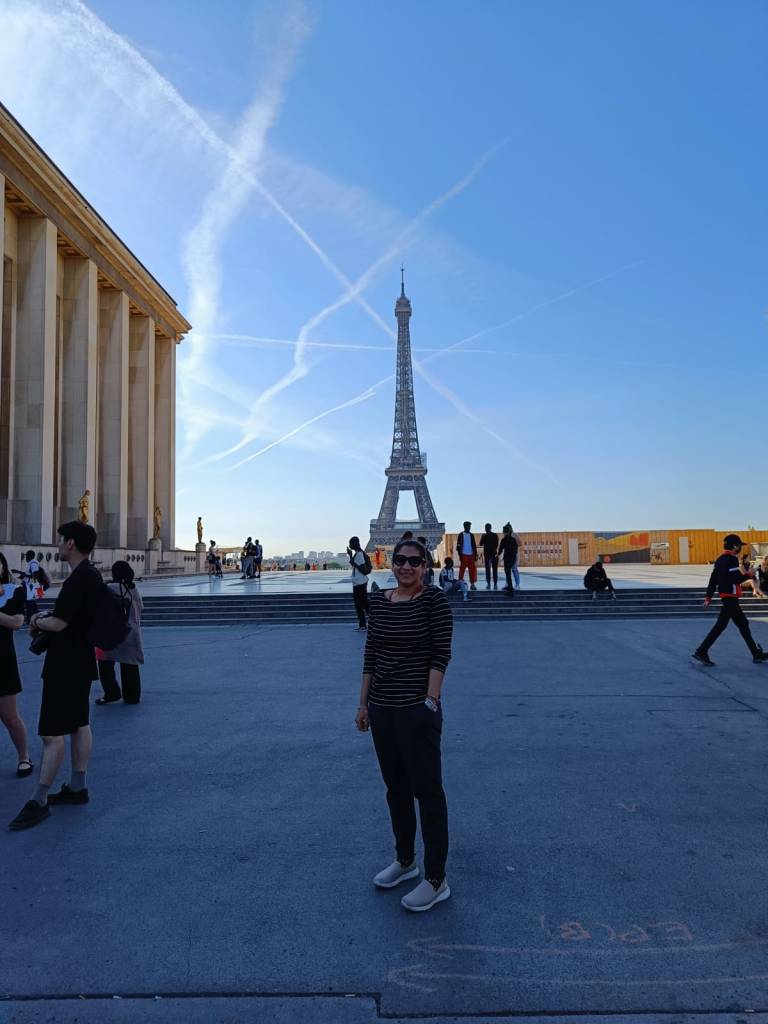
Someone like me, who rigidly prefers to stay on track and cannot fathom the idea of a detour while travelling to Canada via Paris, decided to make the most of a six-hour layover. I still have to pinch myself over it!
I knew something had to shift inside of me to breathe again. So, there I was, throwing caution to the wind, standing next to the Eiffel Tower, gleefully reminding myself that the choices of the living must remain in living and preferably in the present.
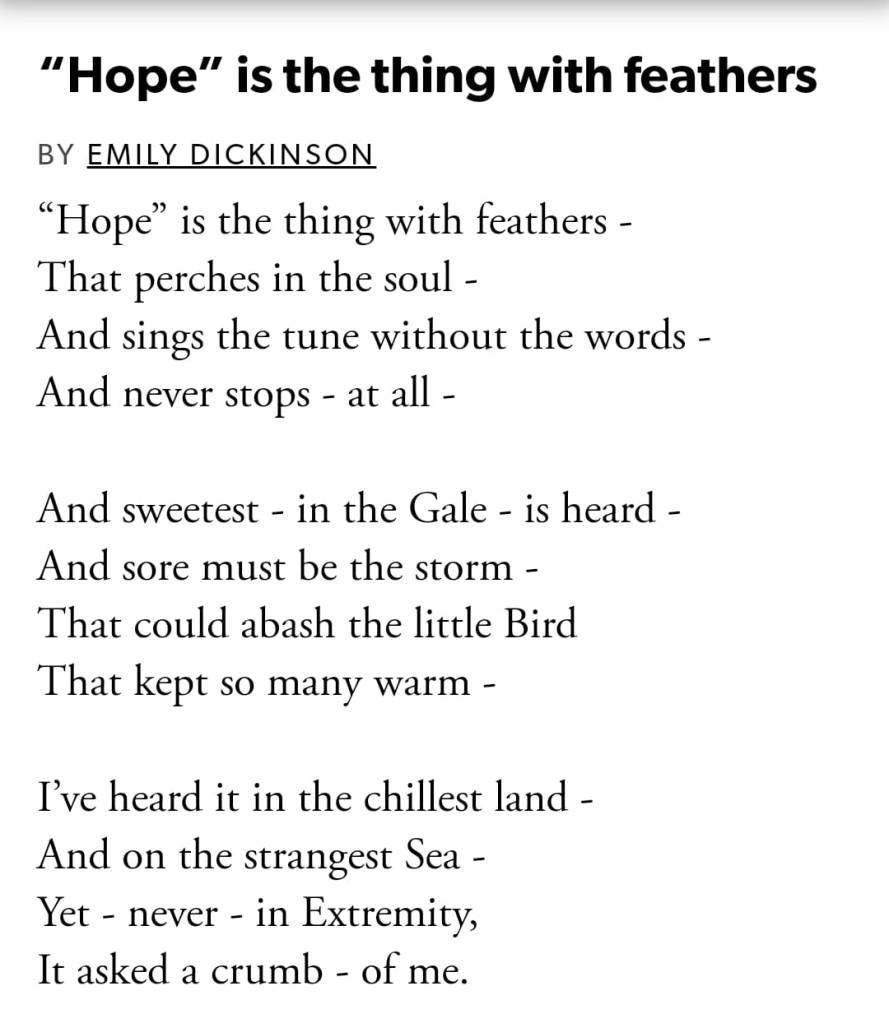
There could be myriad ways my story could have ended. One that began with displacement could have ended in me pirouetting around my fractured heart, engulfed in self-pity. Instead, my story ends with hope. No matter where I land, I must never give up on Hope because Hope is the thing with feathers bound to carry you to beauty and beyond!
This week, while learning about distributed stories and Multiplatform Storytelling I was reminded of the distributed story I have been finding during the last few years.
I first found it in a converted newsrack dispenser: after solving a riddle to unlock the box, I was rewarded with a treasure trove of more stories hidden inside.
Let me explain. It was a geocache.
Have you tried #Geocaching? I first heard of it from a friend’s IG post. While they were exploring the east coast with their kids, locals taught them how to follow clues & coordinates on their phones to locate caches. Each one is a piece of a bigger story…
In short, “Geocaching is a real-world, outdoor treasure hunting game using GPS-enabled devices. Navigate to a specific set of GPS coordinates and then attempt to find the geocache (container) hidden at that location.”1
But, what does the container look like?
What do you do when you find it?
There are simple and not-so-simple answers to both of these questions.
Under bridges, you might find trolls, you might find caches, or maybe both. So many stories! (Screenshot from Geocaching.com)
Usually, you just find the hidden box (there are ratings for size so you know if you are looking for something large, regular size, or little micros) and then sign the log as proof that you were there. The logbook inside could be considered a type of story spread across time and authors. Many people may have found it before, or you may be the very first finder!
The Logbook is a story
Sometimes the finders will write a message along with their name on the paper or the digital logbook about what the conditions were like on the day they found it, who they were with, why they were in the area, or a hint to help you locate the cache. Some days there may have been multiple finders, or there might have been long periods of time when no one could locate the container or it was hidden under snow. If you find a few geocaches in the same neighbourhood you may even see some names repeated, these people have added to the same story as you, but in a different order, and in a different time.
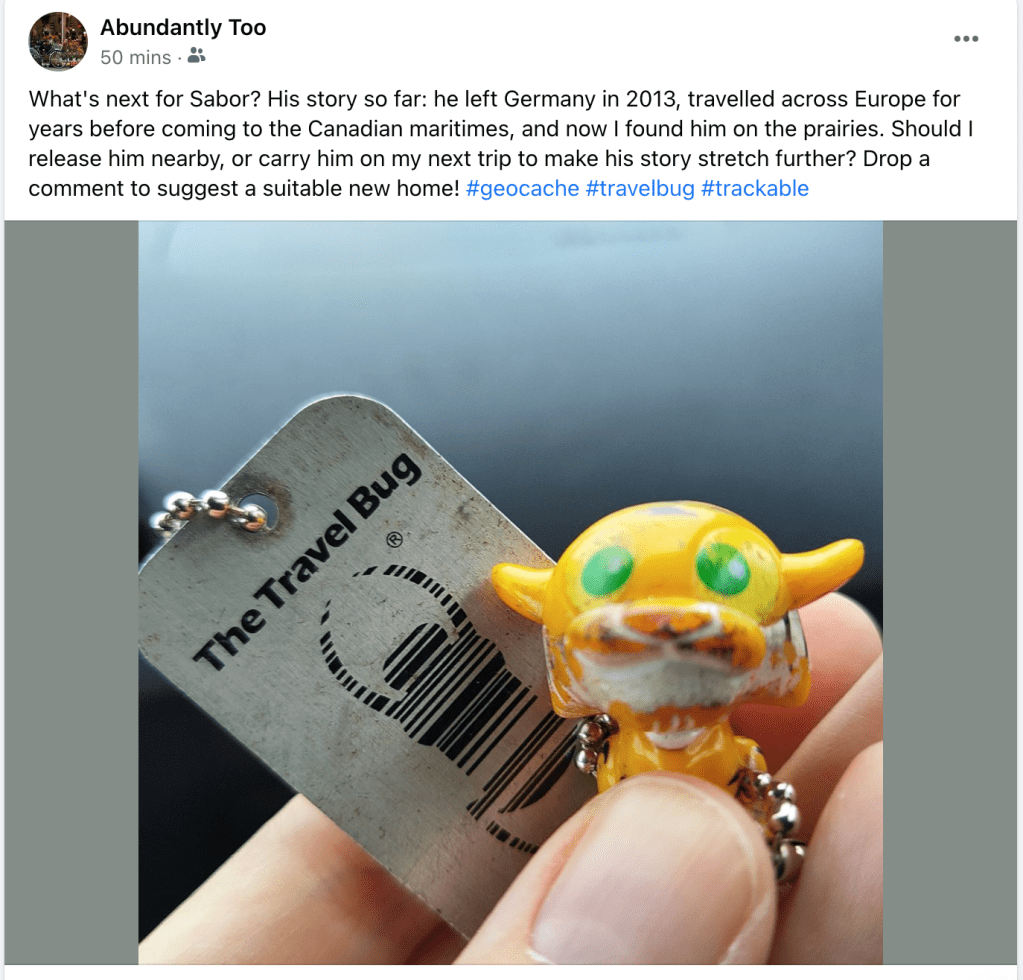
Then there are Travel Bugs like this little guy with his own travel tale.
Caches are stories distributed across every country and continent, with logs by thousands and thousands of different ‘authors’, across more than 20 years (ever since May 2000 when the first geocache was placed). And their story doesn’t even stop there.
Stories within Stories (Literally)
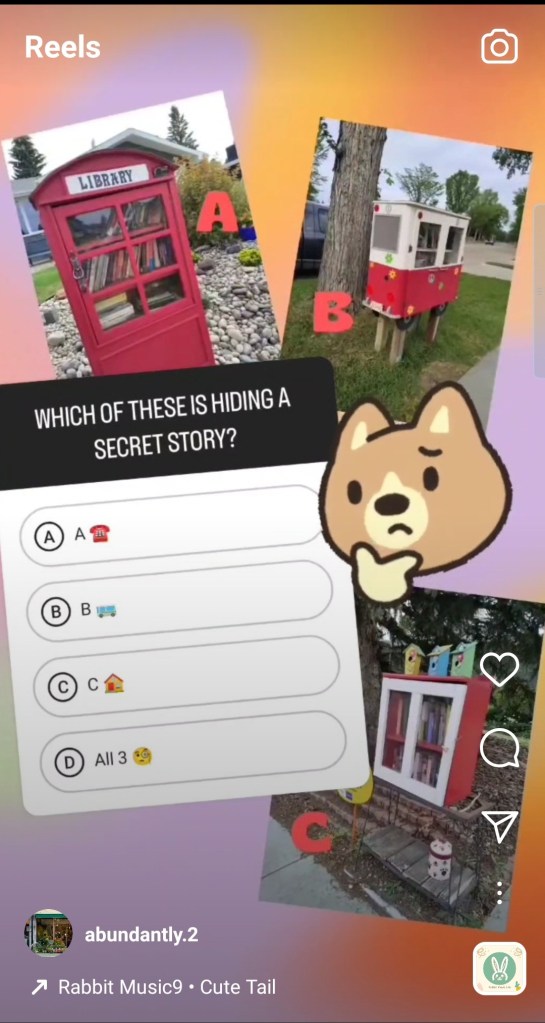
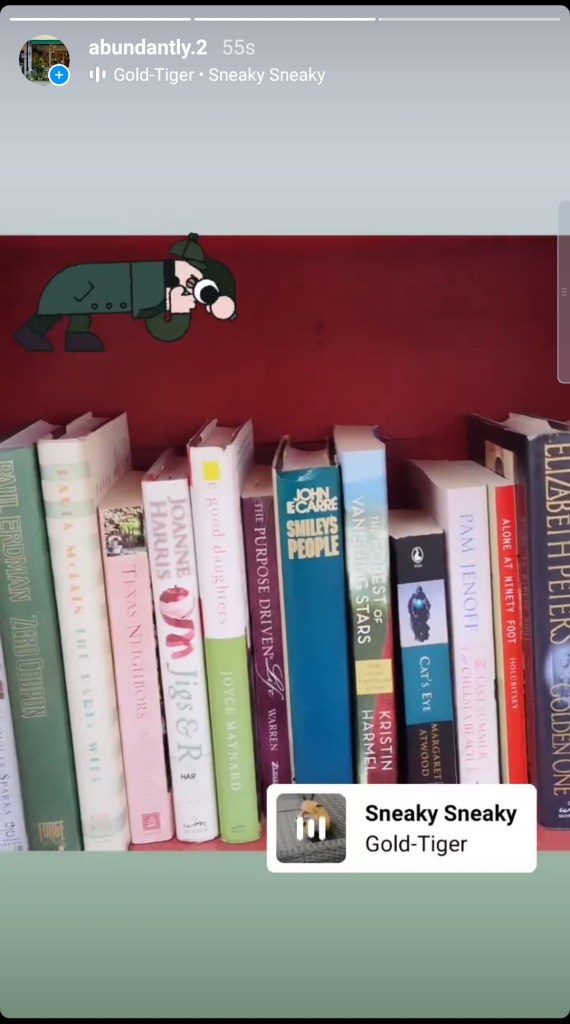
The physical caches can be very tricky, even when you are at the correct location you might not spot them. Is it actually a branch or rock, or a camoflauged hiding place? Is it a novel inside that Little Free Library, or is it a locked book safe or magnetic container?
This video about Little Free Libraries in New York shows that you may have a similar story hiding close to you.
Not to be limited to the ‘little free’ type of library, I have also found a cache in an actual municipal library. The clue was the Dewey Decimal number for the book and shelf, of course.
A few years ago I was inspired to read the novel “I Am a Cat” by Natsume Soseki after visiting Japan and finding a cache under this cat statue where the author’s home was originally located.
Original home of author Natusme Soseki, in Bunkyo, Tokyo, Japan with geocache cleverly hidden near the 2 cat statues
It was another example of distributed storytelling as I was physically in the setting of the book more than 100 years after it was written, signing my name to the log at the monument, then reading the full novel later and reliving the same neighbourhood through the eyes of author Soseki.
There are also ‘Other’ cache types – of which I can only scratch the surface. These include virtual caches, EarthCaches (going physically to a special geological location and answering questions to prove you were there), letterboxes, puzzle/mystery caches, gadget geocaches, events, GPS games, and multi-stage caches (like WherigoTM Caches or Lab caches), and more.
The Puzzle or Mystery caches are very interactive – before you can even get the location you need to solve a puzzle. It might be in code, rely on finding clues in the area, or involve finding hidden code in the web page of the cache itself – then deciphering how that relates to GPS coordinates. Those logbooks tend to be shorter when you’ve found them, but there is definitely a story inside about the people putting in the effort to add their names to the list.
Most recently, the story has been extended beyond the earth and its ocean and into even more rare territory. In 2008, one of the first space tourists hid a geocache in a locker on the International Space Station. In 2021, the Perseverance Rover landed on Mars with a geocaching trackable that could be logged by non-astronauts if they found the code on the images that were sent back to earth.
Can you find it?
The instructions and list of the 79,889 people (and counting) who have found it so far are here.
Then, you will have to look through NASA’s raw image files here to find it.
Look for a ‘selfie’ of the Rover.
Don’t get distracted by the hundreds of thousands of Mars vista and rock pics!
When you start looking around, will you find some of these stories or caches near you? When you do, will you just read and experience the story, thinking about who was there before, or will you add your name and be led into a new world of storytelling?
Storytelling dates back thousands of years when it adhered to visual and oral traditions using myriad ways to communicate them, including drawings, songs, chants and poetry. The evolution of storytelling remains fascinating because, as human beings, we continue to find novel ways of communicating and sharing our experiences through stories that can capture our imagination and make us feel connected.
So, while the new mediums challenge storytellers to adapt to novel ways of communicating and presenting stories, the principles around good storytelling have remained steadfastly resilient.
So, what principles continue to help create great stories that we deeply resonate with and remember? Read on to know more!
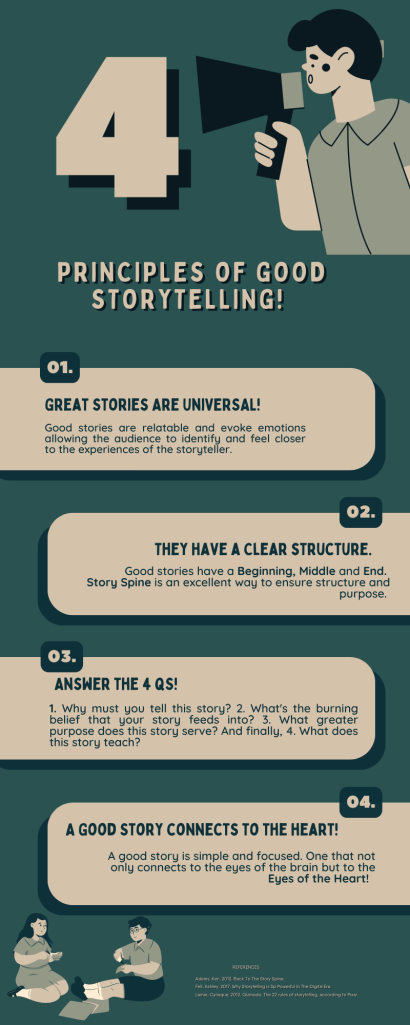
1.Stories That Have A Universal Appeal
The stories that offer universality through their characters and respective experiences instantly result in the most profound connections between the audience and the storyteller. According to Pixar Director Pete Docter, the relatable and identifiable stories also evoke emotions and remain with the audience, adding to their longevity.
2. Stories That Have A Clear Structure & Purpose
An appealing story must be able to draw its reader into its well-crafted world. For that to occur, it must be able to use the Story Spine and adhere to the guidelines of good storytelling, including the following:
1. The Beginning
2. The Event
3. The Middle
4. The Climax
5. The End
3.The 4Qs That Can Help Create Good Stories!
Good stories don’t just happen! Storytellers must cultivate the practice of self-awareness and honesty as part of the process. Before telling a story, answering these allows a storyteller clarity and purpose behind their work, often leading to memorable creations.
Ask yourself –
Why must you tell this story?
What’s the burning belief within you that your story feeds off of?
What greater purpose does this story serve?
What does this story teach?
4.Good Stories Have A Heart!
Good stories connect to the eyes of the brain but, more crucially, connect to the eyes of the heart! Principles of good storytelling, especially in the digital age, serve as a vital reminder. With more innovative platforms and mediums and their ever-growing tools, which certainly play a role in enhancing the audience’s experience, a good story, in the end, remains simple and one that speaks to the heart of its audience.
Conclusion
So, if you want to be able to tell incredible stories, follow these principles. Put yourself through the process, practice your craft and with perseverance, you will have your perfect story!
Although I think my life is quite habitual and unappealing to others due to my routine consisting of working, cooking, watching TV and reading with my spouse before bed with the off chance of gaining the motivation to use my yoga membership, I decided to try to document a scenario that occurred in my day for a Twitter thread. I challenged myself to use Vaynerchuks philosophy to simply document rather than create. “Just tell the world what’s going on. Describe your journey, outline your vision, and describe your thoughts, ideas, actions, wins, losses, anxieties and ambitions online.” I was surprised that the storytelling basics applied to my interaction with my cat that had me in hysterics and took a dip into my bank account. I came home to find my usually loyal cat meowing loudly in the basement, not at his usual place at the garage door keenly awaiting my return. I went downstairs to find him staring at a spider crying. I was a bit taken aback that he cowered in front of such a tiny creature, but I digress because I am no fan of any small critters myself. I took a Kleenex and swiftly disposed of the spider. The horrified look on my cat’s face when I did so, turned me from hero to villain within minutes. I used to be a beloved cat Mom, but my cat now painted me as a spider killer and refused to look at me physically turning his back when I entered the same space as him. Ridiculous? Absolutely! But I yearned for redemption. I ended up caving and going to Petsmart to purchase him yet another toy for his pile. And no, I did not get him a mouse now knowing he is not a hunter.
When? – late afternoon, main character returns from work
Why? – cat was scared of spider and then owner
The bonus question of “how” I was going to keep the audience’s attention was by using a GIF to convey my cats horror. The short story also had the suspense of wondering why my loyal cat didn’t greet me at the door, a bit of comical relief with a GIF chosen, and a plot twist making it engaging, because who doesn’t love when the heroine becomes the villain? Well…clearly not me as I was emotionally invested in my pet! However, it taught me that storytelling does not have to be complex. A story can be achieved from a small insignificant part of your day that you found interesting or inspiring.
Photo by u0410u043bu0435u043au0441u0430u043du0434u0430u0440 u0426u0432u0435u0442u0430u043du043eu0432u0438u045b on Pexels.com
Perhaps I should have paid more attention to the 6+ warning on the Nerf Super Soaker box, or maybe I should have just let the flowers enjoy their water. But we can’t live in the what ifs, so I’m here to share the story of what I thought was going to be a #momwin.
Thinking it was a great idea, I recently purchased some Super Soakers for my kids to enjoy while our summer actually feels like summer. However, what quickly transpired was far from my expectations. There was no epic water battle, just the rise and fall of a younger brother who thought he was invincible.
My real-time Twitter thread uses storytelling techniques and principals in a number of ways. It holds all the elements of a story:
Setting (the sunny backyard)
Characters (3-year-old and 5-year-old brother/sister duo)
Plot (Mom bought fun new super soakers for core summer memories)
Conflict (in its truest form: sibling conflict)
Arc (the rise and fall of a not-so-invincible younger brother)
Using the 8-point story arc as a reference, the Twitter thread’s stasis begins in the backyard. The super soakers are full and the kids are calmly watering the flowers. They have chosen their course of action and it’s peaceful, useful.
Then Mom steps in and triggers a change. The idea of chasing each other around the yard with cold water as ammunition excites both children, but only one remembers the one and only rule: if you spray your brother/sister, they can get you back.
The 3-year-old embarks on his life-long quest to take down his older sister. He pulls the trigger and soaks her back. He has won, he’s victorious, and he’s on top of the world.
The 5-year-old is surprised by her suddenly cold back and she makes the critical choice to challenge her brother. She begins to chase him around the backyard, anticipation is growing, the smile appears on her face, the dread on his.
The climax is reached as she narrows her sights on her younger adversary. Will she be successful and soak her brother with cold water? Will the water fight continue?
We come to the Twitter thread’s reversal when the 5-year-old makes contact with her target. Due to her critical choice and the actions taken during the climax, she has sprayed her brother with cold water and he is now on the ground. He sadly accepts defeat and retreats into typical 3-year-old ways.
The resolution of the story happens when the children agree to take a break and go back to watering flowers. Peace is restored and they return to a new, albeit somewhat scarred, stasis.
In addition to these storytelling principals, the Twitter thread includes images and video to engage the audience. In his article, How to use storytelling to craft better tweets, Nick Reese says that “Tweets with video [attract] 10x more engagement than Tweets without video”.
To keep the audience coming back for more, and to keep the story at the top of the feed, the Tweets are published separately, with the second Tweet coming an hour after the initial post was shared.
This Twitter thread is intended for everyone, however parents, guardians, and caregivers will be able to connect to the story the most. Its colourfulness offers an all-too-relatable story in a funny and entertaining way.








 EXSM 3989 - Digital Storytelling Class Blog