Categories
Uncategorized

Storytelling For Your Brand

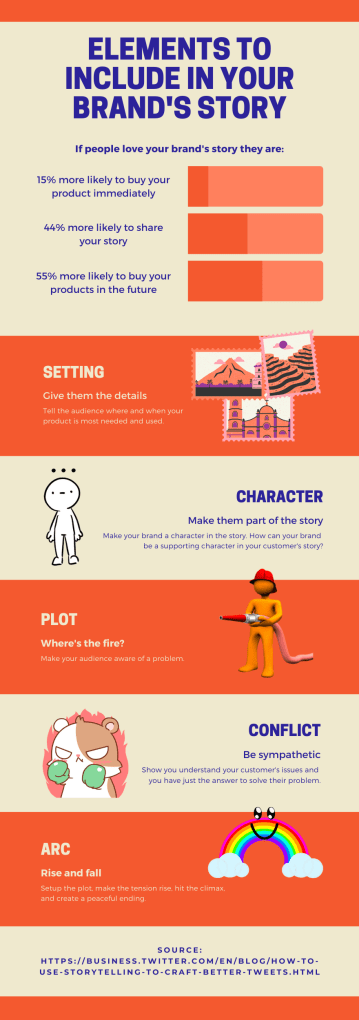
Storytelling for your brand is key to developing a relationship with your audience and potential customers. The emotions you portray and the image you establish in the mind of your audience affects their perception of your brand and products, and their decision to purchase. But how do you tell your brand’s story and create these emotions? There are five elements that should be included in your story.
Setting

This is your opportunity to set up the story and explain to the audience what your products do, when they are used and most needed and any features they have. This part of the story is really like a show and tell, where the audience gets to see the products in all their glory.

Character

Think of your product as a character in the story you are trying to tell but your audience is the main character. How does your product support the main character? How does it fit in to the main character’s story? Shifting our thinking, to how our product plays a role in the life of a customer, will help develop the remaining elements in your story.

Plot

Customers need a reason to spend their hard-earned money. Set up a problem or issue that is common among your brand’s customers. Maybe your customers didn’t even know this was a problem. But guess what? You have the answer.

Conflict

Now that we have a problem, show that you understand your customer and their needs. Create a fire and make your product the hero. This is an opportunity to show your product in action and how it can be the hero in your customers’ story.

Arc

The arc in a story creates a rise in tension, a climax and an ending. The arc adds the drama to the story and helps develop the emotion and feeling in the story. Every part of the arc is equally important to creating a story that customers become emotionally invested in. The setup, the plot, the rise of conflict, the climax and the ending, together, equally, create a memorable story that will be associated with your products and your brand.

Memorable stories with emotion and a great arc are key to engaging with your customers and creating new customers. Great brand stories drive conversions. If people love your brand’s story, they are 55% more likely to buy your products in the future, 44% more likely to share your brand’s story and 15% more likely to buy immediately. Make sure to consider all the elements when you’re creating your brand’s story. Create a setting, make your product a character, find a problem, be the hero and present it in an arc to your audience. Now, go tell your story!

Looking for more social media marketing tips, follow me at focuspocus.ca
Categories
Uncategorized

Hairspray (1988)

Most people are familiar with the hit Broadway musical Hairspray and the 2007 film adaptation starring Nikki Blonsky, Zac Efron and John Travolta. Fewer are familiar with the original 1988 film it was based on. Directed by cult film icon and “Ru Paul’s Drag Race” guest John Waters, the film stars Rikki Lake, Jerry Stiller and frequent Waters’ collaborator Divine.

Source: Wikipedia

The basics of the plot, about a plus-sized teen named Tracy Turnblad who becomes a dancer on a local program called The Corny Collins Show, fits well into Ken Adams’ story spine breakdown:

Every day, Tracy watches a dance show after school and practices her dance moves.

But one day, she tries out for an open spot for featured dancers and becomes one of the most popular on the show.

Because of that, Tracy is nominated for the show’s talent pageant and begins a relationship with a dancer she has a crush on.

Because of that, she angers her rival, the rich mean girl Amber, who bullies Tracy.

Then, Tracy learns more about racial segregation of the show that keeps Black dancers from participating.

Because of that, Tracy begins to speak out against injustice as part of her pageant platform and challenges the status-quo of the show.

Then, a riot over integration breaks out at a live show taping and Tracy gets arrested.

Because of that, Tracy is banned from the pageant and her friends and family help her fight back and crash the pageant live on-air.

Until finally, Tracy is crowned the winner, and the hosts announce that The Corny Collins Show is officially integrated.

Of course, this simple summary doesn’t include all the fantastic details and side stories that made this film so appealing to me when I first saw it as a preteen. As a plus-sized girl, it was refreshing to see a larger girl written to be accepting of and confident in herself, a universal theme that would meet the standards of the Pixar storytelling model. Tracy is unashamed of her body and pursues the affections of the leading man without any hesitation or reservation. When Amber, her mean girl rival with conventional looks, criticizes Tracy’s body, Tracy holds her own and impresses the judges for dance council with her answers and poise while Amber is sent home and suspended from the show for her bullying. The people who criticize Tracy are presented in a poor light while the movie shows her moving on and becoming successful without changing her appearance to suit others.

Source: Filmfed.com

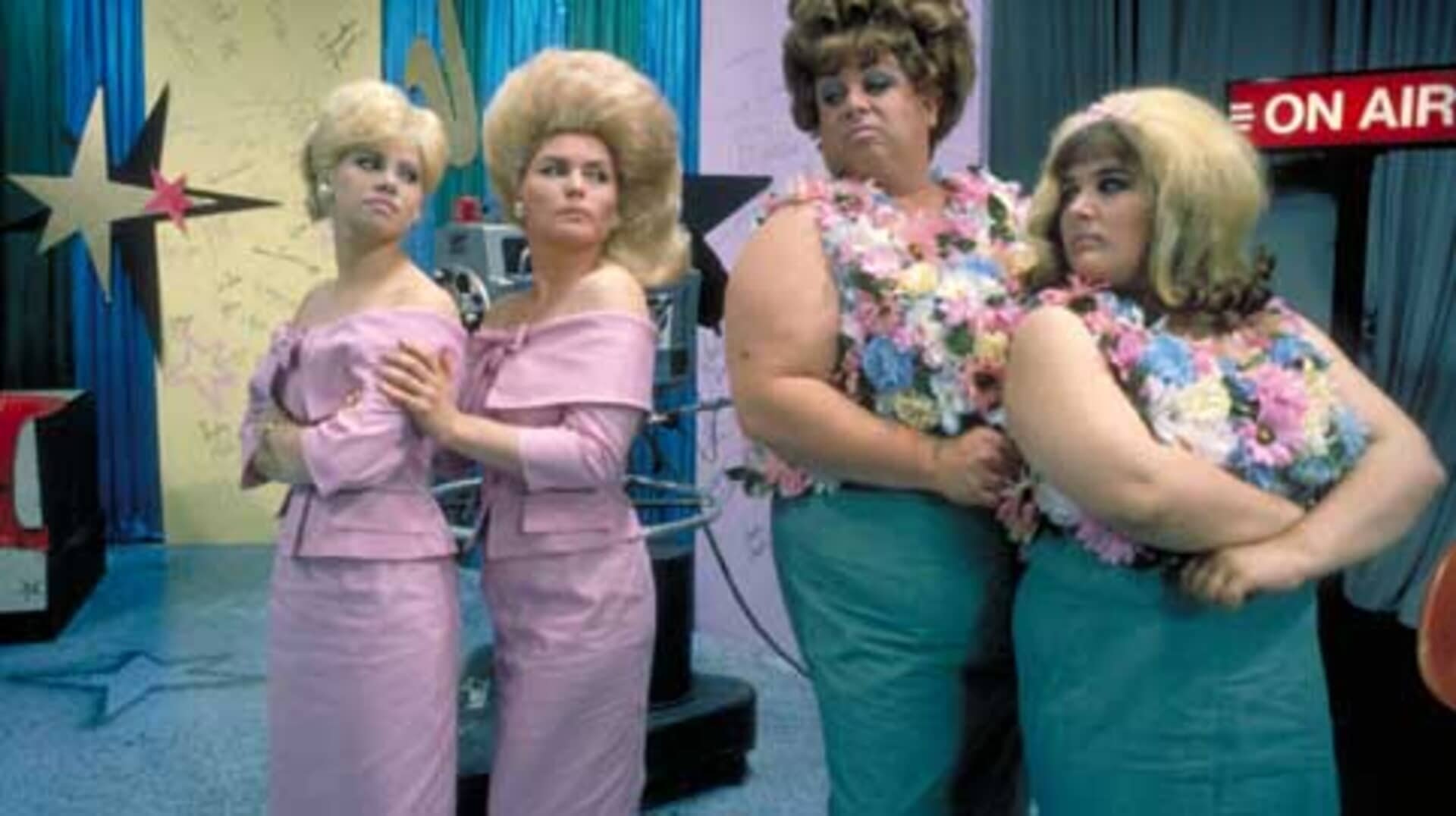
In a Twitter thread recounted by the Gizmodo article, “The 22 rules of storytelling according to Pixar,” storyboard artist Emma Coats wrote that a character should be admired for “trying more than for success.” In Hairspray, Tracy uses her popularity to speak out against injustice for others and not just for herself. She speaks up for her friends who are not allowed to dance and joins a protest against segregation over being on an episode. She is admirable in her convictions and even her hairstyles are a metaphor for Tracy’s journey and the changing times as she goes from popular tall and ratted styles to the more modern sleek styles of the latter part of the tremulant 1960s.

Source: Warner Bros

The outrageous fashion and exaggerated takes on popular hairstyles of the 60s give it the eye-catching appeal that allows you to instantly recall the feel and setting of the film. The story is told with a visual flair and an over-the-top aesthetic characteristic to John Waters’ direction. Though not digital elements, they are an example of how visuals make an impact and help us to remember a story, as discussed by Ashley Fell’s Ted Talk on digital storytelling.

Even though it is, as critic Pauline Kael noted in her New Yorker review, more of a parody of a teen comedy and not as sincere as its musical counterpart, the 1988 Hairspray is still full of heart and endearing in its universal messages of acceptance and social justice. It deserves to be remembered as much as its musical adaptation and enjoyed as an introduction to John Waters’ wild film canon.

Source: Pinterest

Design a site like this with WordPress.com
Get started