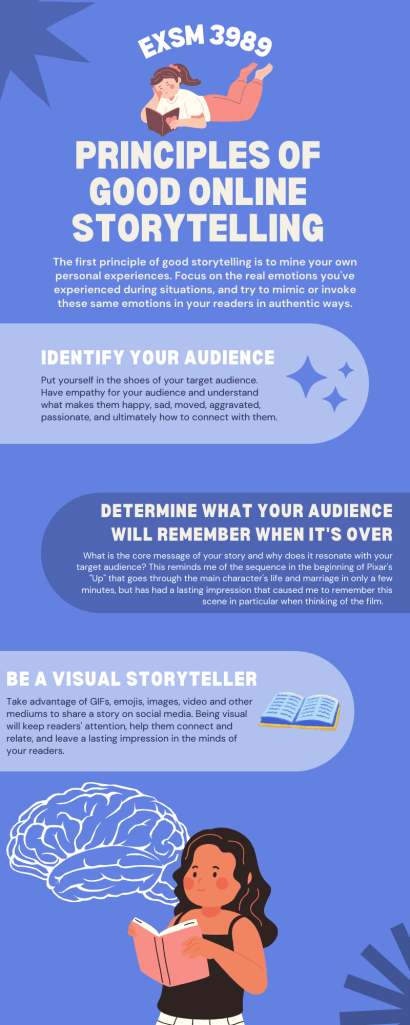
Even more importantly, in this internet-dominated world we live in, what makes a good online story?
Aside from the basics, like having structure (like a clear beginning, middle and end), writing in a captivating way, and selecting what story to tell: What are the essential principles of storytelling?
The answer lies in your audience. To connect with them, you are going to have to put yourself in their shoes, leave lasting impressions, and intrigue them with compelling visuals like GIFs, memes and images.
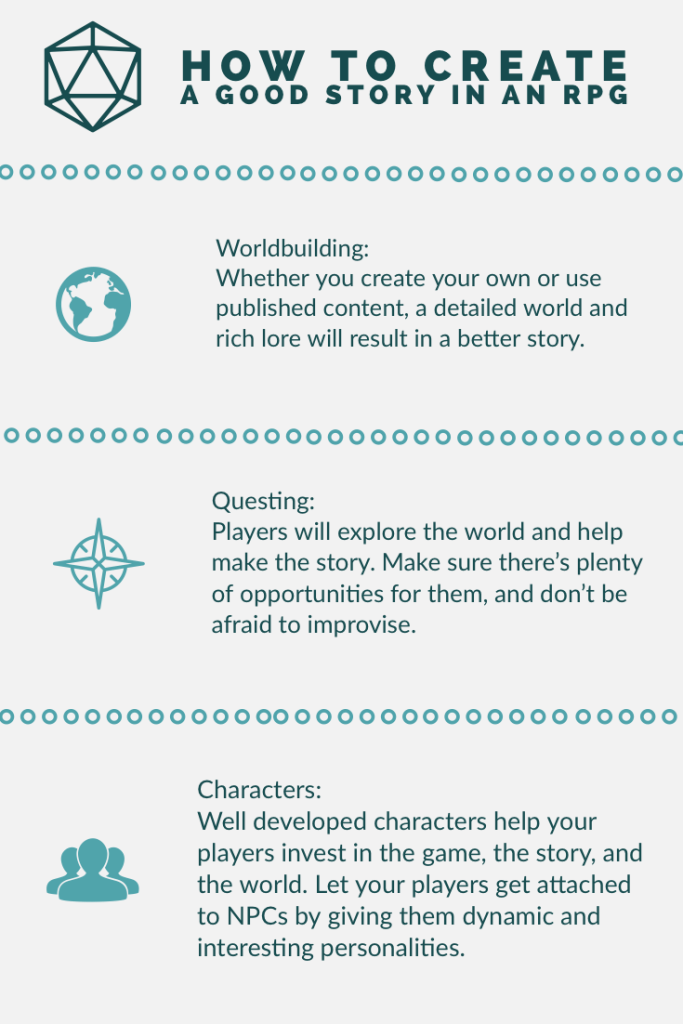
Role Playing Games are all about storytelling. As a Game Master (GM) or Dungeon Master (DM), there are several things that you should think about when you play.
Worldbuilding
Questing
Characters
If you can create a rich world, with well thought out lore and details, it will help your story come to life.
While you help tell the story, your players are the real stars. Give them lots of opportunities to explore your world. Be ready to improvise.
Well-developed characters are essential in a good RPG. Players create their own characters but they should work with you to find their place in your world. Additionally, your NPCs should be well developed and have interesting personalities. Let your players get attached to other characters and they’ll be truly invested in the game and the story.
Of course there’s more to DMing than just these points, but it’s a great place to start creating a compelling story.
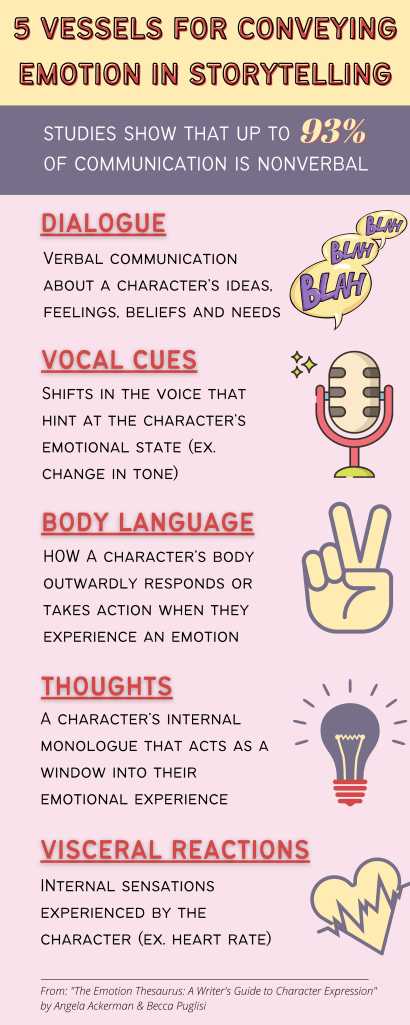
Great storytelling hinges on a storyteller’s ability to convey and evoke emotion. Emotion is at the forefront of a character’s journey, thus being an important aspect of propelling the story forward. There are no stakes in a character’s personal story without emotion. While we may perceive that verbal communication is the predominant method of communication, studies actually show that 93% of communication is nonverbal. Because of this high statistic, storytellers must ensure that their characters are expressing emotion in a multitude of recognizable ways. Below are 5 different vessels for conveying emotion in storytelling according to Angela Ackerman & Becca Puglisi in their writing handbook “The Emotion Thesaurus: A Writer’s Guide to Character Expression.”
5 Vessels for Conveying Emotion in Storytelling
Dialogue
Dialogue refers to the words a character uses to articulate their ideas, beliefs and needs. Dialogue is an effective method of revealing a character’s emotional state, but it should rarely be used on its own. Making use of verbal dialogue in conjunction with non-verbal communication is important when attempting to convey realistic displays of emotion.
Vocal Cues
Vocal cues are shifts in the voice that hint at a character’s emotional state. Examples of vocal cues are hesitations, changes in tone or pitch and words that are suddenly spoken faster. While dialogue can be manipulated by the character and words can be chosen carefully, vocal cues are harder to control.
Body Language
Body language is how a character’s body responds when experiencing an emotion. When a character experiences a strong emotion, the body’s reaction will be bigger and there will be less control over the body’s movement.
Thoughts
Thoughts refer to the internal monologue of a character where a mental process corresponds with an emotional experience. Thoughts are not necessarily always rational but they convey how certain people, places and events impact a character’s point of view.
Visceral Reactions
Visceral reactions are internal and instinctive sensations. Examples include heart rate, an adrenaline rush and light-headedness. These are the most powerful form of nonverbal communications as relying too much on visceral reactions can create melodrama and clichéd phrasings when describing them.
Further Resources
Check out Ackerman & Puglisi’s book and blog, “Writers Helping Writers”, for more great tips on character portrayal, conveying emotions, writing, and storytelling. And if you’ve got any tips for conveying emotion in storytelling, share them in the comments!
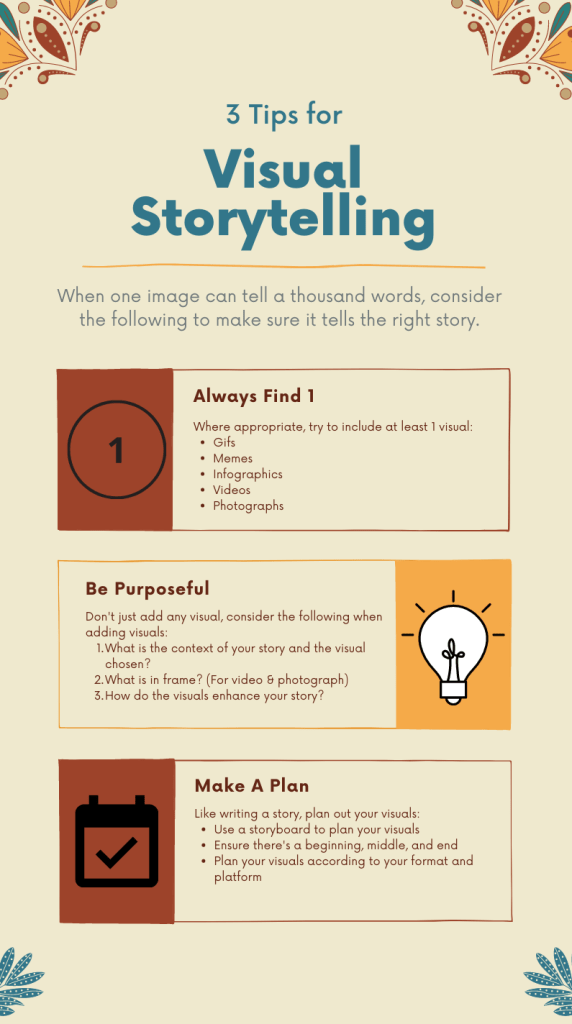
Social Media is a highly visual medium and any story told on a digital platform would be remiss to not include some form of visual. But it’s not as simple as just throwing any visual onto your Tweet. The following 3 tips are meant to guide the process of deciding what visual to use and how best to use it.
When telling a story online, be sure to consider the following 3 things:
Always find 1
Where possible, consider finding at least some type of visual to accompany your posted content. Pick anything from the list below!
Be Purposeful
Choose your visual carefully and consider the questions listed in the infographic below.
Make a plan
The visuals are part of your story so be sure to plan accordingly!
If you’re anything like me, you might struggle to create a good, compelling story! Thankfully, there are a few ways to make sure that you are able to succeed.
Some basics to rely on include:
having a theme or purpose to your story
giving your story structure
making your story interesting
Of course the basics are not limited to this list, and there are several other ways to craft an effective story and hone your storytelling skills. These three points are a good way to get started!
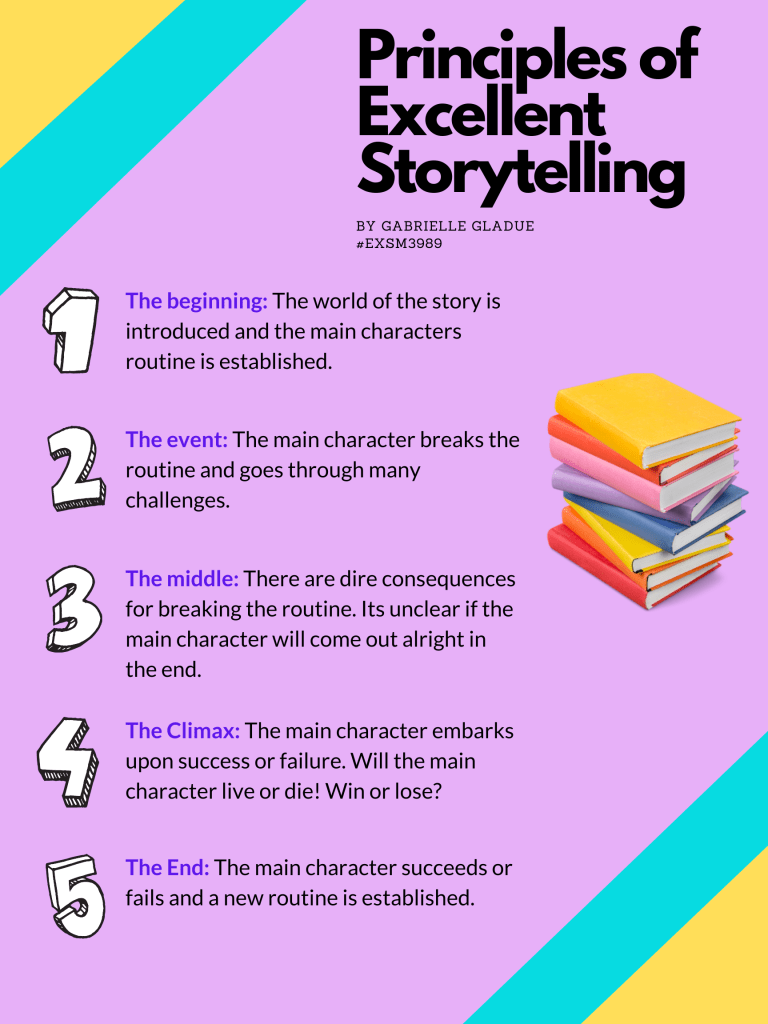
Check out the infographic below for an explanation as to why these basics are important!
One of my favourite storytelling techniques we’ve learned so far in the Digital Storytelling Class is The Story Spine.
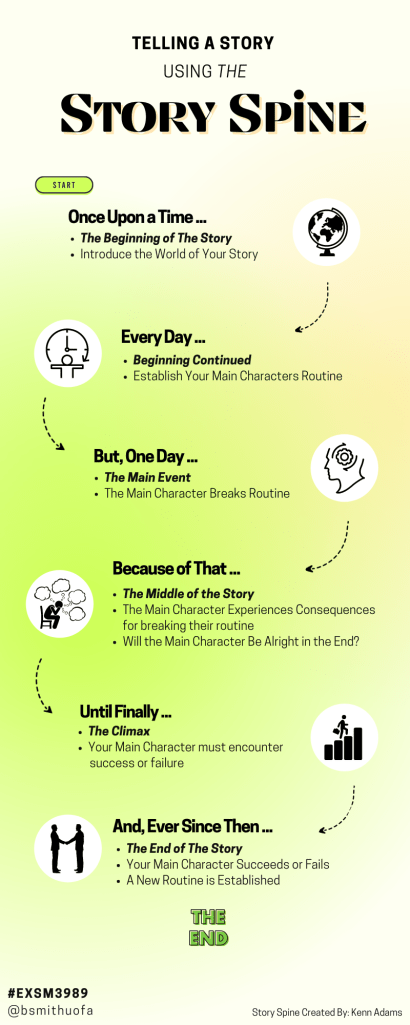
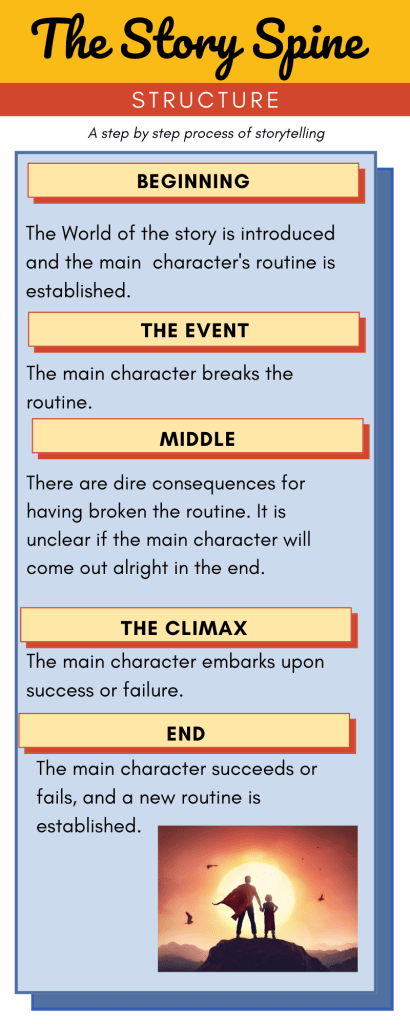
The Story Spine is a quick and easy-to-use template that literally tells you where you are in the story (the basic structure) and what should be happening at that point in time (the story function).
It’s up to you to fill in the blanks!
The Story Spine takes you and your main character on a journey from the beginning, middle, and end, to all the consequences in between!
My infographic below displays the information needed in order complete your own Story Spine.
You might even notice some of your own favourite stories utilize the Story Spine technique! It’s super fun and easy to use. Give it a try 🙂
My infographic is describing The Story Spine , a storytelling method which our class learned about in Module 2 of this course. For those of you just like me wondering what an infographic is, here’s the definition from our pal Google:
infographic [ˌinfōˈɡrafik] NOUN
a visual image such as a chart or diagram used to represent information or data.”a good infographic is worth a thousand words” · “complicated scientific information can be made more accessible by using infographics”
My infographic on The Story Spine is below. I created it using a free template on Canva, well free if I remember to cancel my 30 day trial within 30 days or they will charge my MasterCard 🙂
It put things so simply by breaking down the structure of a story and it’s function. The Story Spine is; Once upon a time….Every day…..But, one day…Because of that….Because of that….Because of that….Until Finally…. And, ever since then….
Consider your favorite story, if you trim the fat and filler you’ll find that what you’re left with are the bones of the story, the spine. I did this in my first class blog using a favorite story of mine, National Lampoons Christmas Vacation.
I liked using this tool and will look for occasions to use it again in the future!
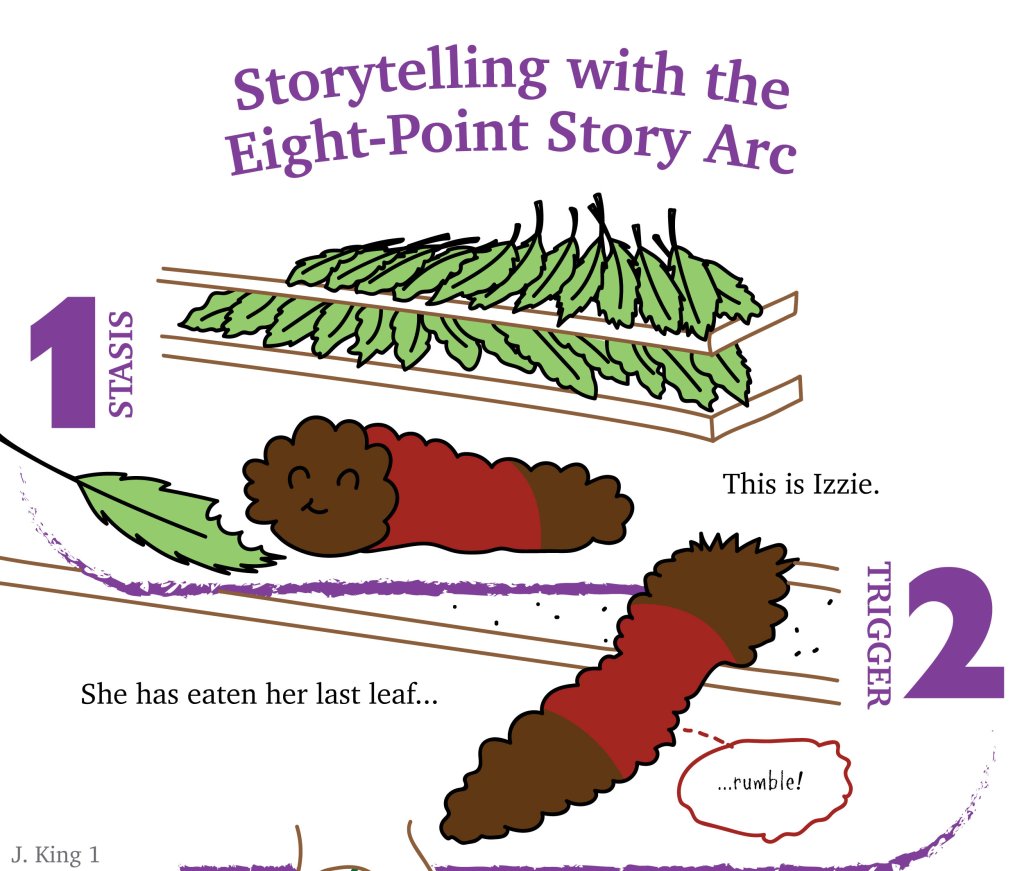
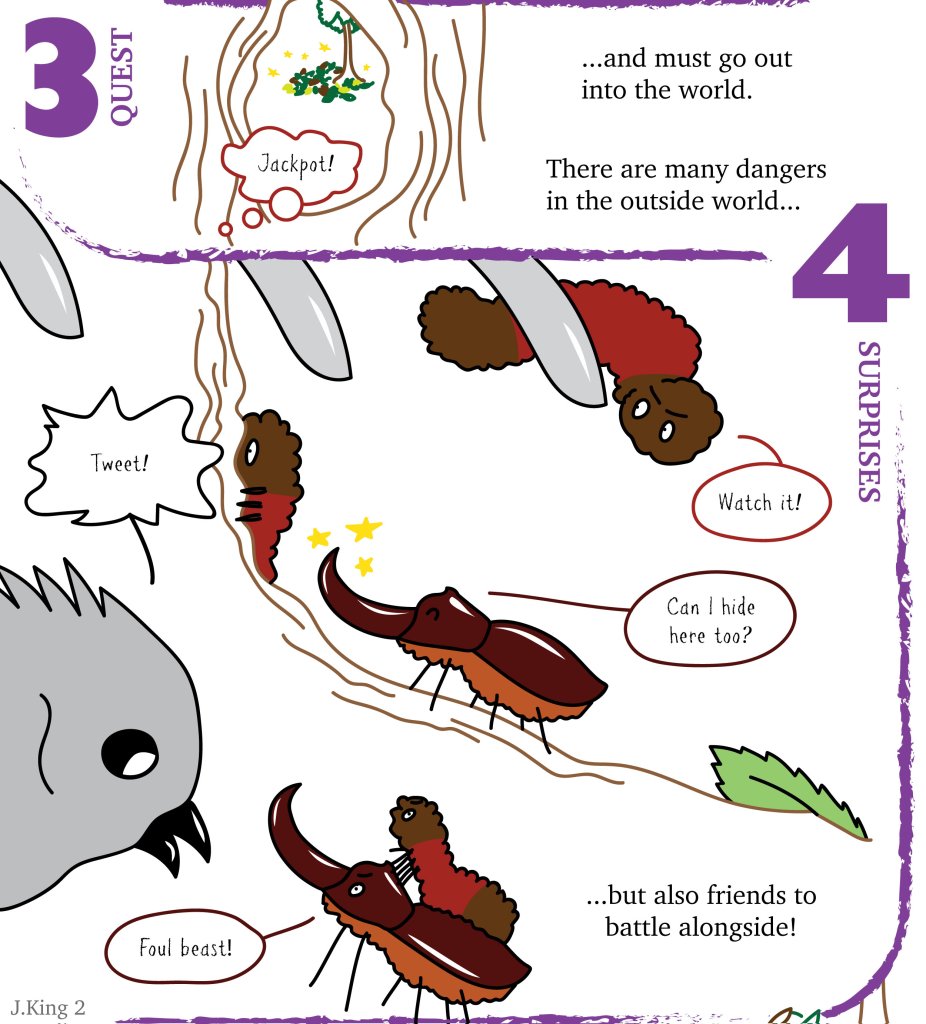
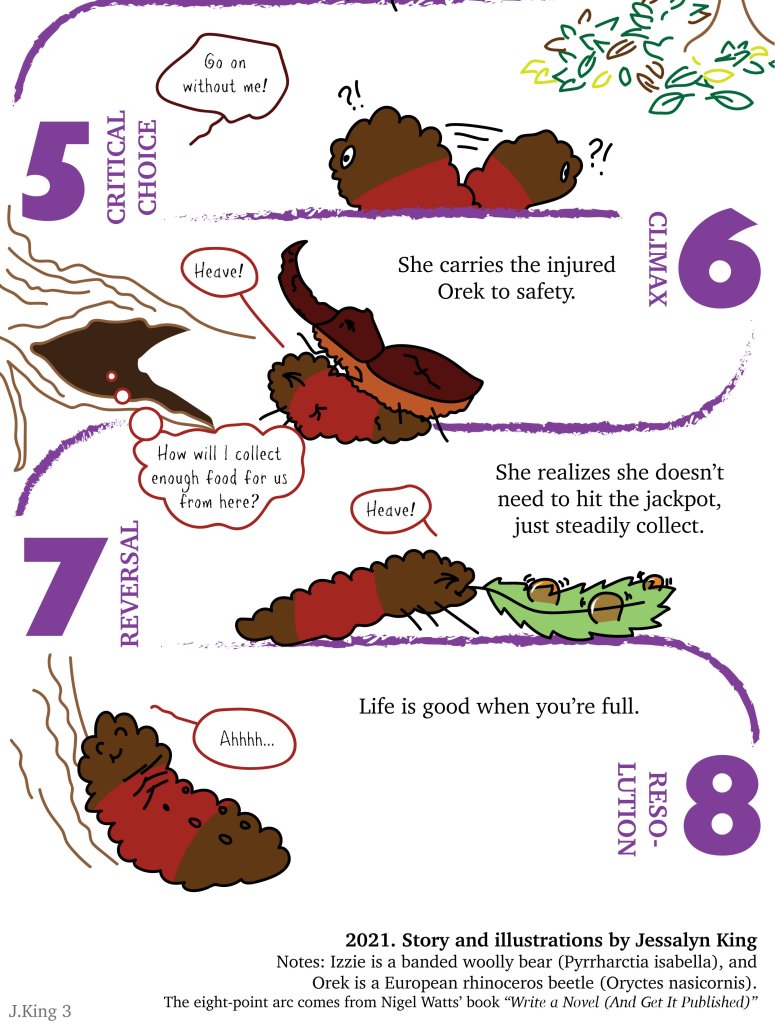
The eight-point story arc, a concept in Nigel Watts’ book “Write a Novel (And Get It Published),” introduces how a writer can bring a character from their everyday life to a new normal after having learned something.
“New normal” is one of my least favourite phrases these days! But it’s worth it for this woman.
The eight points in the arc
Stasis: this is the characters’ everyday
Trigger: something happens outside their control
Quest: they now have a purpose to fulfill
Surprise: things happen along the way
Critical choice: characters will need to make difficult decisions
Climax: surprises and choices lead the characters to a high point in tension
Reversal: characters learn from the story and become heroes
Resolution: characters find a new stasis and resolve all tensions
In the infographic below, I’ve applied the 8 steps to a simple story of two adorable insects just trying to get by in the cruel world.
Science notes!
Izzie is a banded woolly bear (Pyrrharctia isabella), which turn into the Isabella tiger moths. Orek is a European rhinoceros beetle (Oryctes nasicornis). Both are herbivorous, with Izzie eating a wide range of plants and trees (unlike many caterpillars who are very picky eaters) and Orek eating mostly fruit and sap (unlike the youth of the rhino beetles which eat vociferous quantities of rotting wood). The adorable evil bird is an American bushtit (Psaltriparus minimus), which eat insects like Izzie and Orek. Not this time, bird, not this time.
I used insect information from several sources including the following:



 EXSM 3989 - Digital Storytelling Class Blog