Categories
Uncategorized

4 Types of Storytelling

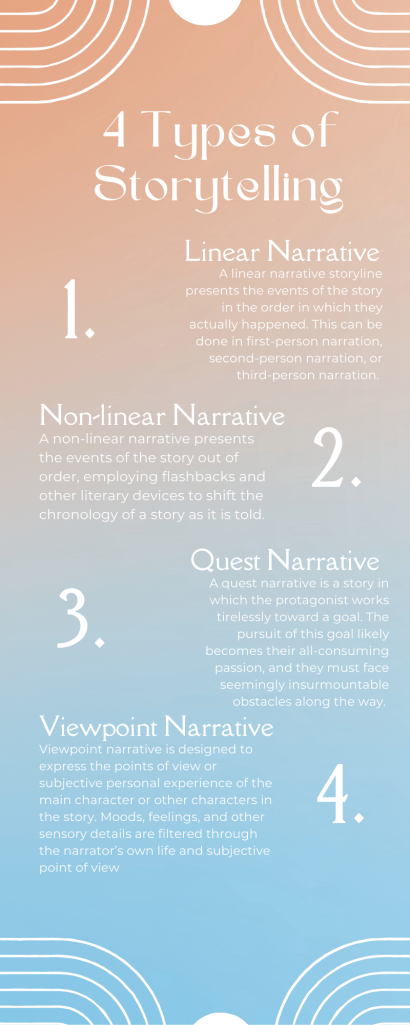
There are so many stories to tell and even more ways to tell them! No matter the type of story that you are writing, understanding the different narrating types can help you tell your story in the best possible way. My Infographic above highlights the 4 types of storytelling as determined by Masterclass.

Enjoy!

Categories
Uncategorized

Storytelling For Your Brand

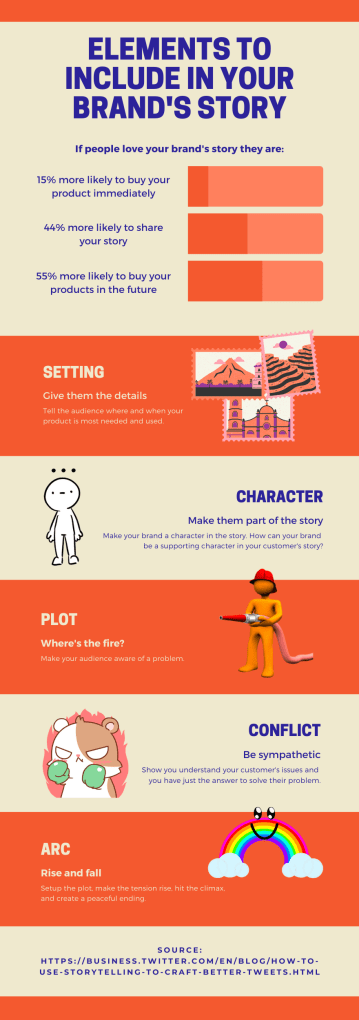
Storytelling for your brand is key to developing a relationship with your audience and potential customers. The emotions you portray and the image you establish in the mind of your audience affects their perception of your brand and products, and their decision to purchase. But how do you tell your brand’s story and create these emotions? There are five elements that should be included in your story.

Setting

This is your opportunity to set up the story and explain to the audience what your products do, when they are used and most needed and any features they have. This part of the story is really like a show and tell, where the audience gets to see the products in all their glory.

Character

Think of your product as a character in the story you are trying to tell but your audience is the main character. How does your product support the main character? How does it fit in to the main character’s story? Shifting our thinking, to how our product plays a role in the life of a customer, will help develop the remaining elements in your story.

Plot

Customers need a reason to spend their hard-earned money. Set up a problem or issue that is common among your brand’s customers. Maybe your customers didn’t even know this was a problem. But guess what? You have the answer.

Conflict

Now that we have a problem, show that you understand your customer and their needs. Create a fire and make your product the hero. This is an opportunity to show your product in action and how it can be the hero in your customers’ story.

Arc

The arc in a story creates a rise in tension, a climax and an ending. The arc adds the drama to the story and helps develop the emotion and feeling in the story. Every part of the arc is equally important to creating a story that customers become emotionally invested in. The setup, the plot, the rise of conflict, the climax and the ending, together, equally, create a memorable story that will be associated with your products and your brand.

Memorable stories with emotion and a great arc are key to engaging with your customers and creating new customers. Great brand stories drive conversions. If people love your brand’s story, they are 55% more likely to buy your products in the future, 44% more likely to share your brand’s story and 15% more likely to buy immediately. Make sure to consider all the elements when you’re creating your brand’s story. Create a setting, make your product a character, find a problem, be the hero and present it in an arc to your audience. Now, go tell your story!

Looking for more social media marketing tips, follow me at focuspocus.ca

Categories
Uncategorized

The Principles of Good Storytelling

Ever wanted to know what principles constitute good storytelling? Keep reading and find out!

Principles of Good Storytelling

Following Pixar’s Principles for Good Storytelling

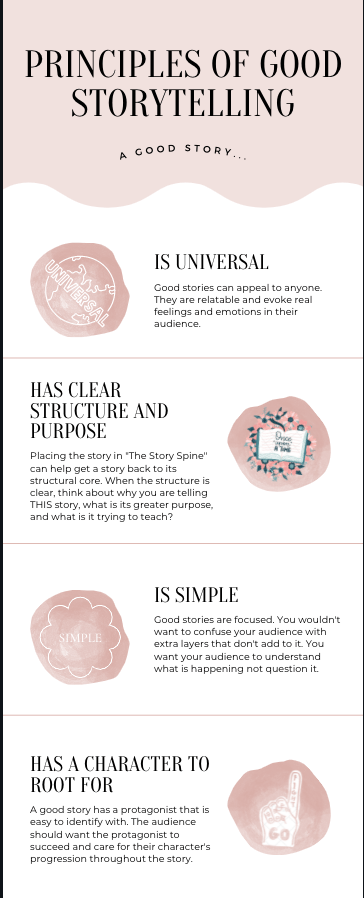
As we can learn from the above infographic, the 4 key principles, as determined by Pixar, to good storytelling are,

  • universality
  • clear structure and purpose
  • simplicity
  • a character to root for

Consider this, can we really tell a good story if one of those aspects is missing? I suppose a story can still be told… But, will it resonate with the desired audience? Will it achieve what the storyteller is trying to achieve?

The Design

You may be asking, if I am using Pixar’s principles of storytelling, shouldn’t this infographic be much more colourful? (as expected of Pixar related content)

I wanted the design to be simple (as one of the storytelling principles is). I wanted the content to speak – rather than the colours. I suppose I also wanted to mirror my own aesthetic, which is often muted rather than colourful.

Either way, I hope you enjoyed this little post and my infographic.

Categories
Uncategorized

Things to consider before telling your story

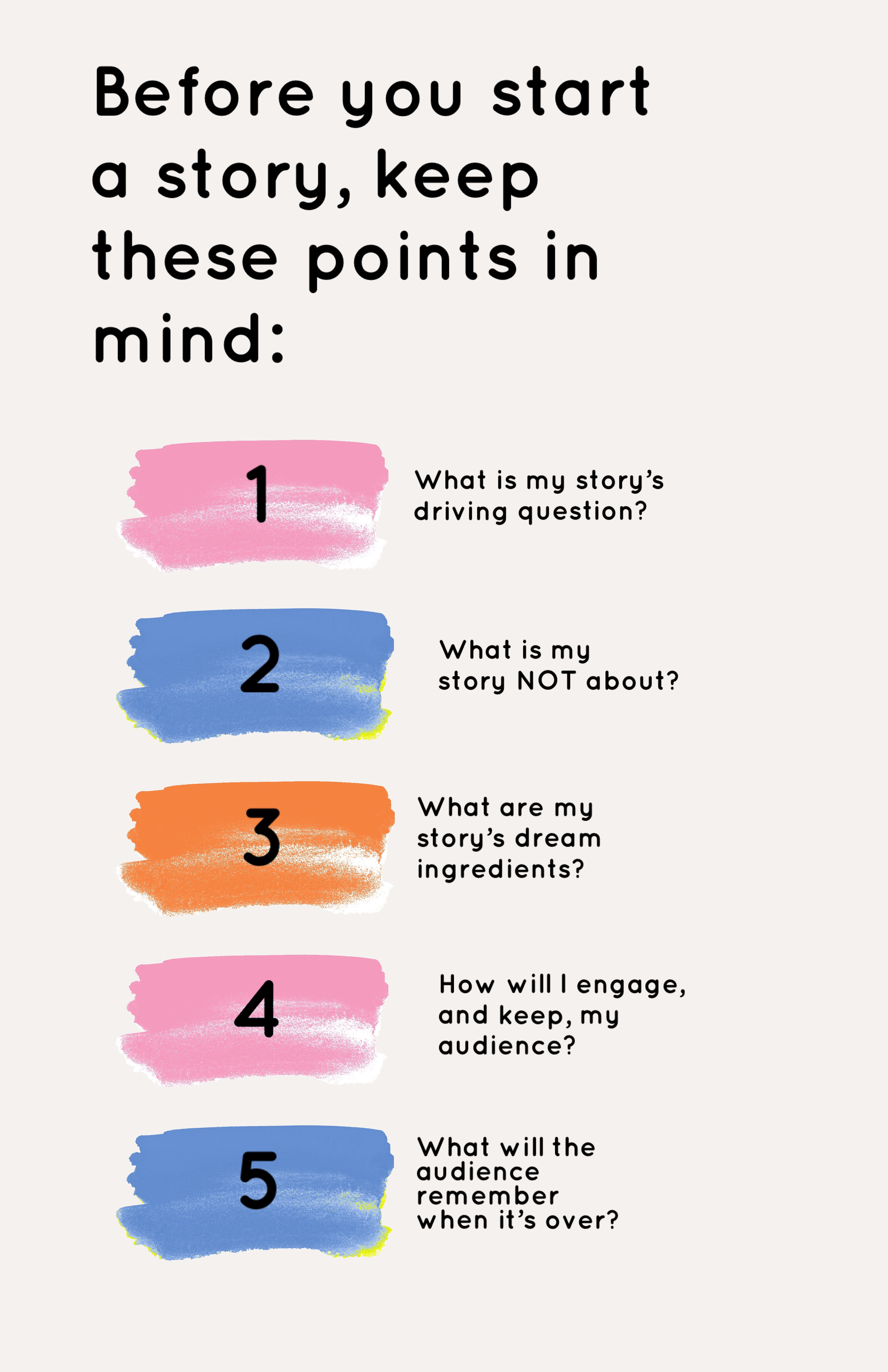
The infographic below outlines five things you need to consider at the outset of your story making process. It reflects an investment in your creative process that informs the story and guides you to its completion.

1. What is my story’s driving question?

Think of this question as a challenge to find the focus of your story. Without a clear mission or purpose for your story, you can lose focus on your message and end up challenging your reader to decipher it rather than leading them on a effortless journey. Think of what question the reader wants answered by your story and form it with the answer to that question firmly in mind.

2. What is my story NOT about?

The challenge here, before you start writing a story, is to become aware of the balance between providing a comprehensive, informative story and overwhelming the reader with extraneous details that, while relevant, distract from the central message of the story. Think of this question as an invitation to trim the fat by making a list of the details and context that will distract the reader from the focus of the story. You want to answer the driving question the reader is looking to have answered by your story, not leave them with more questions.

3. What are my story’s dream ingredients?

Another way of asking this is what elements to your story are crucial to its message. Here, you’ll want to consider any complex issues that require context. What will your story require to be memorable? How can you tie various story elements together cohesively?

This step doesn’t require that you know all of your essential ingredients in advance. A lot of those will come through the writing process. What it does, however, is assist you in forming your best story right from the start.

4. How will I engage, and keep, my audience?

This consideration is your reminder to get creative with your story and your storytelling process. Keep in mind the why of your story, your driving question. How can you make that interesting? Can a theme or thread be weaved throughout the story that makes it more compelling? Consider why your audience is here and what will make the biggest impact on them.

5. What will the audience remember when it’s over?

Focusing on what you want the audience to remember guides you in building the story. Being aware that nobody remembers entire stories, what scenes or ideas do you want to leave your audience with? What new perspective or expansive idea do you want them leaving with? Know that, and write towards it.

Categories
Uncategorized

The Essentials of Story: Classic Tips for a Digital Age

You want to tell a story that will resonate with an audience, but this has become increasingly challenging with the average online reader’s shrinking attention span. What are effective tools you can use to hold your audience’s attention and make them remember your story?

Fortunately, online stories are really not all that different from traditional ones. Both media harness the same principles to stick in the reader’s mind. See below for a handy infographic covering the main points.

Essentially, effective strategies for digital storytelling come in three key features:

Following a narrative arc, for example, the hero or buyer’s journey. Even if your story is an advertisement, audiences want to watch a protagonist (perhaps even themselves) face obstacles and arrive at a satisfying conclusion.

Evoking emotion through tactics like relatability, suspense, and emotionally-charged language. But be careful, as using emotion without nuance can make your story seem manipulative.

Harnessing visuals to hold attention. Because we are visual creatures, we process images much faster than text. Movement, colour, and vibrancy can all keep your reader engaged.

As Katy French states powerfully in her article, Why Data Storytelling Is Marketing Gold for Your Brand, “In a world where we are besieged by data but desperate for meaning, data storytelling helps connect the dots.” By harnessing classic tools for powerful storytelling, we can provide meaning for an oversaturated online audience in an ever-evolving digital era.

Categories
Uncategorized

GO BEYOND THE BASICS.

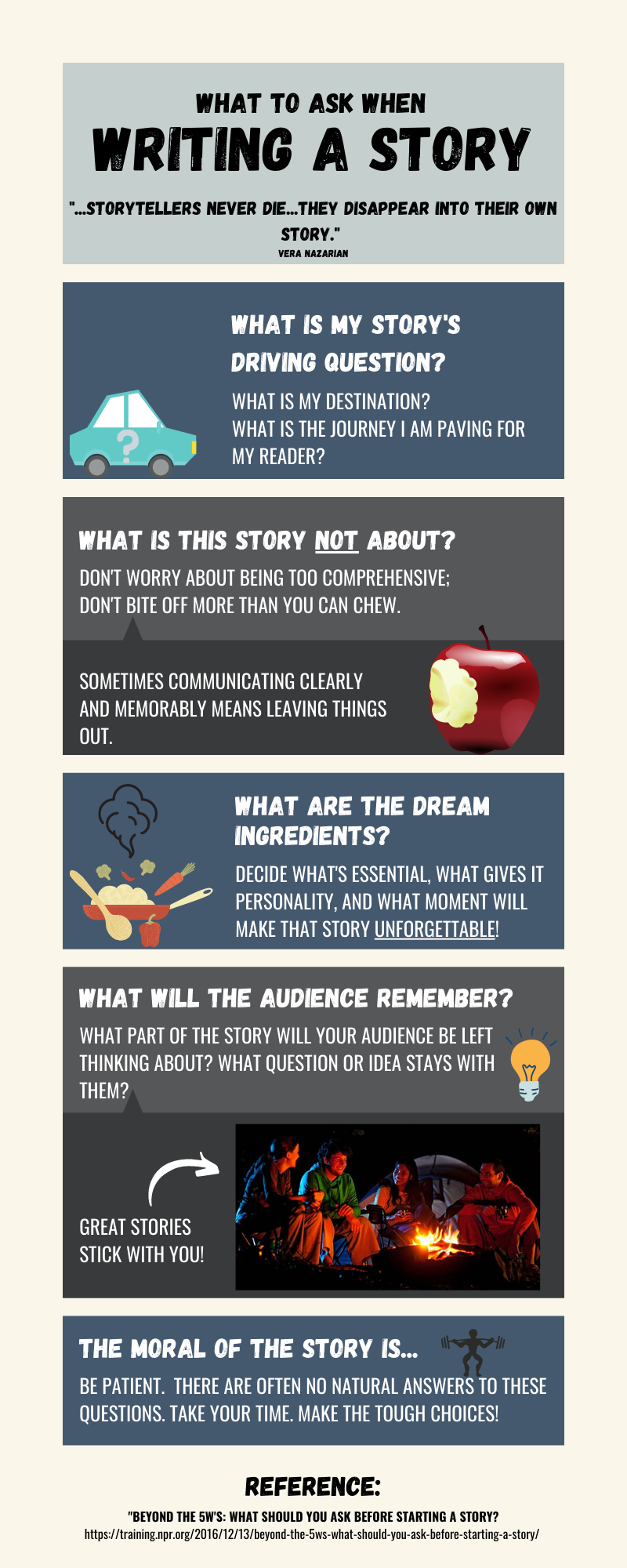
MY INFOGRAPHIC FOCUSES ON REACHING BEYOND THE 5W’S OF STORYTELLING, OPTING TO GIVE SOME ADDITIONAL INSIGHT INTO WHAT TO LOOK FOR (AND WHAT NOT TO LOOK FOR!) WHEN WRITING A STORY.

THE MORE THOUGHT PUT INTO THE INGREDIENTS, THE BETTER AND MORE MEMORABLE YOUR TALE WILL BE.

GOOD LUCK! 😊

Categories
Uncategorized

Live Tweeting my Facebook newsfeed (cause why not)

I am absolutely the last person who has any business being on Twitter (or any social media for that matter but, more specifically, twitter). Why, you ask? (Or maybe you don’t but here’s an answer anyway)… because I like to fade into the background where I’m not seen or heard, to be invisible. Never been interested in sharing my opinion or risking being seen as controversial or worse, divisive.

But more than just that, it’s about me being a meaning making machine, moreso than is natural for most of us. I’ll attach meaning about myself to reactions and comments that only exists in my mind and give that power over my mood and my outlook… I’m working on this, relentlessly… In fact, if I really thought about why I ended up in this course, it probably has a lot to do with wanting to challenge that fear in some small way. And it is a fear, one that no longer serves me or aligns with who I wish to step into being.

So maybe that’s where this attached twitter story originated from. Who really knows? At one point, when I embarked on creating it, I just thought I was desperate for story ideas and settling. Mighta been a little bit of both.

My idea was to share snippets of my Facebook newsfeed along with my thoughts on what I was sharing. It started out with the use of a hint of sarcastic humor in inviting the reader into the story. I tried to be engaging in the random thoughts that accompanied the screenshots of the posts. And it ended with a bit of self deprecation, giving a tinge of insight into my inner world.

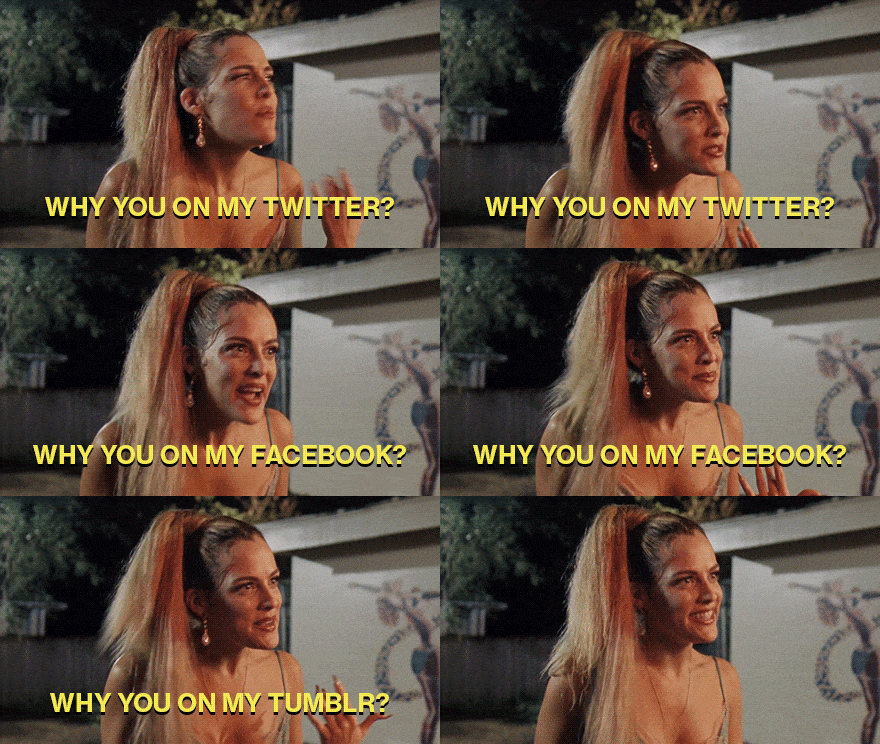
I would never of course but this gif does reflect my feelings about much of what I see social media being used for.

Categories
Uncategorized

Where this fairytale ends, a revenge thriller begins.

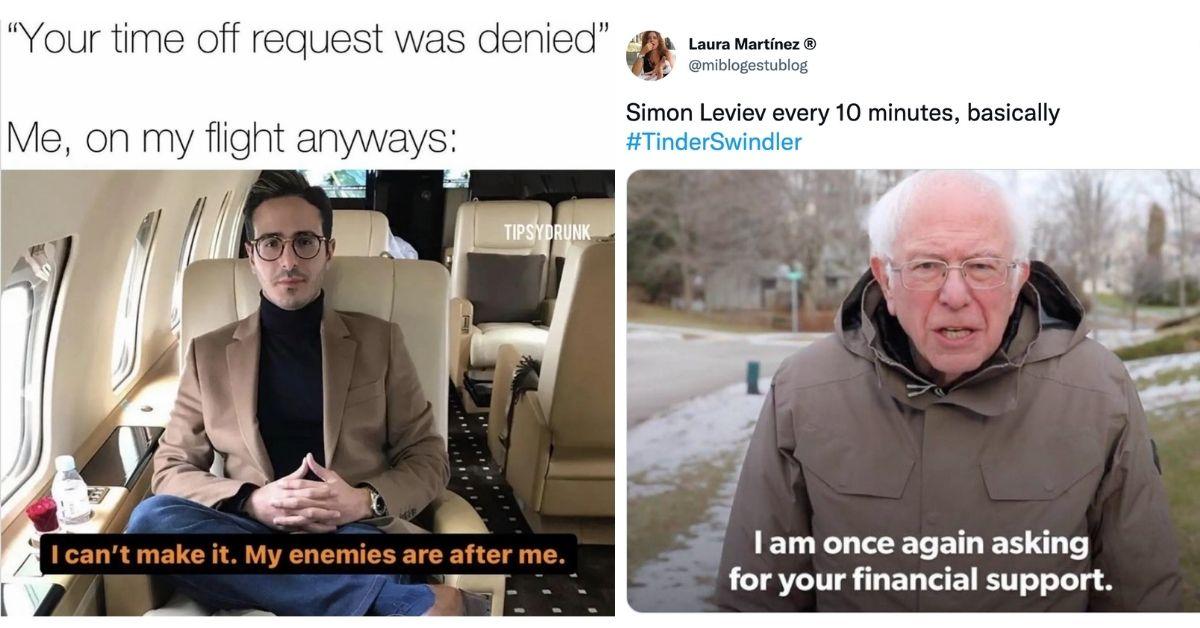
By now, I’m sure you have all heard about – or at least seen the memes – of the infamous Tinder Swindler. The Netflix original documentary shares the story of a group of women who were the victims of a dating app-based swindler posing as a wealthy, jet-setting diamond mogul.

The story left me with a mix of emotions, shock, awe, frustration, humour – all mixed in a one-hour and 54-minute documentary. The story left me with a mix of emotions, shock, awe, frustration, humour – all mixed in a one hour and 54-minute documentary. While the story continues to unfold in front of our eyes, with the story’s villain, Simon Leviev, claiming his innocence, the documentary combines true crime and a familiar dating app to portray an all too relatable story.

From the beginning, readers are attracted to the romance, mystery, and relatability of a modern-day love story. Referencing The 8-Point Story Arc, the Twitter thread’s statis provides a familiar landscape that readers can identify – swiping on Tinder; a setting that over 75 million monthly active Tinder users can relate to.

As noted in Nick Reese’s article, How to use storytelling to craft better Tweetsthe almost two-hour documentary is now into digestible chunks by breaking the storyline down into a twitter thread. 

Following topics conveyed in Victoria Smith’s Ted-Ed video How to make your writing suspenseful, the Twitter thread follows the documentary’s cliff hanger ending – suggesting that the story is not over yet and encouraging the readers to want to learn more.

Categories
Uncategorized

20 something date

We could write a Twitter story about anything really and I chose a strange date I went on in my early twenties. Not sure why it popped into my head but my friends always remember it as a funny one.

Read the whole thread here:

My story in summary is about a date that didn’t really go as expected for me. A young man named Breton met up with me at a restaurant downtown. He suggested that we each order something and share our food. When we got our dishes, he weirdly decided not to share with me. After dinner he asked me to go get some tea with him. Wanting to talk to him a little more I agreed. I like coffee shops, right? Instead of heading to a hip café we start walking towards apartment type buildings and I realize I am going to his place. This kind of behaviour isn’t me and I’m a bit scared and feeling mislead. When we get to his place he tries to kiss me at awkward times, he tries to sing to me to impress me and ends up crying hysterically when I decide to leave. It all comes crashing down on me and I’m thankful I wasn’t murdered by a man named after a cracker.

I used tactics I have learned in the course for my story. I tried to evoke some suspense, emotion, and be relatable to the audience. The story has a clear beginning, middle and end but also applies some short story points from the 8 point story arc.

Stasis: The young 20-something is introduced, hoping to find love

Trigger: She decided to go on a new dating platform

Quest: She sets off on her date with an open mind

Surprise: The date ends up being very strange and doesnt share with her. he leads her to his apartment without warning.

Critical choice: The young lady is scared but decided to stay

Climax: the man tries to kiss her without warrant and serenades her in a desperate attempt at love

Reversal: The character musters up the courage to leave the situation and the date cries hysterically.

Resolution: The character vows to stay off dating sites for a while.

Categories
Uncategorized

A Bedtime Story

Bedtime in the Watson household. Not my favourite time. I live-tweeted bedtime tonight because instead of me handling my boys’ bedtime routine, my husband did the bulk of it while I got to take a breather. It allowed me to see it as a story featuring my favourite characters, and when it comes to finding a simple universal story to tell, who can’t relate to kids who don’t really want to go to bed?

My husband and I parent well together, but I as a work-from-home mother, I would definitely be considered the primary caregiver in our household. It’s a dynamic that works well for our family, but by the time bedtime rolls around, Mom’s exhausted. Dad gets home from work with fresh parenting legs at 6:30 and we put our young children to bed at 7:30 when the big guy has Kindergarten in the morning, so bedtime is Dad’s time to shine!

Using a Twitter thread, you can see a clear beginning, when Dad calls bedtime, a long drawn out middle where my sons delay going to bed for over an hour, and then and ending where they lose a high-stakes wrestling match and finally go to sleep. Yeah, I said a wrestling match. Check out the story here:

The 8 Point Story Arc

Tonight at bedtime, my husband got the boys to brush their teeth and get their pyjamas with only a minimal struggle. This is our stasis. Our everyday life. Then, when it came time to tuck them in, our 3-year-old couldn’t find his security object – his “Stinky pillow.” It’s this little cuddle pillow with baby Dumbo on it that he has had since he was born, and he has not spent a night with out it. “Stinky” missing is our trigger. And man, is it ever a trigger. It’s a trigger from a storytelling standpoint, and for a 3-year-old’s meltdown.

So begins our quest. The quest for “Stinky pillow.” Dad and the boys look for the pillow, but can’t find it, so I go to look for it. In the meantime (surprise!) Dad and the boys have a wrestling match before bed to try and take the little guy’s mind off of his missing pillow while I look for it. I get annoyed that my husband is wrestling with the kids at bedtime and getting them riled up instead of doing relaxing things (like, I don’t know? Read a bedtime story?!) and walk away to calm down. I collect myself and remind myself that bedtime is Dad’s time to do things his way.

Then I hear my 5-year-old doing his ring announcer voice. He introduces himself and his little brother as the “Brothers of the Instructions” rather than the “Brothers of Destruction.” That’s The Undertaker and Kane, by the way. Thinking of my 5- and 3-year-old sons being associated with anything to do with instructions gets the better of me, and I start laughing. My son thinks I’m laughing AT him, so he gets mad at me. My husband knows why I’m laughing, so to avoid explaining something my son won’t understand, he says “if Mommy won’t stop laughing, she has to be the referee for the next match.”

I agree on the stipulation that if Dad wins the match, it’s lights out. This is my critical choice. And once I wouldn’t always make. But tonight I did. In our story’s climax, the boys decide that it’s a fair stipulation, and even though it is now way past bedtime, and I would usually be irritated that everyone is still awake, I join in and play with my family. Of course, in our reversal, Dad “wins” the match, and the boys finally agree to go to bed. I am then left to reflect on how grateful I am to have my husband handle bedtime, which is my resolution.

Design a site like this with WordPress.com
Get started