Categories
Uncategorized

Five Tips for Digital Storytelling

So you want to tell a story using a digital medium. Where do you even start? With these five handy tips, of course!
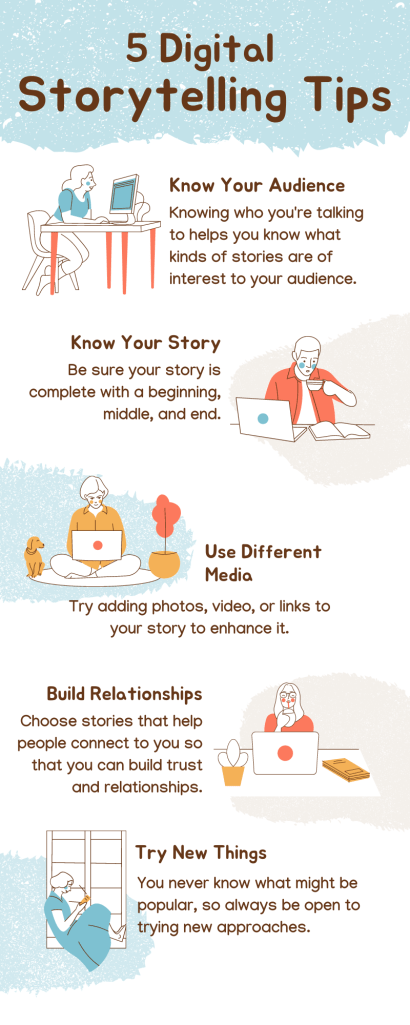
These are five basic tips that apply to all digital stories you might want to tell. Here are some elaborations on the points made in the infographic:

1. Know Your Audience

It’s important to know who you’re talking to when telling a story. What kind of stories does your audience like? How do they like to be told them? How are they likely to react? Being able to answer these questions will allow you to tailor your story so that it’s received by the people you want to reach and ensure that it drives you outcome you’re looking for.

2. Know Your Story

Meandering conversations can be enjoyable with friends over coffee, but when you’re vying for the attention of the online masses, knowing what you want to say and how you want to say it is important. Make sure your story is well structured with a beginning, middle, and end, and that it fits with the platform you’re using to tell it. There’s nothing worse than writing a great tweet only to discover you need four extra character spaces.

3. Use Different Media

This blog post wouldn’t be half as interesting without the infographic in it. That’s because different ways of presenting information catch our attention, and visual information is absorbed much more quickly than text. So be sure to play around with what formats you put your story in. Think a podcast might be a good medium? Give it a try! Have the perfect gif to convey how you’re feeling? Use it! Don’t let standard text limit how you express yourself.

4. Build Relationships

This one is a bit tricky. The point of telling stories online is to forge a connection between whoever’s telling the story and whoever’s taking it in. That way, you can build familiarity, trust, and even friendship between you and your audience. With this, you can become a respected authority on your topic of choice and position yourself as your audience’s go-to for information, products, advice, or whatever it is you provide. So make sure to choose stories that make things personal so that people can relate to them, and thereby relate to you.

5. Try New Things

It’s comfortable to stick with the tried and true, but don’t be afraid to venture into the unknown every now and then! Whether there’s a new format available on a social media platform, or whether you just want to try telling a different kind of story that day, experimenting is the best way to find new methods of expressing yourself and engaging your audience. You never know if something will work until you try it, after all.

Now that you’re equipped with these tips, go out and try telling some stories! Practice makes perfect, but keeping these basic principles in mind will give you a direction to start in.

Categories
Uncategorized

Ways to use digital storytelling to advertise your brand

Photo by Pixabay on Pexels.com

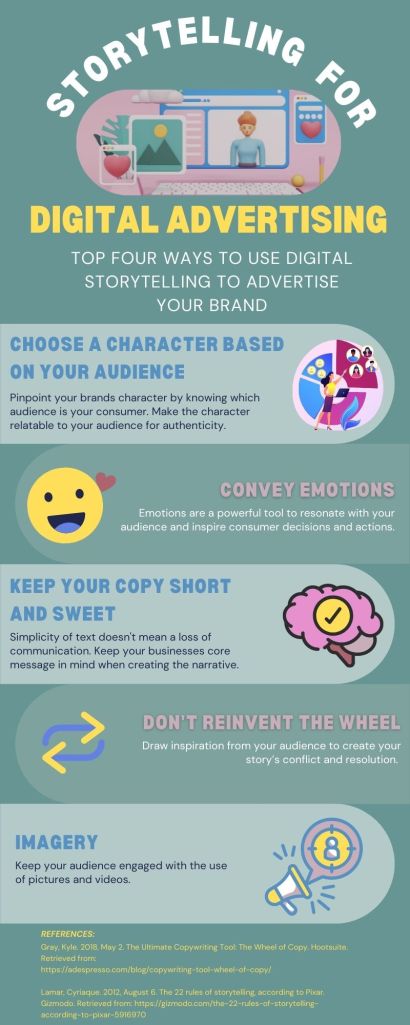
For centuries storytelling has been a way to connect with others. Graphics can be found at archeological sites and caves to tell historic tales. Elders bonded with youth via storytelling passing on their wisdom and language.  Storytelling has no doubt changed over the years as digital platforms allow businesses to connect worldwide with their audience. If you’re a business owner wanting to connect with your audience digitally via storytelling but don’t know where to start don’t fret, I have put together an infographic of the tops four ways (in my opinion) to utilize digital storytelling for your ads. So, you will swim rather than sink so to speak. This article will go more in depth as to why they are my key points to include in your thought process.

#1 Choose a character based on your audience.

Pinpoint your brands character by knowing which audience is your consumer. If your audience are children, then a cartoon character is suitable, but it is not transferable to an adult audience. The character you choose also has to fit the narrative you want to sell. If it is adventure you are selling than someone outgoing, tanned and toned will give authenticity to the story as they will look experienced in the outdoors. I myself am a soon to be Mom I don’t want to be sold a breast pump by a male, when I go into a Buy Buy Baby I want to speak with an older female sales staff such as an experiences grandma for tips and tricks that are tried and true. Thus, the main character in your story needs to be relatable to your audience for authenticity.

#2 Convey Emotions.

Emotions are a powerful tool to resonate with your audience and inspire consumer decisions and actions. There is a wide spectrum of human emotions to depict in your storytelling and evoke from your audience. No matter which you choose to portray bear in mind the tone in which your story will be perceived by your audience. For more ideas on emotions to use for your brands marketing strategy please read this article by Hootsuite https://adespresso.com/blog/copywriting-tool-wheel-of-copy/

#3 Keep your copy short and sweet.

Keep your audience engaged with the use of pictures or videos. The infographic I created for the purposes of this lessons is a prime example. It had condensed text that still got my message across and the use of illustrations to be eye catching and engaging. Even though this blog article expands on the topic and this contains more text, it is still pleasing to the eye as there are breaks in the text with graphics.

#4 Don’t reinvent the wheel.

The fundamentals of storytelling do not differ from traditional story writing you learnt academically when changing to media advertising. Your story will still need a conflict and resolution to keep your audience’s attention. Don’t spend hours of brain power conjuring up ideas for your story, draw inspiration from your audience to create your story’s conflict and resolution. What is a conflict in your audiences’ life and how can your product or service aid them in resolving the issue at hand?

I hope you find this helpful to get your storytelling ideas percolating for your next campaign!

Categories
Uncategorized

The 5 W’s of Storytelling

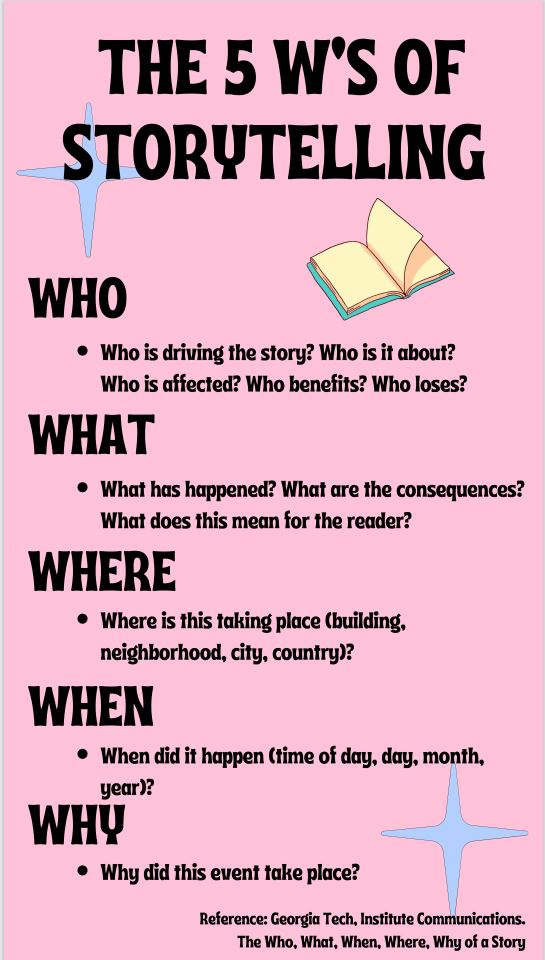
All stories need the 5 W’s to help answer the audiences questions.

The Who, What, Where, When and Why?

The “Who” is usually the main character of the story. This helps tell the audience who we will be following.

The “What” is the event of the story that is causing everything to happen, i.e. a plane crash.

The “Where” is where in the world is this taking place? This sets the scene for the audience, i.e. the library, in outer space.

The “When” is when in time did the story take place, i.e. the 1950s.

The “Why” is why did this take place? Give a bit of back story to the audience to help understand the character and what is happening makes sense.

Going back to the basics helps make sure you aren’t missing any key information the audience may need to fully understand the story.

Categories
Uncategorized

Fishing for a Good Story

When thinking about how to tell a good story, there can be a lot to remember. Good stories have a clear structure – a beginning, middle and end. Good stories answer the 5 Ws: Who, What, When, Where, Why. Good stories have a purpose, a conflict, a character, the list goes on and on…

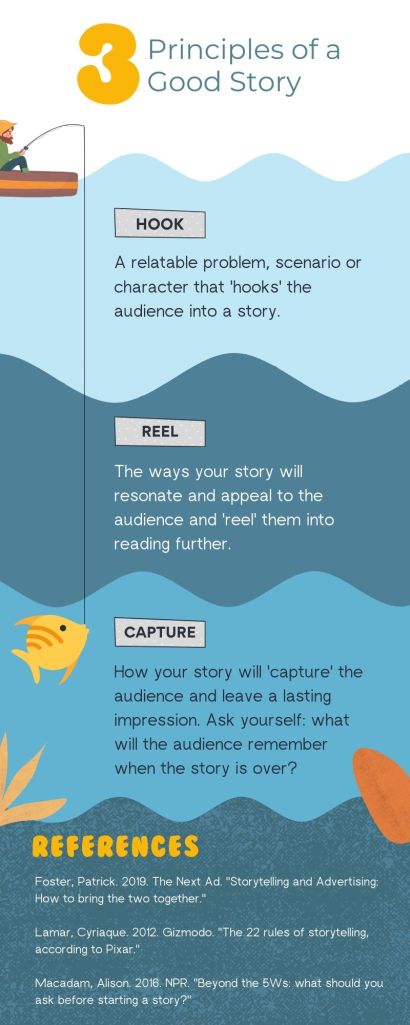
But knowing how to tell a good story can be as simple as knowing how to fish. All you have to do is remember these 3 principles: hook, reel, and capture.

3 Principles of a Good Story

Hook

We live in a world where access to information is quick and attention spans are short, so every good story must have a hook to attract your audience.

In some stories, the hook is a character to root for. As Emma Coats shares in The 22 rules of storytelling, according to Pixar, characters are the heart of many good stories because they give an audience someone to admire and challenge so they have a “reason to root for the character”.

A hook can also be a mission or puzzle, or even a problem that needs to be solved by the audience. Your story then presents a journey for your audience to discover the solution.

Reel

After you’ve hooked their attention, you need to reel your audience in so that they stay engaged with your story.

Alison MacAdam in Beyond the 5 W’s recommends asking these questions when developing your story:

  1. How can you illustrate it in a way that’s interesting?
  2. [Is there] an emotional or intellectual thread that can run throughout the story?
  3. Are there ear- or eye-grabbing ways to attract the audience?

Whether it’s adding emotional elements to resonate with your audience or captivating visuals to catch their eyes, find ways to keep your audience engaged while they read your story.

Capture

Good stories capture an audience and leave a lasting memory. Patrick Foster in Storytelling And Advertising: How To Bring The Two Together states that a good story is “a compelling story; one that reaches the heart of the consumer and evokes a feeling or a memory.”

When a good story is told, audiences remember and often act.

If your story introduces a problem-solving product to a target audience, telling a good story can mean that the audience remembers your brand and even purchases your product.

Let’s Go Fishing

Telling a good story is hard work, which can also be said about fishing. But if you remember the 3 simple principles of hook, reel, and capture, your work becomes a little bit easier.

Categories
Uncategorized

How to Tell a Great Story

Based on the article by Carolyn O’Hara

Stories are for telling, whether to exchange knowledge or entertain. Each person has a story to tell, be it fiction or based on true events.

Sharing stories has been an art and a way for safeguarding our history (or fiddle with it) for millennia. Stories let express our opinions and emotions about our surrounding, but also unleash our creativity.

In this blog, I summarize the article titled “How to Tell a Great Story” by author Carolyn O’Hara, published in 2014. Although Carolyn focuses on how to tell a compelling story in a business context, I try here to take the learning and generalize them to any storytelling form and context.

At the end, I add an infographic to summarize these learnings and tips, in case you would like a visual brief summary.

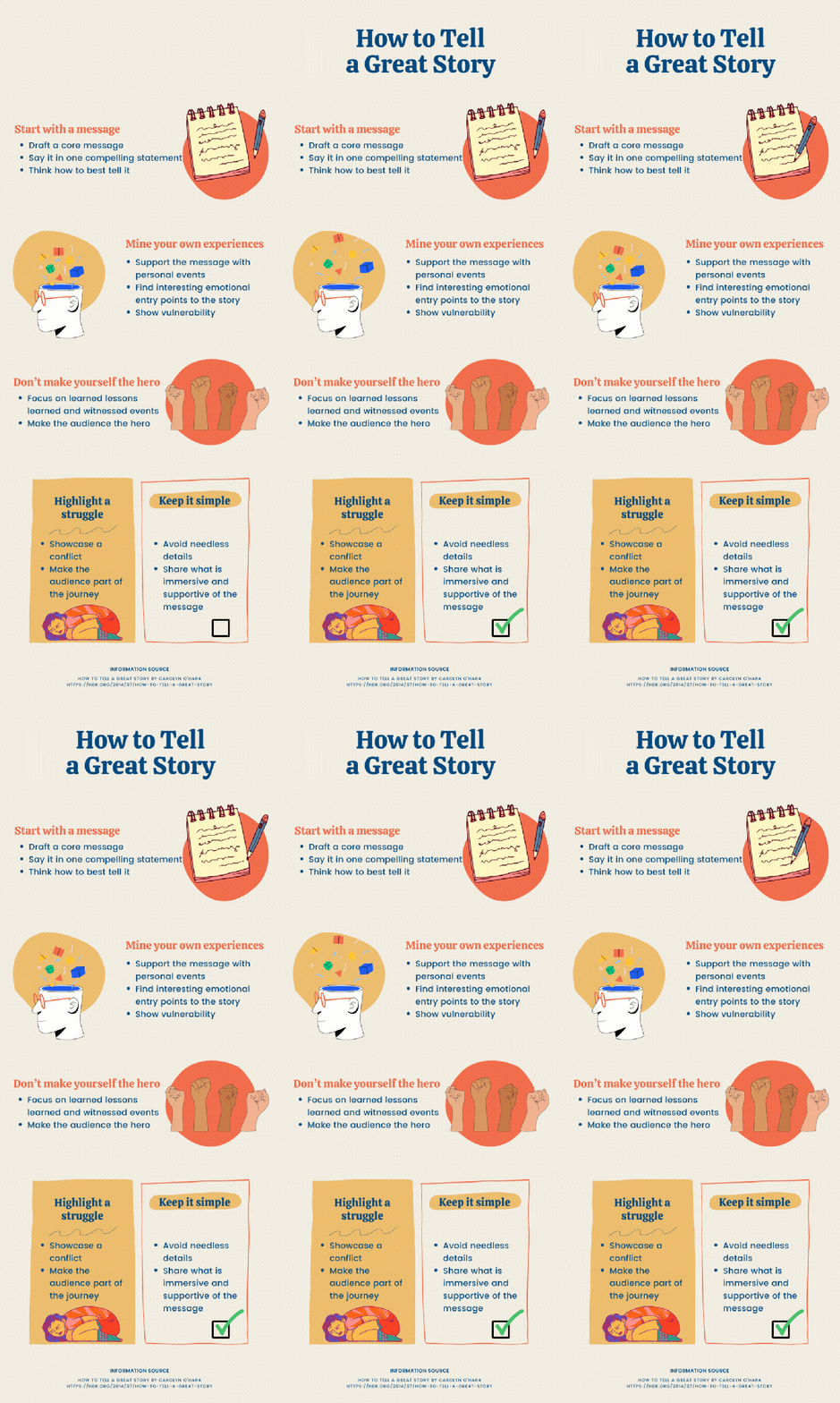
 Stories create long-lasting memories and evoke emotions that are way more powerful than graphs and reports alone! Here’s what Carolyn suggests to tell a successful story, in 5 brief and practical tips.

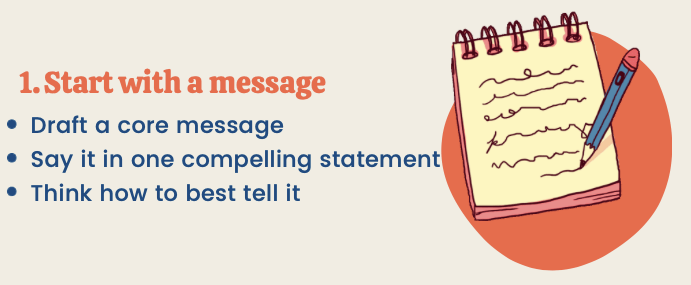
If not the most important element of any story, it is one of the most important: the moral of the story! What message are we conveying to the audience we are engaging? And how can we ensure the engagement is successful? According to O’Hara, each decision about your story should flow from those questions.

It is crucial for your story to be able to state its core message in one single compelling statement.  “Beyond the 5Ws: what should you ask before starting a story?” is a great read by Alison Macdam exploring the additional questions one should ask when writing a compelling story. An awesome summary of the article is in the image below:

Print this poster out! Here’s a PDF. (Illustrations by Chris Kindred)

Now how to make the story relatable and engaging? The following section got some tips on thay!

According to Plymouth University associate professor, Julie Parsons and Senior Lecturer in Education, Brunel University London, who recently examined our interest in reading about people’s experiences during the pandemic, this behaviour is part of our genetic make up as a species. Our stories are shaped by engaging with others’ stories and experiences. According to the author, this is an active type of exchange allowing us to make sense of the world around us. “We’re always looking to the Other because we’re storied beings – because we make sense of our lives in relation to others,” according to Chappell.

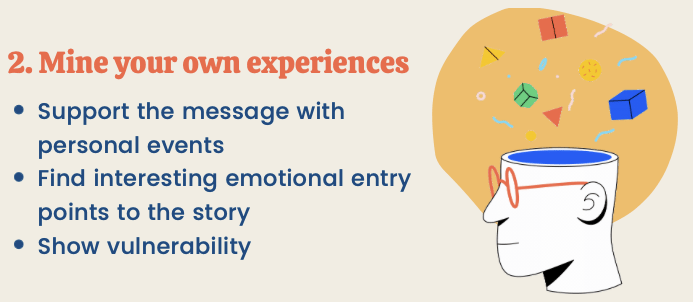
O’Hara suggests asking ourselves: What events in our life make us believe in the idea we are trying to share? These emotional entry points, be it a struggle, failure, and barriers overcome add a layer of authenticity and relatability to the story. “The key is to show your vulnerability”.

But in doing so, another challenge arises: falling into the faux-pas of portraying oneself as the hero! What should the focus be instead? Next section talks about that.

Let’s not confuse being the hero if the story with being the central figure!

The main focus of the story and the engaging component should be “lessons you’ve learned, or events you’ve witnessed.” says O’Hara. Not only that, but to get that extra engaging element, strive to make the audience the hero! According to the author, this would improve engagement and buy-in, thus contributing to the story’s success. And nothing steers interest like a struggle. Why? Keep reading!

Now that we have the compelling message and moral of the story all figured out, supported by a bouquet of lived experiences, are we done? Nope! According to Aerogramme Writers’ Studio’s “Back to the Story Spine” an important element of the story spine is “But, one day”! What does mean? A conflict, a challenge, a routine break! A highlighted struggle will make the story relatable and believable! Who hasn’t struggled before? And it’s always rewarding to be part of the solution process; part of the journey!

What’s the final tip to making your story great? Keep it simple! Drama and twists are always fun, but overdoing it might be a big turn off! I always ask myself I delete this or that detail, would my story be impacted? And would the experience be less engaging or entertaining! I the answer is NO, saying goodbye is then easy! The main purpose to focus on what is immersive and supportive of the message!

A summary infographic of the 5 tips

Categories
Uncategorized

Kelly’s Recipe for Scrumptious Storytelling

Kelly D Morrison

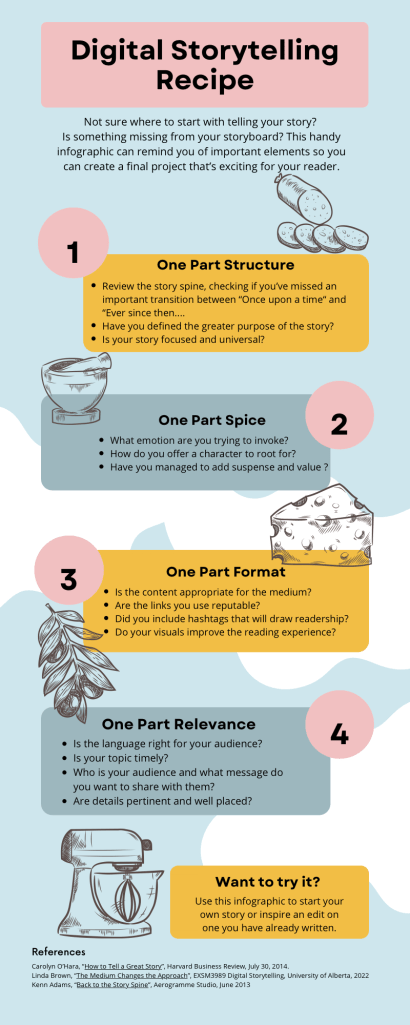
It happens to the best of us. We re-read our digital story and can feel something is missing. Or, worse yet, we have a momentary block about where to start. Sound familiar?

If so, you can refer to this infographic. Much like a recipe, missing a key storytelling ingredient can make the final product feel flat. And of course, adding too much of a good thing can make the creation inedible.

While reviewing it, I hope something stands out and gives you an “ah-ha” moment.

Let’s look a bit deeper…

For example, pre-defining how you add value for the reader can give you confidence that the reader will walk away remembering the lesson or emotion you offered. Adding suspense can be as simple as inserting imagery that suggests there could be something hidden, or playing with dramatic irony where the reader learns something that’s hidden from the character.

And where is this going to be read, anyway?

Sometimes writers can get so excited to share their message, they fail to consider how to alter the message for the medium. Could your visual be stronger for Instagram? Maybe you should change it to a video or GIF for Facebook? Did you polish the wording to appeal to your professional contacts on LinkedIn?

Keep writing, regardless if you feel stuck or unsatisfied with what you wrote. By reviewing what you’ve written with the ideas offered here, you will stir up some great creations.

Salut!

Categories
Uncategorized

Principles Of Good Storytelling!

Storytelling dates back thousands of years when it adhered to visual and oral traditions using myriad ways to communicate them, including drawings, songs, chants and poetry. The evolution of storytelling remains fascinating because, as human beings, we continue to find novel ways of communicating and sharing our experiences through stories that can capture our imagination and make us feel connected.

So, while the new mediums challenge storytellers to adapt to novel ways of communicating and presenting stories, the principles around good storytelling have remained steadfastly resilient.

So, what principles continue to help create great stories that we deeply resonate with and remember? Read on to know more!

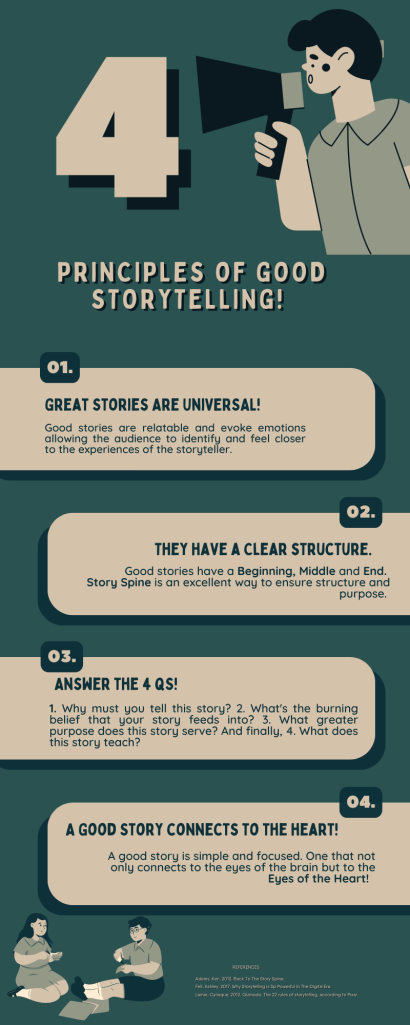
1. Stories That Have A Universal Appeal

The stories that offer universality through their characters and respective experiences instantly result in the most profound connections between the audience and the storyteller. According to Pixar Director Pete Docter, the relatable and identifiable stories also evoke emotions and remain with the audience, adding to their longevity.

2. Stories That Have A Clear Structure & Purpose

An appealing story must be able to draw its reader into its well-crafted world. For that to occur, it must be able to use the Story Spine and adhere to the guidelines of good storytelling, including the following: 

1. The Beginning 

2. The Event 

3. The Middle 

4. The Climax 

5. The End  

3. The 4Qs That Can Help Create Good Stories!

Good stories don’t just happen! Storytellers must cultivate the practice of self-awareness and honesty as part of the process. Before telling a story, answering these allows a storyteller clarity and purpose behind their work, often leading to memorable creations. 

Ask yourself – 

Why must you tell this story?

What’s the burning belief within you that your story feeds off of? 

What greater purpose does this story serve?

What does this story teach?

4. Good Stories Have A Heart!

Good stories connect to the eyes of the brain but, more crucially, connect to the eyes of the heart! Principles of good storytelling, especially in the digital age, serve as a vital reminder. With more innovative platforms and mediums and their ever-growing tools, which certainly play a role in enhancing the audience’s experience, a good story, in the end, remains simple and one that speaks to the heart of its audience. 

Conclusion

So, if you want to be able to tell incredible stories, follow these principles. Put yourself through the process, practice your craft and with perseverance, you will have your perfect story!

Categories
Uncategorized

Things to Keep in Mind Before You Tell a Story.

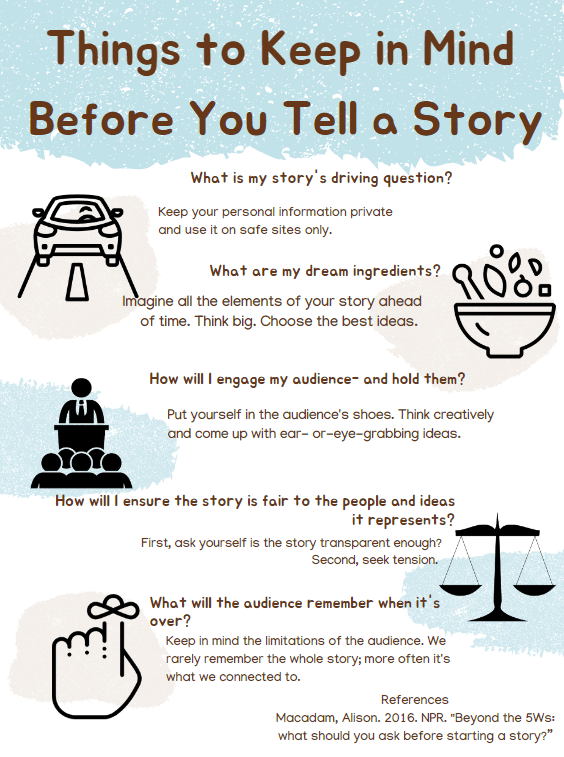
There are some fundamental questions which you should consider before telling a story. Storytelling always includes the “5 W” questions – Who, What, When, Where, Why, and the bonus How. Answers to these questions may change in the process of storytelling.

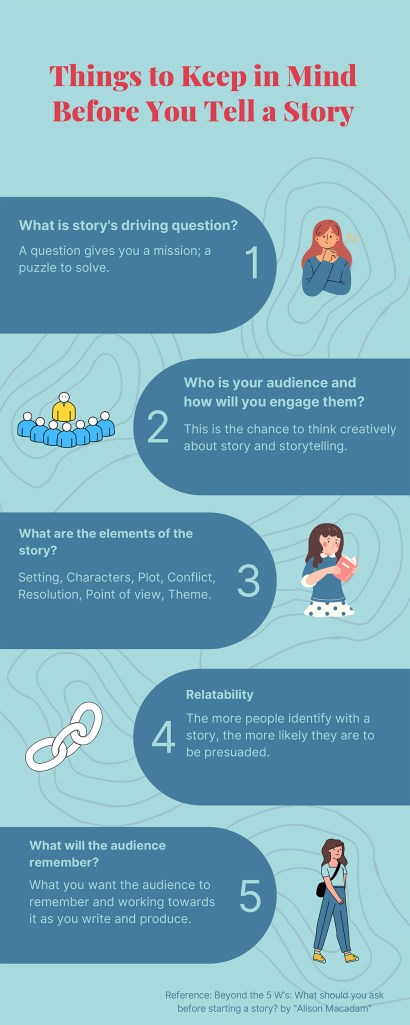
Below is the infographic of key point to keep in mind before telling a story.

1. What is story’s driving question?

A question gives you a mission; a puzzle to solve. The process of answering that question focuses your reporting and allows your story to become a journey for the listener or reader.

2. Who is your audience and how will you engage them?

This is the chance to think creatively about story and storytelling. Always try to put yourself in your audience’s shoes. What interests you? what would you enjoy reading or listening to? 

3. What are the elements of the story?

Imagining the elements of your story ahead of time is a time-honored approach. It helps you conceive your story and plan your reporting. The basic elements of the story are Setting, Characters, Plot, Conflict, Resolution, Point of View and Theme

4. Relatability

A story’s relatability allows people to empathise with the plot, themes and characters in an intimate way so that its core message is one that becomes meaningful to us. It is, what some describe, the quality that enables us to become part of the story and makes the good ones resonate so deeply.

5. What will the audience remember?

If your reader could only take away one thing from your story, decide what you want it to be and focus on developing that material.

Conculsion: If you remember to ask these questions at the beginning of writing or telling your story it will help guide your story.

Reference: “Beyond the 5 W’s: What should you ask before starting a story?” by “Alison Macadam”

Categories
Uncategorized

Things to Keep in Mind Before You Tell a Story.

Storytelling always includes the “5 W” questions- Who, What, When, Where, Why, and the bonus How. But according to Alison Macadam, there are other fundamental questions one should consider before engaging in storytelling. The answers to these questions might change the story in its entirety.

Storytellers might want to consider the following tips or questions to strengthen their article, social post, advertisement, etc., wherever a story can be found these questions should have been asked by the writer.

1. What is Driving My Story?

There can be benefits to asking questions at the beginning of storytelling rather than starting by accounting events or making character statements. If you ask questions and use the answers to build your story it allows the story to grow and be a journey for the audience.

Professional Tip: If you have multiple questions, you probably have multiple stories. Stick to one and answer it well. Your audience will stay with you.

2. What are my dream ingredients?

To help better plan and tell your story imagine the elements, key points, or storyspine pieces ahead of time.

Professional Tip: Ask the following prompts

  • What voices are essential?
  • What complicated issue must be explained?
  • What quotes will address your driving question?
  • What moment or scene will make the story unforgettable?
  • What transition will tie the pieces together?
  • What will give the story personality?

Cast a big net of ideas and then choose the best ones to incorporate into your story or writing.

3. How will I engage my audience- & hold them?

Professional Tip: Always try to put yourself in your audience’s shoes.

What interests you? what would you enjoy reading or listening to? Try to be as creative as possible and then outline your big ideas, emotional arch, or plot. Remember why would you want to read it, and why is it important? know your target audience and why the story would appeal to them.

4. How will I ensure my story is fair to the people & ideas it represents?

Make sure your story is clear to the audience that even if it is being told from one perspective that different viewpoints are still present.

Professional Tip: One of Pixar’s Rules of Storytelling states “if you were your character, in this situation, how would you feel?” If your story involves real people and real ideas, I think this is a strong question to help determine if the story is fair and how the perspective being written might make others feel.

Even when the story focuses on one person or situation, ask yourself where the conflict resides. Last but not least, a story is never going to fairly represent all characters (fiction or fact) this is why novelists sometimes write the story from the other character’s perspectives. Alison Macadam shares that transparency is built by telling the audience where they can find related stories.

5. What will the audience remember when it’s over?

The audience rarely remembers the entire story. We will remember key plot pieces, favorite characters, or maybe a detailed setting this is because we have an emotional connection to the material.

If your reader could only take away one thing from your story, decide what you want it to be and focus on developing that material.

Professional Tip: You can build your stories to have the impact you want them to have. You just need to keep the impact in mind while creating the story.

In conclusion, if you remember to ask these questions at the beginning of writing or telling your story it will help guide your story. There is no single correct answer to these questions. You as the author of the story get to choose which answer help you complete your story.

Categories
Uncategorized

Good Storytelling Needs Heart

 Great stories share common elements, from longer stories that follow a hero’s journey and full story spine approach to short advertising messages that make you the hero, solving your problem by using their product. 

In learning about storytelling principles, I noticed that various authors count their rules differently, but that there are definite themes. This makes so much sense – as humans, we all respond to intense emotions and familiar situations.

In the 22 Rules of Storytelling According to Pixar, would-be storytellers are given some great hints for appealing to audiences. The Rules were distilled from years of making heartwarming animated movies, but do we really need all 22 rules for every type of storytelling?

Introducing the Short List

4 Storytelling Rules

Let’s explore these, and integrate the insights from another source, 

Storytelling and Advertising: How to bring the two together.”

4 Storytelling Rules

This is based on Pixar’s rule #2 “You gotta keep in mind what’s interesting to you as an audience, not what’s fun to do as a writer. They can be v. different.” 

You want to target your customer by thinking about what kind of content they want to see.

Down to Pixar’s rule #15 “If you were your character, in this situation, how would you feel? Honesty lends credibility to unbelievable situations.”

You can inspire emotions so your story is heartwarming, funny, uplifting, or gives fear of loss so the audience is moved to action. Like a photo album, each emotion builds into a larger narrative, and as long as they are authentic you can inspire nostalgia or fellow feeling or more. You can create a ‘friend’ bond with the right tone in the story.

The next rule is based on the Pixar article’s rule #16 “What are the stakes? Give us reason to root for the character.”

Your character can be the audience themselves, or a character or hero that you create. What problems are they facing? Include an apex where the audience can connect emotionally to the outcome, and use compassion. Solve the problem in a unique way to stand out from the crowd and make your audience really remember your story and your voice.

To finish, I used the last rule on Pixar’s list, #22 “What’s the essence of your story? What is the most economical telling of it? If you know that, you can build out from there.”

Use a strong level of detail to make a memorable story, but be wary of irrelevant information that is distracting. You want to make a vivid picture, and not lose focus. Also, use a photo or video to get your message across even more clearly. Our brains can process an image in just 13 milliseconds, get that on your side!

Try out the rules for yourself!

Whether you follow these 4 rules or you choose to lean on a different list of storytelling principles, just remember to get those stories out! No one can tell your stories but you.

Design a site like this with WordPress.com
Get started