Categories
Uncategorized

Oh, the Places You’ll Go!

Colorful hot air balloon on sunset sky
Photo by Emre Kuzu on Pexels.com

Oh, the Places You’ll Go!

“You have brains in your head. You have feet in your shoes. You can steer yourself any direction you choose. You’re on your own. And you know what you know. And YOU are the one who’ll decide where to go…”  Dr. Seuss

Oh, the Places You’ll Go! is one of my favourite stories. This motivational story is a classic coming of age tale. Like many high school teenagers, I was gifted this book upon graduation to encourage me to see the limitless possibilities that life could bring.

Theodor Seuss Geisel aka Dr. Seuss has captured the hearts of readers young and old since 1937. Dr. Seuss wrote in prose using a rhyme scheme that was often very catchy.  

“You’ll be on your way up! You’ll be seeing great sights! You’ll join the high fliers who soar to high heights” Dr. Seuss

Along with catchy rhymes, Dr. Seuss books have bright and colourful psychedelic illustrations.  Dr. Seuss includes colour, picture and movement in all of his books.

Photo by Pixabay on Pexels.com

 Oh, the Places You’ll Go! has a distinct story spine. As playwright Ken Adams describes in the story spine, the structure of this book is clearly defined.

  • The Beginning – “Congratulations! Today is your day. You’re off to Great Places! You’re off and away!” This sets the tone for the story. You are the main character! 
  • The Event – Once you are off and away the story leads you in a direction to choose your own adventure.  Dr. Seuss gives you examples of paths you may choose “And you may not find any you’ll want to go down.”
  • Middle – Dr. Seuss has captured the reader flying high in a hot air balloon through the story.  The motivational undertone is strong and powerful.
  • The Climax – Just when you feel everything is going in the right direction, the hot air balloon you were riding gets stuck in a tree! This is a great metaphor for the highs and lows you will ride through life. 
  • End – After navigating the choose your own adventure and riding the highs and lows, Dr. Seuss metaphorically says “And will you succeed? Yes! You will, indeed! (98 and ¼ percent guaranteed.)”
  • The Moral of the Story   KID, YOU’LL MOVE MOUNTAINS!

Pixar Animation Studios Rules for Good Storytelling outline many practices that Dr. Seuss used in his story telling. One thing I love most about this story is how rule #4 Good stories give you a character to root for applies. As the reader is the main character, you are rooting for yourself!

“What you’re trying to do, when you tell a story, is to write about an event in your life that made you feel some particular way. And what you’re trying to do, when you tell a story, is to get the audience to have that same feeling.” Pixar director Pete Docter

I highly recommend this story. This is a great book to read at any stage in life (not only for high school graduates)!

Take a couple minutes to watch this wonderful book in its digital form. 

Visit this site to learn more about Dr. Seuss.

Your Mountain Is Waiting!

Categories
Uncategorized

The Boy Who Lived

“Words are, in my not-so-humble opinion, our most inexhaustible source of magic. Capable of both inflicting injury, and remedying it.”

-J.K Rowling

The task of picking a favourite story was daunting, as an avid lifelong reader, it was near impossible. But then I thought of the above quote in J.K. Rowling’s fantasy series, Harry Potter; words are amazing and with them, people are able to create whole new worlds and stories that bring people out of their normal lives and into something, well, magical, which is exactly what J.K. Rowling did for me when I was young.

The story of Harry Potter is well known around the world. On his eleventh birthday, a young boy named Harry Potter discovers that he is a wizard and possesses the ability to use magic.

He is then introduced to the Wizarding World, where unbeknownst to him, he is already famous for being the Boy Who Lived, having survived a killing curse as a baby from the powerful dark wizard, known as He-Who-Must-Not-Be-Named.

To harness his new found abilities, Harry goes to Hogwarts School of Witchcraft and Wizardry, a boarding school in which young witches and wizards are sorted into houses based on their qualities. There he encounters new friends (and enemies) and find a place in which he finally feels he truly belongs.

Throughout their six years at Hogwarts, Harry and his friends find themselves continually drawn into the struggle against Lord Voldemort, while still navigating the challenges of adolescence and well as understanding and growing their magical abilities. This journey’s story concludes with an epic war between the forces of good and evil at Hogwarts with the final showdown of Harry and Lord Voldemort.

The saga of Harry Potter is one that so clearly follows the rules of storytelling. The story is simple and focused: Harry must defeat Lord Voldemort for the Wizarding World to survive. The characters are highly relatable, as it is easy to find something of yourself in each of them so inevitably you want to keep rooting for them. They also never give up, despite being so young and having many obstacles thrown at them, they persevere and move forward. Yet they each have their own opinions and are not scared to show it; they understand that they all bring something unique to the table that an ultimately help.

“To have been loved so deeply, even though the person who loved us is gone, will give us some protection forever.”

– J.K. Rowling

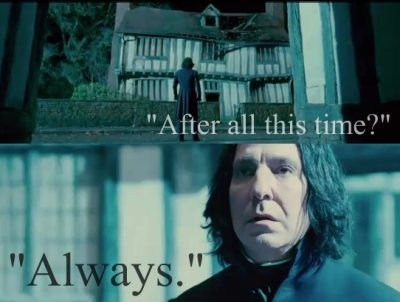
The main theme that resonated with me through all seven books was that of love. Harry’s mother was able to protect him because of the love she had for him, even though she was gone; Harry’s friends continually risk their lives for one another because of the love they share. And even Snape, one of the most despised characters throughout the series, is heartbreakingly redeemed (in my opinion) by love.

The love that is seeped into the whole series is what makes it a great story; it brought purpose, gave the characters a reason to continue fighting, and made the story relatable, even though it’s set in a fantasy world that we can only envision. It is also what brings people back to the story and what audiences will remember when its over.

Categories
Uncategorized

Pride and Prejudice

“It is a truth universally acknowledged, that a single man in possession of a good fortune, must be in want of a wife.”

—Jane Austen

The first sentence of Jane Austen’s Pride and Prejudice is extremely well-known, and for good reason. It immediately captures the reader’s attention by making a bold statement, and also offers a concise summation of the entire plot. The book revolves around a group of sisters and their potential suitors, and highlights the centrality of advantageous marriage in the Regency era. It has managed to captivate readers for well over 200 years, and though different print versions all had their own style, the core story is what has people coming back, generation after generation.

“Netherfield Park is let at last!”

—Mrs. Bennet

As Ashley Fell explained in a TEDxUniMelb talk, good stories have colour, picture and movement. Given that so much of the novel is set indoors, in ball rooms and drawing rooms, it may seem as though the characters aren’t really going anywhere. However, there is in fact constant movement, with individuals calling on friends, attending events, gathering in the drawing room for conversations and more. Austen also peppers the story with visual details that allow the reader to truly immerse themselves in the world, documenting everything from the trim on a dress to the scathing look delivered across a dance floor. These rich descriptions mean the story lends itself well to adaptations, such as the 1995 miniseries or the 2005 feature film starring Keira Knightley as Elizabeth Bennet.

“To Elizabeth it appeared, that had her family made an agreement to expose themselves as much as they could during the evening, it would have been impossible for them to play their parts with more spirit, or finer success.”

—Jane Austen

As outlined in “The 22 rules of storytelling, according to Pixar,” good stories are universal. While the customs and courtship portrayed in the novel are from an earlier time, the concepts of love and family are themes that every human is impacted by.

There are several different models of marriage presented in the novel, from the passion-filled courtship between Elizabeth and Mr. Darcy to Charlotte Lucas’ decision to marry Mr. Collins, simply because the match would provide her with financial security. Every character navigates the expectations of the Regency period in their own way, deciding what they value most.

The family connections that characters have serve a tremendously important role in the process as well. Elizabeth often feels embarrassed by the behaviour of her family, from her younger sisters’ antics to her mother’s schemes, and must navigate those complications as she tries to make sense of her romantic feelings.

There’s a reason that romantic comedies remain popular to this day, and that there are still sitcoms revolving around zany families and their interactions — the themes of love and family are universal.

“I am no longer surprised at your knowing only six accomplished women. I rather wonder now at your knowing any.”

—Elizabeth Bennet

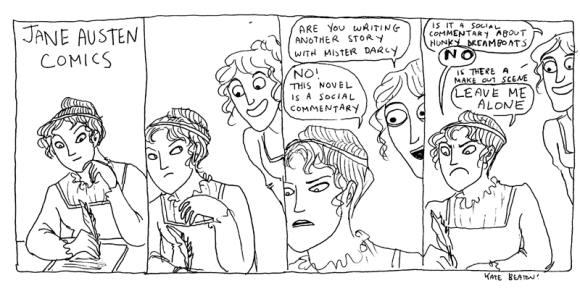
One of the reasons Elizabeth is such a beloved character is precisely because of how opinionated she is, particularly when contrasted against many of the other, more passive women in the novel. As the above quote demonstrates, she’s quick to point out that Mr. Darcy has unrealistic expectations of women, and through their interactions she proves time and time again that she considers herself his equal.

This is particularly notable when considering the stakes at play. The Bennet sisters were in a social class where an advantageous marriage was the only real way to achieve stability and independence, a fact underscored by Mrs. Bennet’s clear desperation to get all her daughters married off ASAP.

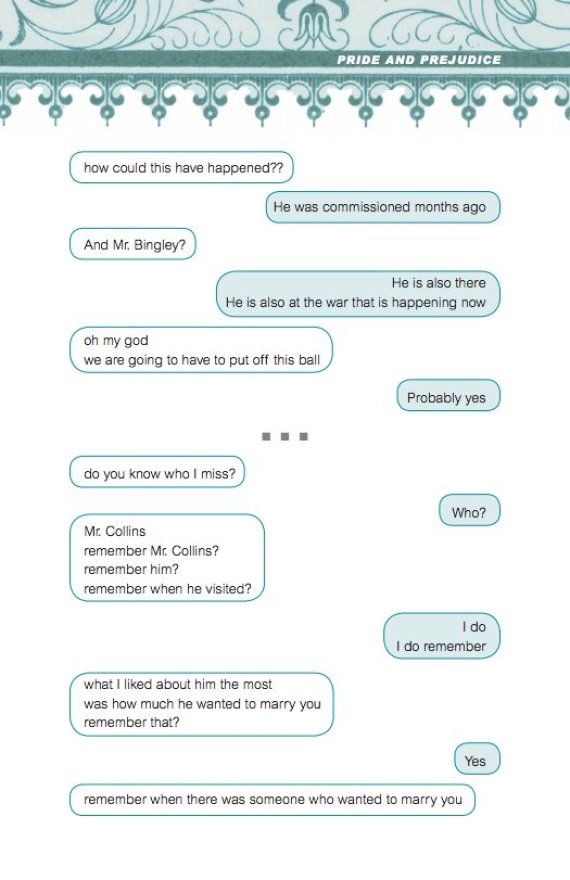
A page from Mallory Ortberg’s Texts from Jane Eyre: And Other Conversations With Your Favorite Literary Characters, in which she imagines a text conversation between Elizabeth Bennet and Mrs. Bennet.

This undercurrent amplifies the significance of Elizabeth’s bold nature — she is unwilling to compromise, as Charlotte Lucas did, and marry someone she doesn’t feel is the right match, even though it would promise her a life of comfort.

Elizabeth Bennet, 2.0

In a 2016 piece published for NPR, Alison Macadam urges her followers to look beyond the simple 5W’s of journalistic storytelling and ask an important question — “what will the audience remember when it’s over?” In the case of Pride and Prejudice, it is the characters that truly stand out, which is perhaps one of the reasons they have been at the centre of so many additional works. Readers were desperate for more about the characters, and there are countless new stories that explore the world through their eyes.

Categories
Uncategorized

Show me the Money

Breaking Bad series review

The TV series Breaking Bad the story featured, a chemistry teacher, who found out he had terminal cancer, and wanted to leave his family a nest egg and decided to start a new part-time job on the side as a meth cook.

The entire plot of the series follows the reading materials outlined in our course story spine

If you were faced with similar circumstance would you consider turning to a life of crime to support your family?

Most people get excited about cold hard cash, what would you do if you had 80 Million Dollars?

This is the amount of money that Walter White had stashed away.

Most would retire, travel, buy a business, donate some of it, help family, you get the point.

The overall plot of the show showed the lead charter Walter White turn from a shy unassuming teacher to a killer, who was more motivated by money than everything else.  He would keep saying that he was doing this for his family, but at the end of the series admitted that he liked cooking crystal meth because he was good at and world renowned.

His family was totally in the dark regarding his crime spree until later in the series he kept everything a secret from his wife Skyler and son Walter Jr.

Walter’s, brother in law Hank who worked for the DEA was hot on his trail throughout the series finally catching up to him near the end of season 5. 

In one of the episodes, Walter ended up burying 10 barrels full of cash valued at 80 million dollars in the desert in New Mexico.

Most of us have fears of leaving the planet before we are ready and leaving our families in a tough spot financially and we can relate to this.

He ended up working with one of his former students Jesse who turned into his full-time business partner, they would take on rival drug gangs and have many confrontations over the course of the series.

Jesse was an interesting character, a high school drop out, who cashed in bigtime as a meth cook.

Throughout the series, the life of crime took a toll on him and eventually he made a run for it relocating to Alaska.

Throughout the series Walter developed a major loyalty and friendship for his partner Jesse and would have done everything for him.

In a strange twist at the end, Walter ordered a hit on Jesse but ended up instead of having him killed he saved his life.

The major characters in the story followed the 22-rules-of-storytelling/

The story also had some comical moments to it one episode featured a fly which would have contaminated the lab where the cooking was taking place, and it ground everything to a halt for a full 2 days, as Jesse and Walter tracked down the The Fly.

Also, a highlight for me was when Walter White purchased a new Red Charger for his son, his wife Skyler made him return the car.  On his way back to the dealership he did several doughnuts lighting up the tires he turned into a total badass Walter’s Driving.

The final episode was sad, as Walter said goodbye to his young daughter Holly, he knew that everything had caught up to him, his cancer returned, and he didn’t have long left to live.   

 The final episode featured Walter taking out rival gang members before he was shot, he freed his partner Jesse.

Walter made me feel good at the end he sent a large amount of money through his former business partners to his family through his son Flynn (Walter Jr.).

To wrap it was a wild ride Five memorable seasons filled with every twist and turn imaginable and really it will test a person’s thought process of what would you do if this was you?   # 80 million dollars

Would you consider a life a crime to support your family? # Family Values Breaking Bad wrap up Breaking Bad followed the 5 W’s

Categories
Uncategorized

The Great Gatsby

So we beat on, boats against the current, borne back ceaselessly into the past.

F. Scott Fitzgerald

The quote above is the final line in F. Scott Fitzgerald’s classic novel, The Great Gatsby. It’s stuck with me for years ever since I read the novel in high school. The novel, published in 1925, is widely considered to be one of the greatest stories ever written even though it’s author died believing it a failure.

For those of you who haven’t read it – or maybe wiped it from your mind! – the novel is set in 1920’s New York and follows a summer with Jay Gatsby, a strange newcomer to the high society scene who loves to throw lavish parties but never attend them. The novel is written in the classical, typical format and harkens back to the era of the Roaring Twenties when anything seemed possible and anyone could rise above their upbringing and become someone else. The book has been converted onto film many times, with the latest offering from back in 2012. Allowing for some artistic liberties, I think the trailer below captures the absolute decadence and opulence of the upper classes in the 1920s. It also provides an interesting introduction to the main character.

Gatsby is often described as “magnetic, paradoxical, and chimerical,” but the lack of descriptive attributes given to Gatsby within the novel allows you, as the reader, to create Gatsby in your own mind. Gatsby could be you or it could be your neighbor, friend. This makes the novel relatable on an intimate level. In fact, no one in the novel actually seems to know who Gatsby actually is or where he came from and so lavish, extravagant stories are generated about him. This relatability aligns with many of Pixar’s “Rules of Storytelling:”

#5: Simplify. Focus. Combine characters.

All of the characters in The Great Gatsby have a role to play and it is well defined in the novel and through their actions. There are limited side characters so there is limited side stories that could potentially through the novel off track and lose momentum.

#13: Give your characters opinions.

This is especially relevant with our narrator Nick. He’s not shy in sharing his opinions about the people he’s encountering, including his less than favorable outlook on his cousin Daisy and her husband Tom. Having the novel written from the viewpoint of a single character, also allows you to put yourself in their place. As though you were there at Gatsby’s party, observing exactly what Nick is describing.

#21: You gotta identify with your situation/characters, can’t just write ‘cool’. What would make YOU act that way?

This is where I believe that Fitzgerald excels. In making his characters relatable and providing just enough information for you to form a picture, the reader is able to put themselves in the place of those characters. For example, the reader roots for Gatsby although you don’t necessarily understand him. The reader initially roots for Daisy, believing that she’s trapped in a loveless, cheating marriage but as the story evolves, you become more and more dissatisfied with her actions and you realize she wants the best of both worlds – Gatsby’s love and Tom’s money. It makes the reader say, “I would never do that!”

Fitzgerald has managed to keep readers engaged in his story for close to 100 years. Although set in a certain time period, the general themes throughout the novel, transcend time and are applicable, albeit in a different way, to the present day. For me, I appreciate the classical way that the novel is written. It makes me long to pick up an actual book – not just read it on my phone or tablet. It makes me want to curl up with a tea and a warm cat, and immerse myself in the world that he has managed to create. Isn’t that what a good story is supposed to do? Take you out of your current and into somewhere else?

Reading gives us someplace to go when we have to stay where we are.

Mason Cooley

Categories
Uncategorized

Introduction

This blog is part of the University of Alberta Faculty of Extension Social Media Citation program (EXSM 3989 Digital Storytelling).

It is a class blog that will be populated each term with posts from students learning about digital storytelling.

Design a site like this with WordPress.com
Get started