Digital Storytelling can be compelling, engaging, and interactive through graphics, images, text, video, animation, and music.
These visuals help emphasize and tell your story; visuals are processed 60,000 times faster than text; in fact,
90% of information transmitted to our brains in visual, making your audience more likely to engage.
A great visual social media platform to check out is Instagram. Instagram’s purpose is to share photos or videos with their audience, and with over 500 million daily active users, the reach is limitless.
Instagram’s stories feature allows snippets of stories in 15-second frames, where users can get creative and share richer interactive stories with their audience.
But like all good storytelling, you need a plan to help reach your goals and objectives and not get lost along the way.
Before you pick up your phone and start creating, check out these five steps to help get your started.
These five steps will work as a guide to ensure your story is exactly how you envision it. What are you waiting for, go get creative!
There are always questions prior to writing a good story. The following are the question that should be answered even before you think about publishing.
First Question: What is the driving question of the story you are writing. What is the reason? What is the purpose? Ask these questions to yourself, joy down answers and come up with the best driving reasons that you can come up with.
Second Question: Is the story transparent. Will the reader understand your story. Make sure you are targeting the correct audience with a story that question: Will it make sense to them and will it have them keep on reading.
Third Question: Will the story engage the audience. Will the story prove to be provoking emotion, suspense, intensity. Will the audience, the ready, want to keep reading.
Fourth Question: What are the stories ingredients? Do these ingredients help the story along? Secondary characters, secondary plots. Will these help or hinder what your story is about
Fifth Question: What will the audience remember? Will your story leave a lasting impression with your audience. Will they want to recommend it to someone else?
These questions are important to answer before finishing a good story. If you can’t answer these, chances your work will be weak and forgettable. And no one wants that. We all want a happy audience who has read a good story!
Do you find yourself struggling to keep your story on track? Storytelling doesn’t have to be tough. Just remember to plan ahead, remember what you want your audience to learn and keep it simple.
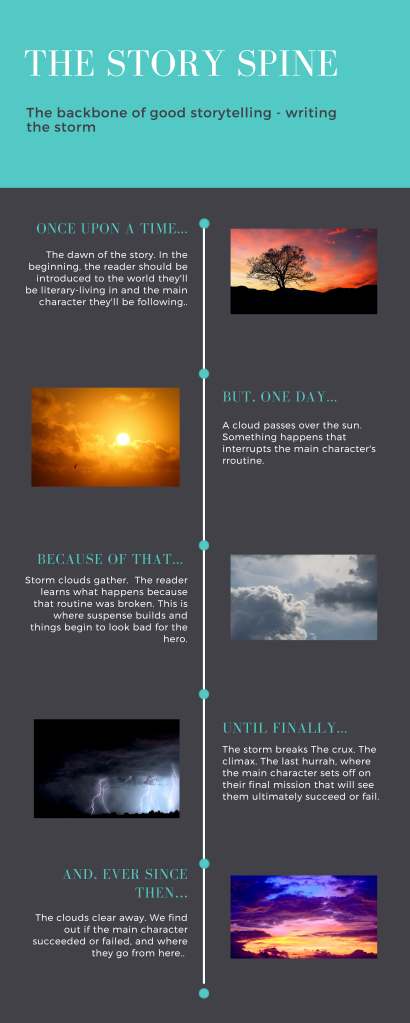
In many ways, the plot of a story follows the same sort of timeline as a storm. A new day starts, gets a little darker, and the next thing you know a storm is raging.
The story spine provides a brief layout of how a story should go. Thinking of it in terms of the life cycle of a rainstorm can help a writer visualize exactly what comes next.
From sunrise (the beginning of the story) through the gathering clouds, the storm itself, and then, finally, the clearing sky, this layout helps keep it clear to the author where they need to go next.
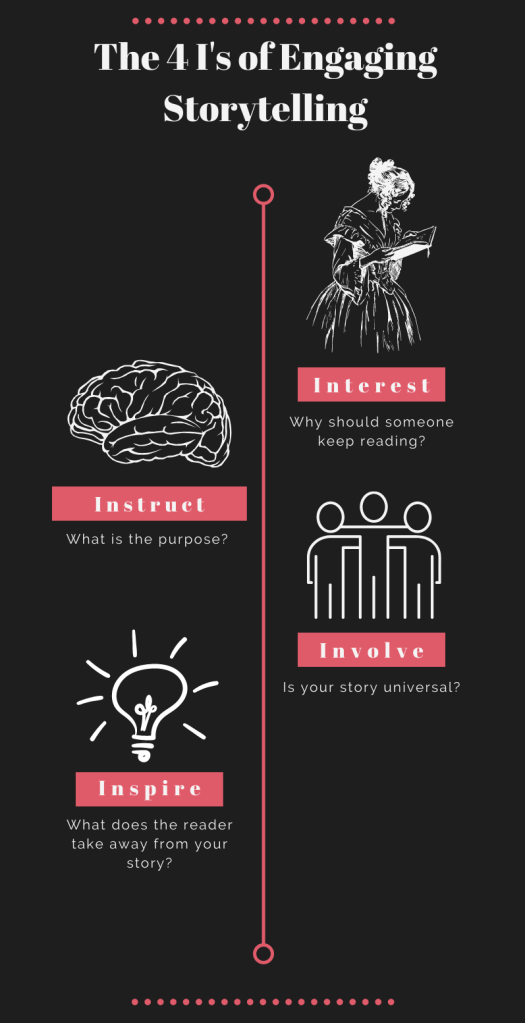
There’s a good chance you’ve heard of the journalistic 5 W’s of storytelling — who, what, where, when, and why (and sometimes how). However, have you ever heard of the 4 I’s of storytelling?
First of all, your story needs to capture the reader’s attention. Particularly in the digital world, where there is a barrage of information and texts available to every audience, your story needs to stand out in some way and hook the reader, lest they just keep on scrolling.
In order to ensure you’re provoking your reader’s interest, think of some of Pixar’s 22 Rules of Storytelling. Give your characters strong opinions that will ignite curiosity in the reader, whether or not they agree with the character. Also ask yourself the important question of “why must I tell THIS story?” This will help you get to the heart of the narrative, and a well-told story will hold a reader’s interest.
#2: Instruct
Ashley Fell’s job involves taking dense data and transforming it into something that is more engaging for a reader — and that process of instruction is something all stories do, even if there isn’t a spreadsheet filled with data to translate.
This is because good stories have meaning. They have a clear structure and purpose, and whether it’s sharing specific information or simply sharing a way to look at the world, they instruct the reader.
One thing to keep in mind is simplicity and focus, another key characteristic of good stories — in order to ensure your reader understands the purpose at the core of your story, you want to carefully curate the information you present so that everything is clear for the reader, and they aren’t left confused.
#3. Involve
Engaging stories are universal, which means they must involve the reader in some way. Don’t get stuck thinking that you need to write about a situation or experience that everyone would be familiar with, though — that’s not what’s meant by universal.
Ultimately, it doesn’t matter if the reader can relate to the specific, unique situation that is presented in the story — what matters is how they feel. An engaging story will provoke a particular feeling or emotion in the reader.
#4. Inspire
As Pixar’s principles of storytelling explained, good stories give you a character to root for — but it’s more about the journey than the destination. Readers are more interested in the intricacies of how a character does something, and what their journey was along the way, than in where they end up.
Whether you’re trying to get a reader to look at the world through a more optimistic lens, or trying to get someone to buy a product from your business, you want to inspire them in some way.
Today, more than ever before, there are a huge range of mediums through which stories can be told. Different platforms all have particular benefits and drawbacks, and it’s up to you to figure out the best way to tell your story. If you keep the 4 I’s of engaging stories in mind, you’ll snare a reader who simply can’t be torn away from your tantalizing tale!
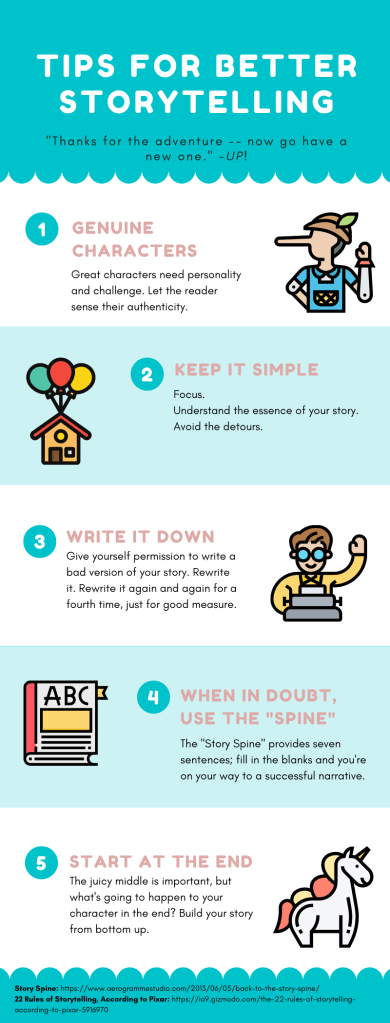
So how do we make our stories interesting? Ever thought what keeps readers engaged to the very last word in your story? What can captivate readers and make them get lost into your world?
Here are 5 tips to get you going and not get lost yourself.
Let’s talk about the BASICS
Remember that you need to know your audience, or at least get a clear idea who you’re writing for. As writers we often see the angle of the story from an author’s angle. We tend to neglect to put ourselves in the shoes of the ones who will consume it or be consumed by it. You have to know what floats their boat, what evokes emotions and what moves readers to action. Ask yourself the What, Who and Why – What will you write about; who do you write for and why do you write?
Begin with the END in MIND and Make a Good Story Spine
To write a story with no clear end in mind can catapult your whole story to a mess. You have to ask yourself the defining question – what do you want your readers to feel or do after reading your story. The story must progress in a manner that is not cluttered with irrelevant scenes, parts or characters. A great story line only has significant elements and knows how to unravel gems of the story at the right time – not too soon and not too late. A well drafted and structured story spine can help us write better closing / ending to our stories too.
Let your story come alive!
The characters in your story will be what people would want to connect to. Hence, it’s imperative to think things through before you decide on your leads. Every human is an emotional being. If you can craft your story in a manner that invoke reactions from the audience, then your story is alive. Writing any story isn’t just ideas put into paper in a certain order or manner. A story must be written with a purpose, be it to inspire, encourage, or address any issue that which man is familiar with or generally concerned about. You need to see the story morphed into the individual lives of the readers/viewer
Empower your Story with the use of Multimedia
Visuals always help you capture the soul. If a picture can paint a thousand words, imagine what GIFs, images, infographics, videos can do to your story? How much more if you can make your story interactive by a montage of all this multimedia? Our generation has an entirely different behavior in information consumption. People in this age are easily distracted, hence if you can make your story appealing to the eye, and since the information is processed faster when visually presented compared to regular text, it allows the readers to capture the gist before their short span interest starts to dwindle.
Our brains value visuals over any other type of information.
90% of the information transmitted to the brain is visual – (Source MIT)
The human brain can process an image in just 13 milliseconds – (Source: MIT)
50% of the brain is active in visual processing – (Source: Piktochart)
Human brains process visuals 60,000 times faster than they do text – (Source: University of Minnesota)
93% of communication is nonverbal – (Source: Ubiquity)
We are exposed to 5x more information today than we were in 1986 – (Source: Telegraph)
While considering the principles of great storytelling, the article, “The 22 Rules of Storytelling, According to Pixar” immediately came to mind. This post nails, what I consider to be, Pixar’s key to success.
Pixar can tell a great story; that’s a fact many people can agree on. Each of their films are relatable, touching, funny, and leaves you wanting more.
I recommend reading the linked post above, but before you head off, take a gander at the points that most stand out to me.
Character Development
Pixar develops rich, multidimensional characters. They create characters that are humorous, characters you love, and some you love to hate. They all have something in common, though: they are genuine.
Dug from the Disney Pixar movie, Up!
Simple Stories
Though this one may not be immediately apparent, each movie exists on a simple plot. For example:
Up! – A senior wants to travel to his dream location. Along the way he meets friends and foes that change his outlook on life.
Brave – A young princess wants to carve a new path in life. Her choices bring peril to her family and kingdom.
Merida, the main character from the Disney Pixar movie, Brave.
Monsters, Inc. – Monsters are raised understanding they have only one job to do. After an incident, it becomes clear that everything they have ever believed may not be as it seems.
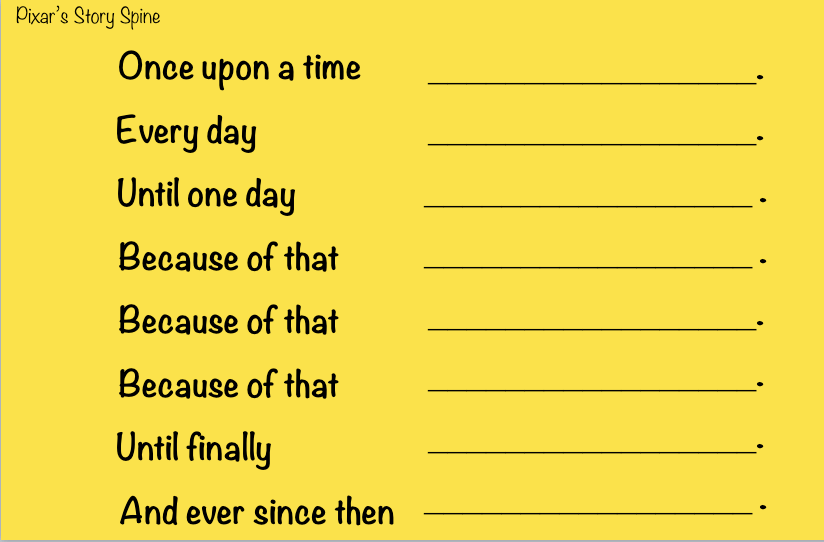
The Story Spine
The key to a successful narrative can to be found in answering seven rather simple statements. Pixar does this successfully too.
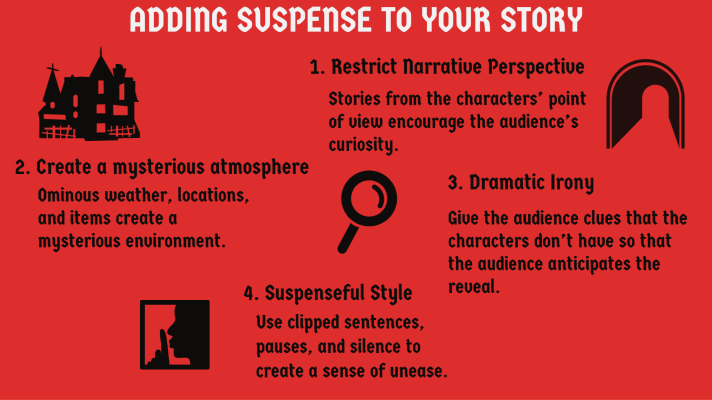
As a fan of mystery and Gothic novels, I enjoyed watching Victoria Smith’s video “How to make your writing suspenseful”. When it came time to make an infographic, I knew I wanted to create an infographic version of Smith’s video outlining suspense techniques for storytelling. My goal was to create a mysterious and spooky infographic to mirror the information conveyed. Hopefully this fits the bill!
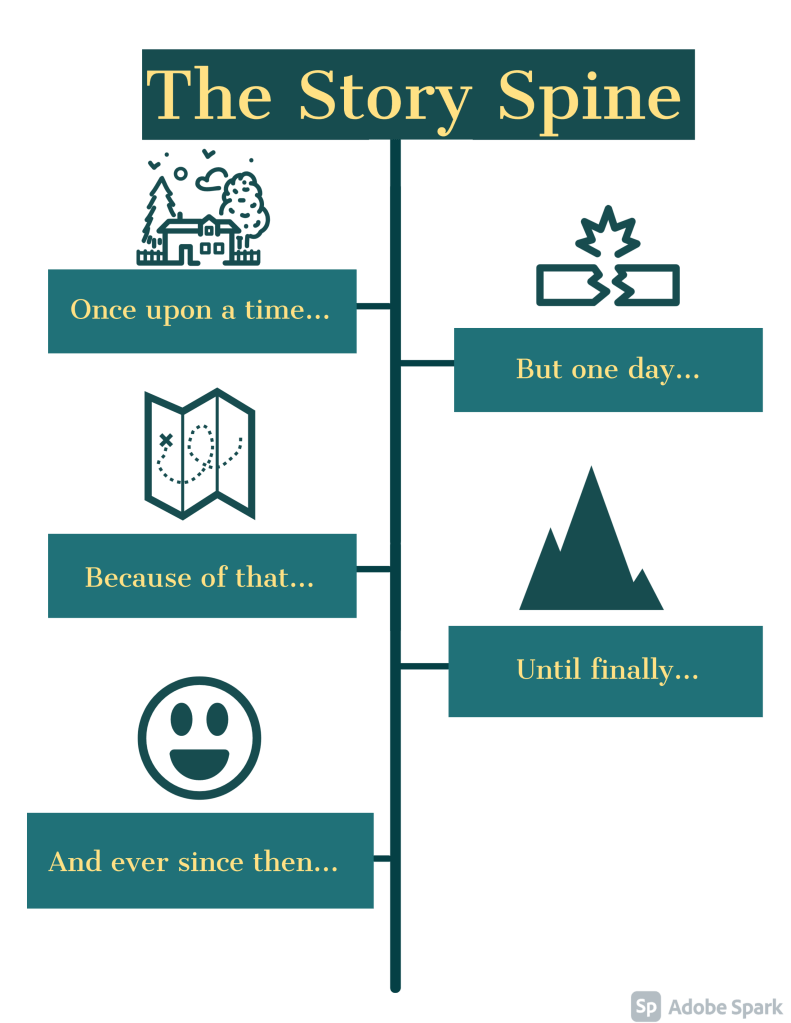
To develop a successful story, you need to look at the story spine; think of it as the bare backbone of a story, which you then fill in with details to flush out the story.
This spine can be seen in almost every story, but is perhaps most apparent in a story like “Lord of the Rings”, as shown below.
The Beginning – “Once upon a time…” – where the world and main character’s routine is introduced.
Frodo lives a quiet life with other hobbits in the Shire.
The Event – “But one day…” – the main character’s routine is broken.
Frodo’s uncle leaves him the One Ring, which must be destroyed.
The Middle – “Because of that…” – the consequences of breaking the routine; it is unclear what will happen to the characters.
Frodo must embark on a perilous journey across Middle Earth to Mount Doom and destroy the Ring.
They form the Fellowship of the Ring which helps Frodo traverse Middle Earth and through the challenges he faces along the way.
The Climax – “Until finally…” – where the main character embarks on either their success or failure; often the height of the storyline.
Frodo finally reaches Mount Doom but struggles both internal and external forces to destroy the Ring.
The End – “And, ever since then…” – the main character either succeeds or fails and a new routine is established, whether for better or worse.
Frodo destroys the Ring, saves Middle Earth, and returns to the Shire with the other hobbits, until he decides to depart Middle Earth.
This story spine can be used for any kind of story, whether a fantastical quest through a new world or a short marketing campaign for a business. When it doubt, it is a great starting point for any author.













 EXSM 3989 - Digital Storytelling Class Blog