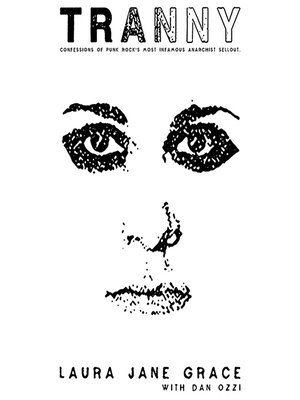
A title housed on my bookshelf that routinely gets dusted off and re-read for its resonant storytelling is the autobiography “Tranny: Confession of Punk Rock’s Most Infamous Anarchist” by Laura Jane Grace.
Key to its success is one of the most recurringly cited elements of the craft: the main character. Tranny is the first-hand account of Laura Jane Grace’s intertwined experience as a transgender woman and punk artist as lead singer of Against Me. Her story is a raw and vulnerable account that pits her against both the industry she hails from, as well as prominent narratives of the transgender experience in the LGBTQ+ community. Examples of this include the title of the book itself which is a usurping of common slang used against the community, or how she candidly recounts feelings of regret as her sex reassignment transition takes a harrowing toll on her body.
But it is this honesty, and willingness to admit her own complexities and confusions, and stand in her own strength that keeps the reader drawn. As narrator and main character, Grace highlights many of the rules of storytelling noted by Emma Coats and many others: she is lauded for trying over succeeding, she is honest to herself and her audience, she holds and upholds her opinions regardless of controversy, and her story is one of high stakes at every turn.
Not only does Grace demonstrate her strength as a character in the story, but it is important to note she also stands strong as the narrator. Throughout the book, Grace maintains her own viewpoint as simply one individual that is transgender; never does she claim to be an expert on the topic or seek to speak universally on the subject or the experience. By staying true to her own story, beliefs and values and remaining authentic without overreaching her perspective, I think she personifies one of the key factors of engaging with storytelling as identified by Megan Wenzl.
What makes Grace story particularly unique is her incorporation of multi-modal media, an important element of experiential storytelling as identified in The Medium Changes the Approach. Of course, the book is mainly comprised of its own text, but weaved throughout are old journal notes, annotations of her lyrical discography, and old interviews. For instance, the book references a seminal Rolling Stone magazine article that in many ways served as Grace’s public coming out; however Grace criticizes the interview for misrepresenting her intent and being transphobic in its misgendering of her and its hyper-focus on her femininity or “passing” as a woman.
This multi-modal approach brings new life into the book, as well as into some of Grace’s older work. For example, in the previously released track “The Ocean” Grace (formerly known at the time as Thomas Gable) sings, “And if I could have chosen, I would have been born a woman/ My mother once told me she would have named me Laura/ I’d grow up to be strong and beautiful like her/ One day, I’d find an honest man to make my husband.” Previous thought would have viewed this as merely fantasizing or daydreaming of alternative lives and characters, but new revelations of Grace’s gender identity offer it new meaning. Additionally, the book was published alongside the release of the album Transgender Dysphoria Blues, making them profound accompaniments for each other.
Lastly, Grace’s use of the Storyspine is dynamic and well-played. Although it features the standard beginning-introduction, middle-conflict, and end-resolution of all great stories, as an autobiography it also features several cycles of this order while acknowledging that many more will continue in her future; the ending of the book is simply that: the ending of the book, not of Grace’s story. Furthermore, my favorite part of this piece is that the story’s central tenant is based around her journey of healing and self-acceptance and not her coming out or transition as transgender. It goes Beyond the 5Ws to ask what the story is not about, and how is it fair to the ideas or individuals it represents?
I can wax poetic all day about Laura Jane Grace as an artist and as an individual, but her storytelling is best done and well done all on her own.







































 EXSM 3989 - Digital Storytelling Class Blog