Categories
Uncategorized

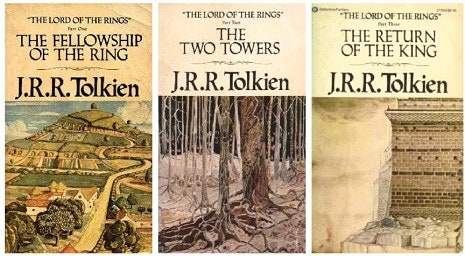
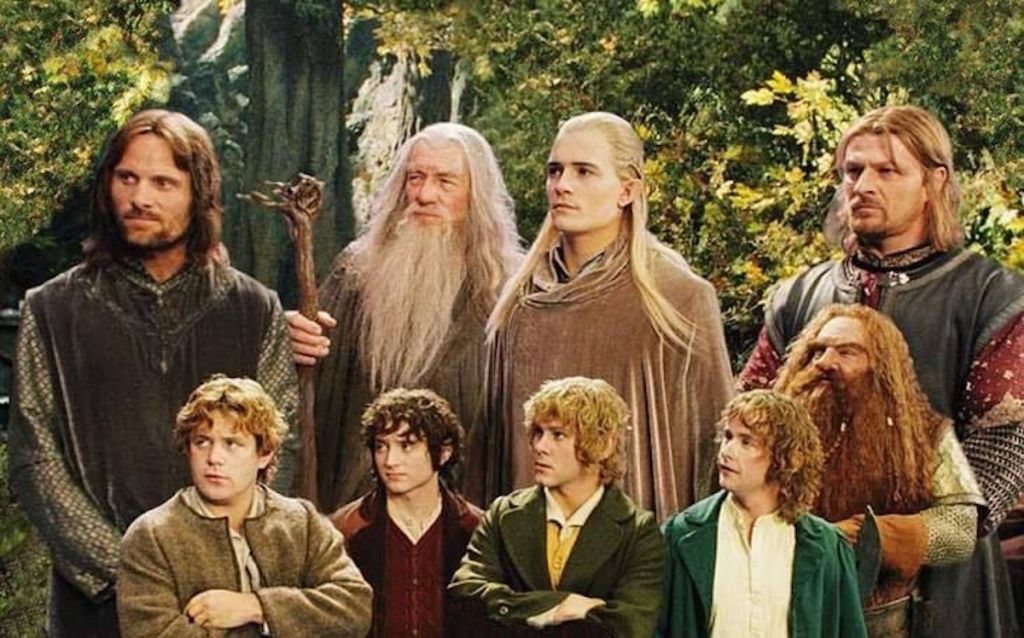
Memorable Storytelling: The Lord of the Rings

“All you have to decide is what to do with the time that is given to you”

– J.R.R. Tolkien

To this day, the Lord of the Rings trilogy is my favourite fantasy fiction film series. To many it is a classic – the best fantasy series of all time.

To me it is precious.

I first watched the series when I was a little girl. I remember being terrified! The effects, the battles, the emotion was too much. I ended up forcing my parents to leave the theatre. But I knew there was something special here and I was missing out.

A few years later, I mustered the courage to try the series again.

I was utterly captivated, blown away by the ambition and scope of the film! The cinematography, film score, costumes, and characters transported me into Middle Earth.

Key Storytelling Elements

Relatability and morality:

The audience falls in love with the main characters – the good and honest hearts of the hobbits. And despite their small size and lack of combat skills they embark on a perilous journey to save Middle Earth. The characters that join them (Elves, Men, and Dwarves) have their own struggles. This arch of temptation and redemption amongst their comrades adds depth and feeling to the story.

High stakes:

Frodo is the Ringbearer. His mission is to take the ring to Mount Doom. He must face menacing creatures (Nazguls, Orcs, Trolls) and treacherous landscapes (Misty Mountains, Mines of Moria, Black Gate, Cirith Ungol) before throwing the ring into the fire and destroying it for good. Should he fail, all of Middle Earth will fall to the Dark Lord Sauron. Throughout the story the audience is at the edge of their seats, rooting for the characters in what seems to be an impossible task.

In depth material:

This film series was adapted from J.R.R. Tolkien’s books, providing bountiful material and reference. The films do an excellent job of leaning on this material, staying true to the intent and focus of the original story. As a result, the imagery and detail of the film is impressive, making watching the film even that more memorable.

Closing Thoughts

If you have not yet had the chance to dive into the fantastical world of Middle Earth, I highly suggest that you do! The story is packed with adventure – full of life and lessons. And the film is visually and audibly stunning.

Now please excuse me as I re-watch this 11 hour masterpiece!

Categories
Uncategorized

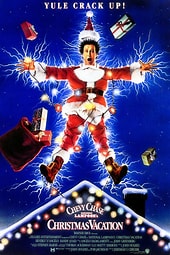
National Lampoon’s Christmas Vacation

One of my favorite stories is the classic holiday movie, National Lampoon’s Christmas Vacation. It’s just not Christmas until I’ve watched it! On the topic, there’s only 175 days until Christmas – sorry not sorry!

As Ashely Fell discusses https://www.youtube.com/watch?v=mSi0kmqOBu4 “A good story is one that you can identify with.” Clark Griswold and I are one in the same. He’s a hard working, family man. I’m a hard working, family woman. He loves Christmas. I love Christmas. He wants to plan the perfect family gathering just like I try to do for my family year after year. He loses his shit when he’s not appreciated, drinks too much and plots to seek revenge on his boss… I think we all get the point that I’m trying to make – I can relate to all things Clark Griswold.

The movie National Lampoon’s Christmas Vacation was released December 1, 1989. The idea behind the movie was a short story written by John Hughes for the National Lampoon that was loosely based on his own childhood experience, Christmas 59. What I find fascinating is that this movie has only grown in popularity over the past 3 decades. With memorable one liners 41 ‘Christmas Vacation’ Quotes Every National Lampoon’s Fan Knows (housebeautiful.com) being referenced over the holidays on clothing and gifts this story is as Christmas as Santa Claus is!

To outline the story using the Story Spine Back to the Story Spine (aerogrammestudio.com)

Once upon a time there was a hard working, family man named Clark Griswold.

Every day, he fantasized about how he was going to spend his annual Christmas bonus. This year, he was going to surprise his family with a swimming pool.

But one day, a package was dropped off by courier, it was his bonus – a 1 year membership to the jelly of the month club.

Because of that, Clarke had a temper tantrum and went off on a rant about what he’d like as a last minute Christmas gift, his boss, Mr. Frank Shirley brought to him.

Because of that, Eddie left the Christmas festivities to grant Clark’s Christmas wish.

Because of that, the police were called to the Griswold house about a kidnapping.

Until finally, Mrs. Frank Shirley explained to the police that it was all a misunderstanding.

And ever since then, Bonus cheques were reinstated

See the source image

The End.

Categories
Uncategorized

My Perfectly Reasonable Love of Harry Potter (According to Storytelling Principles)

In junior high, I was introduced to the world of Harry Potter.

It’s not like I didn’t know Harry Potter existed up until that point, because I absolutely did (is it possible to not know about Harry Potter?). I just wanted nothing to do with it. I’m the kind of person who will hate a thing just because someone I don’t like likes that thing. And lots of classmates I didn’t like liked Harry Potter, so obviously I hated it.

I even tried to to write an essay about how much I hated Harry Potter. It didn’t go well.

Turns out, it’s hard to prove why you hate something when you haven’t tried it yet.

Go figure.

So, in true Hermione style, I turned to the library and finally read the books I supposedly hated.

Spoiler alert: I loved them.

I have since come to understand why Harry Potter is one of the best-selling novel series in the world. But what is it about this story about a boy wizard that makes it so good? I’ve narrowed down 5 storytelling principles featured in the Harry Potter series that make me come back to this story again and again.

5 Storytelling Principles that Make Harry Potter Great

The story is well organized

This may seem basic, but the Harry Potter series is well-organized. Each book in the series can be organized using the Story Spine. And even the series as a whole follows the Spine very nicely.

Here’s an example using Harry Potter and the Philosopher’s Stone:

  • Once upon a time there was a boy named Harry Potter.
  • Every day he lived in the cupboard under the stairs and thought he was very normal.
  • But, one day he received a letter telling him he was a wizard.
  • Because of that, Harry went to Hogwarts to learn magic.
  • Because of that, Harry learned a powerful magic artifact, the Philosopher’s Stone, was hidden at Hogwarts.
  • Because of that, Harry learned that an evil wizard named Voldemort was trying to steal the Philosopher’s Stone.
  • Until finally, Harry and his friends went to stop Voldemort from stealing the Philosopher’s Stone.
  • And ever since then, Harry learned that he and his friends could protect Hogwarts and stop Voldemort from returning.

Without a good spine to keep the story organized, Harry Potter and the Philosopher’s Stone wouldn’t have become the powerhouse success it is today.

Interesting characters

According to Pixar, you can’t have a good story without interesting characters. The Harry Potter series has so many characters to love (or hate) and each one is unique.

I love that the characters each have their own opinions that help create their personality. No one is passive or wishy-washy. Some follow traditional character archetypes (Harry is absolutely the savior archetype) and there are lots of character foils to keep things interesting.

Some examples:

Both Hermione and Umbridge are big on following the rules. But Hermione is willing to break rules in order to save her friends and do what is right, where Umbridge will condone abuse and murder to uphold the letter of the law.

Dumbledore and Voldemort are both extremely powerful wizards – Dumbledore as a light (good) wizard and Voldemort as a dark (evil) wizard. Both even have groups of followers who view them as leaders.

But my favourite thing about the Harry Potter characters is that even before you really get to know them, you learn what kind of person they are based on the Hogwarts house they’re sorted into.

The stakes are high

Harry Potter has some high stakes stacked against him and right from the start, the odds of him actually succeeding seem very slim. He’s up against a powerful, seemingly immortal dark wizard with a group of evil followers who want to take over the world. And Harry’s eleven. And apparently the only one who can stop Voldemort.

But even though the stakes are high and the odds decidedly not in his favour, I’m rooting for Harry each time I pick up the books because he’s the underdog. Harry arrives in the wizarding world as an orphan who knows nothing about magic. And suddenly he has to fight the guy who killed his parents? No thanks.

As the series go on and Harry encounters increasingly dangerous situations and sees what Voldemort is capable of, the stakes keep getting higher. Harry gets hurt and loses friends over the course of his battle with Voldemort. I keep rooting for Harry because I know he’s willing to do everything and anything to do the right thing.

Sometimes things don’t work out

The greatest thing about Harry Potter (in my opinion) is that things go wrong. Harry is far from perfect, as are every other character in the series. They make mistakes. Plans fail. They’re human and it shows. It’s what makes the story exciting.

Sure, Hermione can brew a perfect Polyjuice potion at age 12. But she can’t tell the difference between cat hair and human hair. And we all know you can’t use animal hair in Polyjuice.

And Neville may be clumsy and forgetful and overall a not very strong wizard, but he doesn’t give up. I cheer so loudly when he finally casts Expelliarmus correctly when he’s training with Dumbledore’s Army. And when he conquers the Boggart in Lupin’s DADA class.

Like Emma Coats says, “you admire a character for trying more than for their successes.” The Harry Potter series would have been very boring and very short if everything went right all the time.

All your questions will be answered… eventually

The world-building in Harry Potter is some of the best I’ve ever come across. The Wizarding World is a vast place with lots of different people and creatures and places and magical things to explore. You end up with lots of questions. Each time I revisit the series, I learn new things about Harry’s world. New elements build upon information you learn in previous books.

For example, in the Philosopher’s Stone we learn about quidditch and its rules for the first time. Then in Prisoner of Azkaban we learn about different types of racing brooms. And then in Goblet of Fire we get to experience a professional quidditch match.

The use of foreshadowing in the series is also really amazing. Some of the hints seem really obvious when I read the books over but they were mind-blowing the first time around.

It may take the whole book, or even the whole series, for your questions to be answered, but they certainly will. Complicated issues will be resolved and explained. And there are even supplementary books, like the Hogwarts Library collection, to help fill in the gaps.


So there you have it, some perfectly logical reasons why I love the Harry Potter series so much. Hopefully now you’ll understand why I own 4 different copies of the series, listen to Harry Potter themed podcasts, and have at least one open Harry Potter fanfiction on my phone at all times.

Categories
Uncategorized

It’s a Book

My mother-in-law and I share a love of reading. Differently. She loves her paper books, and I prefer e-books. So, one Christmas, she sent this book, It’s a Book by Lane Smith, ostensibly for my daughter, but really, as a cheeky little nod to me.

It is slightly ironic then I am going to write five hundred words about this book, as it turns out, it did end up being my favourite. Why? Because the book is one of the shortest books you’ll read. And it’s one that you will laugh out loud at. I don’t want to give away the ending of the book, because you really need to discover it for yourself. But I will tell you that it’s brilliant and totally worth getting the book for your favourite kid (or just pretend it’s for a kid).  

There are just three characters in this book. Well, four, if you count the Book, which is a character in itself. There’s Jackass. A Monkey. A Mouse. Monkey and Jackass are friends. Monkey is reading a Book. Jackass is confused. Does the Book need a screen name? A password? Does the Book tweet? Does it make loud honking noises? Perhaps it needs a mouse (Mouse?). And then Jackass starts reading the Book. And reading. And reading. Then Monkey realises that he is not going to get his Book back. Which leaves poor Monkey having to go to the library to get another Book.

And what happens afterwards? Well, you’ll have to read the book.

What do I love about It’s a Book?

The story – It is simple, straightforward and seriously funny.

The characters – Beautifully illustrated, relatable (well, if you’re my mother-in-law and I), and cute.

It’s universal appeal – Both adults and kids will adore it. Adults, for the subtle jabs at our tech-focused culture. Kids, because it is hilarious and well, slightly subversive.  

It’s commentary on our world – Simple, the book might be, but it makes some important points about my generation (digital immigrants), and my children’s generation (digital natives). Just like dear mother-in-law chose to make her point.

Subtle – It makes its point without hitting you over the head with it.

For such a short book, it does have an impact, and I love recommending it to anyone who asks me for my opinion on children’s books. My daughter and son have both developed a love of reading. To me, reading and storytelling is about taking the reader on a journey. As the reader gets more and more engrossed in the story, the story changes as per the imagination of the reader. It is what I love about books. I have read a huge number of books in my life (last year, I set a personal record of reading 565 books) and I love that I have passed this passion for reading to my kids. Someone once said that you’re never lonely with a book in your hands.

Well, if Jackass can learn that lesson, so can we all.

Categories
Uncategorized

The Moral of the Story

My favourite story is “Pride and Prejudice” by Jane Austen. She wrote her first draft when she was only 21 in 1796, although it was only published in 1813, four years after death. Not only did Jane produce 6 long novels without formal education (or a typewriter), she intuitively understood what to include in her stories and what to leave out to catch and hold the attention of her audience.

Major themes

One of the central questions in Pride and Prejudice is whether it is better to follow social conventions and marry for money and respectability or to marry for love and happiness. Some possible themes such as Marriage, Wealth, Class, and Self-knowledge, are described on Wikipedia.

It is easy to look backwards and evaluate a piece of writing centuries later, but from a contemporary perspective, Jane was writing about what she knew from her own life and experiences. She is following guidelines we considered in our reading “How to tell a great story”;

Do:

  • Consider your audience — choose a framework and details that will best resonate with your listeners.
  • Identify the moral or message your want to impart.
  • Find inspiration in your life experiences.

Don’t:

  • Assume you don’t have storytelling chops — we all have it in us to tell memorable stories.
  • Give yourself the starring role.
  • Overwhelm your story with unnecessary details.

I especially like how this connects to the sixth extra question in “Beyond the 5W’s: What should you ask before starting a story?”, which is “What will the audience remember when it’s over?”. As a young unmarried woman, Jane might have been considering whether social conventions can or should be openly challenged, but in the end her female characters end up happily married to very attractive and financially stable partners. The message seems to be challenge if you wish, but do the right thing anyway to create a happy ending for all.

The Beauty of the Printed Text

My favourite edition of it is the Peacock Edition, illustrated by Hugh Thomson and published in 1894. A description and images of it, and the asking price of various different copies of it, are found at AbeBooks.

The artistic quality of the physical book should not affect the reader’s satisfaction with the story, but it does enhance the experience, especially by providing illustrations that suggest the beauty of the ladies and the positive qualities of the gentlemen. Illustrations were used to encourage the reader to use imagination to create a solid impression of the characters, without an actual representation of an individual. They also added a beauty of their own.

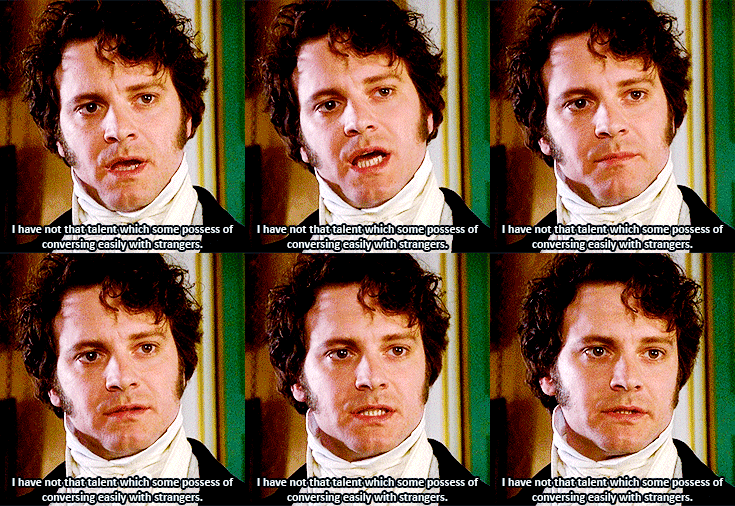
In modern times with technology, readers can find links to various movie adaptations of Pride and Prejudice. If you have read the book a few times, you probably already have a solid impression of what Mr. Darcy looks like. Is that really Colin Firth?

Even worse, let’s not even talk about Pride and Prejudice and Zombies (trailers easily found online).

I will stick with my hard copy of the story, with or without beautiful illustrations. A good story has a virtue of its own, without the modern tools of technology. The moral of Jane Austen’s story holds true, almost as long as Shakespeare’s. Surely there is something to be learned, and enjoyed, in that.

Categories
Uncategorized

The Kite Runner

One day, not so long ago, my 10-year-old asked me, “what was it like to grow up in the 1900’s?” I was a bit thrown off at the phrasing, but recovered and explained that it was very similar to today, without the internet. He looked horrified.

Way back in the 1900’s, entertainment, at least in my house, meant reading. I’ve always appreciated a good story and have dozens of favourites, making it hard to pick just one. I recently re-read a beloved tale, The Kite Runner, by Khaled Hosseini, and was reminded why it consistently stays near the top of my list.

Following the story spine, The Kite Runner goes something like this.

Once upon a time, a young man named Amir grows up in 1970’s Afghanistan, with his wealthy, widowed father and their servants.

Every day, he enjoys his childhood with his servant and best friend, Hassan, while trying to earn his father’s affection.

But, one day, while helping Amir win a kite-fighting contest, Hassan suffers a horrific sexual assault and Amir does nothing to stop it. To make things worse, he frames Hassan for something he didn’t do, forcing Hassan and his father to leave their home.

Because of that, Amir’s family is torn apart. Hassan and his father move away. Amir and his father emigrate to the United States, and 20 years pass without contact with Hassan. Afghanistan is ravaged by war. Amir and his father struggle in America, and his father dies of lung cancer. Amir marries, but he and his wife are unable to have children.

Until finally, Amir returns to Afghanistan and learns what has happened to Hassan. He is given the opportunity to atone for his mistakes, but not without risk and sacrifice, including a confrontation with the person who assaulted Hassan years earlier.

And, ever since then, Amir does his best to move forward and tries to make up for the horrible decisions of his childhood by adopting Hassan’s orphaned son and bringing him to America.

Memorable characters and vivid description.

The Kite Runner has received critical praise and more than its share of controversy. It has sold millions of copies by following the principles of good storytelling. The story relies on universal themes, including strained father/son relationships, and redemption.

Amir is not always likeable, and there are many points in the book where the reader may find themself silently urging him to act differently. But, his guilt betrays his humanity. While he initially shows cowardice, it’s no more than anyone might expect of a 12-year-old boy, and he’s forced to grow up quickly with the resulting impact. This makes him, if not likeable, at least relatable. He’s a real person, who does some awful things as a boy, and then carries the weight of those decisions into adulthood.

Kabul, and then California, are described with rich detail, allowing the reader to imagine themselves sitting beneath an ancient pomegranate tree or browsing the crowded aisles at the Afghan flea market in San Jose. For someone like myself, who grew up watching images of Afghanistan on television, depicted as a hot, sandy desert filled with war and terror, the startling beauty of the country came to life through this book.

Pomegranate Trees

While this book takes place over several decades, and across continents, it remains a simple story of family, and doing what’s right, even when it’s hard. There are twists along the way that keep the reader guessing and interested, and emotional passages that have me in tears every time I read it.

Categories
Uncategorized

More than a Story

As with many avid readers, I have a to-read list that is so long it would be physically impossible to get through in my lifetime. Because of this, I rarely re-read a book, even if it was the best thing I’d ever read. Despite this, Tamora Pierce’s Tortall series is an exception that I will continue to re-read, over and over again.

The series now covers multiple generations in the world and I care about the characters more than most of my casual acquaintances.

From the first book, Alanna, the First Adventure, Pierce hooks readers with a strong, honourable, ambitious girl who wants nothing more than to be a knight in a world where females are not allowed to be knights. The first series in the Tortall world (The Song of the Lioness) follows Alanna’s inability to back down from a fight which gets her into countless scrapes and extraordinary situations. We also see her grow from a pre-teen into a fully-fledged knight-errant, roaming the world in search of glory, then returning to save her homeland from a great threat.

The Story

Alanna and her twin brother swap places on their way to their individual boarding education, with her brother off to learn magic and Alanna off to become a knight by pretending to be her brother. She is able to keep her identity secret until the end of the second book, when she is fully-knighted when a man who has been trying to usurp the throne of her kingdom outs her, and she leaves the kingdom in disgrace, despite having saved the royal family from death by voodoo doll.

The final two books describe her travels as Tortall’s first lady knight in several hundred years, taking lovers, and doing her best to bring glory to her country. While Alanna is off forging bonds with foreign lands, her brother, now the most powerful sorcerer in the world, is taunted into “proving his power” by bringing back the usurper from the dead. Disgusted that her old nemesis is back, Alanna leaves again, this time set on stealing a magical stone from the top of a mountain from a protective spirit that will bring prosperity to her country.

On her way home, she encounters a disowned princess with whom to set up her best friend, the prince of the kingdom. When she gets home, she helps to foil the plot of the usurper, but not before he’s killed the king, queen, and Alanna’s brother.

First Love

Besides being one of the first longer books I read as a youth, and therefore highly nostalgic for me, this series sticks with me to this day for many of the storytelling principles learned in our class.

  • It’s universal,
  • Has a clear structure,
  • Is simple, and
  • Gives us characters to root for.

Universality

The struggle of honour vs malignance, the struggle of women in a male-dominated world, the struggle of a teen to grow up and find her place… Tamora Pierce has written an infinitely relatable tale, even beyond its marketed audience of junior high girls.

Comparing it to Christopher Booker’s 7 Basic Plots, it works in several of them, including “overcoming the monster” (the usurper threatening her homeland), “the quest” (both to become a knight and then to collect the mythical stone that will save her kingdom) and “the voyage and return.”

Clear Structure

Since the books follow Alanna chronologically as she grows, they are separated into clear periods of her life, from girlhood, teenagerhood, new adulthood, to a fully-grown woman.

Simple

These books are not overflowing with descriptions of feasts or fashion (cough cough George R.R. Martin cough cough) that readers (or maybe just me…) will skim over, nor are there any extraneous characters. The series is not convoluted, but not so simplified as to be boring or confusing.

Characters

And of course, the books give us characters we can root for. Alanna is my perfect woman: determined, hard-working, and honourable, while also being stubborn, over-focused, and grumpy. She charms everyone around her, including us readers with her flaws and impresses us all with her strengths. And the author doesn’t shy from throwing the world of troubles at her. She overcomes them all with her own grit and integrity, the friends she made along the way, and a bit of early intervention from a goddess who sees her potential (is that cheating? maybe, but I forgive her!).

Stuck with Me

The stories have stuck with me to this day because of the characters told and the world built. Pierce wrote characters that were realistically strong and flawed, threw so many stakes at them that we had to root for them, and put them in a story that didn’t get in the way of itself with overwriting. Pierce’s example of storytelling is one I hold dear to me as a writer and communicator.

The world Tamora Pierce built will always be a place I want to live in, and her characters will always be my friends.

Categories
Uncategorized

Someone Knows Something – Season 5

A recent story that really resonated with me is Season 5 of the CBC podcast Someone Knows Something. There are three main reasons why I found this season of the podcast so compelling, which I’ll go into more detail in this post. The three reasons are:

  • True story with a clear and compelling structure
  • Compelling characters
  • Universal simple story

First here is a preview of Season 5.

True story with a clear and compelling structure

Someone Knows Something is a true crime podcast in which host David Ridgen works with families to try to solve unsolved mysteries or crimes.

It’s interesting because the podcast has a compelling structure in which two story strands are intertwined into one story.

The first story is the historic crime or mystery that is being investigated. The second is that of the investigation the host does with a family member. 

They both have a clear structure and purpose that you can outline using the Story spine discussed by Kenn Adams. 

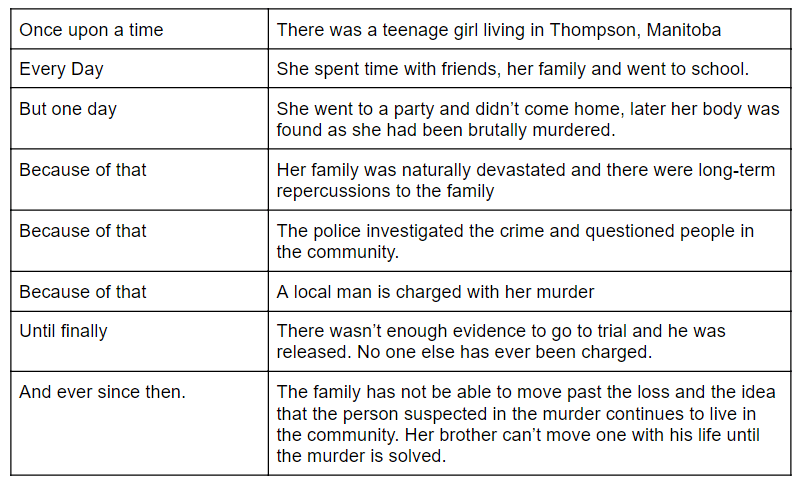
In Season 5 the crime follows this structure:

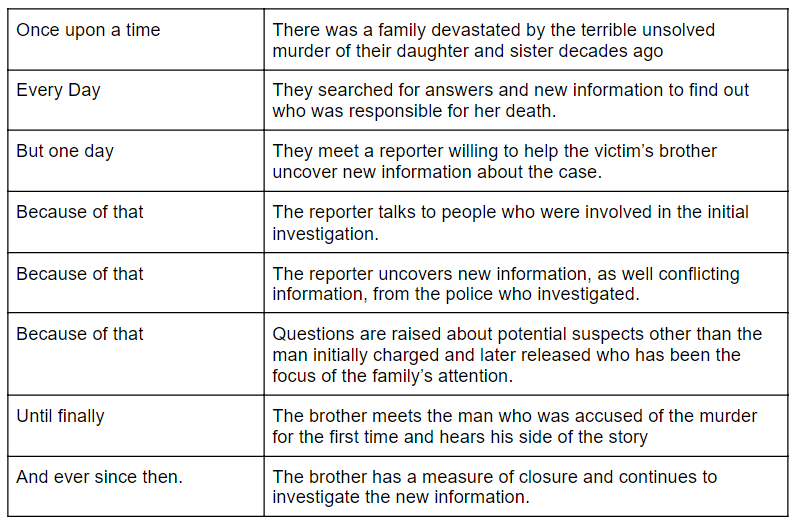
The investigation story follows this structure:

Compelling Characters

In each episode of the podcast we are introduced to new and compelling characters who move both stories forward. They uncover more about the crime that happened and also the story of the journey the host and victim’s brother are taking. All the characters have this common tragedy that connects them and makes them relatable because their lives have all been affected by this common experience.

Cyriaque Lamar highlights in The 22 rules of storytelling, according to Pixar one of the rules you need to ask is:

“Why must you tell THIS story? What’s the belief burning within you that your story feeds off of? That’s the heart of it.”

At the root of the story is the brother who has been driven to find who did this to his sister causing all this damage to his family

Universal Simple Story

While two intertwined story spines with so many varying viewpoints, talk of investigation techniques, DNA and forensic information makes the story seem complex it really is a simple story of a brother and a father who just want, and really need, to know what happened to their sister and daughter.

Again, as Lamar notes, another of the storytelling rules is to ask:

“If you were your character, in this situation, how would you feel? Honesty lends credibility to unbelievable situations.”

This story is filled with honest raw emotions that anyone would relate to if faced with the unthinkable loss of someone close to you in such a tragic and senseless way.

You can find Someone Knows Something on CBC Listen.

Categories
Uncategorized

‘To Kill A Mockingbird’

by Harper Lee

It is important to note that I will be using the abbreviation TKAM as a replacement for ‘To Kill A Mockingbird’ frankly it takes up too much space…

Harper Lee’s book ‘To Kill A Mockingbird’ not only succeeded through the gravity of the content, but in the way it was told.

The book TKAM extends further than just a book, it not only explores the coming of age through the eyes of the protagonist Scout Finch. It explored the racial prejudice and injustices in America, during the heights of the civil rights movement. 

A quick introduction to the book and why I chose it!

As it is a hard story to summarise, due to the gravity of the content, I will provide you with trusty google summary…

“In the Depression era, Atticus Finch, a lawyer, sets out to defend a black man, who is accused of raping a white woman. Meanwhile, his children, Scout and Jem, spy on their reclusive neighbour.”

Google

As mentioned earlier the book extends further then just the story at hand, there are so many important lessons and principles displayed. Such as The Coexistence of Good and Evil, courage, empathy, and morality. I won’t dive into the details of the story, I will leave the mystery for those who haven’t yet had the pleasure of reading this brilliant book.

Exploring Harper Lee’s Storytelling

When I first read the book I was in high school, I had no desire to read books and if I am being honest I still struggle to pick one up. However this book I struggled to put down. Harper Lee created such powerful images, the book felt like a film, a beautiful cinematic production that you don’t want to end. The story spine created multiple mysteries that you couldn’t wait to unravel, leaving you hooked. One of the most essential principles in storytelling is imagery, to paint a picture for your audience is one the most powerful tools.

In the quote below you can see how well Harper Lee used imagery in the story.

Maycomb was an old town, but it was a tired old town when I first knew it. In rainy weather the streets turned to red slop; grass grew on the sidewalks, the court-house sagged in the square. Somehow, it was hotter then; a black dog suffered on a summer’s day; bony mules hitched to Hoover carts flicked flies in the sheltering shade of the live oaks on the square. Men’s stiff collars wilted by nine in the morning. Ladies bathed before noon, after their three o’clock naps, and by nightfall were like soft teacakes with frostings of sweat and sweet talcum.

Scout Finch – TKAM

Not only was Harper Lee brilliant at imagery, she also built a strong connection between the reader and the protagonist Scout Finch.

Pulling on familiar characteristics such as curiosity and stubbornness, brought me back to my childhood, some would say I still present those qualities but, who doesn’t (; … Harper really built on these characteristics and connections which ultimately help the reader build a strong bond with Scout, enhancing the power of the story.


If you never read the book, or even if you have because you were forced too in high-school, it is worth a re-read. Writing this created the urge for me to pick up the book once again.

Changed America for the better.

Former President Obama and the First Lady on TKAM

Categories
Uncategorized

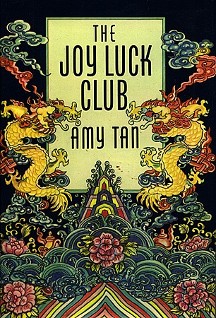
The Joy Luck Club

The Joy Luck Club by Amy Tan (1989)

A yearly re-read of mine, and one of my all-time favourite books is The Joy Luck Club. Although I know most of the stories by heart – the book is comprised of eight short stories linked together and interwoven into a larger overarching story – I read the book time and time again. The feelings invoked by the stories change every single time I read them. New memories are triggered, and new perspectives are gained with each “new” read.

I often get asked why I come back to this specific book, or what about this book makes it so interesting after all these years. For me, it is the relatability of every single character.

I am each character in a sense, as well as I’m not truly just any one of them. The characters are humanly flawed; they are likable and unlikeable, and they are dimensional in every facet of their decisions. Much like humans are in real-life, we can understand their reasoning, and therefore we get to know them with each new dialogue, thought process, or action they perform. Through this understanding, we unconsciously unlock our own memories and emotions. With each new time that we root for a character, or disagree with a character, we are faced with the “why” that comes up for us. We are forced to delve into our own understanding of the story and the feelings that surround it in our own life. 

The Joy Luck Club follows the lives of four women, and their journey from China interwoven with the lessons they hope to bring for their daughters in America.

Beautifully written, the short stories impart the wisdom that is universal in every single parent – the dreams of a better life for their children learned from their mistakes. As a daughter of immigrant parents, I was sheltered from my parents’ pain and struggle. I grew up not truly understanding where I had come from, and usually misinterpreted my parents’ intentions for my future. I am so deeply touched by the stories in this novel because they are words that my parents have never had the want to share with me, so as to protect me from the past.

In America I will have a daughter just like me. But over there nobody will say her worth is measured by the loudness of her husband’s belch. Over there, nobody will look down on her, because I will make her speak only perfect American English. And over there she will always be too full to swallow any sorrow! She will know my meaning, because I will give her this swan – a creature that became more than it was hoped for.

Amy Tan, The Joy Luck Club
Swan, Wikipedia

In reading this novel, I can see my parents, and all parents through another lens – the lens of a human, who didn’t necessarily know exactly what they were doing when they started a family, or a new life in Canada. We have the misguided perception that our parents are to be idealized, or that they are somehow superhuman. The humanization and relatability of every single person is so deeply woven into the theme of this novel, which is an integral part of why it was such a huge success. I feel that I am reading my life and the life of my parents, and of all parents. I know that I am reading the life of daughters, mothers and friends. I feel that by inviting in my emotions, and experiences, the story belongs to me

Because sometimes that is the only way to remember what is in your bones. You must peel off your skin, and that of you mother, and her mother. Until there is nothing. No scar, no skin, no flesh.

An Mei, The Joy Luck Club

What captivates me about a story is that sense of belonging; you want to feel that connection. You want to read a story that isn’t necessarily yours, but to have that ability to make it true to you.

These are the stories that drive meaning. These are the stories that last because they get to be continually recreated by you, time and time again.      

Design a site like this with WordPress.com
Get started