Categories
Uncategorized

Visual Storytelling for Mental Health

Visual storytelling combines the power of human nature (how we establish patterns from experience to find meaning) with science (we retain 10% of what we hear, but 65% when visuals are included) to lead to greater engagement with audiences. Consider the value of tv commercials over radio ads:

  • Visual storytelling helps understanding complex data efficiently by delivering more impact as the result
  • Visual data provide a narrative that is more compelling and drives the audience to take actions
  • The concept incorporates excellent writing, vibrant visuals that bring life to the entire atmosphere of the story

As an example for this Infographic, I looked at mental health from a non-profit perspective and used emotions to drive engagement.

5 Tips to Weave Emotions and Storytelling In Your Copy

  • Make Your Reader the Hero
  • Keep it Minimal
  • Take Your Audience into The Moment With You
  • Understand The Conflict in Your Audience
  • Don’t Reinvent the Wheel – Use Story Frameworks

Lessons Learned

The hardest part of creating the Infographic was following my own advice. I wanted to include examples to demonstrate what I was referring to. For the second point, Keep it Minimal, I wanted to include that meme:

But that would have been about me, and not about them (the audience).

Conflict in Your Audience

For the fourth point, I wanted to provide an example of a current event, to show that putting mental health first takes strength, courage, and sometimes sacrifice. Here are the Tweet and news story that demonstrate that.

The news story behind the Tweet

But I caught myself in time and entered some pictures of flowers and trees instead. Mental health can be about a lot of things, such as gender identity, grieving, disability, isolation, financial difficulties, to name a few possibilities. The Infographic is a roadmap; I had to remember that and remove references to destinations.

References:

N2016. AdEspresso. “Master the power of storytelling in your ads.” https://adespresso.com/blog/master-the-power-of-storytelling-your-ads/

2018. Infographic Design Team. “10 trends and principles of visual storytelling that every designer must follow.” https://www.infographicdesignteam.com/blog/trends-and-principles-of-visual-storytelling/

Zamperin, Rick. “Rick Zamperin: Simone Biles’ mental health is bigger than an Olympic medal. https://globalnews.ca/news/8063928/rick-zamperin-simone-biles-mental-health-olympic-medal/ Retrieved August 1, 2021.

Categories
Uncategorized

A Dive Into Infographics

Simply put in Wikipedia, “Infographics are visual representations of information, data or knowledge intended to present information quickly and clearly”.

Infographics are effective in communication and marketing as it allows the reader to visualize the narrative of the story in a flow that should be easy to follow.

I attempted my first infographic to display key principles of good storytelling. I wanted each point to catch the readers attention, have value, and be easy to understand.

Seen below:

I also shared my infographic on twitter:

https://twitter.com/RachelErinHodg1/status/1421614488474865666

From the knowledge gained, I would like to utilize infographics again!

Categories
Uncategorized

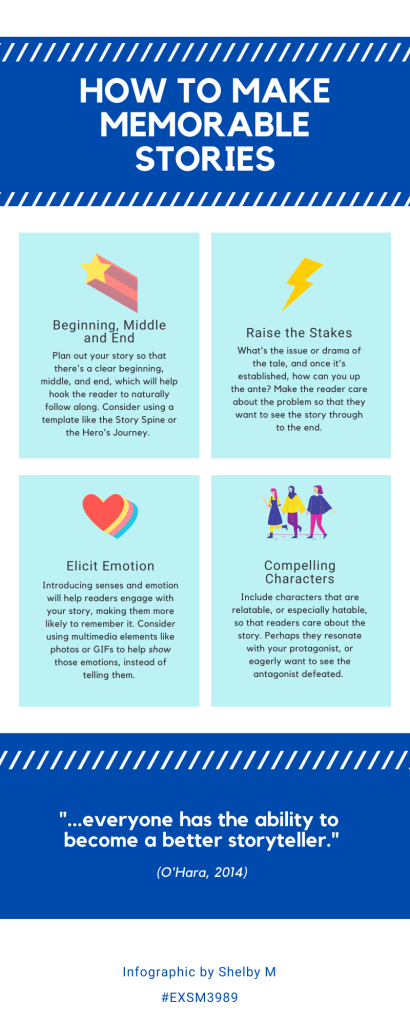
How to Make a Memorable Story

If your readers remember your story long after they read it, it must be pretty good. It means they’ll recommend it to others, perhaps even sharing it on social media and drawing attention to your brand or business. Without being able to tap directly into your readers’ brains, how do you increase the likelihood that your story will be memorable? A good start is to have an organized timeline, high stakes, emotion, and compelling characters.

Read more about each element in this infographic:

What stories will you write? Will your readers remember it? Good luck, authors!

By Shelby M.


Reference:

O’Hara, Carolyn. 2014. Harvard Business Review. “How to tell a great story.” https://hbr.org/2014/07/how-to-tell-a-great-story.

Categories
Uncategorized

The Essentials of Storytelling

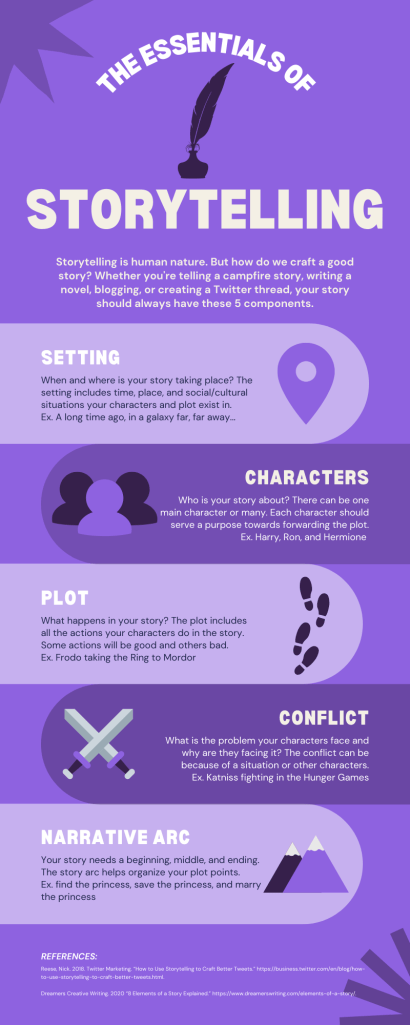
Telling stories is human nature. For as long as there have been humans, we’ve been telling stories. We created pictograms on cave walls, shared oral stories, wrote novels and plays and movies, created songs and dances. In the 21st century, we brought our storytelling online to share with the world. We wrote blogs and Facebook posts and Tweets, created YouTube videos and Vines and TikToks.

Each of these stories are unique and different. They’re aimed at different audiences and created in different mediums and shared in different formats. But despite all the differences, all stories share the same basic principles. So no matter if you’re writing a Twitter thread or the next best-selling novel or blockbuster movie, keep these 5 storytelling essentials in mind:

  1. Setting – where and when
  2. Characters – who
  3. Plot – what
  4. Conflict – what and why
  5. Narrative arc – how
Click here for a free PDF copy

Categories
Uncategorized

Storytelling

For this Storytelling infographic wanted to incorporate some of the basic ideas of the Story Spine as well as Pixar’s storytelling rules in this course. Those really resonate with me and they provided a new view of concepts to apply the work I’ve done in the past and currently.

In my past work as a journalist the focus was on the 5Ws the who, what, when, where, why and writing in an inverted pyramid. However, writing like that means packing the entire story into the lead paragraph – much like a single tweet – and then explaining more about the story after. 

In corporate communication roles in which you tell the story of an organization and the human or character elements can be missed. However, people don’t want stories about organizations, they want to connect with people so the challenge is to always find ways to tell those stories at the level of an individual person.

Now, with so many ways to communicate digitally it is still important to stay focused on telling good stories, regardless of medium, platform or technology.

Categories
Uncategorized

One Step At a Time

One of my favourite concepts I’ve learned so far in this class, has been the Story Spine. It’s such a simple concept, and so easy to follow if you’re experiencing writer’s block or struggling how to start (or finish) a story.

When tasked with creating an infographic, I knew that using the Story Spine would translate to a digital infographic very easily as at its core, the Spine is a set of blocks upon which to build a story. There’s a natural progression to the Story Spine where the previous concept leads into the next, which is where the reader’s eye travels naturally in an infographic.

I found the template on Canva, which was perfect with the book character at the bottom to further illustrate the storytelling subject. I added the circles on the left side as I needed to add an extra heading to each concept. I feel it’s a simple graphic that helps illustrate the simple concept of the Story Spine.

Categories
Uncategorized

Planning a great story? Start here.

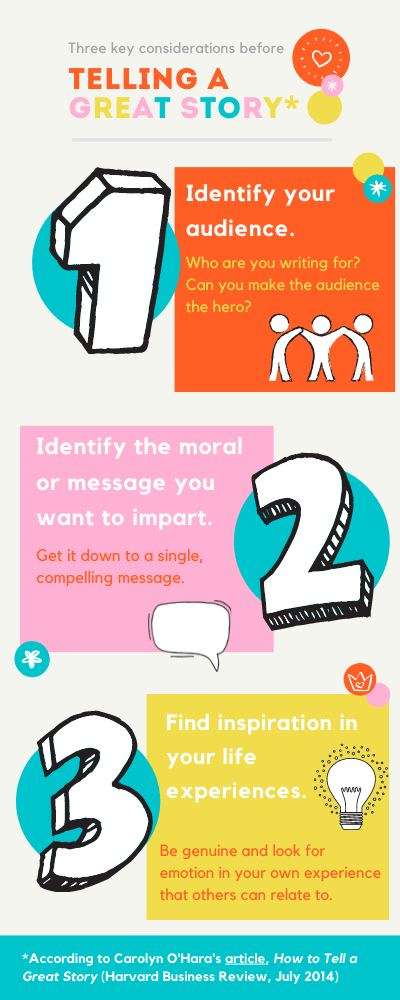
Every story starts with an idea. But, to make a good story great, ask yourself these questions as you work through the story planning process.

Who are you writing for?

What do they look like? How do they behave? By identifying your audience before you start writing your story you can weave in aspects that are important to them, and reflect their values. Look to make the audience the hero, if possible.

What’s the message?

Summarize your key message into one compelling statement. Think about the moral of the story and avoid confusing your audience with multiple messages.

What do I know about this?

Avoid making yourself the hero (leave that for the audience!) but include your own experiences as much as possible. Highlight the emotion of your personal struggles, to help others relate.

Reference: Carolyn O’Hara, How to Tell a Great Story, Harvard Business Review.

Categories
Uncategorized

Storytelling for effective communications

People love stories. From the bedtime stories we grew up with to getting the hot gossip from a coworker. Our brains are designed to respond to stories and imagine ourselves as the main character.

Using storytelling in communications

However, sometimes it can be difficult to keep the principles of storytelling in mind when we work on corporate communications materials. We get lost in the technical speak and the features of our product and service, rather than placing our target audience as the hero of the story.

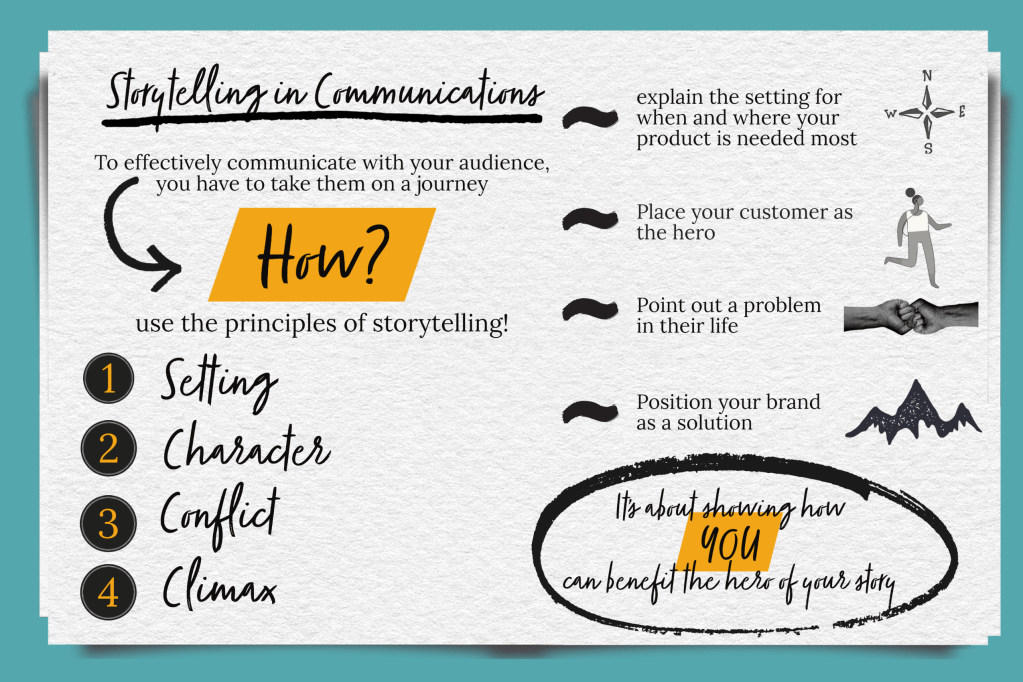
It’s important to always remember the key elements of storytelling when we’re delivering a message:

  1. Setting
  2. Character
  3. Conflict
  4. Climax

No matter what service, product, idea or message you’re trying to deliver, your brand needs to show how you can solve your customer’s problems and make their life better. 

For more specific tips on how to use these principles in corporate communications or marketing, check out this infographic:

Be creative

Storytelling opens up a world of possibilities to engage with audiences and build relationships. These elements are just building blocks for an endless amount of stories in different genres, mediums, and perspectives.

As long as you’re focusing on ways for your customer to star as the hero, and offering interesting, attention-grabbing and meaningful content, you will connect in a way that benefits you and your target audience.

Categories
Uncategorized

Planning a Story

How do you plan a simple story?

Be it a meme, infographic, TikTok, tweet, or an Instagram story, there is a map a creator can take to make an idea a story.

I have an idea

An idea is just the beginning. It can be the message the author wants to tell, or it may just be a character or event.

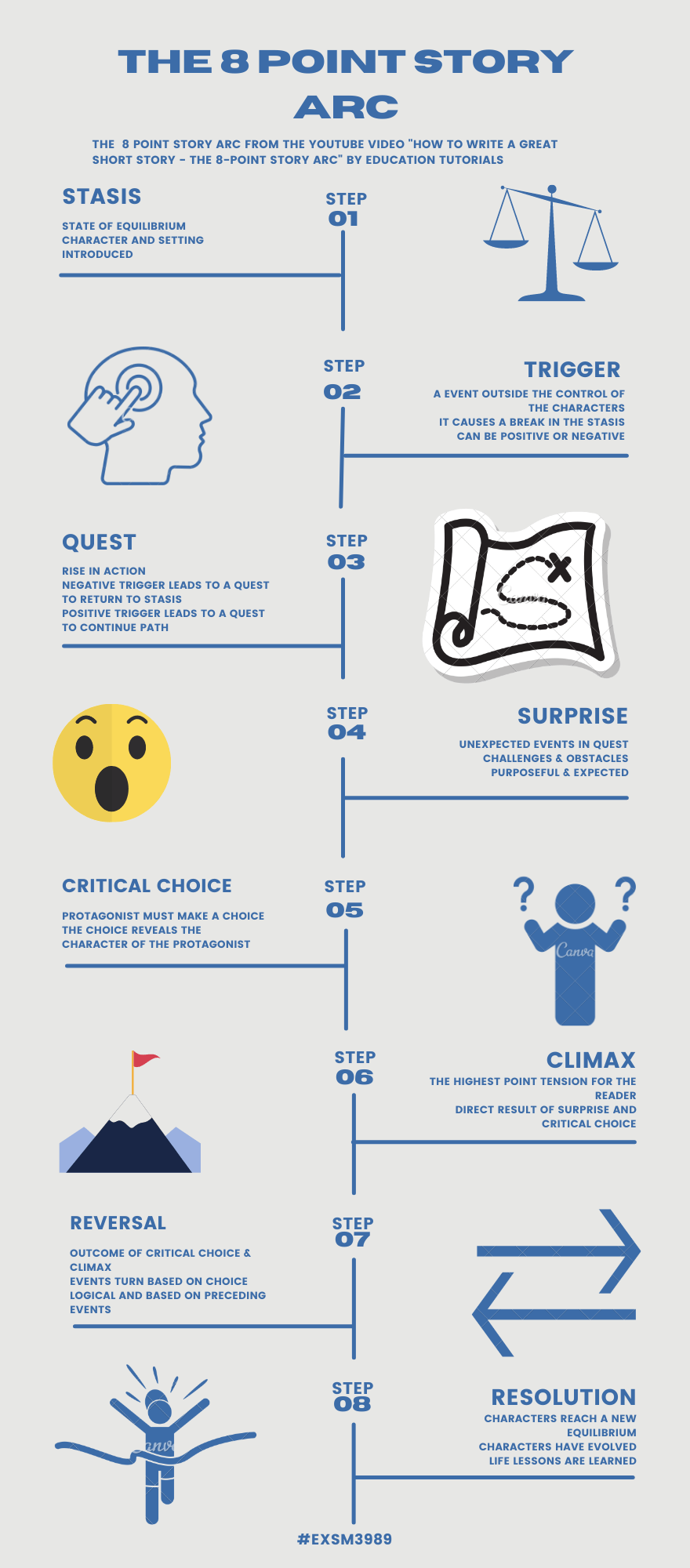
Educational Tutorials’ YouTube video “How to Write a Great Short Story – The 8-Point Story Arc” shows us how we can map out a story.

STASIS

The characters and setting are introduced.  Here the reader learns who the story is about and where the story takes place.

All stories have a beginning, middle, and end. 

TRIGGER

To move from stasis, there is a trigger.  This is an event beyond the protagonist’s control that gets the story moving.  It can be a good thing, like falling in love. Negative events, like a murder, can also start a chain of events.

QUEST

The events that take place due to the trigger take the form of a quest.  The character that fell in love is trying to woo their love, or maybe they need to solve a murder.  The quest can be one event, or many events that build on previous events.

SURPRISE

The quest usually ends in a twist, or surprise.  The result is unexpected to the protagonist, but logical to the reader.

The surprise that awaits the protagonist in their quest leads to them making a critical choice.  The choice made reveals the character of the protagonist. 

CRITICAL CHOICE

How the protagonist handles the choice builds tension, leading to the climax of the story. 

CLIMAX

The climax is the highest point of tension in the story.  The protagonists world has changed as a result of their choice.

REVERSAL

The logical result of the climax and critical choice is the reversal.  This is the change that happens to the setting and characters.

RESOLUTION

Once the dust settles, we have resolution.  The characters have crossed the finish line, and reached a new level of stasis.  Life lessons have been learned, and the story has end.

Categories
Uncategorized

Not sure how to start??

Story telling is as old as humanity. There’s always been a story to tell. There is nothing more enthralling than watching/reading/hearing a good story.

Mother reading a book to her children

For some of us, storytelling comes naturally. For others… it might be a bit harder. That’s where the story spine could come in handy!

Developed by Kenn Adams, the story spine breaks stories into a step by step bare bones structure that provides a roadmap for a storyteller.

When preparing to tell a story, it’s totally fine to start with something like ‘Once upon a time… there was a girl that liked to weed the garden.’

Weeding the garden

By following the storyline through the beginning, to an ‘Event’ where something happens, through the middle of the story to the climax and end. Once you have your main story points, you can start to develop your characters further, introduce new characters, and describe the world of your character.

View the story spine below!

The Story Spine

Reference: Back to the story spine by Kenn Adams. https://www.aerogrammestudio.com/2013/06/05/back-to-the-story-spine/

Design a site like this with WordPress.com
Get started