Categories
Uncategorized

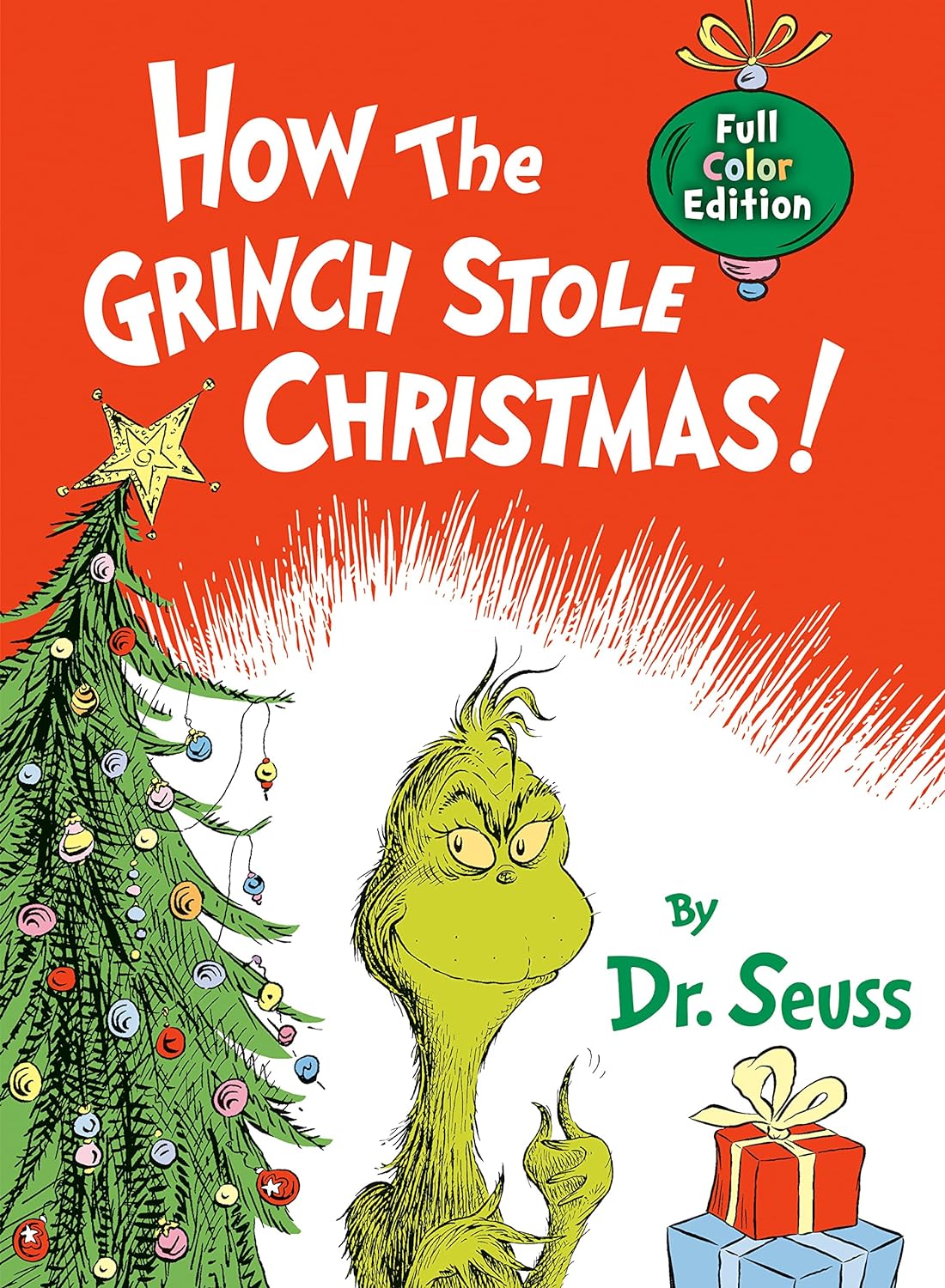
Why the Grinch Stole Christmas

Everyone knows the classic tale of the hairy green outcast that plans to ruin Christmas for the whimsical town of Whoville. The story is not so much about How the Grinch Stole Christmas, even though it is the title, but Why the Grinch Stole Christmas and What he learned in the process. This story is simple, it follows a well planned story spine, is relatable and even though the main character is a grumpy, selfish, beast, in the end we all fall in love with him. But why is that? Why does this interest us? Lets take a closer look at the mechanics of the story.

Once upon a time…

The story begins by describing a secluded Grinch. The author, Dr. Seuss, paints a picture of an outcast that is not like others. “Every Who down in Who-ville liked Christmas a lot… but the Grinch, who lived just north of Who-ville did NOT!”

His location is outside of the town. His name is and identity are different; he’s a Grinch not a Who. And he is the only one that does not like Christmas. While I don’t always like to admit it, there have been times in my life where I felt like I didn’t fit in, like I was not part of the group. Making that connection with the character, makes it feel like we are involved in the story.

Every day…

As the story continues, we learn that every Christmas the Whos’ wake early (disrupting the Grinch’s sleep), quickly open their presents and make a lot of “Noise! Noise! Noise! Noise!” They are then described to sit down to a feast of “Who-pudding, and rare Who-roast-beast”. And if that weren’t enough they would then join hands and start singing!

When it seems like everyone around us is jolly and enjoying all the events, festivities, music, materialism of the season but all we feel is stress, chaos, and empty wallets. I think this one of the reasons this story is so powerful as there are so many that can relate to how the Grinch feels like an outsider, all alone in the craziness of the season. If it wasn’t already, by now the readers interest is peaked. We have an understanding of why he is so grinchy but what will the Grinch do?

But, one day…

For the Grinch this is too much to bare “I must stop this whole thing! Why, for fifty-three years I’ve put up with it now! I MUST stop this Christmas from coming!… But HOW?” All of a sudden, the Grinch got an idea that would finally break the Christmas routine for the Whos’.

This is where the Grinch is able to break the routine he has become accustomed to. He is no longer willing to endure the joy of the Whos’ and has decided to take action. The storytelling is a bit suspenseful here as the author doesn’t tell us exactly what the idea is and is a great way to keep the reader engaged.

Because of that…

The Grinch now must put his idea into action. First, he dresses the part “What a great Grinchy trick! With this coat and this hat, I look just like Saint Nick!” He even enlists the help of his sidekick, his dog Max to play the part of the reindeer.

At this point in the story we are not too sure what the Grinch is up to but we appreciate his creativity and ingenuity. Our curiosity keeps us engaged, which can be challenging today with our short attention spans. This book was original published in 1957 but this story has a strong narrative that promises to keep the readers attention.

Because of that…

They journey to Whoville on a sleigh with empty boxes and sacks in anticipation. In a rather clever way the Grinch imitates Santa Clause and goes down every chimney and clears out every home in Whoville. “Then he did the same thing to the other Whos’ houses. Leaving crumbs much too small for the other Whos’ mouses!”
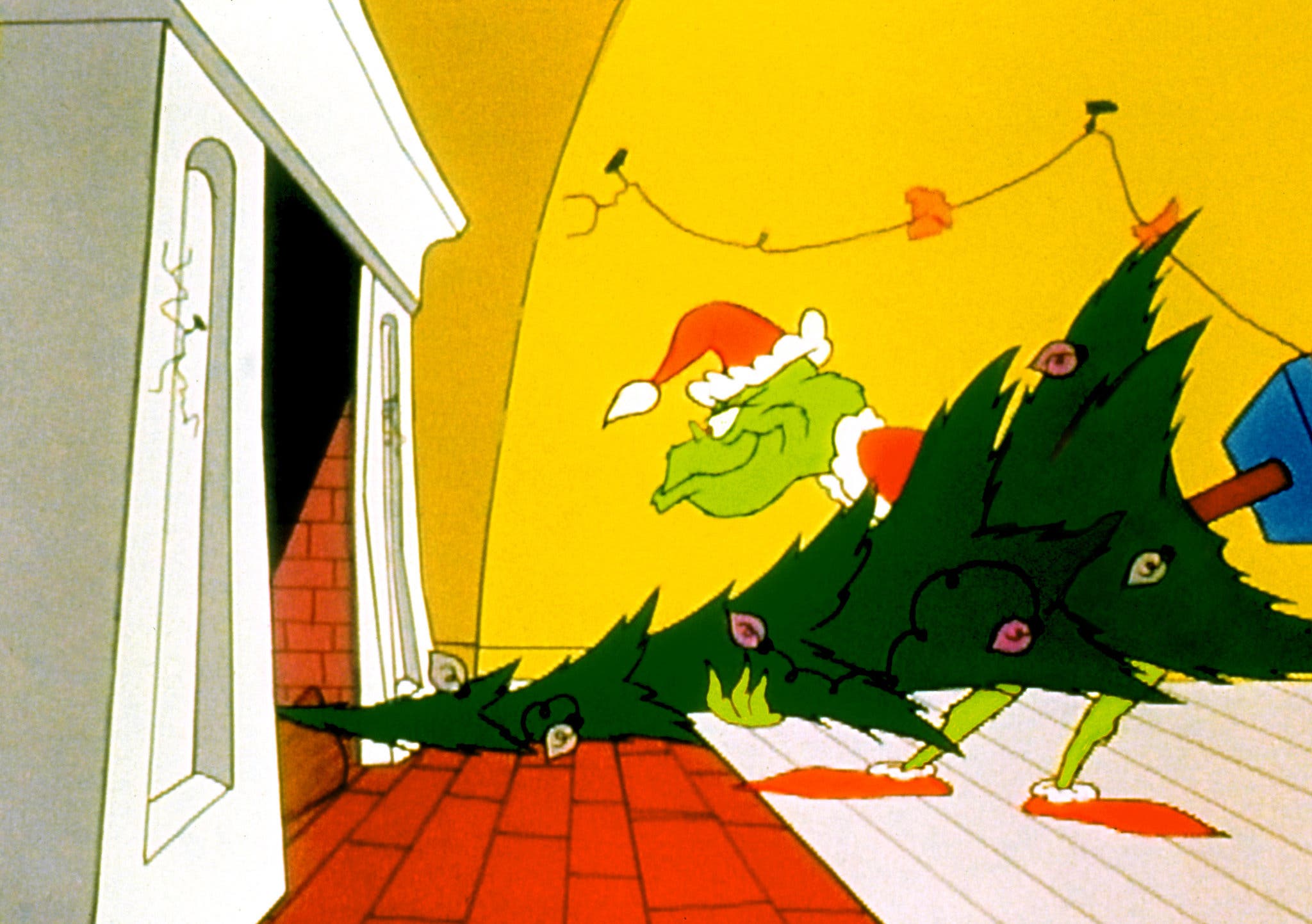
While the thought of breaking and entering another persons home is not something that most of us would condone, we can relate. There has been times in everyone’s life when we have been driven to the brink of insanity and had thoughts of doing things that are questionable. Watching someone act on those thoughts is interesting. To anyone that has ever thought “what if?” this is a glimpse into that reality. This is yet another way the reader feels involved in the story.

Because of that…

Once their mission is complete they travel back up north to dump everything that was collected. The Grinch is filled with excitement in anticipation of what all the Whos’ will find when the awake. “They’re finding out now that no Christmas is coming!” He waits to hear their disappointment, so he can rejoice in their sorrow.

We know that the climax of the story is coming and we are anticipating the outcome. We expect that the Whos’ will wake and be saddened by what they find, much like the Grinch.

Until finally…

To the Grinch’s surprise what he hears is joy. He is confused that Christmas still comes even though he had stolen all the material items that make Christmas. But then he comes to the realization that ” ‘Maybe Christmas,’ he thought, ‘doesn’t come from a store. Maybe Christmas… perhaps… means a little bit more!’ ” The Grinch then takes back all the presents and food and decorations to Whoville.

This is where the theme or message of the story is revealed. And it is the opposite of what we had thought would be the Whos’ reaction. It instructs us and provides meaning that, while at Christmas time there are presents and decorations and food and drinks and materialism, that is not the true meaning of Christmas. It is about the friends and family you share your time with. It is about giving. It is about celebrating together. It is about community. It is about believing in the magic that we all have inside of us. This is where I get those warm fuzzy feelings of Christmas.

And ever since then…

The Grinch then joins the Whos’ in their celebration. “And he… HE HIMSELF…! The Grinch carved the roast beast!

This is the resolution of the story. It eludes to the fact that from that time forward the Grinch participates in Christmas with the Whos’. And I’d like to think that he is no longer an outsider. The Whos’ accept the Grinch into the community the whole year. In the end this leaves us with a sense of happiness and the belief in the magic of Christmas. The ending inspires us to live the true meaning of Christmas.

A Classic Christmas Tradition

As you can see the story has a good foundation. The story spine shows the simplicity of the timeless tale. And the 4 I’s of good storytelling definitely hit the mark. Because of this How the Grinch Stole Christmas has had longevity and a timelessness that has been proven time after time in the many different adaptations of the tale. From the first animated cartoon, to the live action movie, a full length animated movie and even a Broadway musical, audiences through the generations have embraced the true meaning of Christmas.


Categories
Uncategorized

Hyprov – A Live X Feed

Having hypnosis and improve come together is like a perfect storm. The power of relaxation and meditation, with the only thing holding you back is your morality and the power of suggestion. Mix that in with the force of improve with a Canadian legend, and you have yourself a winning combination. Hypnosis shows can be a little lackluster and repetitive, but when you have the comical mind and imagination of Colin Mochrie, it takes it to the next level!

I was lucky enough to have seen Colin Mochrie’s Hyprov comedy show for our company’s Christmas Party this year, and it was one for the books! I’m a 90’s baby, so I grew up watching Whose Line Is It Anyway? and I couldn’t pass up the opportunity to experience an inkling of the cult classic. The show was hilarious and the volunteers were great and it’s what prompted me to live tweet a segment from the show.

When I was live tweeting, I wanted to follow a few simple principles of snippet storytelling. I wrote the way I talk – I wanted to share my experience with others, and I wanted others to be as excited as I was. I wanted my thread to have intent and to set the stage for the joke. I tried to be relatable with how I posted, and wanted to build up the suspense for the zinger that one of the volunteers had. I tried to evoke a reaction/emotion, be it warm and fuzzy for remembering the joys of Whose Line Is It Anyway? or the absolute hilarity that ensued from the joke. I added hashtags where I could and also included visuals that would hopefully catch the eye and used punctuation in a way that would maybe stop someone from scrolling and be interested.

And now for a classic Whose Line Is It Anyway? moment #arctictern

Categories
Uncategorized

A walk to the Off-leash Park

After. pretty crazy-busy week, we’re enjoying a bit of a lazy Sunday. Marshall, my seven-year-old 95-pound house-horse (he’s actually a rather handsome Doberman Pinscher/American Bulldog cross), is relaxing pretty hard in my bed, watching me type on my laptop. I’m trying to think of different stories I could live-tweet for my Digital Storytelling class. 

The bedroom window is open, letting in a gentle breeze. At the honking sounds of distant migrating geese, Marshie perks up, and stares out the window. Then he turns back to me with a whine and a look of askance: “Hey dad, it’s sooo nice today, why don’t we go for a walk?” I look at him for a long second, thinking maybe I should get outside, since I was fresh out of inspiration. “Yeah, sure thing bud, let’s go find your leash.”

After having reading, with interest, FRACTALS analysis of Buzzfeed headlines that garner more shares and likes – animal/pet stories that create joyful emotions seem to rank high – I thought of using Marshall as my furry muse.

I then put together a quick outline using the tips from the tutorial video “How to Write a Great Short Story – The 8-Point Story Arc:

  1. Stasis: A lazy Sunday afternoon in November for Marshall
  2. Trigger: A nice winter’s day, an open window, and the sound of geese makes Marshall want to go for a walk
  3. Quest: Finding and putting on his leash, heading to the off-leash dog park
  4. Surprise: The enthusiastic sniffing of things along the walking trail; sadness of being all alone at the dog park
  5. Critical Choice: Leaving the off-leash area as no-one else was there
  6. Climax: Meeting other dogs on the way back, saying hello!
  7. Reversal: Glad to be back home because it getting colder now,, and treats
  8. Resolution: A tired but content dog, happy to be back lying down on a warm and cozy bed, enjoying snuggles.

This story is a daily straightforward, domesticated Heroes’ Journey, albeit from a doggy point-of-view. I tried to use Gary Vaynerchuk’s statement on good storytelling – whether through an action or an emotion, “the true test of storytelling is how you feel or what you do after you consume it.” I also applied Kenn Adam’s Story Spine structure to help build this expository narrative.

Now, Marshall is a very strong dog and a puller, so we had to get him a figure-eight leash, which goes around his nose and prevents him from straining and choking himself. Normally he hates it, and putting it on him is the most trying part of the exercise. However, today he complied with little fuss – good boy, Marshie!

“Let’s go to the dog park, bud.” Oh yes, he wagged, and promptly relieved himself against a nearby tree.

 As Eric Goldschein writes, “social media post is an informal means of expression. It should be accessible to anyone who wants to learn more about you or your business. Stay away from industry jargon and dense paragraphs and try to have fun with it.” I have tried to pay attention to the tone of my writing, making it more reflective of how I naturally speak – after many years of writing reports, it’s hard to loosen up.

Goldshein also talks about the importance of grabbing an emotional hold of your audience, hence using lots of pictures of my really, really good-looking dog (he’s so hot right now) as the main subject – let’s hope it’s working. 🙂

Check out the Twitter/X thread below:


Marshall is excited to get back to the warmth and coziness of his home. And to one of his favourite snacks – dill pickle flavoured pretzel sticks!

It’s been a good afternoon, and now back to lounging on the bed.

Categories
Uncategorized

Reviving a team? Hire a new coach!

On Monday, November 13, the Edmonton Oilers played their first game under new head coach, Kris Knoblauch.

What could have been an ordinary Monday was anything but after the Oilers management fired head coach Jay Woodcroft the day before. It was announced that his replacement would be a rookie NHL coach, Kris Knoblauch, who previously coached star player Connor McDavid. It was a controversial decision that many had issues with and created great anticipation before Monday’s game to see how well the team would do.

A (very) bad start

VANCOUVER, CANADA – OCTOBER 11: Brock Boeser #6 of the Vancouver Canucks celebrates after scoring his third goal on Jack Campbell #36 of the Edmonton Oilers during the second period of their NHL game at Rogers Arena on October 11, 2023, in Vancouver, British Columbia, Canada. (Photo by Derek Cain/Getty Images)

After a successful (yet not cup-winning) previous season, fans had high hopes for this year’s team. But disaster struck when they were humiliated at home by the Vancouver Canucks, losing 8-1.

The struggle continued and it was clear that some change should be which finally happened before Monday’s game against the New York Islanders.

For these reasons, I chose to live-tweet the highly anticipated event.

A new beginning

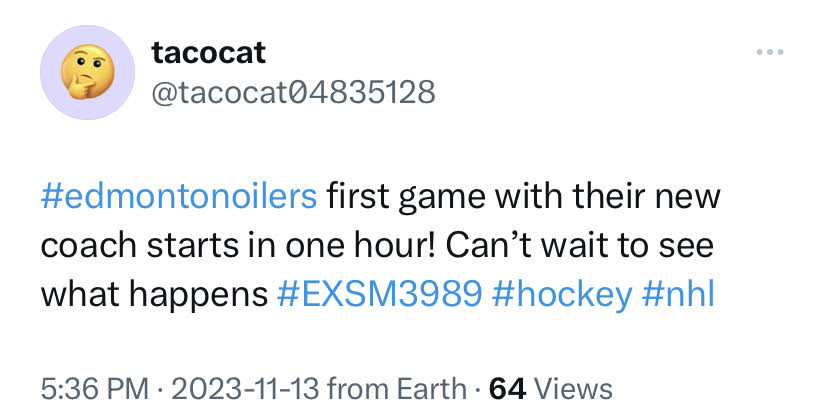
For Oilers fans, the enticement to follow the story was already there. I first tweeted that the puck would drop in one hour as suggested by Hayley Dorney in “How to use post threads“.

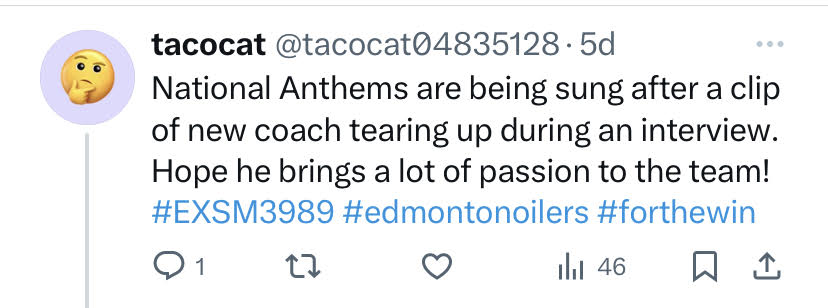
Sixty minutes later the entertainment began and I tried to enhance the emotion by tweeting about a clip of the new coach tearing up in an interview.

The Islanders scored after only 40 seconds which made this seem like it was going to be a sad story to relay. But by the end of the first period, it was tied 1-1 so it only made sense to play up the suspense in my live tweets.

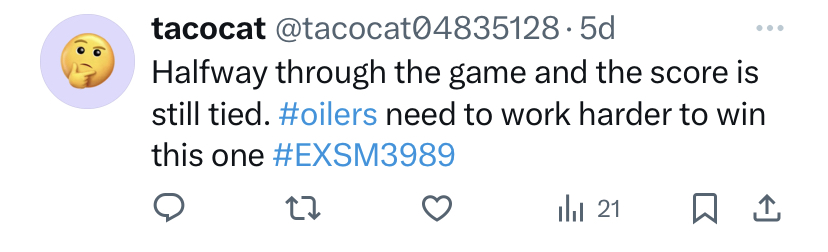
I made sure to include when the game was half over and signify the middle of the event so that it has the proper story arc. In that tweet, I also wanted to emphasize the importance of the team needing to work harder to overcome their challenges.

There was a conveniant cliffhanger in the game after the second period as the game was still tied and could go either way. Thankfully, for fans and this live-tweeting experience, the Oilers scored three goals in the third period. It was a fun time to live tweet the goals, keep the story enticing, and in the end a successful first game for the new coach!

Categories
Uncategorized

Live-Tweeting My Rewatch of ‘The Hunger Games’

Since I haven’t had much opportunity to get out of the house this past week due to illness, I thought I would rewatch Suzanne Collins’ film “The Hunger Games”!

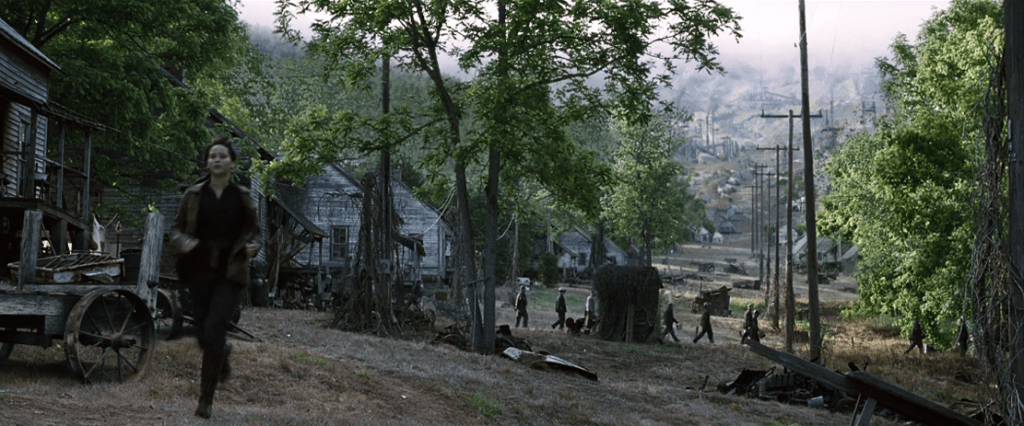
This Twitter Thread is a live-tweeting commentary on my rewatch of this movie. I gave a brief overview of the storytelling components and filmmaking methods. I also underlined my favourite scenes from the film and how they have stuck with me ever since I watched “The Hunger Games” for the first time!

Twitter Thread:

As I was creating this thread, I was careful to use language that was equivalent to the way that I talk! According to The Non-Writers’ Guide To Writing Better Social Media Copy, writing in the same language and tone that you would typically use to communicate makes your writing seem more genuine and natural. Since it makes a piece of writing more enjoyable and easier to read, I made sure to incorporate this idea throughout my thread.

Additionally, I used GIFS to make my thread more visually appealing and fun for the reader, maintaining the reader’s short attention span with images that are relevant to the message I’m trying to convey, creating a more entertaining piece. Using hashtags related to the story is also a technique I used to reach maximum impact and to target the sort of demographic I was attempting to capture.

In conclusion, I loved the idea of live-tweeting a Twitter thread to showcase my experience of rewatching ‘The Hunger Games’! The use of Twitter allows authors to write in shorter chunks, creating a more engaging platform to tell stories on! I would definitely consider embarking on this journey again and live-tweet some of my other experiences.

Categories
Uncategorized

Hallmark Christmas Festival

In one of my many jobs as a secretary for a local church, we brainstorm regularly how to engage the community as Sunday Church is certainly a thing of the past. We came up with the Hallmark Christmas Festival, trying to recreate the scenes of the movie, where the actors go into a Christmas Festival and string popcorn garlands or enjoy a deluxe hot chocolate and so on. We realized quickly we wouldn’t be able to pull if off all by ourselves, so we reached out to community organisations and business asking if they would like to offer a station in exchange for advertising for their business or organisation.

We decorated the church and were super excited when we had 4 other groups commit. In the end we ended up with even more! We advertised with flyers and on social media and we were happy with over 80 people showing up to participate in our #HallmarkChristmasKillam. Hopefully the “First Annual” of many more to come.

Here is my live tweet as we were getting the hot chocolate going, ponies arriving and people starting to set up their stations. Live tweeting a story is definitely not as easy as I expected! Follow along here:

Categories
Uncategorized

Dog Dinner Delight

I love dogs, and I enjoy hearing stories about them. Even Fractl’s analysis of Buzzfeed articles tells me that dogs are a top topic to talk about. So, a “live tweet” of an exciting event, well, for my dog at least, sounded like a good idea.

Piper telling me that it’s supper time.

Following Gary Vaynerchuk’s suggestion of storytelling in micro moments, my story technically unfolds over a relatively short period. However, when recounting it, I’ve broken it down and stretched it out, especially from Piper’s point of view. I thought this would make the story more interesting and fun. I included timestamps, which, hopefully, also added a bit of humor when reading about how some things quickly happened.

Eric Goldschein from “Social Media Today” emphasizes the importance of writing the way you talk. I did my best to achieve that through brevity and a bit of humor. In my short story, you won’t find jargon or complex language either, as I wanted to ensure that the story is relatable to the large number of people who are dog owners.

A dog literally starving to death after not having not eaten in 3 hours…

And finally, this is how I used the 8-Point Story Arc structure:

  1. Stasis: The normal, everyday life of Piper
  2. Trigger: The approaching supper time, marked by the clock and the anticipation building
  3. Quest: Piper’s quest for supper, which involves waiting eagerly, showing excitement, and eventually getting to enjoy the meal.
  4. Surprise: The level of enthusiasm and joy exhibited by the dog during supper time, adding a layer of unexpected delight.
  5. Critical Choice: The moment when I decide to feed Piper, leading to the climax.
  6. Climax: The climax is the actual feeding of the dog, with the first bite symbolizing the peak of anticipation and excitement.
  7. Reversal: The shift from the anticipation and waiting to the actual enjoyment of the meal, turning the focus from the buildup to the satisfaction of the dog’s hunger.
  8. Resolution: A content and happy dog and my satisfaction in quiet, peaceful post-dinner moments.

These narrative elements help structure the story and create a satisfying arc that engages the reader in the simple yet joyful experience of a dog waiting for and enjoying supper.

And without further ado, here’s the link to my Twitter thread: https://twitter.com/WalkeyTalkey_ua/status/1726031194142515269

Categories
Uncategorized

Unveiling the Mysteries of “The Fall of the House of Usher” – A Twitter Live-Tweet Story

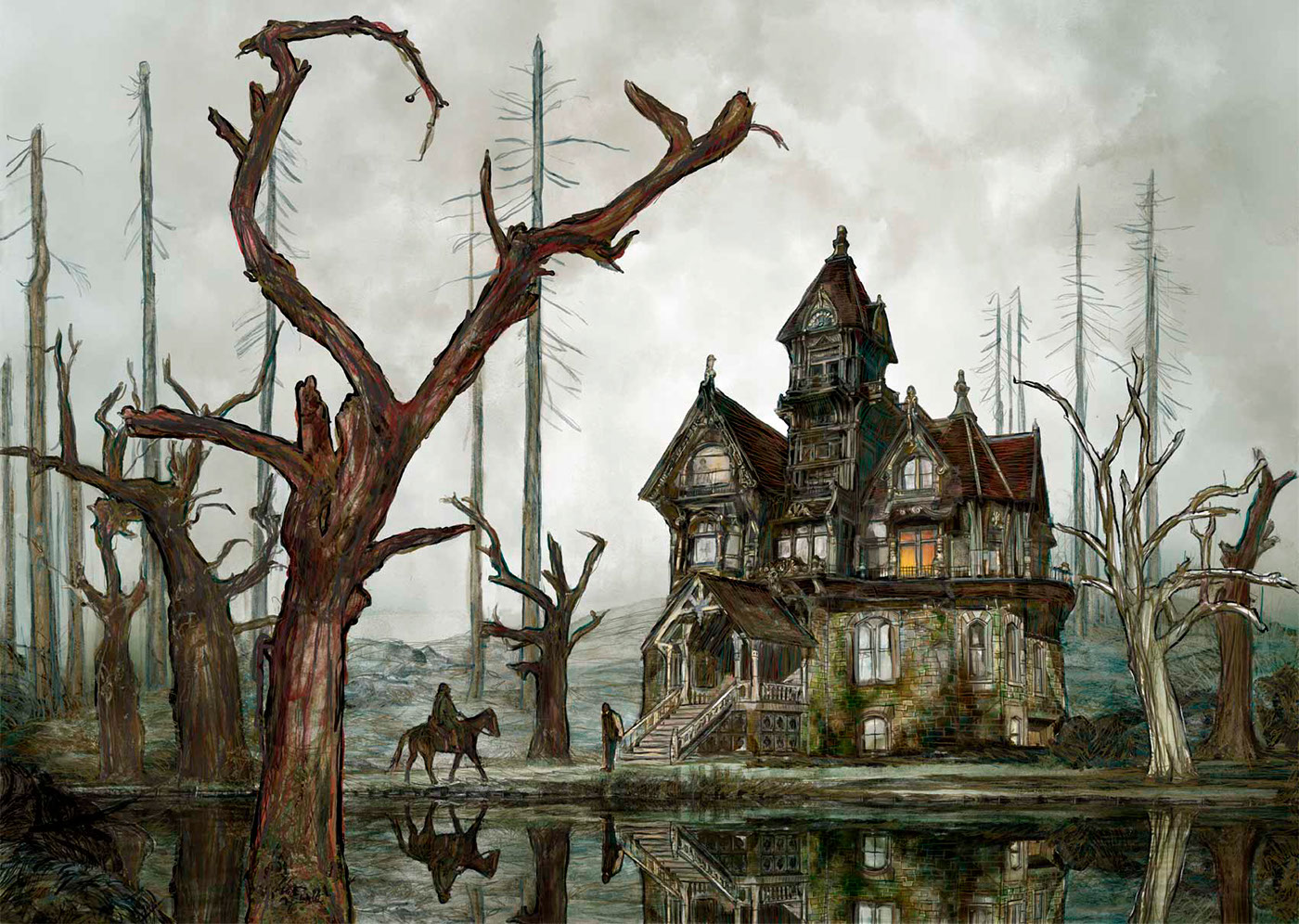
https://www.behance.net/gallery/44358589/The-Fall-of-the-House-of-Usher-by-Poe

Embarking on the journey through Edgar Allan Poe’s gothic masterpiece, “The Fall of the House of Usher,” my Twitter live-tweet thread aimed to capture the essence of suspense and unravel the dark tapestry of the Usher estate.

Twitter Thread: x.com/sa125559/status/1725638128105623968?s=20

Initially inspired by the Wilde quote in this week’s TEDTalk video, I thought about recounting someone’s first reading of The Picture of Dorian Gray. But, this would have been far too ambitious. A natural, and maybe easy, way out was to take the intrinsically imbedded suspense built into the horror genre as the framework for my live-tweet saga.

“The suspense is terrible. I hope it will last.” – Oscar Wilde, The Importance of Being Earnest

The live-tweet thread commenced with a sense of anticipation, reflecting the excitement and trepidation of exploring a classic work of literature. This opening was to capture the audience’s interest from the start, aligning with Gary Vaynerchuk’s advice on hooking the audience.

The tweets strategically unfolded with the plot developments; the escalating tension within the tale transferring to my own reception and recounting. This technique was used to keep the audience engaged and eager to discover the next twist.

The thread followed a (somewhat) coherent structure, dividing the story into clear sections—beginning, middle, and end. Each tweet contributed to the overall narrative and provided a progressive flow while maintaining suspense and intrigue.

Applying the principles of the 8-point story arc from the Educational Tutorials, the Twitter thread’s tone highlighted the heightened stakes and suspense in the story. Elements of the crumbling mansion, Roderick Usher’s parallel fate, and the foreboding prophecy added layers of interest.

I was expecting Eric Goldschein’s article to hammer home the importance of plain language, but was pleasantly surprised with his advice that resonates with my writing philosophy: Writing for your readers. I also tried to include visual elements, a most fun perk of the writing assignments for this course.

Live-tweeting Poe’s dark tale allowed me to experiment with storytelling in a condensed format. The challenge lay in capturing the atmosphere and suspense of each plot development within the character limit. The thread aimed to bring the haunting narrative to a digital audience, combining classic literature with the dynamic nature of online storytelling. Digital advents like tagging, gifs, and hashtags foster a sense of community and engagement, an additional layer to storytelling I think Poe would have enjoyed.

For the full experience, check out the live-tweet thread here.

Categories
Uncategorized

Working my way through A Conflict of Visions

I read to to try to understand the world around me, to find out the why of things. With all the conflicts and schisms taking place both in our country and abroad, a colleague of mine recently handed me a book by Thomas Sowell, “A Conflict of Visions” that discusses the ideological reasons of political struggles. “You should read this,” he said. “Things will start making a bit more sense, from a 30,000 foot view.” So I am doing as he suggested.

Now, I’m still in the early stages of this admittedly weighty book, but it increasing has my attention and is fast becoming a favourite. In the book, the author discusses how political controversies arise from many sources, but the long-term, generational conflicts seem to adhere to remarkably consistent patterns regarding the nature of reason, justice, equality and power. Sowell distinguishes between the idea of a “constrained” vision, where human nature is seen as “enduring and self-centred” and the “unconstrained” vision, in which human nature is “malleable and perfectible.” 

Visions are necessarily abstract and simplistic, he writes, and form the foundations upon which theories are built, a “pre-analytic cognitive act”, something we sense or feel before developing a theory concerning it. Sowell writes that the ancient Greeks ascribed volcanic eruptions, storms or other natural phenomena to spirits or gods, and as our understanding evolved, our vision of the world changed. Issac Newton had a different vision of the world, Darwin another – and so it goes. 

The author uses the Story Spine structure effectively, using a beginning, middle, and an ending to guide the reader through his argument. In the beginning he outlines the roles of visions, with a particular focus on the many social visions that relate to our political and civic lives, and how these affect governance models. Then in the middle, he discusses the ongoing conflict of visions taking place in our society (think Culture Wars) and around the world, by grouping them into constrained and unconstrained visions, with each vision coming to “conclusions that are the logical consequences of its assumptions” leading to repeated conflicts. Sowell ends with a wide-ranging discussion on the actors involved with promoting either vision, their biases and ideologies and social/emotional attachments to their points of view. 

The author also uses the Persuasive Story Pattern throughout the beginning, middle, and the end sections, first laying out the current state (what is) and then outlining what could be, and provides plenty of facts and examples from the social/political sciences and social philosophy to back his claims. The language used, while academic, is fairly straightforward in presenting complex ideas in a relatable, easy-to-understand fashion, which I appreciate.

Thus far, I am finding this book to be quite illuminating; however, I do have a mild criticism. I feel the author would have likely create a more persuasive series of arguments if he had used identifiable characters, settings, and better utilization of the classic narrative arc to establish his arguments – to give them more emotional weight in order to drive his point home

I am looking forward to finishing this book to get a more nuanced insight into the current events taking place around us, and to avoid getting drawn into “taking sides” or polemical thinking that seems to be all the rage these days.

Categories
Uncategorized

The Movie That Gave Me All The Feels

Like most, I love me a good movie. It’s nice to be able to sit down and forget about reality for a bit and dive into the life of something or someone else.

I watched a highly anticipated movie when it first came out in 2009, and to this day, it left a lasting impression on me. I remember feeling inspired, in awe, there was love and loss, conflict and resolution, and had a good, strong narrative. I remember feeling like I was having an existential crisis afterwards. The feeling and inspiration of wanting to do more.. be more.

So which movie gave me all these feelings?

The highest grossing film of all time, James Cameron’s 2009 Avatar.

Emotional Connection

The Na’vi people have a word for “bond” or “connection” and it’s called Tsaheylu – a mental connection to one another. This connection in a way, was brought to life, when experiencing this movie for the first time. You felt like you were a part of the the character’s development and the trials and tribulations of Jake Sully, Neytiri, Dr. Grace Augustine, the Na’vi people, and the creatures of Pandora. Each with their own unique layers, motivations, and struggles. You had characters you fell in love with and were rooting for, and you had the villains you despised. The emotion put into every single detail of the alien environment, music and characters is fantastic and the story it told was remarkable. The connection between the current real world encroachment on our ecosystems is also very prevalent and really gives you something to think about and reflect upon.

Visually Captivating

This movie was innovative and visually stunning especially for it’s time being released in 2009. The movie transported you to a world unlike anything you’ve ever seen before. The colors, CGI effects, movements, symbolism, and the elements of spirituality all tied in to create the most beautiful and captivating cinematic experience. During the plot development in the beginning of the movie (just when you thought the visuals couldn’t get any better) you’re introduced to Pandora at night. The subtle lighting cues and the experience of the bioluminescent environment is like something out of a dream. Avatar was pinnacle in the film industry, as it was one of the pioneers in 3D technology.

The Plot

The film’s plot follows a classic formula of an outsider thrown into a new world facing conflicts, and ultimately finding themselves aligned with the indigenous people. While this theme is not entirely original, Avatar manages to create a compelling narrative with a strong environmental message. The themes of corporate greed, exploitation, and the destruction of nature resonate, and they serve as a reminder of the importance of preserving our planet. The story is captivating, gripping and suspenseful – blending science fiction, action, and romance in a way that keeps you involved and on the edge of your seat from start to finish.

It’s a true masterpiece in it’s own way and it will leave you in awe long after the credits have rolled.

Design a site like this with WordPress.com
Get started