Well, my summer resolution is to explore all of St Albert’s 99.5km of trails is well underway! I’m always wondering why can’t they just make that extra 500m to get 100km? Come on St Albert. Despite the foreboding clouds, I headed out to tick off another walk along the fabulous trail system.
St Albert’s trail system
Tonight the Erin Ridge Ravine!
Completely to my surprise, tonight’s walk included something unexpected.
Vibrant communities have their own way of expressing themselves, and nearby residents have added what could be described as an eclectic art installation to this trail. The community has done a wonderful job of adding something truly unique and fun to their local environment, that encourages others to add their own touches.
We know as #EXSM3989 students a surprise is an important device that can be used in an engaging story.
Which when coupled with suspense can captivate readers…
I attempted to build a bit of suspense around the unexpected find. Using a mini cliff hanger, which is an important, yet sometimes considered cheap and overused as a writers’ tool. Hopefully I didn’t fall into that trap!
We know the medium of Twitter can accentuate the cliff hanger by building up to the unexpected happening or surprise in one or two tweets. Also, a ‘beat’ much like comedic timing can be added, perhaps a GIF to further build the excitement or suspense. The big reveal then happens in subsequent Tweets, which I tried to employ!
You can read all about my unique discovery it in my latest twitter thread here:
Off out for a stroll on the St Albert trails #EXSM3989
We’re lucky to have found a dog as great as Winston. For more than a year we sent in application after application without ever hearing anything back from the rescues and animal welfare groups. Then one day we came across an ad – a family had to rehome their puppy after a month because their baby was allergic to him.
Winston is loving and forceful about it!
We have another Boston who is 8 years old and I always remembered him being easy. While he has taught Winston how to be a polite dog and how to play, one thing we had to learn was how to help Winston through separation anxiety. This live Twitter feed walks the reader through the first day that I put up a gate so Winston couldn’t spend the day with me while I worked from home.
“What needs to happen before people go back to normal life is begin social distance inside of the house. Let’s say, if the dog follows you 100 times, don’t let him follow you 50 times,”
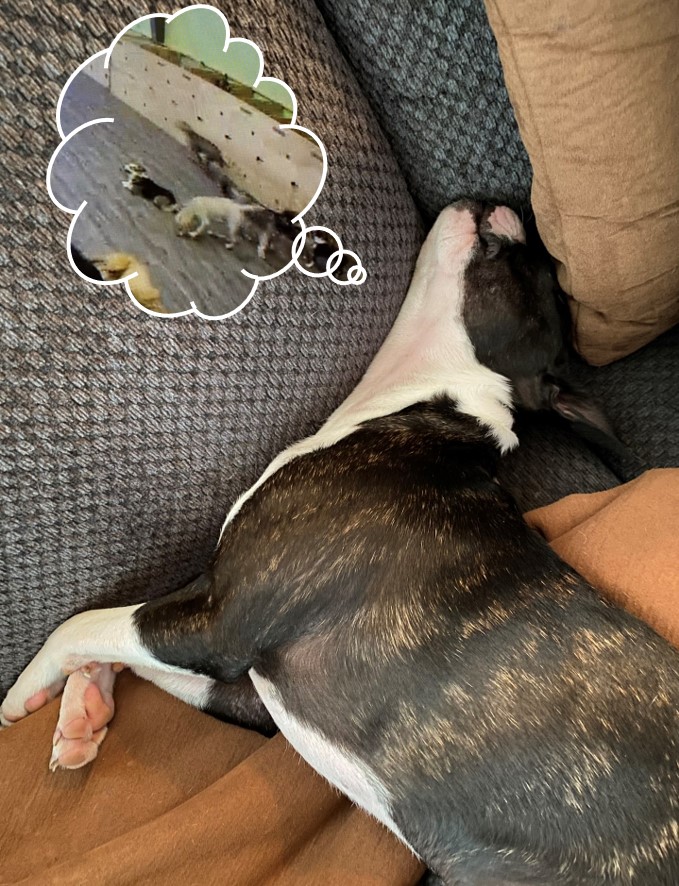
I’m certain Winston dreams of doggie daycarewhile I work.
I wanted to explore a variety of common themes in this exercise. This topic is relatable in 2022 as people struggle with transitioning back to work with a pet who is used to them being around. My concern about my home being destroyed, and fear of the unknown when all I hear is silence, both build up tension and suspense. Seeing what a good boy he is being allows the reader to feel all the emotions with me when I see he is doing some surprise activities when I check on him. It couldn’t be much more authentic because I was really living it! And there is a sense of urgency as I worry about an item he finds and chews.
To help the flow of the story, I followed the structure of a simplified story spine:
Once upon a time… & every day…: I describe how life has gone so far and how we managed Winston’s anxiety and trouble with potty training.
But one day…: It’s time, I tell the readers, to try trusting my dog after all this training.
Because of that…: I set up the room, and prepare the puppy for success.
Because of that…: I describe an almost anti-climactic silence I hear.
Until finally…: I can wait no longer so I start to look in on him. I describe what I see in pictures with very brief commentary.
And ever since then…: I bring the reader to a conclusion about whether this experiment was successful. The story is closed with some surprise added value for the readers.
And now, please enjoy the sweet boy’s first day of freedom!
We got Winston 6 mths ago from a family with 3 kids, no previous pets. Baby was allergic-he lived in a basement, used pee pads and they didn’t even own a leash. It’s been WORK. He’s penned in the day, until tomorrow. I’ll be upstairs, him down. Are we ready for this? #exsm3989pic.twitter.com/wS75LVZfYS
As a former political journalist watching the events turn out the way they did this summer in British politics has been nothing short of engaging and exciting.
The perfect recipe of a scandal remains intact in its ingredients – sex, lies, and cover-ups. The fall of Boris Johnson, who took office only three years ago after successfully organizing a coup against the then Prime Minister, Theresa May, has been a cringe-worthy affair. This will always be the story of a man who tainted the land’s highest office while he was in charge and was equally disgraceful as he exited it. The list of scandals and his denials were a match made in hell. The shambolic display of events eventually caught up with this jocular self-serving PM. Here’s how it all unfolded.
The elements of my story consist of the Setting, Character, Plot, Conflict and Arc, hence using the storytelling principles to craft better tweets but focusing on Twitter moments while deciding the topic and ways to make it engaging.
The Setting
The story revolves around Westminster Politics, and the downfall of yet another Tory Prime Minister marred with scandals and cover-ups. A summer of scandals indeed!
Character
At the forefront of it is the disgraced PM, Boris Johnson, who reeks of lies and deceit as soon as he opens his mouth. Not too far away is his Cabinet Ministers, who have defended him for far too long. Finally, the British Public are as much a part of this nasty business where they continue to be lied to and cheated upon simply because this PM will not stop lying.
Plot
One after another, the series of scandals tainted the pillars of this Tory government – Partygate and Pincher was the top of the list where the Prime Minister lied to the British public and misled the Parliament.
Conflict
The internal investigation of the Partygate scandal led by Senior Civil Servant Sue Gray revealed multiple gatherings, wine, vomiting and fights in the parties held in No 10.
“The report also reveals that a leaving do at No 10 on 17 June that year included “pizza and prosecco” and a karaoke machine. During this event – which went on until 03:00 – one person was sick, and there was a “minor altercation” between two others.“
While the British public followed the rules and stayed indoors, at the cost of being unable to be by the side of their dying loved ones in care homes and hospitals while not being able to attend funerals, those who made the rules thought themselves to be above those same set of rules.
It might have appeared that Boris johnson had survived Partygate by the skin of his teeth. When came the Pincher saga where it was the case of –Pincher by name, Pincher by nature! Serving the fatal blow to Johnson’s Premiership.
Arc
My story has a clear beginning, middle and end.
The End
Once the lies caught up and it was found out that the PM indeed was made aware of the sexual misconduct allegations brought against Chris Pincher even before he was appointed as the Deputy Chief Whip of the Tory Party, it was time for his backbenchers to draw blood. The Cabinet resignations sparked by Sajid Javed, the Health Secretary and Rishi Sunak, Chancellor of the Ex Chequer, forced the herd to leave Johnson’s side.
With almost 50 resignations, the PM was now hanging by a thread!
Twitter Moments
The chosen topic is an ongoing tale of British politics, hence relevant and timely. The political news story presented through snippet storytelling uses images, videos, hashtags and news links to inform and entertain the audience to evoke a reaction and improve discoverability.
My Twitter story also adheres to the different types of moments as laid out in the Twitter Moments. It’s a commentary on a current story that uses humour and satire to reach a broader audience that does not consider itself political. You don’t have to like Boris the bonkers. You only have to say aww to Larry, the cat!
Although I think my life is quite habitual and unappealing to others due to my routine consisting of working, cooking, watching TV and reading with my spouse before bed with the off chance of gaining the motivation to use my yoga membership, I decided to try to document a scenario that occurred in my day for a Twitter thread. I challenged myself to use Vaynerchuks philosophy to simply document rather than create. “Just tell the world what’s going on. Describe your journey, outline your vision, and describe your thoughts, ideas, actions, wins, losses, anxieties and ambitions online.” I was surprised that the storytelling basics applied to my interaction with my cat that had me in hysterics and took a dip into my bank account. I came home to find my usually loyal cat meowing loudly in the basement, not at his usual place at the garage door keenly awaiting my return. I went downstairs to find him staring at a spider crying. I was a bit taken aback that he cowered in front of such a tiny creature, but I digress because I am no fan of any small critters myself. I took a Kleenex and swiftly disposed of the spider. The horrified look on my cat’s face when I did so, turned me from hero to villain within minutes. I used to be a beloved cat Mom, but my cat now painted me as a spider killer and refused to look at me physically turning his back when I entered the same space as him. Ridiculous? Absolutely! But I yearned for redemption. I ended up caving and going to Petsmart to purchase him yet another toy for his pile. And no, I did not get him a mouse now knowing he is not a hunter.
When? – late afternoon, main character returns from work
Why? – cat was scared of spider and then owner
The bonus question of “how” I was going to keep the audience’s attention was by using a GIF to convey my cats horror. The short story also had the suspense of wondering why my loyal cat didn’t greet me at the door, a bit of comical relief with a GIF chosen, and a plot twist making it engaging, because who doesn’t love when the heroine becomes the villain? Well…clearly not me as I was emotionally invested in my pet! However, it taught me that storytelling does not have to be complex. A story can be achieved from a small insignificant part of your day that you found interesting or inspiring.
Photo by u0410u043bu0435u043au0441u0430u043du0434u0430u0440 u0426u0432u0435u0442u0430u043du043eu0432u0438u045b on Pexels.com
The excitement of opening night! Taste of Edmonton is back on, and I had the chance to try it out with friends this week.
To attend an event that features 52 restaurants, food trucks, and pages of food and drink options it is important to start off hungry and ready with food tickets. So that is where we began.
See the full story here in glorious tweet form:
Finding myself downtown and feeling famished because @TasteOfEdm is on! We have our tickets and are ready to find something delicious to share #EXSM3989
I thought I was prepared. I had searched the menu ahead of time, bought a sheet of tickets at pre-sale prices, and with 3 other friends to share items we should be able to taste almost everything, right? But, it quickly became apparent that sharing was not on the agenda for my friends.
And even though I had a few items in mind to try, it was so hard to resist the temptation of the moment. Seeing people enjoying fantastic plates piled high, with things I hadn’t even considered, now I wanted them all. Even the giant slices of chocolate-covered cheesecake looked so good – a past favourite of mine but now a forbidden food for me. But I knew I would only end up like Meg Ryan on French Kiss if I gave in to temptation.
The Festival runs from 11 am to 11 pm each day until July 31st, and we were there right at dinner time. The lineups were starting to grow. It was time to make the critical choice and spend those tickets! I selected my first items from Tokyo Noodle Shop. My friends chose donair poutine and we ate standing up to keep our eyes peeled for our next snack stop.
The momentum built from there: bannock burger, bubble tea, Lemon Heaven, sesame beef, maple buffalo chicken and waffles…and more. Just check out this menu, it feels endless. There was still so much to try, but we were running low on tickets. Was it time to go home and call it a night? Or could we muster more appetite and splurge on a second (or third) course?
The Right Choice
Let’s be honest, we didn’t want to leave and the night was young. So, of course, we settled into some comfy seats and made a new plan of attack for how many tickets to get and what we still needed to try. It was the right decision, the live music was on and the evening was perfect.
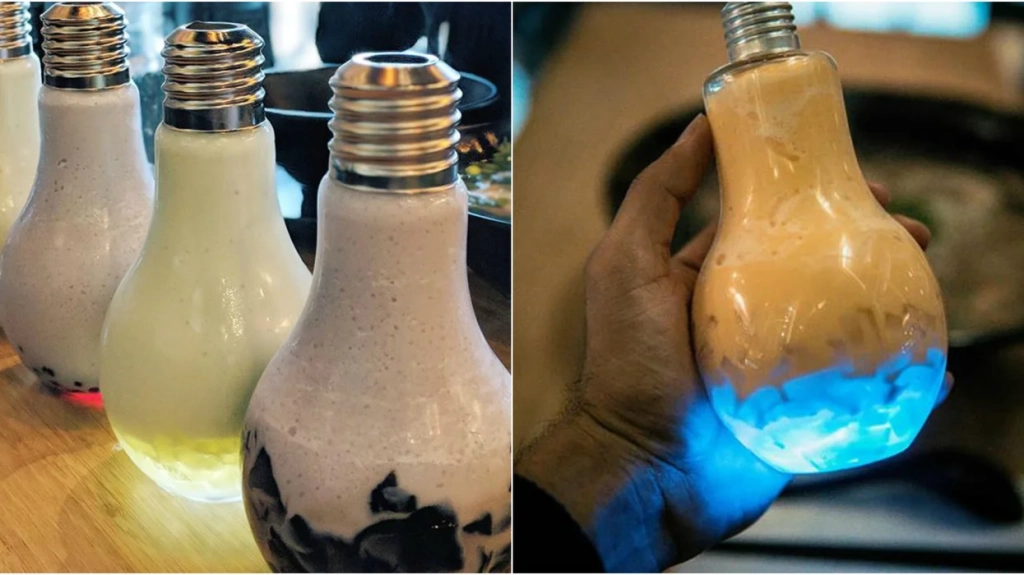
We did another round of our favourite booths and a few we had missed earlier. My friend got the lightbulb drink from I Love Bubble Tea. Important Public Service Announcement – don’t just throw it out when you’re done! There are lights and a battery inside and you can light up your drink using the button on the bottom even while it is full and then take it home for a few more hours of battery time, and to reuse it on your patio for drinks at home.
I didn’t see anyone with theirs lit up – so I’m not sure if that is common knowledge even though there was a similar light bulb drink a few years ago in Edmonton at Miss Saigon.
My own finale to the evening was my Holy Grail of food festivals – a delicious 2-scoop vegan sorbet from Little Bear Gelato. Served in a cone and #zerowaste. So delicious, and the perfect thing to eat while sitting back and listening to the music and watching the crowds.
Yes, we will definitely be back. Thanks Taste of Edmonton!
What did I miss?
My friends came by bike, and there was lots of space to get around. Even without using a rack, we had no issues keeping them near our seating whether we were at the picnic benches or closer to the stage.
Afterward, I learned that if you are parking downtown, Edmonton City Centre has a special parking rate for attendees of only $3 after 5 pm on weekdays and all day on weekends during Taste of Edmonton (east parkade only – enter on 102A ave between 100 and 101 St).
If you have a festival favorite, please let me know! I definitely plan to go back next week.
Perhaps I should have paid more attention to the 6+ warning on the Nerf Super Soaker box, or maybe I should have just let the flowers enjoy their water. But we can’t live in the what ifs, so I’m here to share the story of what I thought was going to be a #momwin.
Thinking it was a great idea, I recently purchased some Super Soakers for my kids to enjoy while our summer actually feels like summer. However, what quickly transpired was far from my expectations. There was no epic water battle, just the rise and fall of a younger brother who thought he was invincible.
My real-time Twitter thread uses storytelling techniques and principals in a number of ways. It holds all the elements of a story:
Setting (the sunny backyard)
Characters (3-year-old and 5-year-old brother/sister duo)
Plot (Mom bought fun new super soakers for core summer memories)
Conflict (in its truest form: sibling conflict)
Arc (the rise and fall of a not-so-invincible younger brother)
Using the 8-point story arc as a reference, the Twitter thread’s stasis begins in the backyard. The super soakers are full and the kids are calmly watering the flowers. They have chosen their course of action and it’s peaceful, useful.
Then Mom steps in and triggers a change. The idea of chasing each other around the yard with cold water as ammunition excites both children, but only one remembers the one and only rule: if you spray your brother/sister, they can get you back.
The 3-year-old embarks on his life-long quest to take down his older sister. He pulls the trigger and soaks her back. He has won, he’s victorious, and he’s on top of the world.
The 5-year-old is surprised by her suddenly cold back and she makes the critical choice to challenge her brother. She begins to chase him around the backyard, anticipation is growing, the smile appears on her face, the dread on his.
The climax is reached as she narrows her sights on her younger adversary. Will she be successful and soak her brother with cold water? Will the water fight continue?
We come to the Twitter thread’s reversal when the 5-year-old makes contact with her target. Due to her critical choice and the actions taken during the climax, she has sprayed her brother with cold water and he is now on the ground. He sadly accepts defeat and retreats into typical 3-year-old ways.
The resolution of the story happens when the children agree to take a break and go back to watering flowers. Peace is restored and they return to a new, albeit somewhat scarred, stasis.
In addition to these storytelling principals, the Twitter thread includes images and video to engage the audience. In his article, How to use storytelling to craft better tweets, Nick Reese says that “Tweets with video [attract] 10x more engagement than Tweets without video”.
To keep the audience coming back for more, and to keep the story at the top of the feed, the Tweets are published separately, with the second Tweet coming an hour after the initial post was shared.
This Twitter thread is intended for everyone, however parents, guardians, and caregivers will be able to connect to the story the most. Its colourfulness offers an all-too-relatable story in a funny and entertaining way.
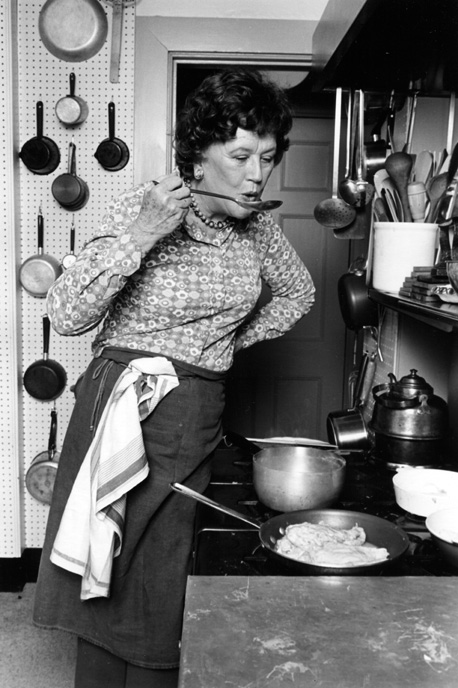
I was first introduced to Julia Child’s cookbook Mastering the Art of French Cooking when I was newly enrolled in culinary school. I will be honest at the time I was not overly interested in her cookbook. I was far too busy learning about Escoffier and the mother sauces. In hindsight, I lacked the knowledge and experience to truly appreciate the content she painstakingly produced for her readers.
Fast forward to the summer of 2009, I had recently completed a three-week study exchange in Singapore. This was my first time experiencing the culture, food, and customs of a country outside of North America. It was an enlightening and at times overwhelming experience. I was also just weeks away from commencing my last year of Baking and Pastry Arts at Sait. The movie Julie & Julia was released in theatres that August. Naturally, being the foodie that I am I had to watch it. For those of you that have not watched the film. The plot goes as follows. Julie had the idea to cook her way through Mastering the Art of French Cooking in one year. She was determined to reproduce all 524 recipes in 365 days and document the journey through her blog. This was no easy task to complete as a novice cook. Julie challenged her capabilities and wanted to give up at times. She summoned her inner strength by asking herself “What would Julia do?”. This moment really resonated with me after some of my own culinary mishaps. I found the film so incredibly charming it inspired me to read Julia Child’s memoir My Life in France.
To quote Julia’s memoir “This is a book about some of the things I have loved most in life”. She goes on to mention her husband Paul, France, and her love of cooking and eating. From her opening introduction, I knew I would have to revisit Mastering the Art of French Cooking in the near future.
Julia Child started her culinary journey shortly after moving to France in 1948. She wholeheartedly immersed herself in French culture to learn the language and social customs of the time. She enrolled in the prestigious Le Cordon Bleu Paris in 1949 to learn French cuisine in her late thirties. I have always been inspired by how Julia allowed her love of food and unwavering support from her husband to guide her down her path and shape her career. I can only imagine the challenges she overcame to learn a new language and study culinary arts with a group of men that doubted her abilities and motivations. The tenacity on her part to pursue the development and publication of her first cookbook was unparalleled at the time by any other author. Julia later went on to have several successful cooking shows, cookbooks and taught generations of home cooks how to make traditional boeuf bourguignon at home. She inspired future generations to pursue careers in food blogging, culinary arts, and hospitality.
Mastering the Art of French Cooking was a labor of love and is one of the most beloved cookbooks in my collection. Julia Child’s unforgettable story will always resonate with me and the way I pursue the things that I love.
Like many women, I grew up being exposed to stories of princesses.
Cue:
Ariel- The little mermaid
Jasmine- Aladdin
Cinderelle – Cinderelle
Snow White- Snow White & the seven dwarves
Belle- Beauty & the Beast…
The list could go on, but you get the point. These stories have the same major plots a beautiful princess finding love and needing to be saved by a charming prince. I watched PIXAR’S Brave as an adult and it has stayed a favorite of mine. Brave gives young girls a new female protagonist ‘Merida’ to look up to. Brave celebrates her independence and skills (archery, knowledge of the woods & horseback riding) as well as her free-spirited nature. It tells the next generation that a girl’s worth is based on her and she can problem solve for herself.
It created a universal emotion; everyone loves a strong, independent woman or at least the feminist in me does. Merida doesn’t need someone to save her, and her story is about her finding out who she is and connecting to her family. The main love plot in this film is the relationship of a mother and daughter growing and changing.
The movie is set in medieval Scotland and has rich visuals full of greens and greys. It has many scenes that are eye-catching including the ring of stones, large mountain scenery, the highland games, and waterfalls.
Merida’s hair is stark red and has enough movement it could be considered a secondary character.
Merida is also relatable because she tries and fails many times before she succeeds. According to PIXAR (which makes sense as it is a Pixar film), 22 rules of storytelling “You admire a character for trying more than for their successes”. Merida tries to be a good daughter, and independent or true to herself in all the wrong ways before she succeeds and accomplishes this goal the right way. She also tries to save her mom by reversing the spell incorrectly before mending the tapestry. She never gives up and her courage and heart are present. You admire her character and grit more than her ability to prove she can rule and not have to marry a prince.
Once upon a time… Lord and his Lady celebrate their daughter’s (Merida) birthday. She sees a willo-wisp, her mother explains they can lead her to her destiny. Suddenly a black bear attacks and her father fights the bear. Lord Fergus lost his leg to the bear known as Mor’du.
Every day… Merida is a brave, independent princess who spends her days’ horseback riding, practicing archery, and exploring the forest. She fights with her mother over not being a “proper” princess.
But, one day… Clans accept the offer to fight for Merida’s hand in marriage. Each of the firstborn of the clans will compete in the category the Princess chooses. Merida suggests archery, she claims as the first-born as well, she’ll be ‘fighting for her own hand.’ She defies her mother and makes a bullseye.
Because of that… Merida flees, where the willo-wisps bring her to a witch. Merida asks for a spell to change her mother. Her mother turns into a black bear! Merida learns that if they don’t want the spell to become permanent, they will have to “mend it”.
Because of that… Merida and her mother bond during her time as a bear. If they do not find a way to reverse the spell, she will stay a bear. Merida finds the stones and realizes that she is in the castle in the legend her mother told her about as a child. The brother who attempted to seize power went to the witch and turned into Mor’du.
Because of that… Mor’du attempts to attack Merida. Elinor saves her daughter, and they go back to the circle of stones.
Until Finally… Merdia knows what needs to be done. Merida mends the tapestry and saves her mother. And then ever since then … Merida and her mother accept each other.
This story was the first of its kind (with movies like Frozen to follow) I believe it is a timeless story and inspires others to be themselves.
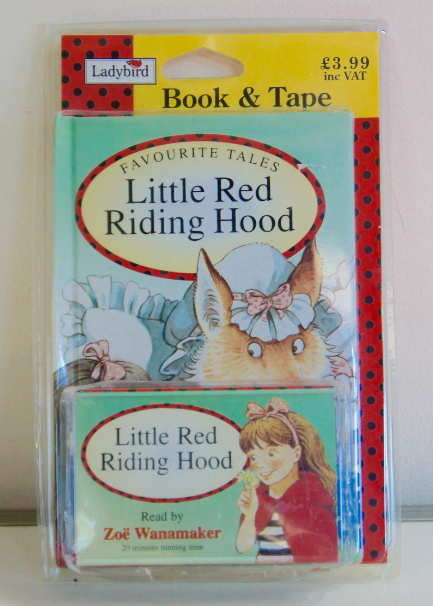
I remember the excitement I always felt when my parents bought us a new Ladybird book with its accompanying cassette. Yes, this is a story from when cassettes were a thing.
My sister and I attended a Francophone school. Born in a Francophone country, Lebanon, we only spoke and learned subjects in French. Although the Lebanese dialect is a spoken derivative of the Arabic language, classical (written) Arabic was only taught at my school as a language.
To enhance our learning, my parents would buy us a Ladybird book in Arabic with its accompanying cassette. That was the original form of an audiobook, which included narration and sound effects to supplement the storytelling. I can still remember the distinct beeping sound that indicated a page turn. We read Little Red Riding Hood, Sleeping Beauty, Cinderella, Hansel and Grettel, etc. But nothing was as magical, impactful, and exciting as The Little Mermaid.
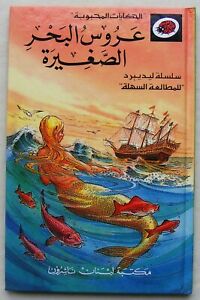
Cover of the Arabic version of The Little Mermaid
Why was I excited? Because the story took place in the sea… a mysterious world that had a life of its own.
Let me share context to why I was fascinated by the sea. Living in Beirut, a city by the Mediterranean, we passed by the sea every day to and from school and witnessed the sunrise and sunset where the sun would disappear daily into the sea. My relationship with the sea was one of fascination and curiosity. Where does the sun go at night? What creatures live there? What do they eat? How do they sleep? Do they go to school? Do they sing? Do they live in tiny houses? These were a few of the many questions I asked myself staring at the sea.
The sandy shore of Beirut
Imagine this: I’m 7 years old and I get this new book. I held the book and I studied its cover: it’s about the sea… about a mermaid… fish… and a ship… Imagine how hard it was for me to sit still at the dinner table, with the book and cassette laying on the kitchen counter facing me. That day, we were having meat stew with peas and carrots. I don’t think I ever ate my dinner with no fuss the way I did that evening. I even finished all my vegetables and rushed to clean my dish. I was determined to avoid any distraction or unnecessary conversation that would delay me from grabbing the book, inserting the cassette into my dad’s Sanyo cassette player, and indulging in this magical story.
A Sanyo cassette player
I believe the love story and sacrifice aspect was too complex for me to understand, but the story answered many of the questions I had: there were creatures who lived deep in the sea; they had a family; they sang; they danced; they had dreams, hopes, and wishes. I identified with the main character, the Little Mermaid, who was curious, adventurous, fun, and kind.
You know the story! It begins by setting the stage for what was going on in that magical world: the mermaids, their life, their family, etc. But the Little Mermaid wanted more. Forbidden from going to the sea surface, that was exactly what she wanted. On her 16th birthday, she goes up to the surface and witnesses the sinking of a ship carrying the prince. She saves him but while doing so she falls in love with him. She was so much in love that she was willing to leave her family in pursuit of her dream. Unfortunately (spoiler alert, this is not the Disney version), the Little Mermaid decides to sacrifice her life for love and ends up turning into sea foam.
Devastating ending? Yes! But the story is so capturing and impactful, that every time I look at the sea and see it foaming, I think of that story. The writers followed the Story Spine in such a masterful way. Once upon a time, there was a little mermaid. Every day she lived her life the way it was dictated by her family. But one day, she decided she was not willing to follow rules that limited her hopes and capped her dreams. Because of that, she went to the sea surface and found the love of her life. Because of that, she decided to undergo a traumatic life-changing metamorphosis. Until finally, and for love, she decided to sacrifice herself and turn into sea foam letting the love of her life live happily. And ever since, the Little Mermaid lives as sea foam. Yep! For love you do anything. It can’t get more magical than that!
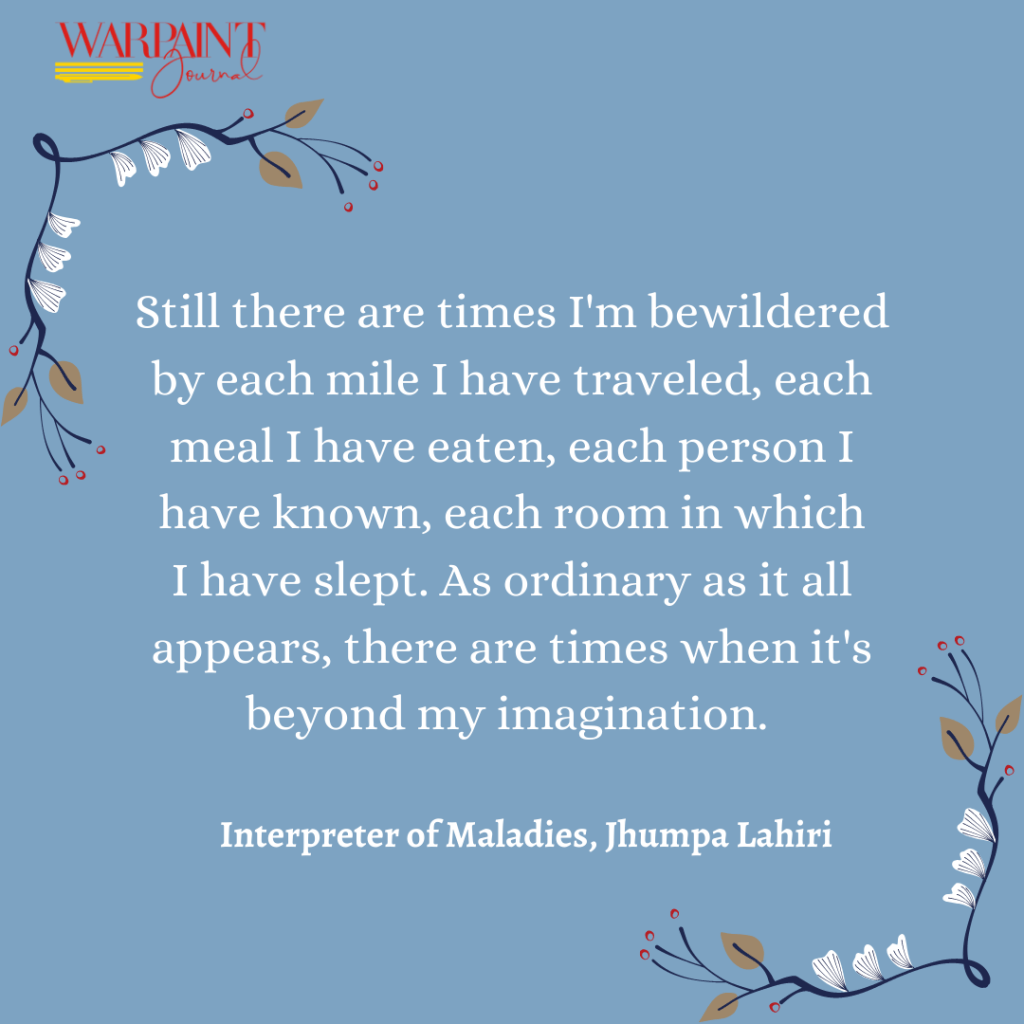
Interpreter Of Maladies by Jhumpa Lahiri is a collection of nine short stories that won the Pulitzer Prize, the Pen/Hemingway Award and the New Yorker’s Debut Book of the Year in 2000.
Lahiri tells the story of several characters as they try to find their place in the world. The book begins with a collection of short stories interconnected by their shared theme: what it means to be an immigrant or an outsider in America. In each story, a character feels like they do not belong—either because they have moved from another country to America or were born here but don’t quite fit in with those around them. Cultural displacement and the pathos of human loneliness cuts across the nine stories where the characters are continuously grappling with their identity.
I remember reading this book as a young girl, ready to leave home to pursue higher studies at Delhi University. What resonated with me was the universality of her characters and their struggle to find new meanings of familiarity and what they would eventually call or understand as ‘home.’
Appealing and Connecting
Structure
Lahiri employs the elements of the Story Spine much too cleverly. Although it is a collection of short stories, it places the nine stories in an order that adheres to the guidelines of good storytelling, including:
One of the many strengths that Lahiri displays, along with the relatability and humanness of her characters, is the simplicity and clarity of her writing that makes for an instant connection between her characters and the readers. The characters that populate Lahiri’s world live in the tense duality of being exiles but are proud to have left India to build a prosperous life in the West. However, the central theme that emerges through colourful details of Indian tradition, cuisine and celebrations are that of the universal struggle of adapting to the ways of a foreign homeland without losing one’s original roots. Their pain and angst intertwine with that of the reader, making it an intensely personal experience.
So whether it’s the married couple who rediscover each other after living together for years in the same house due to a power cut or the story which chronicles an affair between an aimless young American girl and a married Indian man – the stories probe into hope, pain, guilt, desire, dreams and temptation where Lahiri moves beyond a specific cultural identity, and plot to capture human elements, hence connecting to the very heart of its readers.
Lahiri’s Women
Finally, the women in Lahiri’s stories bring to mind other immigrant writers such as Jamaica Kincaid, Maxine Hong Kingston and Zora Neale Hurston. They all offer reactions against their culture’s view of gender roles, combining quiet strength with courage and rebellion.
There’s a story for everyone!
Interpreter of Maladies is both beautifully melancholic and seemingly uplifting in a cathartic way. The amalgamation of intense nostalgia coupled with the mundane quality of its characters’ everyday life makes this a story that has travelled well and beyond into the hearts of many around the globe. She is a master storyteller who knows when to pull in her audience for that personal experience, almost as if she is offering front-row seats with a promise of a special peek just for you.













 EXSM 3989 - Digital Storytelling Class Blog