 So what’s the message?
ssssh SEND SOME SMILES SOON HOPE
So what’s the message?
ssssh SEND SOME SMILES SOON HOPE
So what’s the message?
ssssh SEND SOME SMILES SOON HOPE
So what’s the message?
ssssh SEND SOME SMILES SOON HOPE
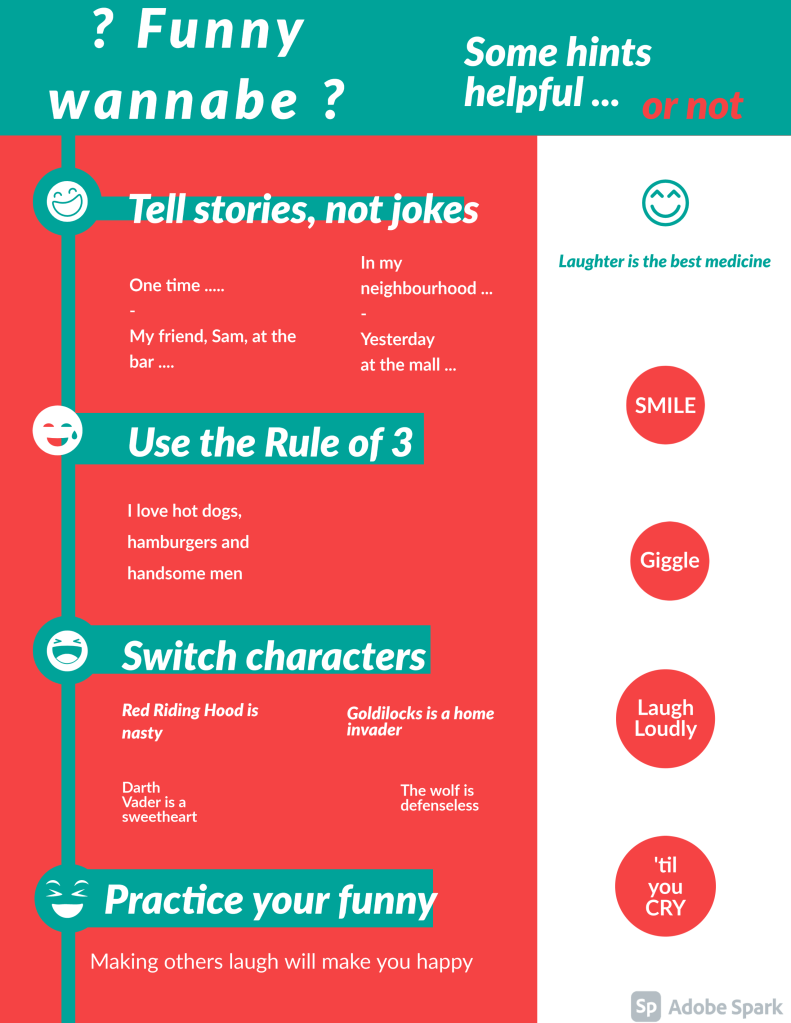
Memes and GIF’s are funny. Some are hilarious. They are meant to make us laugh. At their core is joy. Their sole intent is humour.
What makes us laugh?
What tickles us, brings a grin, smirk, smile, sneer?
How about that giggle, chuckle, howl, roar?
What makes us laugh? How is humour funny?
Inquiring minds want to know!
To me this guy is hysterically funny?
@domdunkhousee is huge on TikToc. 2.6 million likes 320,200 fans
He has pioneered the art of FACE DANCING.
Explaining Funny : Theories that are fails
Trying to explain what makes something funny dates all the way back to Plato and Aristotle. These philosophers mused on what makes us ahhh-mused and called it, the Superiority Theory.
Simply put, people find amusement in the misfortune (yikes) of others because it makes them feel superior (oh boy). Slapstick and teasing have a place in this theory but not much else.
via GIPHY OUCH!

Then a bunch of centuries go by.
Sigmund Freud, the Father and Founder of Psychoanalysis, (you know, the Oedipal Complex guy) presents his Relief Theory. Basically, he believed that laughter is the way people express:
2. release their psychological tension
3. reveal their suppressed fears and desires
4. overcome their inhibitions.
5. yada, yada, yada ……
Relief Theory explains the fun in dirty jokes.
Not so much when things are “punny”.
Puns can be seen as linguistic violations that still make grammatical sense.
“Today a man knocked on my door and asked for a small donation towards the local swimming pool, so I gave him a glass of water.”
“I wrote a song for a tortilla. Well, its more of a wrap.”
“You didn’t hear about the three big holes in the ground? Well, well, well.“
Overtime, continued research resulted in the Incongruity Theory. It has a few variations. Basically, it says that people rely on preconceived notions and expectations. When what they expect to happen doesn’t – bingo! It’s funny. The unexpected, that inconsistency makes us laugh.

EXPLAINING FUNNY: the theory that works
This is The One, Neo, the Benign Violation Theory by Peter McGraw.
When something seems wrong or threatening but is simultaneously okay or safe, it becomes FUNNY.
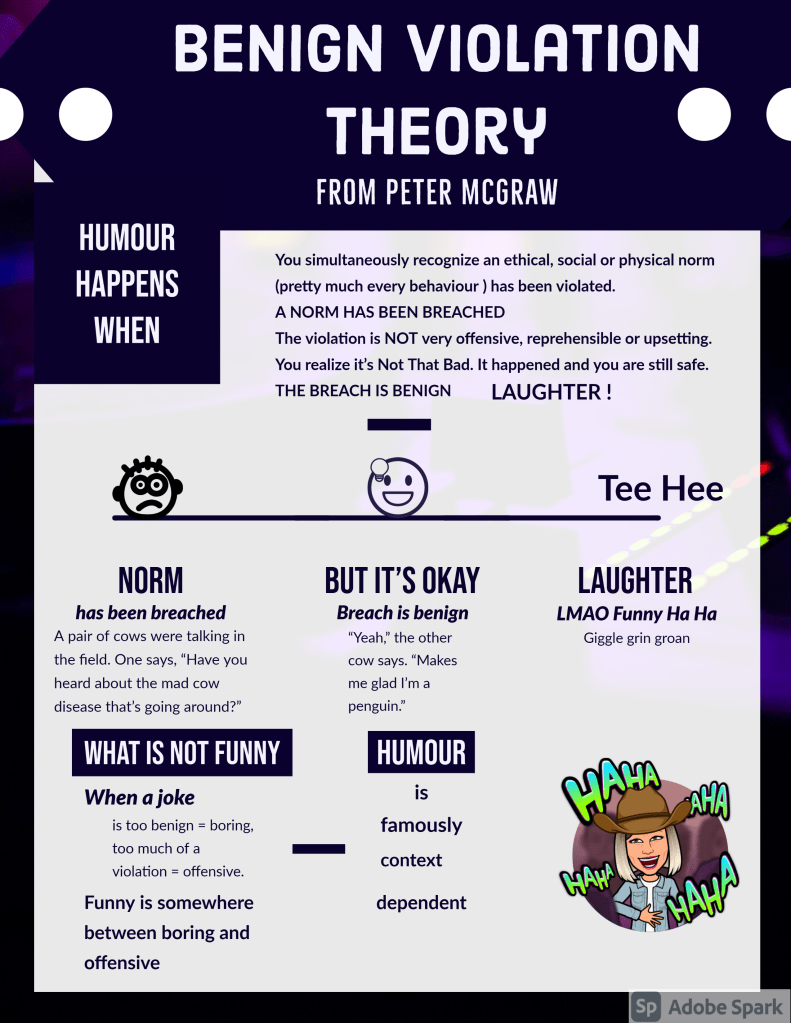
A Funny Aside: “tickling involves violating someone’s physical space in a benign way. People can’t tickle themselves—a phenomenon that baffled Aristotle—because it isn’t a violation. Nor will people laugh if a stranger tries to tickle them, since nothing about that is benign”. Peter Warner, Bold New Attempt at a Unified Theory of Comedy.
There are a couple more theories of humour that deserve mention but that’s all, mention only. The Theory of Evolution: Humour
and
Quantum Theory As It Relates to Why Jokes Are Funny.
Seriously, OMG!
Research into what makes us laugh, what we find amusing continues. Because it all happens in our brains, it has been very difficult to isolate and identify.
No problem for the rest of us.
All we want to do is LAUGH. And share a funny, uplifting moment.
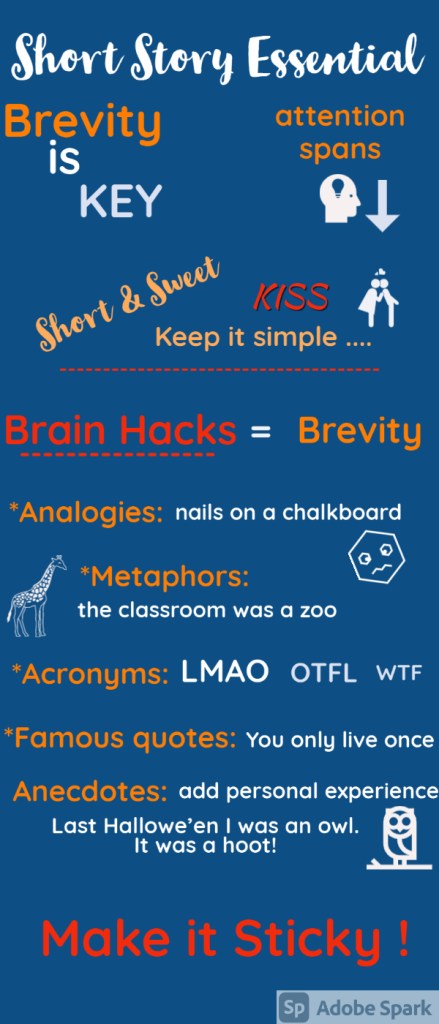
Brevity is essential to short form storytelling. Here are some tools to reduce your word count and still get your message across. It’s all about keeping it short, simple and “sticky”.

The Cook of Castamar
The Story Arc for the first episode introduces the beautiful setting of Castamar. Nick Reese prepared an outline of the elements needed to craft better tweets.
The Setting:
It is a “period piece” set in Spain around 1720. The widowed Duke of Castamar is going to get romantically involved with Clara, the new cook at his castle.

The costumes, sets and scenery are incredibly beautiful. It is, quite literally, a feast for your eyes. And the castle and gardens of Castamar are pretentious and befitting of “royalty”. Since La Cocinera de Castamar (the Cook of Castamar) is a Spanish production, it has been dubbed in English. Don’t get caught up in lip reading.

The characters: The first episode is called The Essential Ingredient. It introduces Duke Diego, still in mourning two years after the death of his wife, and Cook Clara who has been raised cooking in an orphanage and is agoraphobic. There are many other characters and story lines and subplots, so many that it becomes confusing. It’s hard to keep every character and their roles straight but my assumption is they will each have some sort of impact on Duke Diego or Clara, the cook.
The conflicts: Duke Diego has been called by the King🤴 to assume a powerful position in the Court. Diego is still in mourning for his wife and initially refuses the Kings order. He is very resistant to returning to public life.
The people around Duke Diego, including his mother, want him to put aside his grieving. They also want him to find someone else to care about and marry. 👰The Duke is completely uninterested.
The bad guys, Enrique de Arcona, Marquis of Soto and Lady Sol Montijos, are intent on destroying the Duke, for reasons as yet undetermined.
In this episode, the bad guys collude on getting the Duke involved with Lady Emilia Castro, who has a disgraceful secret past, discovered by the evil Count Enrique. He uses this information to gain Lady Emilia’s co-operation with his plan to ensnare the Duke.
There is a big gala planned at Castamar and the king🤴 is to attend. Clara, through hard work and culinary skill has garnered the position of head cook. She has managed thus far to hide her agoraphobia.
The ending: It turns out the King is quite Looney Tunes 😱and he goes missing on the way to the gala. The worry is he has been kidnapped since there is so much civil unrest within the country.
The episode ends with a large search party going out, lead by Diego. Not exactly the PARTY the guests had expected as they are all ushered into the safety of the castle.
All the elements of a good story have been combined to make an entertaining first episode of the Cook of Castamar. Really an enjoyable story set in early 18th century Spain. Loved it!!!💖
See Twitter thread here: https://twitter.com/wordsmith732/status/1457069534729228288

One of my favourite movies is the science fiction cult classic, The Fifth Element. The movie first hit the big screens in 1997, giving it the longevity required for the moniker, cult classic.
The Fifth Element has stayed with me over the last 25 years because of its imagery, future based science fiction, striking characters, innovative special effects and age old story lines of good versus evil and “Love Conquers All”.
The fantastical story line is simple and focused, mainstays of successful story telling.
The Fifth Element contains the conflict, climax and resolution requirements of a story as follows:
Find a more robust Story Spine, prepared by yours truly, here.
The uncomplicated story line of the Fifth Element is easy to appreciate and comforting in its predictability. The characters are straight up, forthright, single natured. There is no “dark side” in the good guys. There is no “goodness” in the bad guys. They are who they are, hero or villain. Throughout the movie they portray single minded focus on their goals – either to save or destroy.
As noted by Ashley Fell in her You Tube presentation demonstrating the Visual Mind, digital stories should also have the three components of color, picture and movement.
The Fifth Element contains all the ingredients of a good story while being a visual delight.
The cinematography is exceptional.
The Fifth Element does not incorporate the dark, gloomy, ominous atmosphere of most science fiction movies. Apart from the deep space scenes that are naturally dark, the movie is well lit, even bright. No evil lurking in shadows waiting to pounce on the unsuspecting.
The world of the future is presented as over-populated, high density yet somehow orderly (apart from the techno garbage heap at the airport to remind us we are a consumer driven throw away society). It is clean and unpolluted, like how we want our world to be. Another universal principal engrained in the message of the film.
The Fifth Element is a feel good movie. The classic battle of good versus evil plays out with victorious heroes and defeated villians.
And the Fifth Element ends with the principal of “Love Conquers All”. Hopeless romantic or not, “happily ever after” stories are memorable. They reinforce our belief in basic goodness, giving cause for optimism and hopefulness.
For me, The Fifth Element is escapism at its best, fun, entertaining, memorable.
 EXSM 3989 - Digital Storytelling Class Blog
