Categories
Uncategorized

Going Home for the First Time

I am blessed with an amazing immediate family. We are small (my parents, brother & his wife, and their two sons and a daughter), but we have strong ties that persisted when I moved away to live with the soldier I ended up marrying in 1999.

Life was good. He had a life with a purpose, and I fully embraced that. When he was added to a deployment to Bosnia the year we were supposed to get married, we moved our wedding up and spent that first year mostly living in different countries and time zones. He often called me at 2:00 am, because no else was using the phone over there at 10:00 am. I started drinking coffee, just to keep my eyes open at work the next day. That was 2000.

His father in New Brunswick sent me some beautiful roses for my birthday that year. I felt special.

When my husband got home, they attached him to the Immediate Reaction Force (IRF). It was just a name to me.

Then September 11th Happened

If Canada responded, he was going to be in the middle of it. That was the start of a whirlwind of three more overseas deployments, 1.5 years travelling with the Strathcona Mounted Troop, and finally a 3 year posting to a different Base. We lived one year, one experience at a time, and waited for life to slow down.

Change came in unexpected ways

In the end, change came to my life rather than his. I transitioned from being fiercely independent to needing a cane occasionally in 2016, to needing it most of the time outside the house. It was progressive, so destined to get more problematic. I talked with my immediate family openly about it, and they helped me make some decisions about what mattered most.

Remember those roses in 2000? Since then, my sister-in-law had 3 little girls I had never met, and not knowing how quickly things would progress, I had to go. Without him. To meet his whole family on the other side of Canada. With the cane. But I didn’t want to have regrets. I didn’t want to look back wish that I had done things differently.

First I needed to find the right cane. I am not that old. I was not that disabled yet. I felt a little bit like an imposter using one, so I wanted something special (read not old lady-ish). So I used Google and social media and found Top and Derby:

They know how to make a cane look appealing:

And I was ready to go. It was pretty intense, not knowing what to expect, but I felt right at home. Here is a picture of me with my father-in-law from that first trip:

Nelson and Rae

Getting to know my three nieces was so incredible. They love to have fun, and made me feel entirely welcome to join them.

Edie, Coco, and Molly (left to right) 2016

They did a lot for my self-esteem, getting used to the way my life was changing. Best decision ever. I have been there three times now, and now that they are getting older, I appreciate so much that I went when they were still little and had time to spend together. I found my second family. Who knows where life will take us all after 2021? I have a feeling we are all going places.
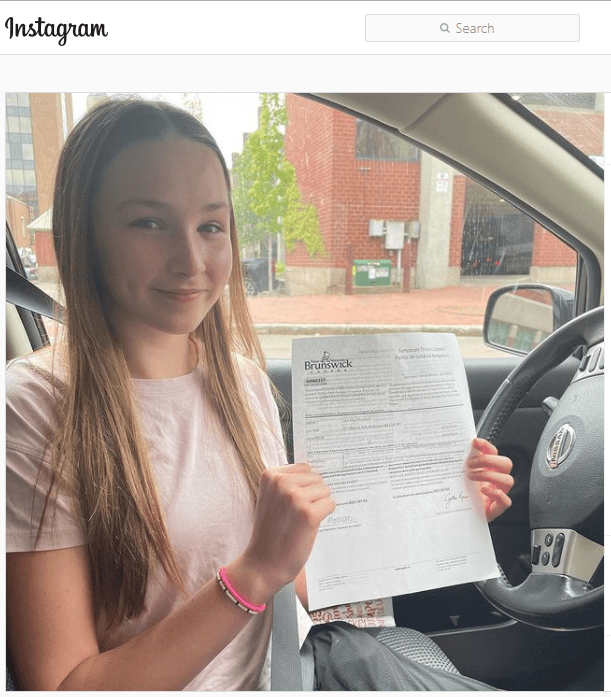
Edie and her new driver’s license 2021

Categories
Uncategorized

Visual Storytelling for Mental Health

Visual storytelling combines the power of human nature (how we establish patterns from experience to find meaning) with science (we retain 10% of what we hear, but 65% when visuals are included) to lead to greater engagement with audiences. Consider the value of tv commercials over radio ads:

  • Visual storytelling helps understanding complex data efficiently by delivering more impact as the result
  • Visual data provide a narrative that is more compelling and drives the audience to take actions
  • The concept incorporates excellent writing, vibrant visuals that bring life to the entire atmosphere of the story

As an example for this Infographic, I looked at mental health from a non-profit perspective and used emotions to drive engagement.

5 Tips to Weave Emotions and Storytelling In Your Copy

  • Make Your Reader the Hero
  • Keep it Minimal
  • Take Your Audience into The Moment With You
  • Understand The Conflict in Your Audience
  • Don’t Reinvent the Wheel – Use Story Frameworks

Lessons Learned

The hardest part of creating the Infographic was following my own advice. I wanted to include examples to demonstrate what I was referring to. For the second point, Keep it Minimal, I wanted to include that meme:

But that would have been about me, and not about them (the audience).

Conflict in Your Audience

For the fourth point, I wanted to provide an example of a current event, to show that putting mental health first takes strength, courage, and sometimes sacrifice. Here are the Tweet and news story that demonstrate that.

The news story behind the Tweet

But I caught myself in time and entered some pictures of flowers and trees instead. Mental health can be about a lot of things, such as gender identity, grieving, disability, isolation, financial difficulties, to name a few possibilities. The Infographic is a roadmap; I had to remember that and remove references to destinations.

References:

N2016. AdEspresso. “Master the power of storytelling in your ads.” https://adespresso.com/blog/master-the-power-of-storytelling-your-ads/

2018. Infographic Design Team. “10 trends and principles of visual storytelling that every designer must follow.” https://www.infographicdesignteam.com/blog/trends-and-principles-of-visual-storytelling/

Zamperin, Rick. “Rick Zamperin: Simone Biles’ mental health is bigger than an Olympic medal. https://globalnews.ca/news/8063928/rick-zamperin-simone-biles-mental-health-olympic-medal/ Retrieved August 1, 2021.

Categories
Uncategorized

Happy Life

For the Live-Tweet Storytelling assignment, I decided to talk about our (my) garden, because it is a big part of my life. That is true in the past and in the present, but for different reasons. I used suggestions from Gary Vaynerchuk’s article “How to Tell a Story on Social Media”, which is available online.

Following the Elements of a Story, I focused on the following:

Setting

I explained how the garden first appeared in my life and what its importance was in the beginning.

Character

This was harder from a personal perspective. I was not trying to sell anyone on anything. I took the approach of explaining how life before and after retirement from the military involves both compromise and opportunity.

Plot

Part of the formula for success being a military wife and a gardener is being spontaneous and not having a long memory. I love my garden. I remember spending a full two years liberating it from the thistles that had taken over before we moved in. I read books on square foot gardening, planting small groups of plants over time for a continuous crop:

He always plants in rows between sticks.

Conflict

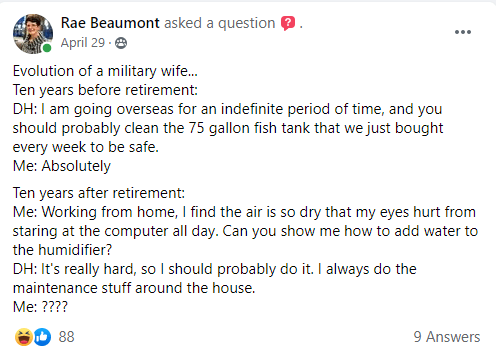
Then he officially retired and moved home. I started to hear a lot of stories about how he “always plants in a row between two sticks” and he “always waters the garden by holding a spray nozzle and standing out there”, instead of using the sprinkler. Change is constant in military life, before and after retirement. Again, spontaneity is necessary. Any long-term military wife understands the power of those two words. Don’t take my word for it. Here’s a Facebook post from a private community of military wives that resonated with a lot of members:

Arc

Beginning, middle and end. I closed my story by sharing a solution for the current challenges in gardening, giving him a quick tool that he can use without asking me. Have a look for yourself:

Categories
Uncategorized

The Moral of the Story

My favourite story is “Pride and Prejudice” by Jane Austen. She wrote her first draft when she was only 21 in 1796, although it was only published in 1813, four years after death. Not only did Jane produce 6 long novels without formal education (or a typewriter), she intuitively understood what to include in her stories and what to leave out to catch and hold the attention of her audience.

Major themes

One of the central questions in Pride and Prejudice is whether it is better to follow social conventions and marry for money and respectability or to marry for love and happiness. Some possible themes such as Marriage, Wealth, Class, and Self-knowledge, are described on Wikipedia.

It is easy to look backwards and evaluate a piece of writing centuries later, but from a contemporary perspective, Jane was writing about what she knew from her own life and experiences. She is following guidelines we considered in our reading “How to tell a great story”;

Do:

  • Consider your audience — choose a framework and details that will best resonate with your listeners.
  • Identify the moral or message your want to impart.
  • Find inspiration in your life experiences.

Don’t:

  • Assume you don’t have storytelling chops — we all have it in us to tell memorable stories.
  • Give yourself the starring role.
  • Overwhelm your story with unnecessary details.

I especially like how this connects to the sixth extra question in “Beyond the 5W’s: What should you ask before starting a story?”, which is “What will the audience remember when it’s over?”. As a young unmarried woman, Jane might have been considering whether social conventions can or should be openly challenged, but in the end her female characters end up happily married to very attractive and financially stable partners. The message seems to be challenge if you wish, but do the right thing anyway to create a happy ending for all.

The Beauty of the Printed Text

My favourite edition of it is the Peacock Edition, illustrated by Hugh Thomson and published in 1894. A description and images of it, and the asking price of various different copies of it, are found at AbeBooks.

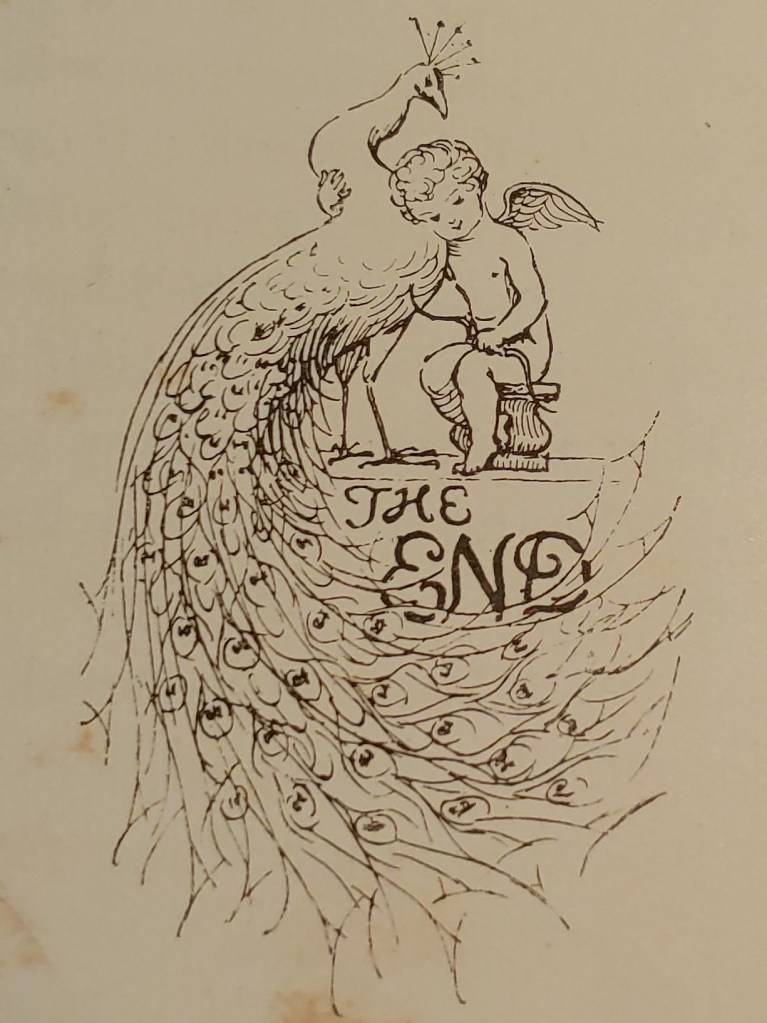
The artistic quality of the physical book should not affect the reader’s satisfaction with the story, but it does enhance the experience, especially by providing illustrations that suggest the beauty of the ladies and the positive qualities of the gentlemen. Illustrations were used to encourage the reader to use imagination to create a solid impression of the characters, without an actual representation of an individual. They also added a beauty of their own.

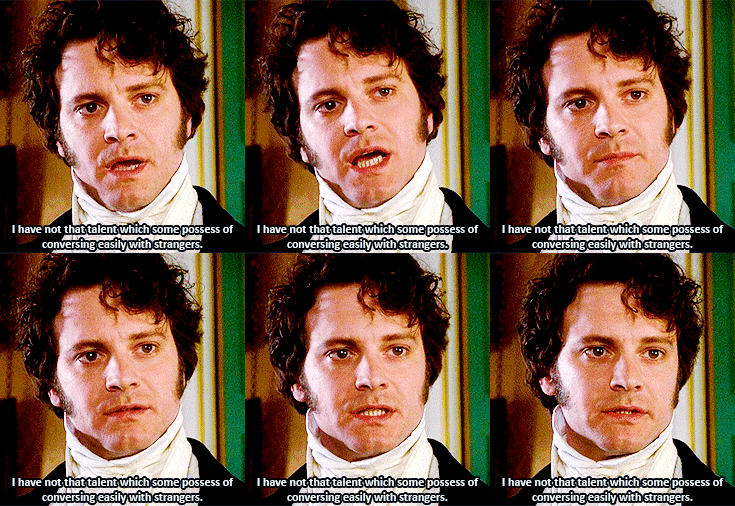
In modern times with technology, readers can find links to various movie adaptations of Pride and Prejudice. If you have read the book a few times, you probably already have a solid impression of what Mr. Darcy looks like. Is that really Colin Firth?

Even worse, let’s not even talk about Pride and Prejudice and Zombies (trailers easily found online).

I will stick with my hard copy of the story, with or without beautiful illustrations. A good story has a virtue of its own, without the modern tools of technology. The moral of Jane Austen’s story holds true, almost as long as Shakespeare’s. Surely there is something to be learned, and enjoyed, in that.

Design a site like this with WordPress.com
Get started