Categories
Uncategorized

Her Grand Gesture

From mom of five to the U of A’s first doctoral grad in piano performance, Lillian Upright’s next act will inspire a new generation

She was 41 when she’d finally run out of excuses.

Lillian Upright, since she was a girl, had dreamed of one day striding onto a stage to play piano with a major orchestra, a “knock ‘em dead” dress flowing elegantly behind her. Instead, she did everything her parents (both
born at the turn of the last century) expected of her: Get married. Stay home. Raise children.

“I had the idea that, ultimately, what a woman should do is marry and have kids,” Lillian says. Which is why going to school for piano performance took a back seat for the first half of her life.

“And also, I think I was chicken,” the now 86-year-old says, then roars with Laughter.

Lillian eventually reached her dream of studying piano and offering a major recital. A gift in her estate to rehabilitate Convocation Hall at the University of Alberta will help ensure that other promising musicians get
the performance experience they need to realize their highest potential.

In the mid-1970s, after her five sons had left home, Lillian started studying piano at the University of Alberta — a program she knew to be one of the foremost in Canada. In just over a decade of tireless study, Lillian would, in 1988, become the first person at the U of A to receive a doctorate in piano performance.
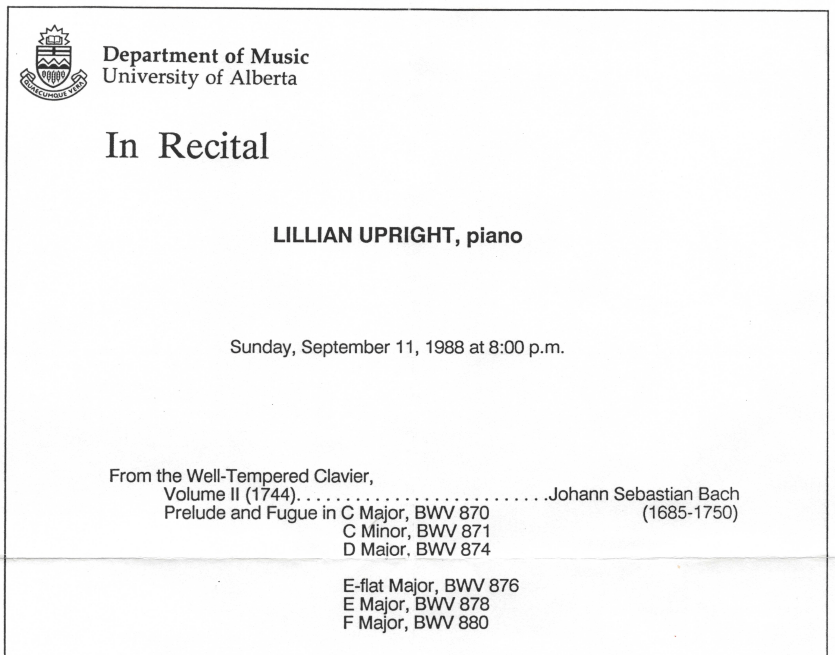
The program from Lillian’s historic recital, making her, at age 55, the University of Alberta’s first doctoral grad in piano performance

That opened the door for her to perform across the country and to deepen her piano instruction by training teachers. She also continued her busy job as long-time music director at the United Church in St. Albert, Alta. One day in 1998, she finally summoned the courage to realize her dream to perform with a major orchestra.

While shopping at a local deli, she cornered Edmonton Symphony Orchestra director Grzegorz Nowak and firmly asked for an audition. Grzegorz agreed and within a year, Lillian was featured at the Winspear Centre, playing Mozart’s Piano Concerto in C Minor — a dramatic piece she had been working to perfect since age 11.

Music has kept me alive. It’s a privilege … to help new students realize that joy.

Lillian Upright

After she retired from teaching at age 75, Lillian wondered what more she could accomplish through music. She sat down one day and thought about how she could help — through her estate. Her sons had families of
their own and were financially Independent.

“Next to my family, music has been that essential thing in my life,” says Lillian.

“And the U of A music program did so much for me, accepting me in my forties and helping to shape me as a performer.”

A crucial part of her education was playing in Convocation Hall, the university’s historic recital space.

Lillian plays the University of Alberta’s new Steinway grand piano, one of the world’s most perfect musical instruments.

“To become a great performer, you have to have a great performance space with a great piano and good acoustics.”

Convocation Hall was opened in 1915 and today is hampered by an outdated stage and seating, noisy mechanical systems, inadequate dressing rooms and poor sightlines.

After learning that, Lillian decided almost on the spot to direct her estate in support of the renewal of Convocation Hall.

Her gift will help ensure that U of A music students have a first-rate venue where they can perform and record recitals, setting the stage for their own dreams of musical greatness.

“Music has kept me alive,” Lillian says. “It is a privilege to be able to help new students realize that the joy it has brought me can be theirs as well.”

Learn how you, too, can leave a legacy for a cause you believe in.
Categories
Uncategorized

Digital storytelling: Let’s get visual (visual)

So, you’ve decided it’s time to get your organization or company’s data to do some serious heavy-lifting for your brand story. You’ve pulled the numbers, hired a designer and now you’re ready to put up the scaffolding. Whether it’s the number of donations you received last year, your edge on last month’s sales next to the competition, or your latest reader survey results, remember to put storytelling principles first.

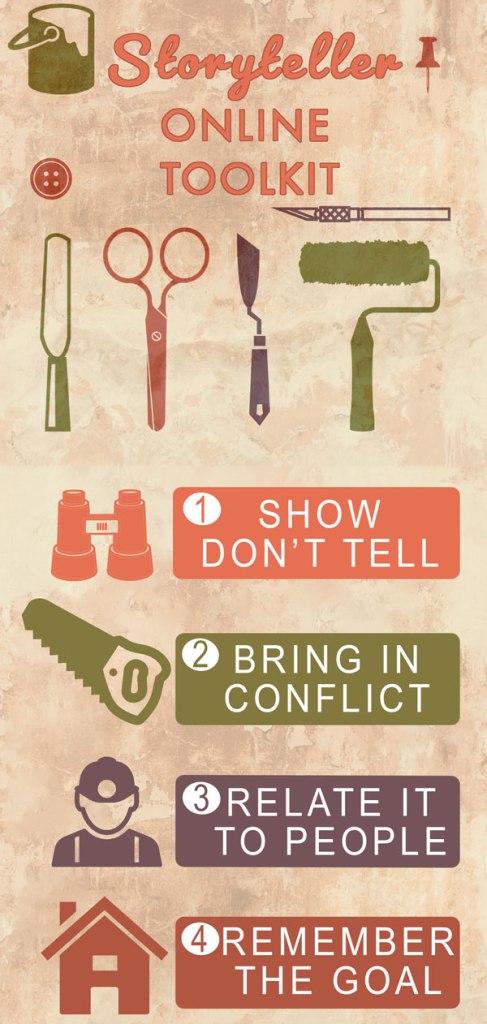
Keep these tips in mind as you start story construction:

  1. Show don’t tell: Let the numbers prove your point. Rather than saying, “We’re better than the competitors,” show the sales data that validates that and let your reader reach their own conclusion.
  2. Bring in conflict: Great stories have great heroes who overcome adversaries. What’s the “battle” your audience faces and how does your product or service make them victorious — and how do the numbers support that argument?
  3. Relate it to people: Demonstrate how the numbers relate to humans. Think donors and customers over the dollars they give or spend, for instance.
  4. Remember the goal: Don’t forget the objective of your story and your message to the audience. Is to build awareness? To drive sales? To hoist your reputation? You can entertain and surprise the reader along the way, but don’t forget why you’re in business and make sure the story helps in your quest.

Categories
Uncategorized

Live Tweeting: Instant Potting Halloween

I had one hour to cobble together a socially distanced All Hallows’ Eve presence on my block. With my obnoxious sweet tooth and sad, single plastic bag of decorations, things were not looking good as I readied my house to stare down the ravenous little Trick or Treaters. Did I avert a nightmare on my street? Find out in 10 thrilling, chilling and filling (because of the candy) tweets!

Categories
Uncategorized

Modern Love’s Modern Storytelling

How Amazon Prime’s star-studded TV series — and non-stop sob fest — sets the bar for an exceptional narrative

I confess that before this weekend, the sum total of my Anne Hathaway viewing was in 2001 when I humoured my sister by going to see The Princess Diaries, an infuriatingly trite rags-to-riches tale about an awkward American teen who suddenly becomes, well, a princess. Let’s just say that while my sister appreciated my willingness to accompany her to watch her guilty pleasure, she could have done without my snarky “oh, c’mon” after each cliché I had to endure.

I’m happy to report that American storytelling — and Anne Hathaway — redeemed themselves over the weekend with a harrowing story of love that at once entertained, challenged and completely surprised me. A rare feat. Here are three ways the Amazon Prime series Modern Love did it. (And yes, spoilers galore will follow.)

Make the everyday relatable

In episode three, “Take Me as I Am, Whoever I Am,” Hathaway plays Lexi, a over-achieving New York entertainment lawyer looking for love. And why not? She’s quirky, beautiful and — it appears — can sing and dance like a Broadway star. (Yup, definitely shed her awkward Princess Diaries years.) Our story opens with Lexi in an agonizingly familiar moment for those of us who are single — staring at her computer about to update her dating profile for the umpteenth time. It’s that classic “Once upon a time” setup, but also what storytelling savant Kenn Adams would call an “Every day” moment — the context we need to understand this protagonist, her universe and her motivation.

Dating profile aside, things seem to go well for Lexi one morning as she chats up an irresistible beau in the produce aisle of a supermarket, then quickly agrees to an impromptu and flirtatious breakfast.

Then … disrupt the everyday

Lexi is on Cloud Nine. Her post-breakfast saunter to her car literally turns into a song-and-dance number — a visual metaphor for the irrepressible delight of this character. As she gushes to her work friend, Sylvia, we sense, however, that Lexi and love don’t last. “I thought you were seeing that musician guy,” Sylvia asks, puzzled. “It wasn’t a match,” says Lexi, to which her friend snaps, “You’re way too choosey.” Unphased, Lexi gets ready for her next date with produce guy — a hint of what Adams would call a “But, one day …” moment.

You see (spoiler!), Lexi has bipolar — a secret she’s kept since she was 15 and one that leads to debilitating bouts of bed-ridden depression. Lexi tries to make good on a second and even a third date with her supermarket super-hunk, but the timing of her mood conspires against her. “I’ve had the flu,” she stammers on date number two, searching for one of many excuses she’s trotted out over the years. But this time, the excuses run dry and Lexi spirals, unable to bounce back. She loses her new love interest, her job and almost Sylvia’s friendship.

This conflict-riddled part of the story is what Adams calls the “dire consequences for having broken the routine” — the routine being Lexi’s perpetual rebounding and covering up the dark mystery in her life. Her pain is real and relatable as she sobs in bed, her date walking away into the night. “Surely there’s someone out there who will take me for who I am,” Lexi’s voice over pleads.

And finally … a refreshing surprise

At this point you might be thinking, as I did, that Lexi’s wish is about to come true. Produce guy will sprint back and take Lexi for who she really is. The end.

Not so fast! What elevates Modern Love here is that the climax — the penultimate ingredient of Adams’ story arc — completely caught me off guard in heartbreaking fashion. As Lexi grimly leaves her office for the last time, Sylvia asks, “Can we get coffee?” What follows is an agonizing scene in which Lexi can no longer escape the antagonist. Herself. “I’m bipolar,” she tells Sylvia, followed by an avalanche of reasons why she’s such an “impossible” friend.

Lexi’s bravery is rewarded. Sylvia holds her gaze and asks questions, ready to accept Lexi for who she is. Suddenly, Lexi no longer has to live her darkest moment alone. In the final scene — the moment Adams terms “And, every since then …” — Lexi is back at her computer. After baring all with her diagnosis, she confidently signs off her dating profile: “This is me. If this doesn’t scare you off, feel free to leave me a message.”

Modern Love succeeds as so many good stories do by getting us to care about the protagonist and the stakes she’s up against. What exalts this story from good to great is how it defies the “Prince Charming” trope by making Lexi the one who needs to save herself. Her courage is raw, honest and, most of all, real to life. That true-to-the-character plot twist is something that Pixar, the undisputed champions of animated storytelling, would applaud, and it made my weekend.

Incredible to think that Disney, creator of The Princess Diaries and many other predictable storylines, now owns Pixar. Now that’s another plot twist I didn’t see coming!

The Story Spine

Here is a quick summary of Adams’ storytelling format, the Story Spine — created in 1991 but still relevant today:

  1. The Beginning: “Once upon a time …” The world and routine of the protagonist is established.
  2. The Event: “But one day …” The routine is disrupted.
  3. The Middle: “Because of that …” The dire consequences of the disruption play out.
  4. The Climax: “Until finally …” Our hero seeks to overcome the adversity.
  5. The End: “And ever since then …” The hero is victorious (or fails) and establishes a new routine.
Design a site like this with WordPress.com
Get started