Categories
Uncategorized

5 Reasons Why Our Long Distance Friendship Works

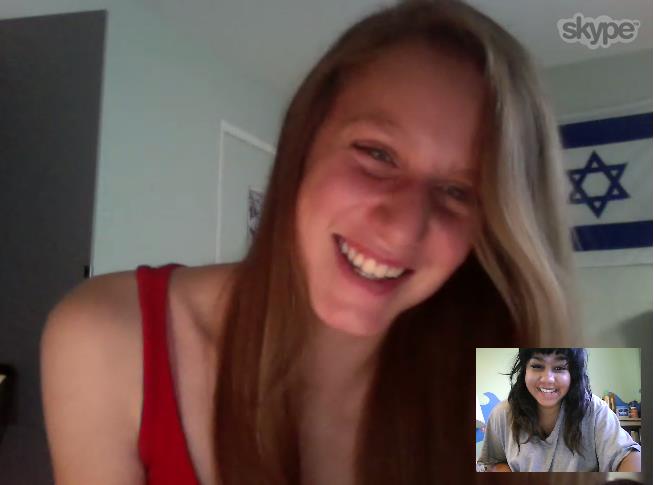
I’ve known my best friend, Jenna, for 12ish years now, and 9 of those years have been long distance. Jenna lives in Israel and I live in Edmonton, and unfortunately for us, the long distance will likely be permanent. That of course doesn’t stop me from asking her every now and again to come back home, but I know that “home” isn’t here anymore. So what does a BFF do to support her BFF?

We put in the work.

Long distance anything is HARD WORK. Our friendship is a labour of big love. When you live in opposite timezones, the instant gratification of having a real-time conversation doesn’t always exist. Sometimes, I’ll be having a really hard day and I just want someone to cry to. Sometimes, she’ll be experiencing a high, and will want me to share in the celebration. While we can’t always be present or participate in the ways we want to, we have never stopped showing up for each other.

How do we do it? I’ve summed up some highlights and insights I’ve gained from my 9 year LDR.

  1. Our Inside Jokes Know No Borders

Over the years, Jenna and I have coined some specific language and jokes that are unique to us. We end all our conversations by saying “Olive you branches” (translation: I love you lots), and “shmeh” (that’s annoying.) For example, back in tenth grade, we both got really into Kid Cudi’s music (like…really into it). We’d text each other the lyrics of our favourite song, “Erase Me” while in math class. Somehow, this song has become our song. Does it have ANYTHING to do with us? No. Will I dedicate this to Jenna on her wedding day? Heck yes.

2. We show up for the Big, Medium and Small Moments.

When my dad stopped responding to his chemo treatments, Jenna flew out to see me. She showed up at my doorstep with a blanket that smelled like her, and the biggest, boniest hug. Of course, flights are expensive, and they’re not always feasible. We don’t expect each other to be able to fly back and forth from one country to another for all of our milestones, but we’ve found other ways to stay connected and involved.

This is where technology comes in. This is where we use and abuse Skype (now Zoom, because Skype never worked in our favour), Whatsapp, Instagram and Facebook messenger. Voice notes are our favourite thing. We send each other monologues on the daily. We talk about everything- what we’ve eaten that day, what that weird dream might have meant, what our biggest hopes and fears are for the future… those voice notes make it feel like we’re together, even when we’re not together.
3. When I spiral, she’s sane

When one of you is a hypochondriac, the other one cannot be. Case in point:

4. We Anchor Each Other

Every so often, I get into a major slump (emphasis on major). This happens almost exclusively when the sun stops shining. Jenna ALWAYS #SADchecks me (SAD = Seasonal Affective Disorder) and I adore her for it.

Exhibit 1:
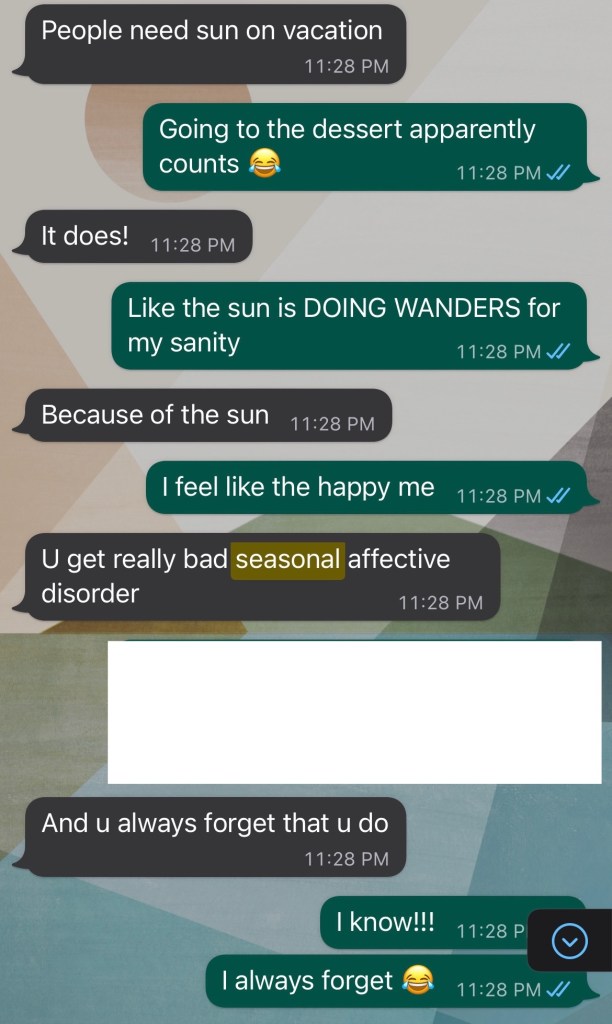
Exhibit 2:

if audio does not play automatically, click here: https://drive.google.com/file/d/1rRxBWtBXa84Dnxs9EntkCAa3GbayLElt/view?usp=sharing

Exhibit 3:

If audio does not play automatically, click here: https://drive.google.com/file/d/1KVo5emkC_igsBOh13Gakc6gFo272vBjE/view?usp=sharing

5. We Use Each Other’s Love Languages

Jenna and I are both big on words of affirmation and acts of service. We water our friendship with a lot of intention and care. Of course we argue and get upset with each other (that’s normal and it’s healthy), but we always hold space for remedying our grievances. Jenna reminds me often that I’m strong and resilient, and I tell her often that I’m so gosh dang proud of how far she’s come and how far she’ll go.

If Audio does not play automatically, click here: https://drive.google.com/file/d/1Ms-bbRobBGGMdkdw9UGDl9Za1gqSejLf/view?usp=sharing

All this is to say that all relationships- friendships included, take work and watering. LDR’s aren’t always ideal, but they can also be beautiful. You can grow together even when you’re apart. I love you long time, Jenna. Here’s to a lifetime more to go!
Categories
Uncategorized

5 Tips for Your Digital Storytelling Toolkit

Storytelling is an art form that takes time, intention and practice to craft. When you add the digital sphere to the mix, it certainly adds to the complexity. What is “good” digital storytelling? How do you convey your message and keep your audience wanting more? Thankfully for you, I’ve done the research and am about to share the basic blocks to build your digital story!

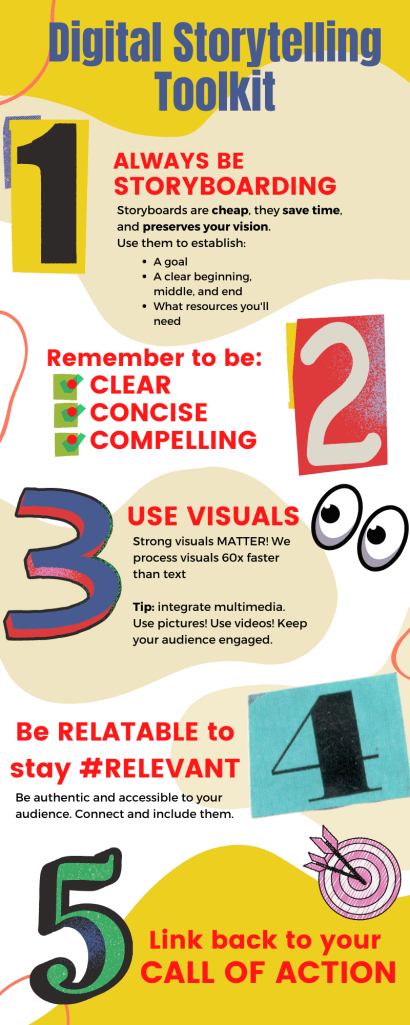
  1. Always, and I mean, ALWAYS Storyboard.

If you have even the teeniest tiniest of inklings to become a digital storyteller, you must have a handy dandy storyboard ready. Storyboards are an inexpensive way to map out your ideas, and to make sure your vision carries through. When storyboarding, ask yourself:

  • What is the goal of this story? (Hint: Your goal should ALWAYS be your Call To Action.)
  • What is my story’s concept? What is the beginning? The middle? The end?
  • ^^ Do each of the above align with my story’s goals?
  • What am I doing to increase my audience engagement through my story? (Consider using geotags, stickers, hashtags to increase your visibility.)

It’s important to remember that it’s okay to edit your storyboard. Ultimately, the goal of the storyboard is to help you plan and make note of which resources you’ll need, including the types of visuals you may need to create. Creating unique storyboards to cater to different social media platforms will help ensure that you are maximizing your reach.

2. The 3 C’s

A good story is clear, concise, and importantly, compelling. The author pays close attention to providing their audiences with the right amount of information– not too much, and not too little.

Introduce your character/brand/message, and spend time showing your audience why they should care. Compel them to care. Without audience buy-in, it’s unlikely your story will take off.

3. Use Visuals

Don’t underestimate the power of visuals AKA don’t forget to add the “Digital” in your storytelling.

In an ever increasing online world, an author is tasked with staying well-versed with the changing online platforms. While these platforms might change, what remains consistent is that humans are visual beings. In fact, 90% of information transmitted to the brain is visual, and we process visuals 60x faster than text.

When creating your story, consider which platforms you’re using and integrate multimedia where possible. Have pictures? Awesome. Videos? Even better! Using Instagram stories? Consider adding stickers or animated text to keep your viewers engaged. Attention to the visual details matters.

4. Be Relatable

Let’s face it, you can write the coolest story to ever exist, but if your audience can’t relate to it in any capacity, the likelihood of them remember it is slim. Of course, you want to stay authentic, but being authentic and being relatable are not two different things. A good story is a universal story, and universal stories are remembered. Universal stories are the ones that stick long after they’ve been read.

Look for opportunities to create engagement with your audience, whether that’s through comments, stories, or re-shares.

5. Connect it back to your Call of Action

Don’t be a sneaky Pete with your Call to Actions. It’s important to remind your audience what you’re asking them to do. Give them clear instructions and make the process easy. If you’re asking them to subscribe to your newsletter, embed that signup link where they can clearly find it.

If you found these tips helpful, drop a comment below!

Categories
Uncategorized

Hide Yo Kids, Hide Yo Pets: Owl Sighting Strikes Neighbourhood Terror

I moved to my neighbourhood in early November, and quickly learned that there is a thriving community Facebook page where folks from all corners of the block come together to indulge in the hot local gossip. Needless to say, scrolling through these posts has become one of my favourite afternoon tea time hobbies. The typical weekday posts include cute pics of cute dogs (and the occasional cat), parents quoting strange things their kids say, or – my personal favourite – the (gentle) reminders to use one’s common sense. It’s truly a great little spot for bonding and venting to your local community.

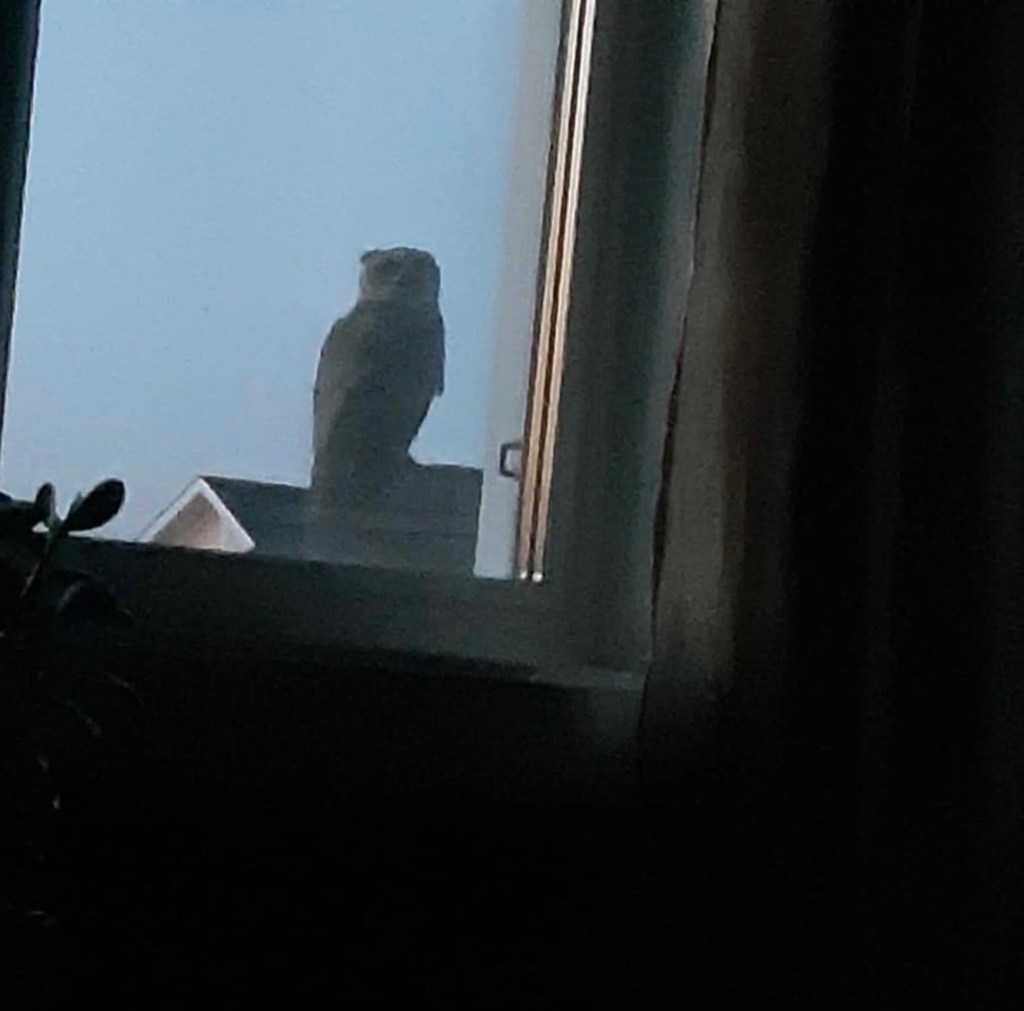
Last week, our neighbourhood went into high alert after a concerned neighbour posted an owl sighting to the Facebook page, and warned everyone to keep their small pets inside.

This post was buzzing with comments and was quickly pinned to the top of the page. Some neighbours went back and forth to confirm whether or not the accused was indeed dangerous or “just a little harmless barn owl.” After much back and forth, it was concluded that this owl was, indeed, concern-worthy.

Very quickly, alliances were formed and a vigilant owl watch committee was created. The brave members strolled the streets, searching for our terror owl.

A week went by, and the owl buzz slowed down. No sightings had been seen, and we resumed our daily nonchalance.

Until today…

OWL SPOTTED:

The terror owl was spotted this afternoon, perched on a neighbour’s window pane, making some seriously sinister eye contact.

BREAKING NEWS:

Moments after the spotting, we learned that a beloved neighbourhood pup, Ellie, had gone missing.

While venturing off isn’t entirely out of character for Ellie, whose photos are often on the Facebook page’s “lost and found” posts, we couldn’t help but wonder if she had crossed paths with our terror owl…

To learn what happens to Ellie and the nightmare owl, read the rest of the story here.

What makes this a good story snippet?

If at any point during this story, you thought “oh my gosh, where is my little DOG/CAT/CHILD,” then I’d like to think that this was a successful story.

Right off the bat, there’s a hook— a lure in– that makes you wonder: why is this neighbourhood being terrorized by an owl? How is that possible? Does anything happen to the pets??!

Setting the stage and the emotion (in this case, fear) from the beginning lets you know that something is happening that doesn’t normally happen in this neighbourhood.

You’re introduced to the main characters: the terror owl and the concerned neighbourhood dwellers. You’re invited into the conversations between neighbours and the actions they take to fend off this owl and protect the pets.

Just when you think that the owl’s flown off to terrorize another community, the plot thickens and things get complicated, thus keeping readers at a heightened state of anticipation.

Visual elements including screenshots and gifs are used to emphasize key points and evoke/enhance reactions, while hashtags are used minimally so as not to detract from the storyline.

Categories
Uncategorized

Mundane Problems, But Make It a Story.

“Seinfeld is a great show. It’s literally about nothing,” said my friend when I asked for a recommendation, and boy was she ever right! Making something out of nothing is the show’s appeal factor; Seinfeld chronicles the lives of four single friends; comic Jerry Seinfeld, hopeless George Costanza, frustrated working gal Elaine Benes and eccentric neighbor Kramer who are navigating the absurdities of everyday life. With a runtime of 9 seasons, the show cheekily dedicates 20 minute episodes to exploring mundane problems. Despite its comical nature, these stories are deeply relatable, keeping viewers tuned in decades after the last episode aired.

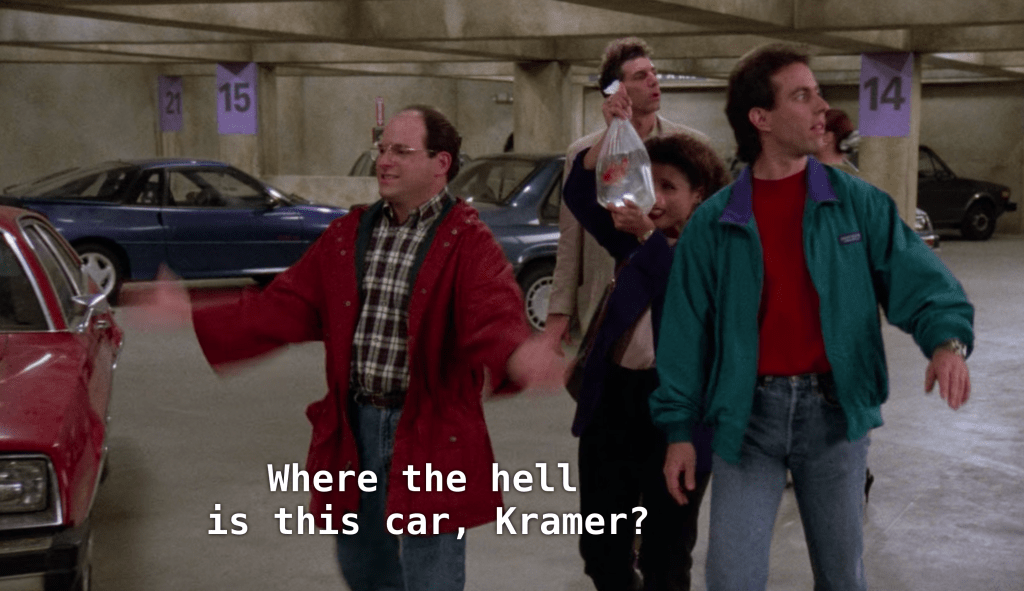
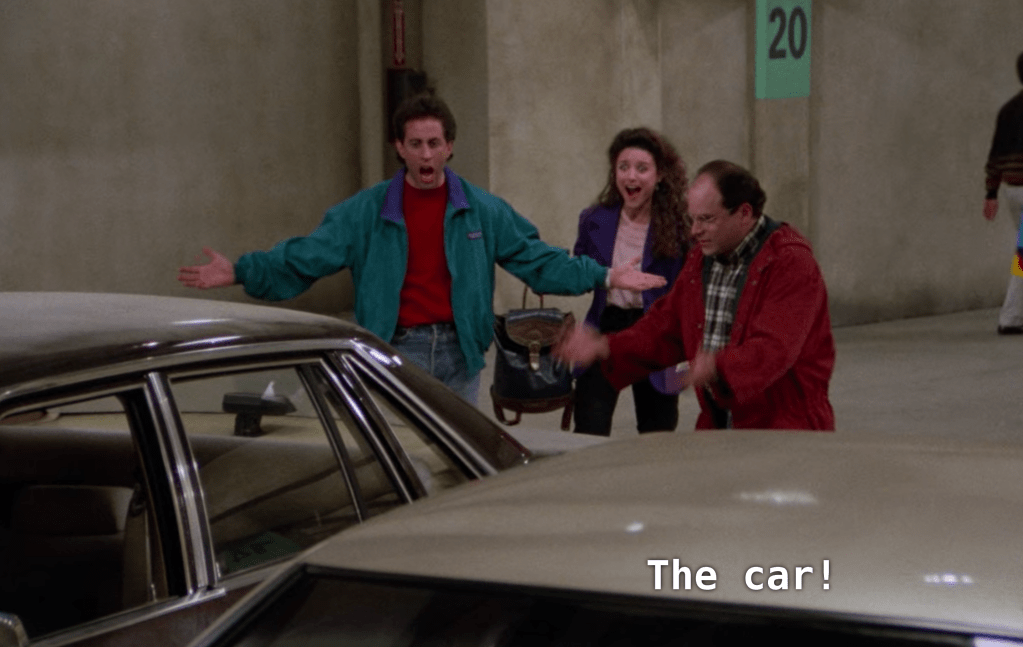
Seinfeld, Season 3 Episode 6: The Parking Garage.

I recently watched an episode titled “The Parking Garage,” where the entire storyline is about getting lost in a parkade. As someone who (often) finds themselves lost in a parking lot, what makes this episode memorable is how relatable the situation is. You quickly empathize with each character as you watch them navigate through some hilarious– but very real – scenarios, like needing to pee really badly when there’s no public washroom, or running very late for an important event. The urgency keeps you hooked and hoping that they find the gosh darn car soon! 

A Good Story Is: Building Something Out of Nothing 

A good story is simple, focused and intentional. It doesn’t overwhelm the audience with questions and information they need to figure out themselves. 

Adam Kens created the Story Spine in 1991 to help writers outline their stories without getting overwhelmed in the details. Here’s an outline of Seinfeld’s The Parking Garage: 

Once upon a time…There were a group of friends named Jerry, George, Elaine and Kramer.
Every day…The group would hang out and go shopping.
But, one day…They forgot where their car was parked, and got lost in the mall’s parkade.
Because of that…Jerry can’t find a washroom, and he really needs to pee. Finally, he gives in and relieves himself in the parkade.
Because of that…Jerry gets caught and arrested by the mall cop for public urination.  
Because of that…Elaine, Kramer and George go searching for Jerry separately, and lose each other in the parkade. 
Until finally…Jerry is released and reunited with his friends. They eventually find the car.
And, ever since then…They agree to write down where they park next time.

At first glance, the story spine doesn’t scream “chaotic hilarity,” but as Kens notes, a story spine “is not the story” but rather the bare-boned structure upon which the story is built. It’s a powerful tool that allows a writer to look at the structural core and ensure that the basic building blocks are in the right place. The story spine helps focus the story, and establishes the 5 W’s: who, what, when, where, why and how. When you’ve got these narrowed down, you can start dabbling beyond the basics.

The Luring In

A good story is one that hooks you in immediately and keeps you attentive. As soon as you lose your audience, your story inherently fails in being heard. You have to be careful to add meat to your storyline without adding too much. Ask yourself: How will I engage my audience — and hold them? A storyteller has to teeter the fine line between delivering too much or too little without straying from the main message.  

In her 2017 TEDX Talk on storytelling in the digital era, social analyst and communications expert Ashley Fell, explains that engaging stories embody the 4 I’s: interest, instruct, involve and inspire. Great stories:

  1. Create interest and maintain our attention;
  2. Instruct: they have meaning;
  3. Involve us; 
  4. and most importantly, great stories inspire us.

This episode does an excellent job in delivering just enough chaos in a short span of time to keep you interested, but not overwhelmed with information. The episode stays focused on the gang trying to find their car, but introduces each character’s motivation to get home quickly.

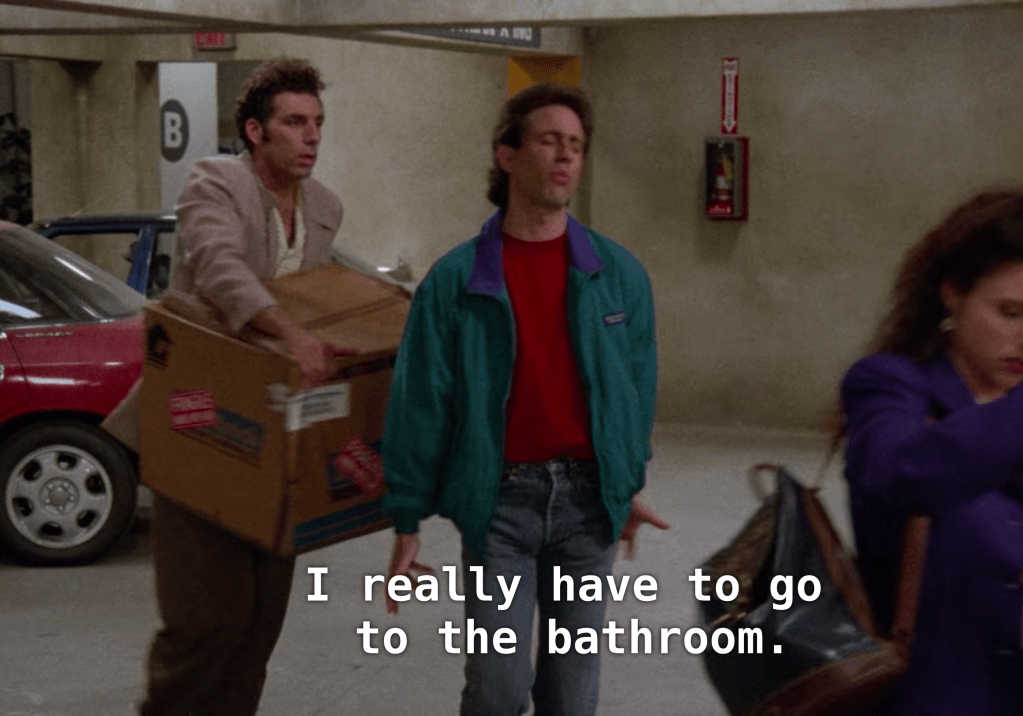
Jerry needs to go home and use the washroom:

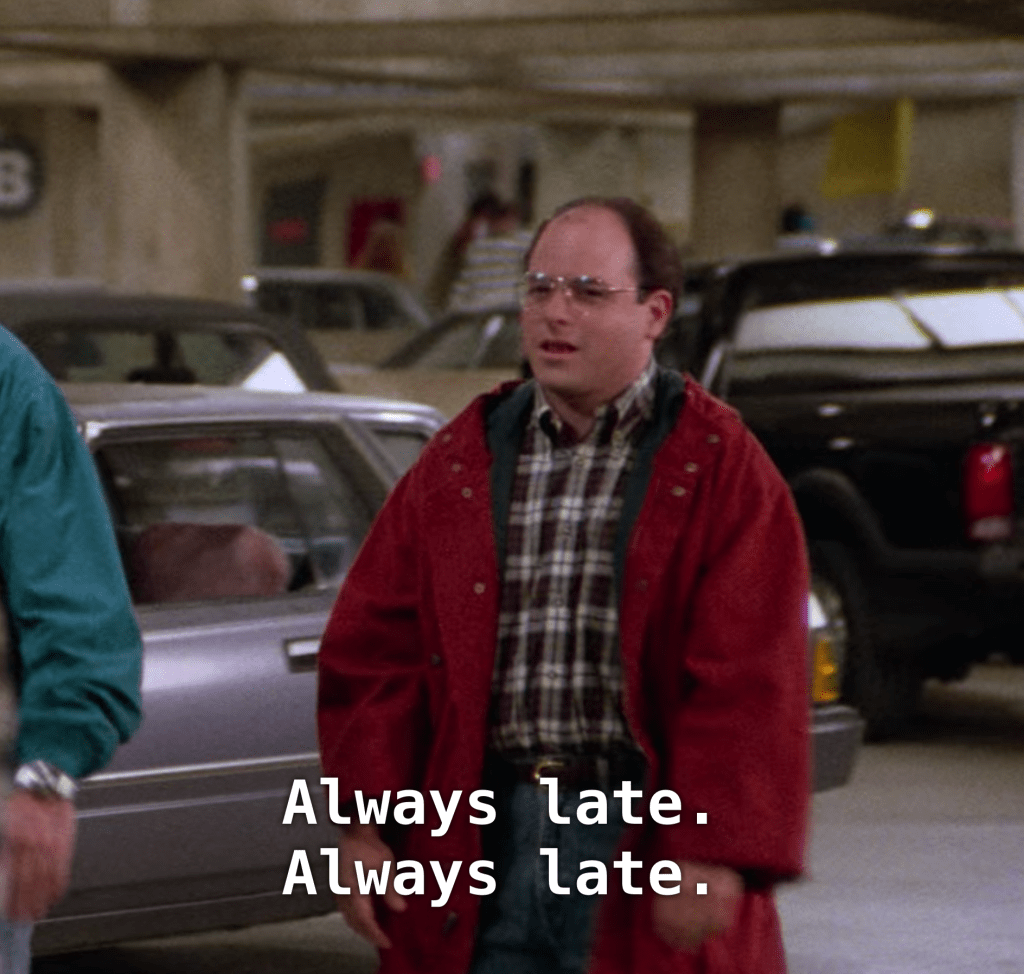
George needs to go home and meet his parents for their anniversary dinner:

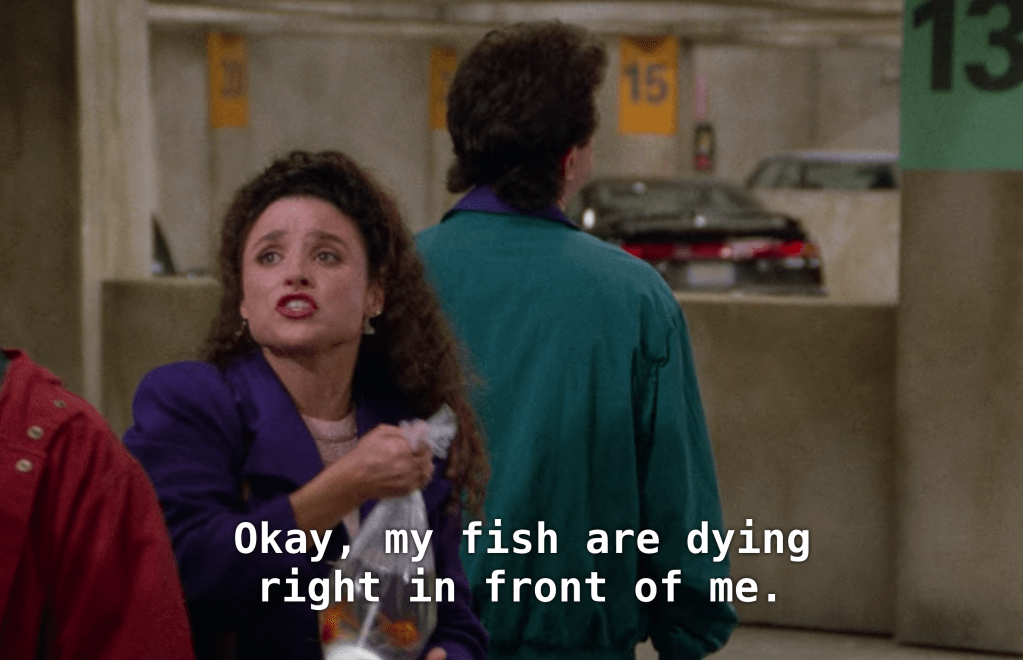
Elaine needs to go home and save her goldfish:

The Buy-In: I Care Because I Relate

The best storytellers look to their own memories and life experiences for ways to illustrate their message. Good stories create “sticky” memories by attaching emotions to things that happen. While I’ve personally never been arrested for public urination, I empathize with Jerry because I know the feeling of needing to go really really badly, but not being able to for whatever the reason may be. We’ve all been there at one point, and while the context might be different, the feeling is universal, and that is what makes this story arc brilliant. 

You can’t help but extend your empathy to not only Jerry’s dilemma, but also George who promised his parents that he would meet them for their anniversary dinner, or Elaine, who needs to get her pet goldfish into a tank before they die. 

The stakes are high for each character- and you’re invited to stay engaged and see what happens. When you feel connected, you start to care. When you care, you remember, and what is a good story if it’s not one that sticks with you long after you’ve finished it? 

When the gang does eventually find their car, they agree to write things down next time. Unfortunately, it stalls in the parkade and the episode ends. Do they learn their lesson? Maybe! Maybe not. But the ending, while memorable, isn’t the reason why I gravitate towards this episode.

If you too need some comfort in the universality of your #FirstWorldProblems, I highly recommend watching Seinfeld. Let me know what elements of the episode captures (and keeps) you engaged!

Design a site like this with WordPress.com
Get started