Categories
Uncategorized

A Family Reunited after 18 Years

In case you missed it, last year I discovered I had an estranged sister after a chance meeting at a coffee shop in my small hometown. You can read the story on my Twitter.

A Little About Me

My name is Marie Smith and I was born in a small town named Towntown, British Columbia.

My parents Mary and Joseph Smith were also born in Towntown and have lived in the town their whole lives.

I also spent my whole life in Towntown until I moved away at the age of 18 to go to school at the University of Northern British Columbia.

Haven’t heard of Towntown? That’s ok. Most people haven’t. The town’s tagline is “The town so nice, they named it twice!”. It’s a beautiful town and for those looking to visit, it’s about a 4-hour drive west from Prince George.

As a high school project I actually documented ‘5 Places To Be in Towntown, BC’. (It features Martine’s Coffee Shop where I met my sister!)

Here’s the video.

5 Places To Be in Towntown, BC

My Family Secrets

But enough about me! I’m sure you’re here to learn more about my family secrets and how I discovered after 18 years of being an only child that I had a sister.

I knew when we drove up to my parent’s house that something was wrong. Both my mom and Annie had the same wide-eyed look on their faces. Like they both encountered the same ghost.

Turns out Annie was the ghost. Well, the daughter that left at 18 seeking independence from her “overbearing” small-town parents.

I found out that Annie hated growing up in Towntown and resented our parents for not moving away sooner. There were a lot of fights and eventually it reached a boiling point. My sister at the age of 18 packed her bags and left Towntown; she asked not to be contacted and my parents fearing they’d lose her forever agreed.

Life As I Know it Now

And that brings us to the present day. I’ve learned a lot of lessons since meeting Annie last year and reuniting our family after 18 years apart.

  1. There’s no such thing as a perfect family. Even a happy family has their secrets.
  2. The past can be broken but love (and therapy) can mend most things.
  3. Having an older, wiser sister is actually so much better than being an only child.
Categories
Uncategorized

Fishing for a Good Story

When thinking about how to tell a good story, there can be a lot to remember. Good stories have a clear structure – a beginning, middle and end. Good stories answer the 5 Ws: Who, What, When, Where, Why. Good stories have a purpose, a conflict, a character, the list goes on and on…

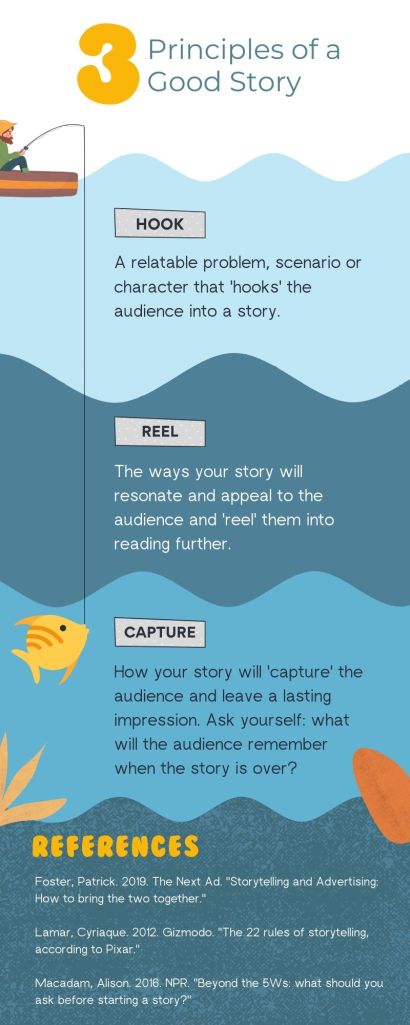
But knowing how to tell a good story can be as simple as knowing how to fish. All you have to do is remember these 3 principles: hook, reel, and capture.

3 Principles of a Good Story

Hook

We live in a world where access to information is quick and attention spans are short, so every good story must have a hook to attract your audience.

In some stories, the hook is a character to root for. As Emma Coats shares in The 22 rules of storytelling, according to Pixar, characters are the heart of many good stories because they give an audience someone to admire and challenge so they have a “reason to root for the character”.

A hook can also be a mission or puzzle, or even a problem that needs to be solved by the audience. Your story then presents a journey for your audience to discover the solution.

Reel

After you’ve hooked their attention, you need to reel your audience in so that they stay engaged with your story.

Alison MacAdam in Beyond the 5 W’s recommends asking these questions when developing your story:

  1. How can you illustrate it in a way that’s interesting?
  2. [Is there] an emotional or intellectual thread that can run throughout the story?
  3. Are there ear- or eye-grabbing ways to attract the audience?

Whether it’s adding emotional elements to resonate with your audience or captivating visuals to catch their eyes, find ways to keep your audience engaged while they read your story.

Capture

Good stories capture an audience and leave a lasting memory. Patrick Foster in Storytelling And Advertising: How To Bring The Two Together states that a good story is “a compelling story; one that reaches the heart of the consumer and evokes a feeling or a memory.”

When a good story is told, audiences remember and often act.

If your story introduces a problem-solving product to a target audience, telling a good story can mean that the audience remembers your brand and even purchases your product.

Let’s Go Fishing

Telling a good story is hard work, which can also be said about fishing. But if you remember the 3 simple principles of hook, reel, and capture, your work becomes a little bit easier.

Categories
Uncategorized

My First Christmas with The Simpsons

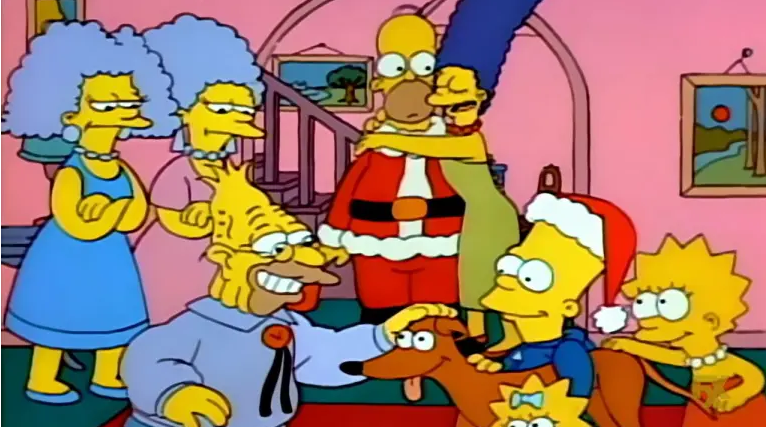
For over 30 years, The Simpsons has entertained families, adults and children alike. The Simpsons is a TV show about a family of 6: Homer (dad), Marge (mom), Bart (son), Lisa (daughter), Maggie (baby daughter) and Abe (grandpa). The first episode of the show aired on December 17, 1989.

Now you might think that I know all these details about The Simpsons because I, like audiences around the world, have enjoyed watching and rewatching episode after episode over the years. Well, you’d be wrong.

Confession time: I have never watched an episode of The Simpsons.

Not during a high school class, or even briefly while flipping through the channels when cable TV was still a thing.

So, why did I choose to live-tweet me watching my first episode of The Simpsons? As we learned in last week’s lesson, a good story is a relatable story. And what’s more relatable than the antics of a lovable (but slightly dysfunctional) family living in the suburbs of a town named Springfield?

A Christmas Special in 8 Parts

To help tell my story and recount the events that took place during the episode to my Twitterverse audience, I used the 8-Point Story Arc:

The stasis of the story takes place on a snowy night in December in The Simpson’s in Springfield. After getting home from a Christmas pageant, the family is gathered around the living room planning their holidays. Patriarch, Homer, is excited to plan a special Christmas for his family with some Christmas savings and an expected work bonus.

The trigger occurs when Homer’s boss informs staff that no bonuses will be given out. To make matters worse, Marge has to spend their Christmas savings on removing a tattoo that Bart had done.

Without telling his family about his bonus, Homer begins a quest to make the best Christmas.

The surprise occurs when Homer decides to make up the money for Christmas by becoming a Santa.

After learning that being a Santa only earns $13, Homer makes a critical choice to try betting his earnings at a dog racetrack in hopes of a Christmas miracle.

His quest reaches a climax as he chooses to bet his earnings on Santa’s Little Helper, a dog with a 99-1 odds of winning.

Homer loses his earnings, but a reversal occurs when he sees that Santa’s Little Helper is also down on his luck after being cast away following the dog race loss.

We reach a resolution as Homer decides to return home and confess to his family that he didn’t receive a bonus. After introducing Santa’s Little Helper to his family, Homer learns that the perfect Christmas isn’t filled with expensive gifts, but with love.

Painting A Yellow Picture

I knew I couldn’t group-watch the episode with everyone on Twitter, but I wanted to at least try and give audiences an idea of the world I was encountering on the TV screen.

According to Eric Goldschein in The Non-Writers’ Guide To Writing Better Social Media Copy, “to keep readers engaged with your content, add photos – as well as graphs, charts, videos, GIFs, and other visual media”.

Using gifs inserted throughout the thread, I shared with the audience some of my feelings and snippets of the episode to build a sense of community.

A Happy Ending or Beginning

Now, if every good story has a beginning, middle, and end, what is the end to this story of a girl who watched her first episode of The Simpsons? Well reader(s), I think I now understand what you see in the TV show. So check back on my Twitter to see if I catch a few other episodes along the way.

Categories
Uncategorized

Not Another Love Story

Growing up in the 1990s to 2000s, I was that little girl who sat criss-crossed on my green velvet family couch watching Disney princesses manifest their Prince Charmings through song, and later watching young boys woo their crushes with boombox serenades. It’s no wonder I consider myself a ‘hopeless romantic’.

During that time, I lived for the “meet-cutes” where boy meets girl under adorable, often serendipitous, but nevertheless fated circumstances. That was my idea of a true love story.

But my favourite story – the one that I’m going to share here – is not that love story.

Once Upon a Time, There was Jane

I first read Jane Eyre by Charlotte Bronte in Grade 9. If you’re unfamiliar with the book, let me break it down using a technique created by Kenn Adams called the Story Spine.

Once upon a time, there was a young orphan named Jane Eyre, who after surviving a childhood of loneliness and abuse, becomes a private tutor for a young girl, the ward of an elusive businessman.

Every day, she tutors her student but continues to wonder about the businessman who hired her, Mr. Rochester, and the mysteries of her new home, Thornfield Manor.

But one day, Mr. Rochester returns to the manor and meets with Jane.

Because of that, Jane forms a relationship with Mr. Rochester, and they fall in love.

Because of that, Jane and Mr. Rochester plan to marry but during the ceremony Jane learns of Bertha, Mr. Rochester’s mentally ill wife, who he has hidden in the attic of Thornfield Manor.

Because of that, Jane is humiliated and runs away from Thornfield Manor.

Until finally, Jane returns to Thornfield Manor, learns that Bertha died after setting fire to the manor, and reunites with Mr. Rochester.

And ever since then, Jane lived a life of love, marrying Rochester and raising their family together.

If my ideal love story was one where a hypothetical couple meets coincidentally while travelling through a quaint village in Europe, spending their days riding Vespas and nights drinking wine at sunset, what made me fall in love with the tragic story of Jane Eyre?

Emotional Thread Connection

The book begins with young orphan Jane living with her abusive aunt and cousins. Her story goes from her being sent to a religious boarding school and living under similarly harsh conditions to facing humiliation and heartbreak while at Thornfield Manor. Alison McAdam writes in Beyond the 5 W’s: What should you ask before starting a story? that to engage an audience you must ask if there is “an emotional or intellectual thread that can run throughout the story”. Jane overcoming adversities hooked me in as if the emotional thread was a physical thread wrapped around my finger forcing me to turn another page.

Admiration Despite Challenges

A good story is often one where the audience isn’t focused on a happy ending but instead on the journey they’ve taken with the protagonist. As Pixar storyboard artist, Emma Coats, shares in her 22 Rules of Storytelling, “#1: You admire a character for trying more than for their successes.” While finishing the book was bittersweet, it was was Jane’s resilience throughout that solidifies the book as one of the greatest stories of love I’ve ever read.

Design a site like this with WordPress.com
Get started