Categories
Uncategorized

Big Timber Remix

This project is a remix of some of the concepts and content work done throughout the course to demonstrate examples of what I’ve learned about digital storytelling for this assignment.

In this long-form blog we look at how different mediums including text, photos, graphics, and video can be used to enhance the story of “Big Timber” and the Wenstob family that owns  Wenstob Timber Resources.

Storytelling has evolved to a complex artform with our increased abilities to express ourselves on digital media platforms such as blogs, social media, and video. Each platform’s messaging and content must be carefully constructed for that platform’s requirements to enhance and shape the storytelling experience for its unique audience.

Although medium is foundational to experiencing the message, many universal principles comprise good storytelling.
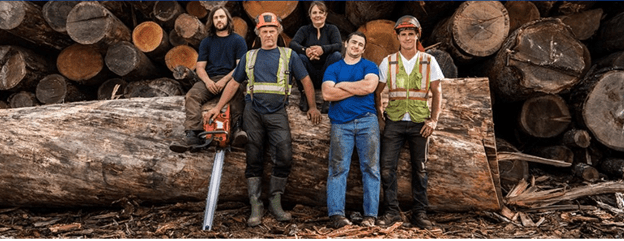
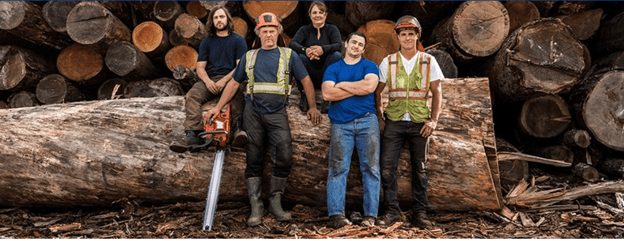
Wenstob Timber Resources

How to Make a Story

Every engaging story has a beginning, middle, and end during which protagonist(s) and antagonist(s) engage in conflict and then work out a resolution. But there’s much more. We must relate to the characters’ journeys. Good stories tug at our emotions as we recall life feelings and experiences universal to humans on this earth regardless of where we live. We care about the protagonist and want him/her to win.
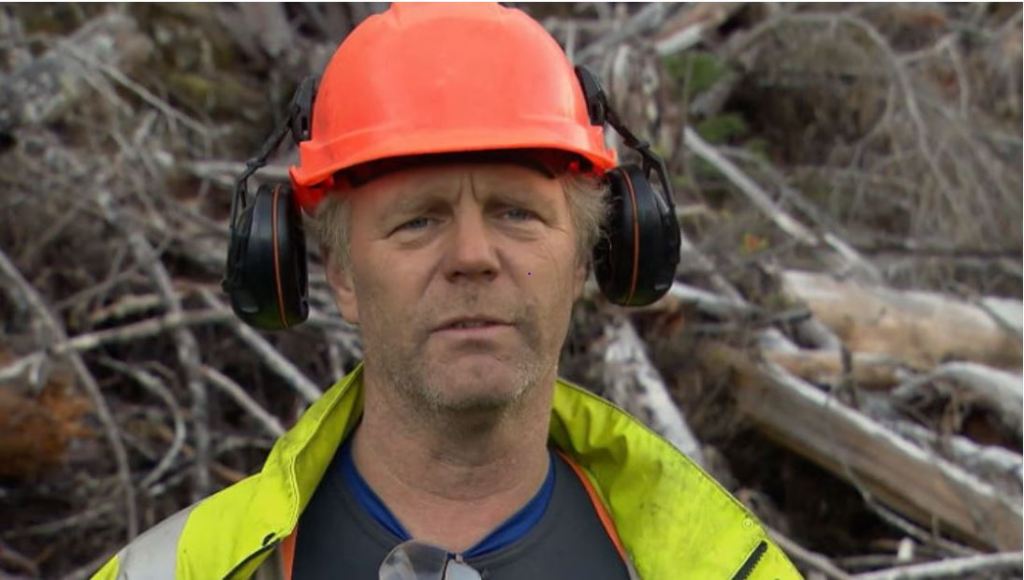
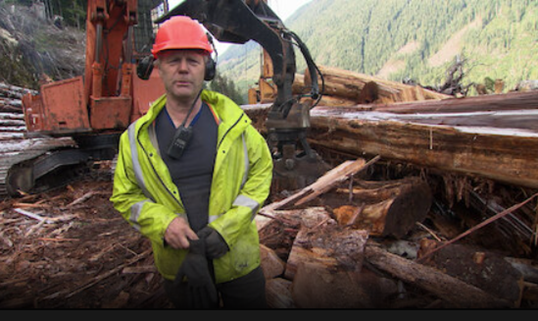
Ken Wenstob Entrepreneur

An example of great storytelling is the story of the Wenstob family from Wenstob Timber Resources.  Ken Wenstob, logger, and sawmill owner is a larger than life opinionated force to be reckoned with. This story depicts the universal theme of the heroic individual, which is Ken the protagonist, leading his team through everyday life experiences that compound to become immense obstacles, the antagonists, that they continually overcome.  The audience identifies with these real-world aversities as pain or learnings in their own lives and is therefore drawn in emotionally as Ken’s team pushes all human and equipment limitations to exhaustion to meet their time sensitive goals and arrive at a new place. 
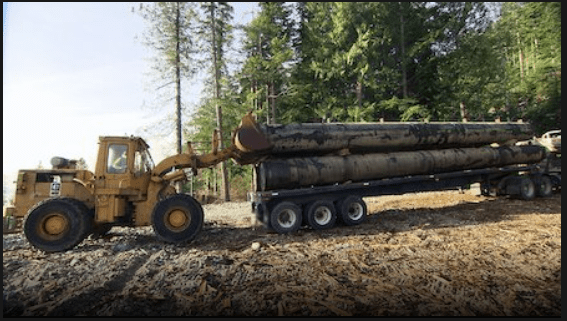
Wenstob Timber Overcoming Adversities

Use a Story Spine

Online video channels like Netflix support visual storytelling.  In the “Big Timber” series, each 45-minute episode is delivered through clearly defined five phase story plans where Ken and his team undergo a journey to solve a problem and ultimately end up at a new normal or stasis. This formula of structure also known as a story spine  is the timeless “secret sauce” proven to be a corner piece of a what makes many stories exceptional.   The five phases unfold as Beginning, The Event, Middle, The Climax, and End.

The story spine for each 45-minute episode of “Big Timber” runs something like this:

  • Once upon a time there was a heroic entrepreneur named Ken Wenstob who operated one of the last privately-owned sawmills on Vancouver Island
  • Every day, his team brings logs from their timber claim on the mountain to keep the sawmill running and turning logs into lumber
  • But one day, he is locked out of his timber claim because the road at the bottom of the mountain is closed
  • Because of that, he has to find another source of logs
  • Because of that, he has to get his old barge and boat yarding logs on the inlet shoreline
  • Because of that, he fixes his equipment and builds a dock
  • Until finally, Ken goes all out with new team members and fixed old equipment
  • And ever since then, Ken has another ongoing source of logs to supply the sawmill

How does that story spine work in visual and digital storytelling?

New Media Storytelling

We can present the same story spine text as an Infographic. This visual representation makes the information easier to retain and apply. In this case, all the words are there, but it is much easier for our brains to understand the visual layout to quickly grasp the content than it is with the text format above.

Read the infographic story spine below to see if you agree.

We can also reconstruct the above story spine word content into a story thread for a Twitter audience that likes short text. We tell the story with snippets by condensing a 45-minute episode into a few linked short text posts with some branded images, based on the 5 phases of the story spine.

Or, we can give different insights into the story using an image-based platform like Instagram which allows the business (brand) to interact more intimately, personally, or one-on-one with its fans. We see and hear the Wenstob family storytelling, chatting, relaxing, playing a guitar at night around a campfire near the water in this IG post.
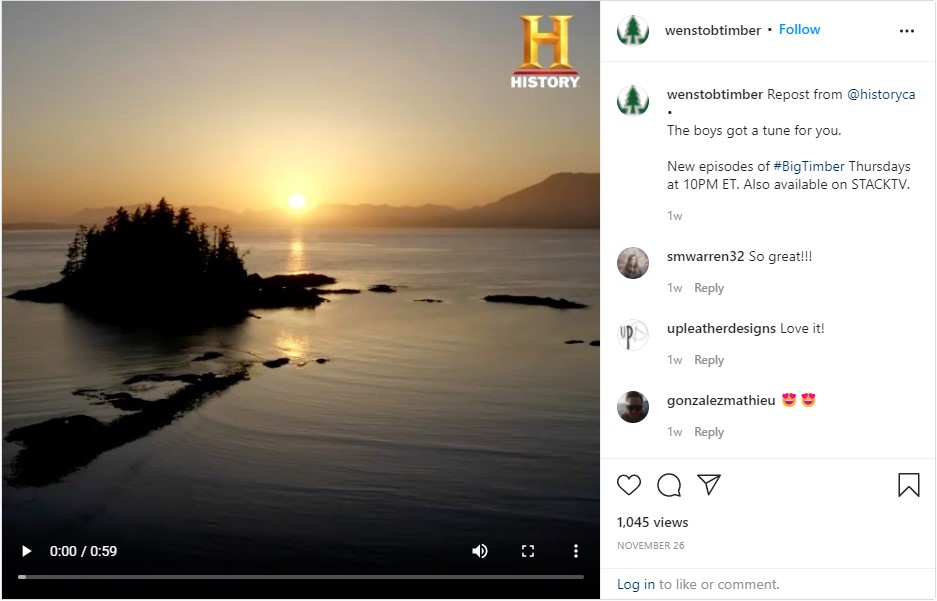
See post on Instagram: https://www.instagram.com/p/CWwaA6cldoA/

Storytelling with Video

The “Big Timber” story breathes strong storytelling principles, is inherently visual, and is highly suited for a visual digital medium. In addition to enjoying the interactions of the Wenstob team, the audience is continuously drawn in by the spectacular landscape colors, pictures, and movements of the immense equipment in the forests.  The visuals of logging equipment and the operations team cutting the giant trees on the mountains are breath-taking. In reference to Marshall McLuhan, Canadian philosopher, the medium does become the message in this case.
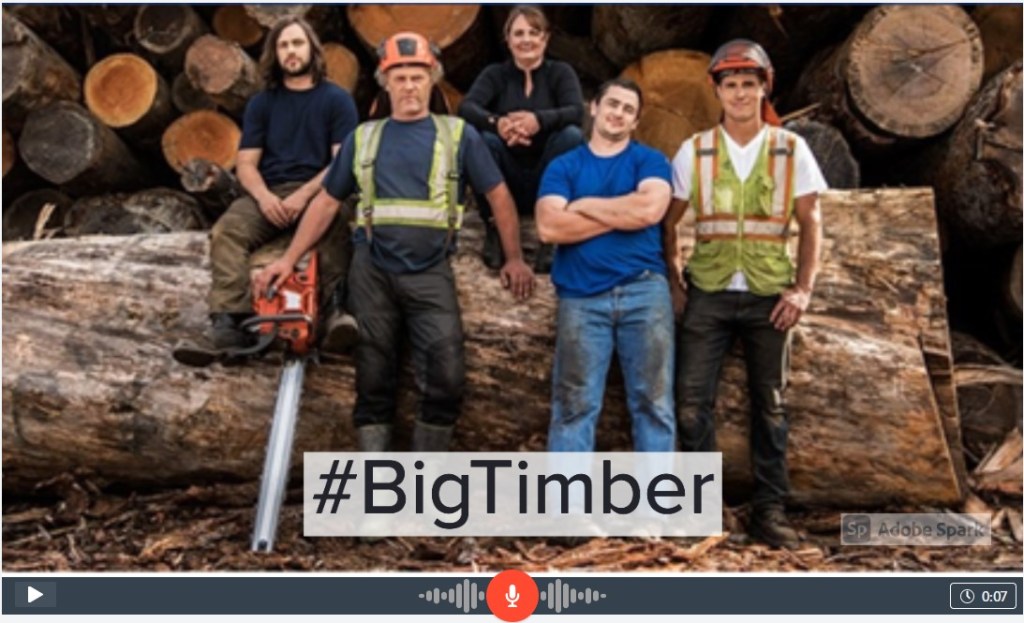
See video on Adobe Spark: https://spark.adobe.com/video/b49DRPvAMepS1

What About Season 2?

At the end of Season 1, the team achieves 220 loads of logs or 10% more than the required goal for the winter. There is a team celebration lunch on the mountainside. Although it was a very challenging year, Ken announces he has purchased another claim for the next year.  

At the end of Season 1, there is also data that tells a story about the journey’s of those people who watched the season on Netflix and who engaged with the various social properties. From that data, the producers can extract stories and then make decisions regarding whether or not Season 2 should be produced, and to drive the right visuals and narrative.

In Conclusion

Storytelling across platforms is the new normal. It allows us to create stories that engage audiences using various technologies that permeate their daily lives. The media deliver unique content creations that are linked together to enhance and complement the story narrative. Ideally, the content pieces are in synchronization together.

#Storytelling, #EXSM3989, #WenstobResources, #BigTimber
Categories
Uncategorized

Visual Storytelling for Businesses

Visual Language is a Powerful Tool for Storytelling in the World of Business

Visual language makes data easier to understand because our human brains process visuals 60,000 times faster than they do text. Science has known since 1921 that “a picture tells a thousand words.” Therefore, it makes sense that applying visual language storytelling in the business world will yield powerful results to help companies grow better.

My Story Arc

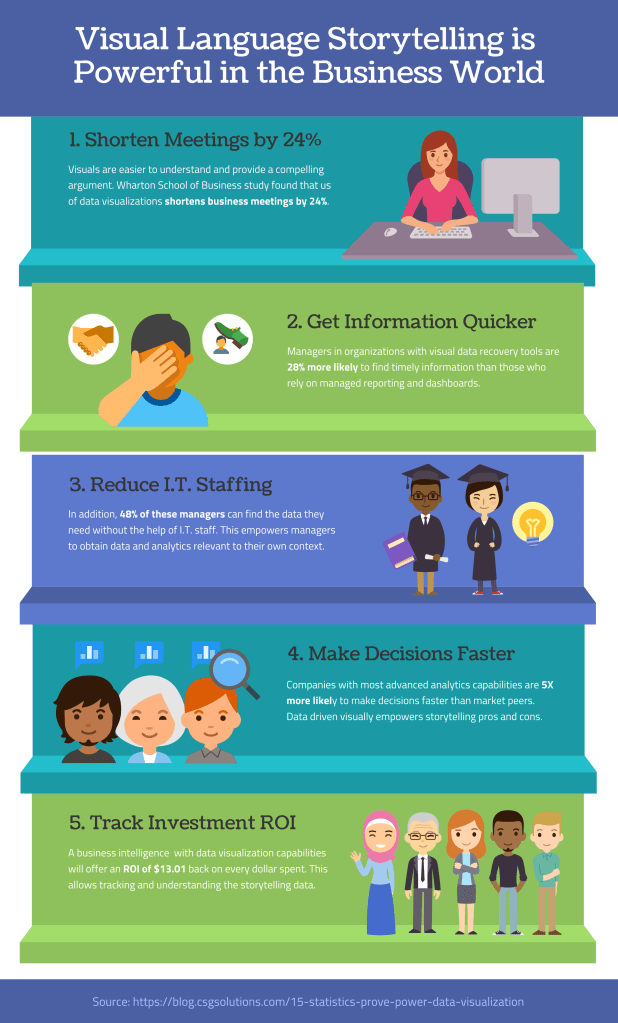
The story arc for my infographic is based on a blog about data visualization tools.  My infographic shows how businesses are empowered through data storytelling to grow revenues and concurrently reduce their investments of time, human resources, and dollars in operational processes.

The first step, or beginning, is to use visual data storytelling to free up staff hours by reducing time in meetings because the visuals are more quickly understood (1). The middle of the story arc is empowering managers to get real-time information directly through visual language driven platforms (2); this will reduce I.T. time on manually sourcing lagging data (3); management will be empowered with confidence of real-time data to make decisions faster (4). At the end, investment in tools for data visualization storytelling to inform business operations will have a positive return on investment (ROI) by a trackable dollar amount of reduced overhead (5).

Takeaways

One of my biggest takeaways is the importance of playing to our brain’s strengths so to speak. Not only does the human brain process visuals 60,000 times faster than  it does text, but 90% of the information that is transmitted to the brain is visual.  For all types of education or information transmission, whether in the business or personal context, we should first think about how we can use visual storytelling. And of course, the most effective solutions will involve digital. As we move forward, the opportunities for digital storytelling will be unlimited.

Categories
Uncategorized

Ready to Begin

My live-tweet story is Big Timber’s Season 2: Episode 1 “Ready to Begin.” My story has 12 tweets;  hashtags are #BigTimber and #EXSM3989. This episode is streaming in Stack TV, but I pretended it was a live TV show. As I was watching it for the first time,  it felt like a live story to me.

The Beginning

This is the continuing documentary of everyday life (stasis) of Vancouver Island entrepreneur Ken Wenstob and his family who own and run Wenstob Timber Resources. As this episode begins, we learn it is springtime, but the snow has not melted on the mountain where Wenstob Resources has their new logging claim. The weather, a trigger beyond their control, makes it too dangerous to try to get their massive equipment up the mountain. Then there is a second trigger. Ken, our protagonist, learns that he has been fined $1M by the government for leaving logs on the mountain last year when the logging season shut down early due to forest fires and then snow and he could not get the logs out.  He has only 16 weeks to pay this fine or his operations will be shut down. And so, Ken begins his quest to find another source of cedar logs to fill the spring orders coming into the mill.

The Middle

As we move into the middle of the story, there are surprises. Ken decides to enlist a couple of his old boats to beachcomb for huge cedar logs on the beaches. These logs are free to take but very had to get to due to remote locations. There are more surprises as Ken’s team works on the boat strategy to access the logs. First, there is Seacrest, a very old landing barge that has two powerful diesel motors but only one will start. The mechanic works hard and finally it starts. Second, the digital engine of a new boat carrying the crew will not start. The mechanic does not know this type of motor, but he does figure it out while patience between the workers has worn very thin. The third surprise is the tide is going out and they are losing opportunity to begin yarding logs.  

But Ken’s critical choice is that he never thinks of giving up on anything. He calls in a reinforcement, his cousin who comes via his own boat,  to help the team start yarding the logs. This is the climax. Ken’s cousin brings expertise and equipment which pushes the rest of the crew to get to the site and start logging. They try to pull the huge logs off the beach without cutting them which would give them highest value per log. But, another surprise, none of their pulling equipment can withstand the pressure. So, ultimately, they are forced to cut the logs into pieces to yard them.

The End

As the episode ends, there are major changes (reversals) for the entire team. Ken, the protagonist, has created a new stasis (resolution), to get the cedar logs he needs for his mill to make boards and generate revenues to pay his $1M fine.  Instead of using logging trucks on mountain roads to log his claim, he uses barges on the ocean to yard free cedar logs from the beach. This episode is a perfect story arc.

In Conclusion

Live tweeting is a new experience for me. It was challenging to absorb the information and write posts that quickly without losing the ongoing storyline. I was very busy for the full 45 minutes of the episode, a few minutes before, and a few minutes after. Thank goodness for the commercials that gave me a minute or two to catch up.  I had prepared some images in advance that I used as I tweeted. Rereading my tweets today, I think there is an engaging story arc that has clear structure and purpose; that generates feelings and emotions; that is simple; and that gives us a character, Ken Wenstob, to root for.  I also think there’s room for me to improve. Next time I will work to make the tweets shorter and remember Gary Vaynerchuk’s hack  that I’m documenting, not creating.   #BigTimber is a Canadian documentary. The storyline is as large as Ken Wenstob’s life.

Categories
Uncategorized

A#1 Storytelling Blog Post

Real Canadian Story

Wenstob Timber Resources Team

I recently binge watched Season 1 of “Big Timber”. The series is produced on the Canadian History channel and featured on Netflix. It’s the story of the Wenstob Family from Wenstob Timber Resources which is the last independently owned sawmill on Vancouver Island. The family business is headquartered in Sooke, BC. This engaging series depicts the universal theme of the heroic individual leading his team through immense obstacles that they continually overcome. The audience is drawn into the emotions of real-world experiences as the team pushes their human and equipment limitations to the limit to get dangerous jobs done.  

This Story Has Spine

The story spine is evident. Each episode has clear structure and purpose. Meet Ken Wenstob, logger, and sawmill owner, who is a larger than life opinionated force to be reckoned with. Every day his sawmill produces the best possible quality lumber from timber he and his team harvest from his claim that is far away up Vancouver Island on a mountain. In each episode, Ken the protagonist, is seriously challenged by an unforeseen antagonist. His team must keep the logs coming down the mountain, so that Wenstob sawmill survives. Every episode is a nail biter.  

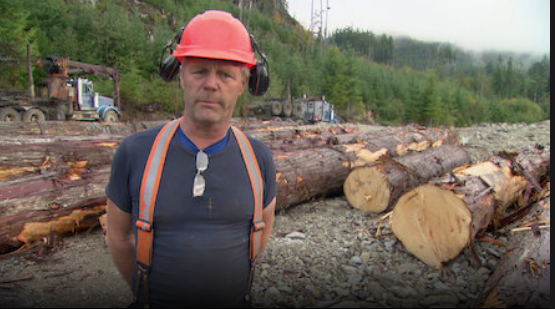
Ken Wenstob on the Mountain Claim

The challenges are so amazing the viewer must watch just to see how there can possibly be a solution.  Ken and his family struggle against a wide range of antagonists including:

  • changing seasons
  • mountain roads
  • bridge failures
  • equipment failures
  • local regulations
  • big competitors
  • staff turnover

The episodes are simple and focused. We want Ken, the main character, to succeed. It’s admirable what he chooses to do and amazing that he always succeeds! Ken is driven by fear of his business not surviving if he does not find or create solutions to get 200 loads of logs out of their logging claim before winter comes and their claim expires. But, after they embark upon dangerous and often unimaginable solutions, Ken and his team always experience success or partial resolutions that keep them moving forward with new routines and solutions.  

At the end of Season 1, the team achieves 220 loads of logs or 10% more than the required goal for the winter. There is a team celebration lunch on the mountainside. Although it was a very challenging year, Ken announces he has purchased another claim for the next year.  

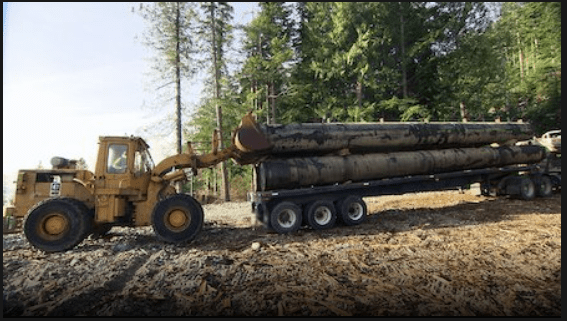
Wenstob Timber Resources Equipment at Work at the Claim

Powerful Visuals

The “Big Timber” story breathes strong storytelling principles, is inherently visual, and is best suited for a visual digital medium. In addition to enjoying the interactions of the Wenstob team, I am continuously drawn in by the spectacular landscape colors, pictures, and movements of the immense equipment in the forests.  The visuals of logging equipment and the operations team cutting the giant trees on the mountains are breath-taking.

According to Ashley Fell, science confirms we process visuals 60,000 times faster in the brain than text. Story visuals from these episodes kept popping into my mind the next few days after I viewed them. This series really connected with my heart. I found it so interesting I could not stop watching; it instructed me about the disappearing entrepreneurial lifestyle around logging on Vancouver Island; I became very involved with the characters’ stories; and I was truly inspired by the courage of Ken, the protagonist.

I am ready and waiting for Season 2! This amazing story of one person’s undefeatable will and leadership must continue to be told.

Ken Webstob at the Mountain Claim

Design a site like this with WordPress.com
Get started