Categories
Uncategorized

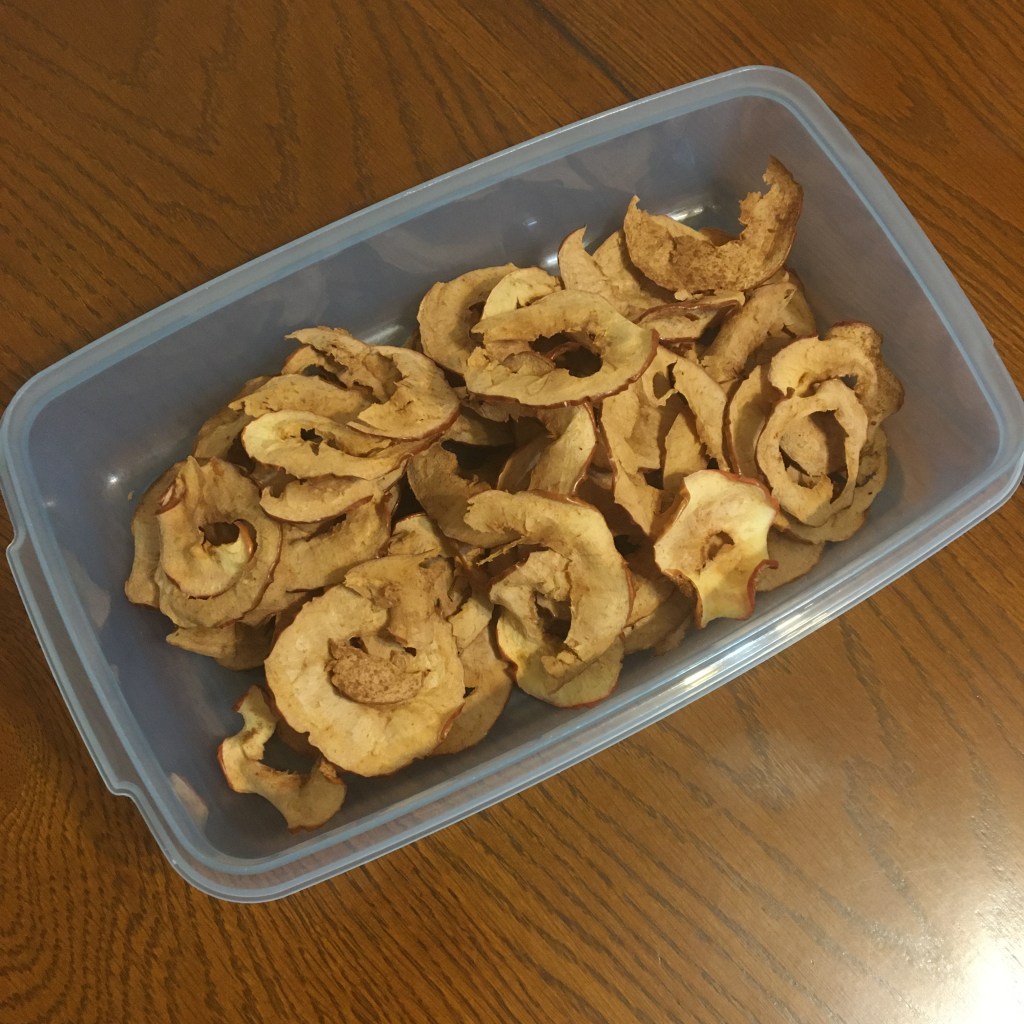
Baked Apple Chips Recipe

You can really tell that it’s summer when the farmer’s market starts up. There’s nothing better than farm fresh fruits and veggies (and those delicious sausage breakfast sandwiches for brunch).

It was at the Lacombe farmer’s marker two weeks ago when inspiration struck. While perusing the stalls of local honey, fresh bread, and various seasonal vegetables, we stumbled across a stall selling apple chips. We bought a bag for $5 and ate so many they barely made it home.

The next week we returned and bought a bag of fresh Pink Lady apples from the same vendor with the intention of making our own apple chips.

My mom, sister, and I have made apple chips before and they’re the perfect summer snack. It’s been a bit of a process each time as we tweak the recipe:

One early attempt resulted in paper-thin apple slices that stuck to the tray while baking.

Another had more cinnamon than apples.

A particularly memorable attempt was made by my roommate in our college dorm where she spent nearly 5 hours baking a single tray of apples only for them to turn out both soggy and burnt (we blame the finicky oven).

This time, we think we have finally perfected the recipe. Our recipe is listed and the end of this post but first I’d like to share and few tips and tricks for making the perfect apple chips.

3 Tips for Making Apple Chips

Start with the right apples

For our recipe, we use Pink Lady apples. Apples that are sweeter and crisper – like Pink Lady, Golden Delicious, and Honeycrisp – work best because they don’t require any extra sugar and hold up well to baking or dehydrating. But really, any baking apple will do. We’ve even had success baking the crab apples we grow in our backyard. Just be aware that the baking times may vary for different varieties.

Keep the slices consistent

The key to making perfect apple chips is to make sure your slices are a uniform thickness. This ensures that the apples bake evenly. We recommend using a mandolin to cut even slices but it is possible to get the same result with a knife. The ideal thickness is a few millimetres. Apples that are too thin tend to stick to the baking sheet. Apples that are too thick take a very long time to dry out.

Experiment with spices

Baked apples taste delicious on their own but they also taste amazing with some classic apple pie spices. Our personal favourite apple chips are just sprinkled with cinnamon but you can also try allspice, nutmeg, cardamom, and ginger or a combination of all of them!

Our Baked Apple Chip Recipe

  • Yields: 3 apples-worth of apple chips
  • Prep Time: 10 minutes
  • Cook Time: 1-2 hours

Ingredients

  • Pink Lady apples, thinly sliced
  • Cinnamon to taste (optional)

Instructions

  • Wash and core apples. Using a mandolin, slice them thinly (about 1-2mm in thickness).
  • Spread the apples in an even layer on a baking sheet lined with parchment paper. Keep the apples close together but not overlapping.
  • Sprinkle the apples with cinnamon (or spices of your choice).
  • Bake apples at 250F for 30 minutes or until edges are brown and slightly curling. Flip slices over and bake for another 30+ minutes.

Enjoy your delicious summer snack!

Categories
Uncategorized

The Essentials of Storytelling

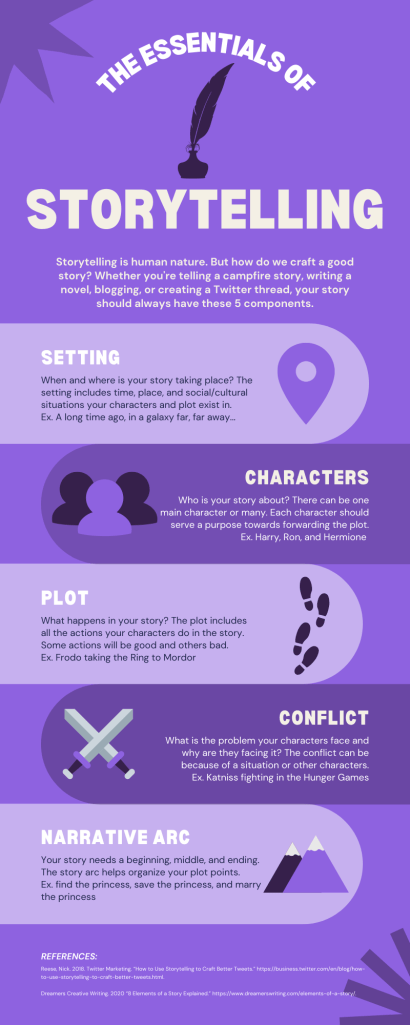
Telling stories is human nature. For as long as there have been humans, we’ve been telling stories. We created pictograms on cave walls, shared oral stories, wrote novels and plays and movies, created songs and dances. In the 21st century, we brought our storytelling online to share with the world. We wrote blogs and Facebook posts and Tweets, created YouTube videos and Vines and TikToks.

Each of these stories are unique and different. They’re aimed at different audiences and created in different mediums and shared in different formats. But despite all the differences, all stories share the same basic principles. So no matter if you’re writing a Twitter thread or the next best-selling novel or blockbuster movie, keep these 5 storytelling essentials in mind:

  1. Setting – where and when
  2. Characters – who
  3. Plot – what
  4. Conflict – what and why
  5. Narrative arc – how
Click here for a free PDF copy

Categories
Uncategorized

An Adventure in Live-Tweeting about Video Games

Photo by Michael Adeleye on Pexels

I would like to preface this post by saying that I am not a regular Twitter user nor am I a dedicated video game player so this blog in general is very outside my comfort zone. But, I do enjoy a good story and have been told by strangers on the internet that I can tell a pretty good one, so this assignment wasn’t all that bad.

I decided to live-tweet about something that happened while I was playing Animal Crossing: New Horizons on the Nintendo Switch this weekend. I realize I’m a little late to the game (sharing your game-play of ACNH is so 2020) but since I’m notoriously late to everything, it checks out. My sister got the game for Christmas and together we’ve been building up our island, Odyssea, for the past 7 months.

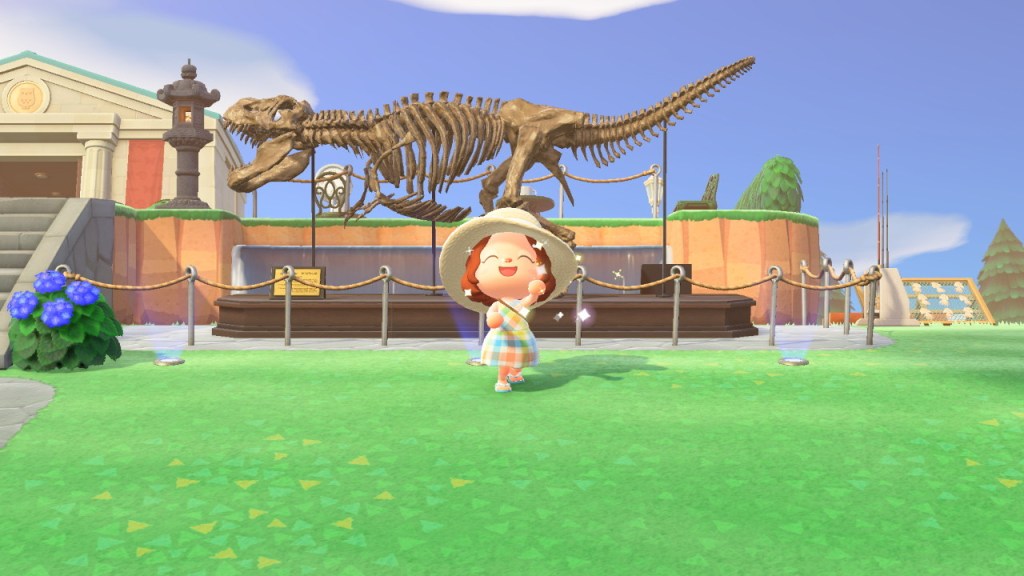
Not to brag, but Odyssea is pretty great (and yes, the name is a pun on the Odyssey. Both my sister and I really love Greek mythology). We’ve got a cool museum full of dinosaurs and art, a camping spot next to the orchard, an outdoor pool and basketball court, and a whole neighbourhood for our 9 villagers.

My Animal Crossing avatar outside the Odyssea Museum

During a normal evening on the island catching fish and bugs as I tried to pay off a massive loan to Tom Nook, I happened across the event that sparked my Twitter thread story time.

The story goes like this: my sister and I have been competing in a self-imposed pitfall seed battle for the past few months. We take turns burying the seed on our island in hopes that the other person walks over it and falls in. This time, instead of one of us falling in, one of our villagers was the unfortunate victim.

My Twitter Thread

This live-tweet thread was lots of fun to create and highlights some important storytelling techniques. Read on to see the 3 storytelling techniques I used to tell my Twitter story!

3 Storytelling Techniques to Use in Live-Tweet Stories

Start with a good hook

If your story isn’t interesting from the very beginning, people aren’t going to want to read it.

This is especially true with Twitter storytelling. People nowadays have very short attention spans so if your first tweet doesn’t catch their attention and make them stop scrolling, then they’re not going to read the rest of your story.

I decided to start my live-tweet thread with a bold statement: “OMG I JUST PUSHED MY NEIGHBOUR INTO A HOLE!?” It’s written in all caps to make people stop and take notice. And while it’s exciting, it doesn’t give away too many details – people will have to read the rest of the thread to see what happens. But I did include #acnh to let people know this happened on Animal Crossing.

Have a beginning, middle, and end

Remember that plot diagram from middle school? Those same principles still apply when you’re writing stories for social media.

In the beginning of my Twitter thread, I set the scene and introduce the characters. In the first few tweets its revealed this event takes place on my Animal Crossing island, and that Hornsby, a villager on the island, and I are the central characters.

In the rising action, I discover the potential pitfall seed danger and realize I have to save Hornsby before he falls in. I use suspense to draw this section out longer.

The climax is where, instead of saving Hornsby, I push him into the pitfall seed hole.

The falling action and conclusion is where I gave Hornsby an apology gift and decide to stop the pitfall seed battle I’ve been having with my sister.

Following this simple narrative pattern helps to organize your story and ensures you have all the elements of a good story (setting, characters, conflict, plot, etc.).

Use emotion

Social media is the perfect place to put emotion into your writing. If your story doesn’t evoke any emotion, people aren’t going to be interested in reading.

I chose to make my story humorous for obvious reasons (watching Hornsby fall into the hole was very funny). I express this emotion through the words I used, my use of capslock text, and the GIFs and hashtags I included in some of the tweets.

Part of the humor also comes from the dramatic nature of my story. I find stories, especially funny ones, are always better if they’re dramatized a bit. This event is something that happens normally in Animal Crossing and is much less dramatic that what I made it out to be. Villagers falling into pitfall seeds is just part of the game and really isn’t something all that interesting. But through my use of humor, I’ve made it interesting.

Plus, the pros at Buzzfeed say using humor is a surefire way to drive engagement so who am I to ignore their advice.

But humor isn’t the only emotion I evoke in my story. I also build sympathy for Hornsby be describing him as an innocent bystander in the pitfall seed battle my sister and I were having.


And there you have it folks, 3 easy ways to tell good stories on social media. Now you’re ready to harness those 280-characters and tell the best story you can.

Categories
Uncategorized

My Perfectly Reasonable Love of Harry Potter (According to Storytelling Principles)

In junior high, I was introduced to the world of Harry Potter.

It’s not like I didn’t know Harry Potter existed up until that point, because I absolutely did (is it possible to not know about Harry Potter?). I just wanted nothing to do with it. I’m the kind of person who will hate a thing just because someone I don’t like likes that thing. And lots of classmates I didn’t like liked Harry Potter, so obviously I hated it.

I even tried to to write an essay about how much I hated Harry Potter. It didn’t go well.

Turns out, it’s hard to prove why you hate something when you haven’t tried it yet.

Go figure.

So, in true Hermione style, I turned to the library and finally read the books I supposedly hated.

Spoiler alert: I loved them.

I have since come to understand why Harry Potter is one of the best-selling novel series in the world. But what is it about this story about a boy wizard that makes it so good? I’ve narrowed down 5 storytelling principles featured in the Harry Potter series that make me come back to this story again and again.

5 Storytelling Principles that Make Harry Potter Great

The story is well organized

This may seem basic, but the Harry Potter series is well-organized. Each book in the series can be organized using the Story Spine. And even the series as a whole follows the Spine very nicely.

Here’s an example using Harry Potter and the Philosopher’s Stone:

  • Once upon a time there was a boy named Harry Potter.
  • Every day he lived in the cupboard under the stairs and thought he was very normal.
  • But, one day he received a letter telling him he was a wizard.
  • Because of that, Harry went to Hogwarts to learn magic.
  • Because of that, Harry learned a powerful magic artifact, the Philosopher’s Stone, was hidden at Hogwarts.
  • Because of that, Harry learned that an evil wizard named Voldemort was trying to steal the Philosopher’s Stone.
  • Until finally, Harry and his friends went to stop Voldemort from stealing the Philosopher’s Stone.
  • And ever since then, Harry learned that he and his friends could protect Hogwarts and stop Voldemort from returning.

Without a good spine to keep the story organized, Harry Potter and the Philosopher’s Stone wouldn’t have become the powerhouse success it is today.

Interesting characters

According to Pixar, you can’t have a good story without interesting characters. The Harry Potter series has so many characters to love (or hate) and each one is unique.

I love that the characters each have their own opinions that help create their personality. No one is passive or wishy-washy. Some follow traditional character archetypes (Harry is absolutely the savior archetype) and there are lots of character foils to keep things interesting.

Some examples:

Both Hermione and Umbridge are big on following the rules. But Hermione is willing to break rules in order to save her friends and do what is right, where Umbridge will condone abuse and murder to uphold the letter of the law.

Dumbledore and Voldemort are both extremely powerful wizards – Dumbledore as a light (good) wizard and Voldemort as a dark (evil) wizard. Both even have groups of followers who view them as leaders.

But my favourite thing about the Harry Potter characters is that even before you really get to know them, you learn what kind of person they are based on the Hogwarts house they’re sorted into.

The stakes are high

Harry Potter has some high stakes stacked against him and right from the start, the odds of him actually succeeding seem very slim. He’s up against a powerful, seemingly immortal dark wizard with a group of evil followers who want to take over the world. And Harry’s eleven. And apparently the only one who can stop Voldemort.

But even though the stakes are high and the odds decidedly not in his favour, I’m rooting for Harry each time I pick up the books because he’s the underdog. Harry arrives in the wizarding world as an orphan who knows nothing about magic. And suddenly he has to fight the guy who killed his parents? No thanks.

As the series go on and Harry encounters increasingly dangerous situations and sees what Voldemort is capable of, the stakes keep getting higher. Harry gets hurt and loses friends over the course of his battle with Voldemort. I keep rooting for Harry because I know he’s willing to do everything and anything to do the right thing.

Sometimes things don’t work out

The greatest thing about Harry Potter (in my opinion) is that things go wrong. Harry is far from perfect, as are every other character in the series. They make mistakes. Plans fail. They’re human and it shows. It’s what makes the story exciting.

Sure, Hermione can brew a perfect Polyjuice potion at age 12. But she can’t tell the difference between cat hair and human hair. And we all know you can’t use animal hair in Polyjuice.

And Neville may be clumsy and forgetful and overall a not very strong wizard, but he doesn’t give up. I cheer so loudly when he finally casts Expelliarmus correctly when he’s training with Dumbledore’s Army. And when he conquers the Boggart in Lupin’s DADA class.

Like Emma Coats says, “you admire a character for trying more than for their successes.” The Harry Potter series would have been very boring and very short if everything went right all the time.

All your questions will be answered… eventually

The world-building in Harry Potter is some of the best I’ve ever come across. The Wizarding World is a vast place with lots of different people and creatures and places and magical things to explore. You end up with lots of questions. Each time I revisit the series, I learn new things about Harry’s world. New elements build upon information you learn in previous books.

For example, in the Philosopher’s Stone we learn about quidditch and its rules for the first time. Then in Prisoner of Azkaban we learn about different types of racing brooms. And then in Goblet of Fire we get to experience a professional quidditch match.

The use of foreshadowing in the series is also really amazing. Some of the hints seem really obvious when I read the books over but they were mind-blowing the first time around.

It may take the whole book, or even the whole series, for your questions to be answered, but they certainly will. Complicated issues will be resolved and explained. And there are even supplementary books, like the Hogwarts Library collection, to help fill in the gaps.


So there you have it, some perfectly logical reasons why I love the Harry Potter series so much. Hopefully now you’ll understand why I own 4 different copies of the series, listen to Harry Potter themed podcasts, and have at least one open Harry Potter fanfiction on my phone at all times.

Design a site like this with WordPress.com
Get started