– Kelly Dawn Morrison –
With each post on social media, your hope is to interest your readers long enough that they learn, sign up, or get inspired, amused, angry, and a whole spectrum of emotions you can evoke. If you want your message remembered and maybe even shared, your story will contain some tenets of story structure; a beginning, middle and end; a story spine outline where possible, and answers to the 5 W’s.

Social Networking
On LinkedIn, your professional network will want to share your content if they believe their network will find it valuable. They’ll want it to be factual, and maybe even include reputable sources. If you decide to story tell on Facebook and Twitter, your social network will expect to read your story in your voice. Your profile will allow you to interact with your readers, which further engages them.
Avoid “vaguebooking“, which leaves the reader with a line of question marks and potentially a damaging impression of how you handle emotions. You can do this by sharing the facts (the 5w’s) and considering why you feel it’s important to share.
Photo Sharing
Instagram and Pinterest are the major photo-sharing platforms. Where a picture is worth a thousand words, the visuals shared on Instagram are powerfully influencing, but don’t allow you to link out within your captions. Even with this limitation, the Stories feature lets the creator share snippets the reader can click through. This could provide a platform to follow the story spine (2) structure:
- Once upon a time…
- Every day….
- But one day…
- Because of that…
- Because of that…
- Because of that…
- Until finally…
- And ever since then…
Video Sharing
No matter what story you are sharing, YouTube and Vimeo both help you dig into all the details and bring forward emotions through moving images, sounds and structure. Embed your video within a post if you want to elaborate, or let it stand alone. For the smoothest delivery, create a storyboard and a script. Although you want to avoid reading the script (and sounding like an animatron), scripting the video will help make sure all your points are covered. Starting your story with the audience in mind will help you to get the algorithm working for you.
Interactive Media
If you have a funny, visually exciting or educational story to share, sharing on Snapchat or TikTok can be a great way to reach younger (-thinking) audiences. You can tell your story in a creative way, including video, filters, music and overlay text. Plan your story in parts that will fit within the time allowances for each platform.
Blogging/Community Building Sites
Much like this blog, yours can be a final landing place where the readers collect all the details. You can also use it as a launching pad from which your readers discover all the pieces of your story. Tumblr and Redditt are split into categories or niches, where a WordPress blog might be entirely based on one niche. Much like Social Networking sites, the ability to engage with the audience keeps the story alive and growing. The blog format provides space to use multiple images and videos, and longer stories tend to rank higher in Google searches, especially if you link out to other resources.
Wrapping it all up
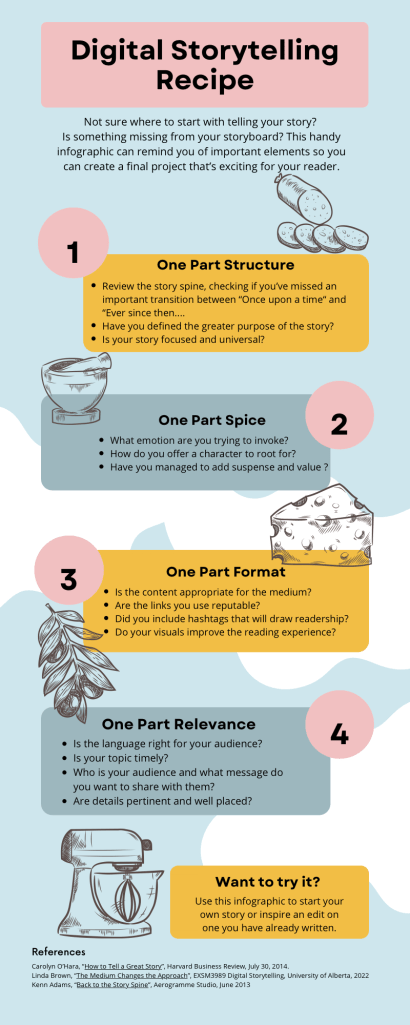
With all the choices available to tell your story, it’s easy to get overwhelmed and frustrated. Keep it simple and keep it structured to leave room for your creativity to flow!
References:
- Alison McAdam, “Beyond the 5 W’s: What should you ask before starting a story?”, NPR, December 2016
- Kenn Adams, “Back to the Story Spine”, Aerogramme Studio, June 2013


 EXSM 3989 - Digital Storytelling Class Blog