Categories
Uncategorized

Burundi: A History of Conflict

Burundi is a small country in east Africa. The Kingdom of Burundi dates back as far as the 16th century. During the 19th century, Germany colonized the area, creating the colony of German East Africa. An attack on the region by allied forces during World War I saw the area shifted to be under Belgium’s control, and after World War II, the area was classified as a United Nations Trust Territory.

Burundi gained its independence from Belgium in 1962, following upheaval in the area, including the Rwandan Revolution. Ethnic tensions in the country were high, and a failed coup d’etat occurred in 1965 because of that. Two more coups shortly thereafter succeeded in deposing the country’s monarchy, and Burundi was declared a Republic.

However, King Ntare V returned to Burundi in 1972, during a rebellion. Ntare was quickly assassinated, and the rebellion was countered with what became known as the First Burundian Genocide. Tensions between ethnic groups remained pronounced for decades, with the balance of power shifting back and forth, until 1992 when an attempt at introducing a system of multiple political parties resulted in a civil war, which caused the Second Burundian Genocide. Hundreds of thousands of Burundians were killed in the genocides and civil war.

At the start of the 21st century, peace talks and involvement from the United Nations led to a calming of conflicts, and reconstruction efforts began in 2006. Unrest has plagued the nation, however, with the United Nations Human Rights Council calling on the Burundian government to end its continued practice of serious human rights violations. To this day, Burundi remains one of the world’s poorest nations, with a lack of stability, security, and resources.

UNICEF has identified that 78% of Burundian children are living in poverty. Roughly 500,000 Burundian children live in extreme poverty. Because of this, the work that nonprofit Harbor4Life does is essential. Running an orphanage outside of the capital of Bujumbura, H4L has helped dozens of children and young adults to be cared for, receive the necessities of life, and be educated.

Please see these social media posts to learn more about the work that Harbor4Life does, and how you can help it achieve its goals and support the children that depend on it.
Categories
Uncategorized

Five Tips for Digital Storytelling

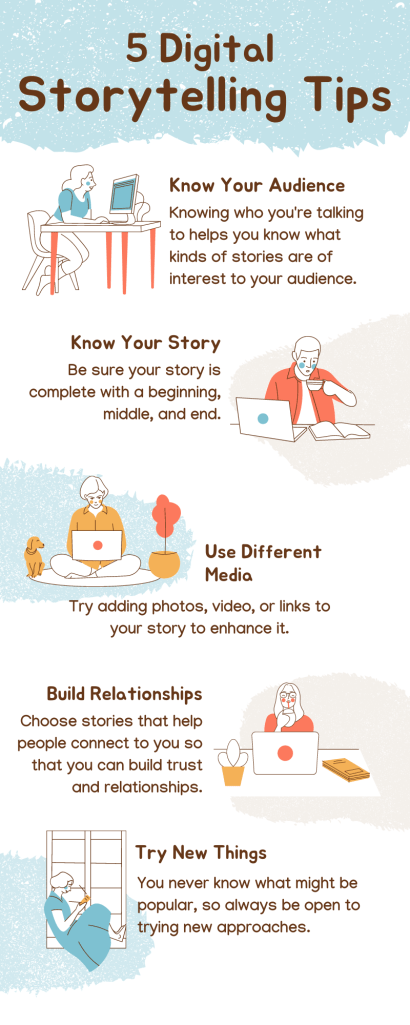
So you want to tell a story using a digital medium. Where do you even start? With these five handy tips, of course!

These are five basic tips that apply to all digital stories you might want to tell. Here are some elaborations on the points made in the infographic:

1. Know Your Audience

It’s important to know who you’re talking to when telling a story. What kind of stories does your audience like? How do they like to be told them? How are they likely to react? Being able to answer these questions will allow you to tailor your story so that it’s received by the people you want to reach and ensure that it drives you outcome you’re looking for.

2. Know Your Story

Meandering conversations can be enjoyable with friends over coffee, but when you’re vying for the attention of the online masses, knowing what you want to say and how you want to say it is important. Make sure your story is well structured with a beginning, middle, and end, and that it fits with the platform you’re using to tell it. There’s nothing worse than writing a great tweet only to discover you need four extra character spaces.

3. Use Different Media

This blog post wouldn’t be half as interesting without the infographic in it. That’s because different ways of presenting information catch our attention, and visual information is absorbed much more quickly than text. So be sure to play around with what formats you put your story in. Think a podcast might be a good medium? Give it a try! Have the perfect gif to convey how you’re feeling? Use it! Don’t let standard text limit how you express yourself.

4. Build Relationships

This one is a bit tricky. The point of telling stories online is to forge a connection between whoever’s telling the story and whoever’s taking it in. That way, you can build familiarity, trust, and even friendship between you and your audience. With this, you can become a respected authority on your topic of choice and position yourself as your audience’s go-to for information, products, advice, or whatever it is you provide. So make sure to choose stories that make things personal so that people can relate to them, and thereby relate to you.

5. Try New Things

It’s comfortable to stick with the tried and true, but don’t be afraid to venture into the unknown every now and then! Whether there’s a new format available on a social media platform, or whether you just want to try telling a different kind of story that day, experimenting is the best way to find new methods of expressing yourself and engaging your audience. You never know if something will work until you try it, after all.

Now that you’re equipped with these tips, go out and try telling some stories! Practice makes perfect, but keeping these basic principles in mind will give you a direction to start in.

Categories
Uncategorized

My Old Flatmate

For my live tweeting, I chose to share a story about a person I met by chance and knew for a short time back when I lived in London. His name was Ricco. (Or was it?)

https://twitter.com/janitaburgess/status/1551773467615174656

This story is kind of two stories in one. The central story is about my former flatmate being a bit of a jerk and firing a client of his, but I’ve bookended it with bits that explain how I was a part of things, since I needed a place to live, and how it all affected me.

The story doesn’t follow a traditional beginning – middle – end structure. One could argue that there are multiple beginnings to the story, or multiple endings. But each snippet follows from the one before it in a domino effect. Kind of like triggers and heaps. And from there, a beginning, middle, and end emerge in both the central story and the bookended parts.

However, I have answered the basic Who / What / When / Where / Why / How questions that all stories must answer. The bookended parts of my story are central to some of those questions, which is why I included them rather than leaving them out.

Similarly, I have (hopefully) evoked a reaction from the audience with my story. The reaction I hoped to evoke was one of sympathetic annoyance at what my flatmate did, and also one of amusement as I describe what I took away from it. 

I had a difficult time thinking up something to live tweet about (my life is boring), so I hope this story and its conclusion and corollary are fitting.

Categories
Uncategorized

An Awesome Story

I have a confession: I read fanfic. Is that even a confession-worthy declaration anymore? Regardless, the story I’m going to share today is a fanfiction story. It’s not just any fanfiction story, though; it is a masterpiece of digital integration and meta-storytelling. It is called The Theory of Narrative Causality.

Firstly, this fanfic is over a decade old, which is forever in internet years. Secondly, I haven’t read it in about a decade and I don’t remember the specifics. Looking at the master post, there do seem to be some NC-17 bits, so access at your own risk.

The story is very meta. It’s a fanfiction using the characters from the 2010 BBC series Sherlock. However, it recasts them as “normal” people who are fans of the original Sherlock Holmes stories of Sir Arthur Conan Doyle. Then it plops them squarely in Livejournal-era fandom and has them all participate in a Big Bang event. Sherlock is an artist who is paired with John, an author, and the two of them create a story/art collaboration that winds up being a fanwork version of BBC Sherlock itself. The characters literally create the story from which they originated.

But that’s not even the best part. Thanks to some coding magic I will never understand, the story is formatted exactly like a series of online interactions. There are scenes that are recreated comment sections, for example, and you can actually interact with the comment page elements. It is absolutely delightful because you can tick the ticky boxes!

(Caveat: I haven’t gone through and checked if all those elements are still functional a decade later. I wish this had been posted to AO3, but that would be the world’s most insane work skin, so I don’t blame the author for not doing that.)

I’m not going to say this is my favourite story ever, since I don’t really have a favourite story, but I did immensely enjoy it back in the day, and given its digital elements, I thought it was quite fitting to share here.

As for why I like it, the digital elements aren’t the only thing. I like stories that are self-aware and comment on themselves. I like retellings because you can add an angle/reading to the original story, like “What does it say about and/or do to the central theme of this story if we change or enhance this one element?” Something along the lines of modern retellings of fairy tales, for example. 

This story has a lot of that. Since the characters are already known to the audience, their behaviour in this different setting is both predictable and not. When they repeat lines from the series, it’s a cute reference, but when they deviate from expected actions, the reader has to ask why, ask how the particulars of this version of the story affected them and made them different. 

Also, this whole story is basically a love letter to fandom, which is one of the great loves of my life, so that’s also a point in its favour.

I’ve written all of this and realized that I haven’t referenced the readings/teachings of this module at all, so let me add that now. This story is, at its heart, a love story. It is very universal and relatable, which was one of the rules of storytelling from Pixar, even though it didn’t make it into the actual article about Pixar writing rules, which makes citing it awkward. You root for the characters to get what they want while they struggle with it all. And it’s very satisfying when they succeed.

Design a site like this with WordPress.com
Get started