In 2006, the research project TRACE (Teens Report on Adolescent Cannabis Experiences) was launched. Researchers at the Nursing faculty at the University of British Columbia strived to understand the context in which youth cannabis use took place. The ‘data’ of the research consisted of interviews with teenagers. The research team interviewed 77 teenagers who shared their thoughts and experiences with cannabis.

Of course, of course, let me explain why this is relevant.
The study uncovers that many teenagers use cannabis to deal with feelings of distress. These feelings could be depression or/and anxiety. Additionally, teenagers were NOT aware of resources that could help them alleviate their feelings of distress.
Considering these findings, is NOT surprising that youth (15-24-year-olds) are age group LESS likely to seek help for mental health problems. Ultimately, these unattended mental health problems can affect youth academic, interpersonal, and societal spheres. That’s why it’s important.
Shortly after, the team involved in the TRACE project started rolling out articles. These articles addressed smoking cannabis considering gender, the effect of school staff on students’ cannabis use, smoking cannabis in nature, and using cannabis to relieve feelings of distress.
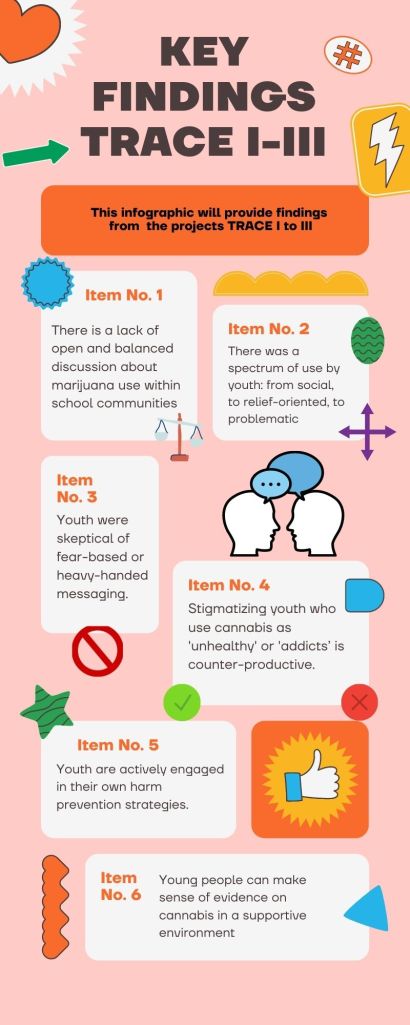
The projects TRACE I -III uncovered essential findings, which can be found in the infographic below
Based on the findings of TRACE I and II, the research team put together a film as part of TRACE III. Cycles is a film that embodies knowledge translation by exploring how high school students engage in decision making as to whether to use or not use cannabis. The film is a fictional drama that revolves around two main characters, teenagers. The film portrays how different factors influence teenagers to use and not use cannabis. It is NOT a moral tale; however, it allows for the viewer to reflect on the consequences of potentially consuming cannabis.
Moreover, the film calls the viewer to ponder the complex context of cannabis consumption, which reflects reality’s decision-making. The film can be used in classroom settings as an educational resource. There is a Facilitator’s guide with lesson plans, designed for teachers or any individual who decides to facilitate the session.
TRACE IV was carried out between 2017- 2018; this consisted of conversations with PARENTS of teenagers who have used cannabis. The researchers wanted to understand how the conversations took place and if any resources could facilitate these discussions.
The findings uncovered that parents who use cannabis have been excluded from conversations. Parents believe that a harm reduction approach should be prioritized or, at a minimum, a pragmatic “abstinence-plus” approach. Parents who consumed cannabis felt stigmatized, impacting the context for the conversation with their adolescent children.
Based on the data of TRACE IV, there have been two publications so far, one article that addresses the assumption that parents are the best cannabis use prevention and analysis of resources available for parents.

You may think that there will be no more TRACE projects, 4 are enough, but NO

Currently, we launched TRACE V. What are we trying to study now? Youth who may have experienced health or social inequities and use cannabis.
The GOAL is to identify how marginalized youth (outside “the mainstream”) perceive the potential risks of using cannabis and including youth as co-developers of harm reduction messages…..through Digital Storytelling

So far, we have talked with 33 youth ( ages 17-24) across Canada. These people have been kind enough to share their experiences with cannabis and personal life experiences with what I like to call health and social struggles, including mental illnesses, discrimination, chronic illnesses, trauma, child maltreatment, and low income.
TRACE V has its own Instagram, where you can find its awesome study flyer (tracev.letstalk) and a video honouring some of TRACE’s accomplishments over the last decade. Additionally, the link in the bio leads to a linktr. ee that provides links to articles, the Cycles video, and links to cannabis education.
Thank you for reading; consider yourself informed!





 EXSM 3989 - Digital Storytelling Class Blog