How do you plan a simple story?
Be it a meme, infographic, TikTok, tweet, or an Instagram story, there is a map a creator can take to make an idea a story.
An idea is just the beginning. It can be the message the author wants to tell, or it may just be a character or event.
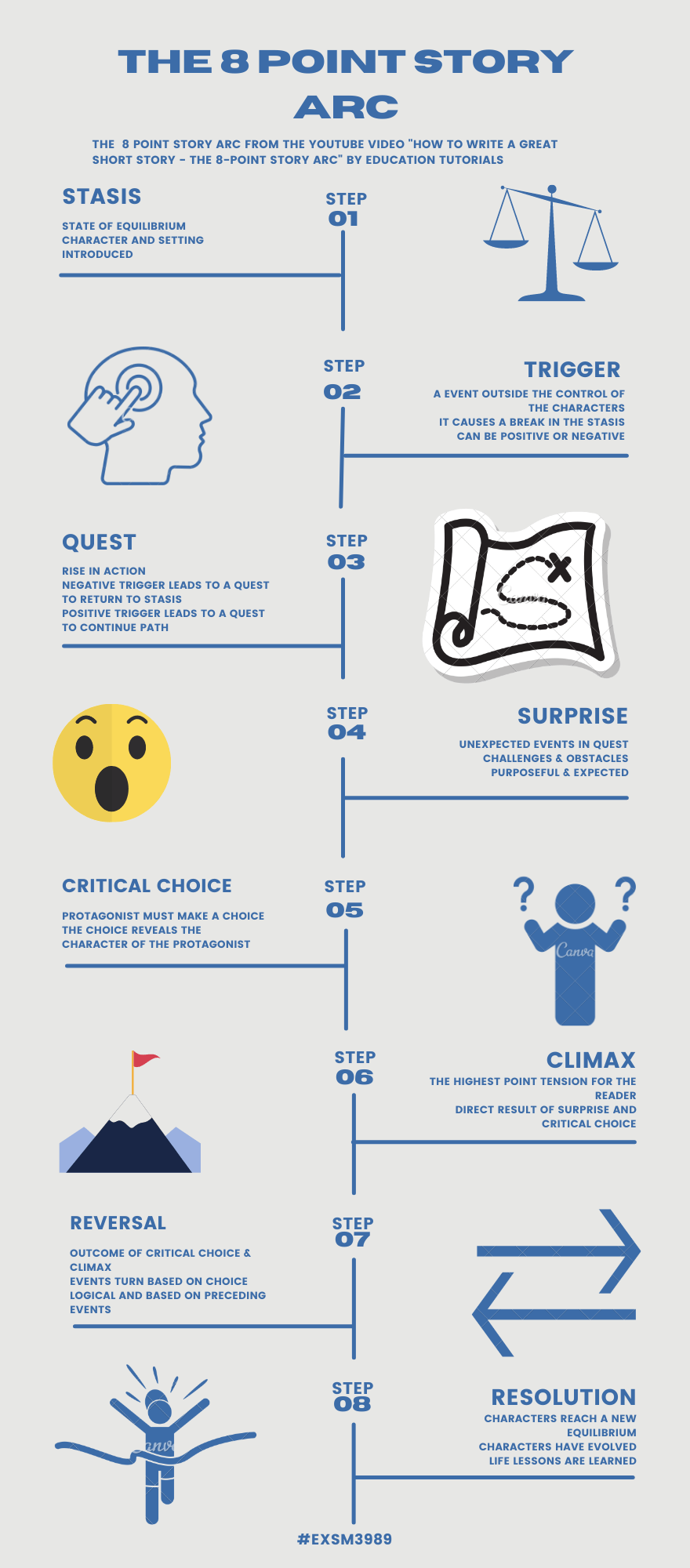
Educational Tutorials’ YouTube video “How to Write a Great Short Story – The 8-Point Story Arc” shows us how we can map out a story.
STASIS
The characters and setting are introduced. Here the reader learns who the story is about and where the story takes place.
All stories have a beginning, middle, and end.
TRIGGER
To move from stasis, there is a trigger. This is an event beyond the protagonist’s control that gets the story moving. It can be a good thing, like falling in love. Negative events, like a murder, can also start a chain of events.
QUEST
The events that take place due to the trigger take the form of a quest. The character that fell in love is trying to woo their love, or maybe they need to solve a murder. The quest can be one event, or many events that build on previous events.
SURPRISE
The quest usually ends in a twist, or surprise. The result is unexpected to the protagonist, but logical to the reader.
The surprise that awaits the protagonist in their quest leads to them making a critical choice. The choice made reveals the character of the protagonist.
CRITICAL CHOICE
How the protagonist handles the choice builds tension, leading to the climax of the story.
CLIMAX
The climax is the highest point of tension in the story. The protagonists world has changed as a result of their choice.
REVERSAL
The logical result of the climax and critical choice is the reversal. This is the change that happens to the setting and characters.
RESOLUTION
Once the dust settles, we have resolution. The characters have crossed the finish line, and reached a new level of stasis. Life lessons have been learned, and the story has end.
 EXSM 3989 - Digital Storytelling Class Blog