Categories
Uncategorized

Girls can weld too!

Video.and article written and producedby Deven Kumar.

In Alberta, the skilled trades are traditionally seen as male-dominated occupations, but Leduc Composite High School Career and Technology Studies teacher Jessica Chisholm and welding technician Tracey Meaver are developing new ways to encourage female students to get involved.

Although Jessica enjoyed the welding trade, in 2017 she decided to take the next step in her career and began working toward her Bachelor of Education Degree at the University of Alberta. She wanted to share her skills and passion for welding with students, and to teach them how to work safely.

“I run the fabrication/welding program here at the high school,” said Jessica Chisholm. “During 11 years in the welding trade, I worked toward achieving my Red Seal Journeyman Welding Certification and my B-Pressure Welding Certification. I spent the last several years of my welding career as a TIG Welder.”
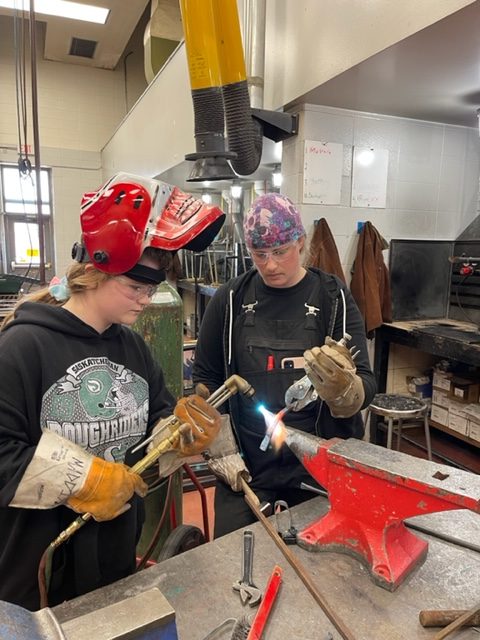
Jessica Chisholm with one of her students.

“Also, being a female in a primarily male-dominated industry, I strive to be a role model for females interested in pursuing a trade,” she said.

Tracey Meaver has been at the high school for 17 years, most of which has been in the welding program. “I participated in training at CLAC Career Development College’s welder training facility where I achieved my Canadian Welding Bureau certification,” said Tracey. “Over the years, I have completed my Alberta Health and Safety Certification in order to ensure the safety of the students in the welding shop and as they transitioned into the workplace.”

“I cannot imagine doing anything else as a career, and I very much enjoy coming to school every day,” said Tracey. “We are seeing a greater number of females enrolled in the welding program than in previous years, and we are both extremely proud of this.”

Tracey Meaver assisting a student.

This year, with the help of Women Building Futures and a generous donation from PCL, Jessica and Tracey introduced a very successful lunch-hour program – Girls Try Welding.

The goal for this program is to build the confidence of the girls who were interested in registering for the welding program, but felt intimidated by its perceived macho ethos. They also want to raise awareness of the career opportunities in the skilled trades for women.

“We had much more interest than we initially expected, with 14 girls signing up,” said Tracey. “We taught the group welding safety, GMAW welding, and then they used their individual creativity to complete small projects they were able to take home.”

“Our goal has been to create an inclusive welding program where all students feel welcome,” said Jessica. “Offering this program ensured that female students from our school community had a chance to learn a little about welding in a safe environment and build up their confidence with the tools. One of our students even created a metal sculpture that was showcased in the high school art exhibition!”
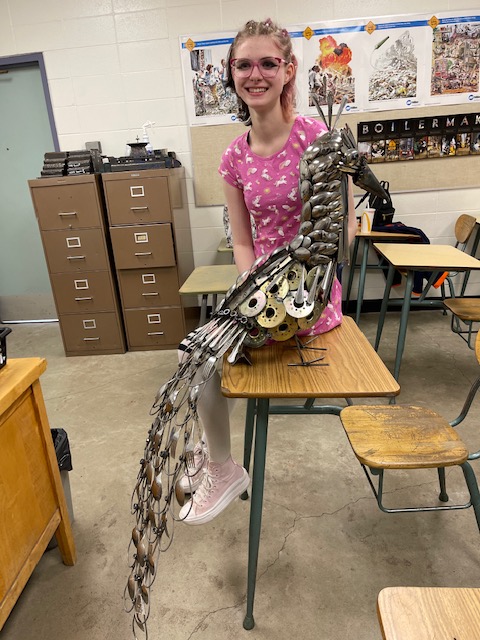
Hannah, a welding student, created this peacock sculpture out of unwanted kitchen cutlery.

“We were fortunate enough to have a few of these girls enroll in the welding program in the second semester,” she added. “Moving forward, since we received such great feedback about this program, we will be offering it again in the fall.”
Categories
Uncategorized

How to tell a great story (in business settings)

We all stories at work — to persuade bosses to support our projects, to explain to a direct report how she might improve her performance, or to inspire a colleague who is facing challenges.

Storytelling is an essential skill, but how can you tell a compelling story in a business environment? And more importantly, how can you improve your skills at telling stories that persuade?

According to Carolynn O’Hara, writing in the Harvard Business Review in July 30, 2014:

“Every storytelling exercise should begin by asking: Who is my audience and what is the message I want to share with them? Each decision about your story should flow from those questions.”

Carolynn O’Hara

See below for an infographic on the five things you should consider when setting out to tell a great story in a business setting:

May the metaphors, alliterations, and all the other rhetorical devices be with you!


Categories
Uncategorized

A walk to the Off-leash Park

After. pretty crazy-busy week, we’re enjoying a bit of a lazy Sunday. Marshall, my seven-year-old 95-pound house-horse (he’s actually a rather handsome Doberman Pinscher/American Bulldog cross), is relaxing pretty hard in my bed, watching me type on my laptop. I’m trying to think of different stories I could live-tweet for my Digital Storytelling class. 

The bedroom window is open, letting in a gentle breeze. At the honking sounds of distant migrating geese, Marshie perks up, and stares out the window. Then he turns back to me with a whine and a look of askance: “Hey dad, it’s sooo nice today, why don’t we go for a walk?” I look at him for a long second, thinking maybe I should get outside, since I was fresh out of inspiration. “Yeah, sure thing bud, let’s go find your leash.”

After having reading, with interest, FRACTALS analysis of Buzzfeed headlines that garner more shares and likes – animal/pet stories that create joyful emotions seem to rank high – I thought of using Marshall as my furry muse.

I then put together a quick outline using the tips from the tutorial video “How to Write a Great Short Story – The 8-Point Story Arc:

  1. Stasis: A lazy Sunday afternoon in November for Marshall
  2. Trigger: A nice winter’s day, an open window, and the sound of geese makes Marshall want to go for a walk
  3. Quest: Finding and putting on his leash, heading to the off-leash dog park
  4. Surprise: The enthusiastic sniffing of things along the walking trail; sadness of being all alone at the dog park
  5. Critical Choice: Leaving the off-leash area as no-one else was there
  6. Climax: Meeting other dogs on the way back, saying hello!
  7. Reversal: Glad to be back home because it getting colder now,, and treats
  8. Resolution: A tired but content dog, happy to be back lying down on a warm and cozy bed, enjoying snuggles.

This story is a daily straightforward, domesticated Heroes’ Journey, albeit from a doggy point-of-view. I tried to use Gary Vaynerchuk’s statement on good storytelling – whether through an action or an emotion, “the true test of storytelling is how you feel or what you do after you consume it.” I also applied Kenn Adam’s Story Spine structure to help build this expository narrative.

Now, Marshall is a very strong dog and a puller, so we had to get him a figure-eight leash, which goes around his nose and prevents him from straining and choking himself. Normally he hates it, and putting it on him is the most trying part of the exercise. However, today he complied with little fuss – good boy, Marshie!

“Let’s go to the dog park, bud.” Oh yes, he wagged, and promptly relieved himself against a nearby tree.

 As Eric Goldschein writes, “social media post is an informal means of expression. It should be accessible to anyone who wants to learn more about you or your business. Stay away from industry jargon and dense paragraphs and try to have fun with it.” I have tried to pay attention to the tone of my writing, making it more reflective of how I naturally speak – after many years of writing reports, it’s hard to loosen up.

Goldshein also talks about the importance of grabbing an emotional hold of your audience, hence using lots of pictures of my really, really good-looking dog (he’s so hot right now) as the main subject – let’s hope it’s working. 🙂

Check out the Twitter/X thread below:


Marshall is excited to get back to the warmth and coziness of his home. And to one of his favourite snacks – dill pickle flavoured pretzel sticks!

It’s been a good afternoon, and now back to lounging on the bed.

Categories
Uncategorized

Working my way through A Conflict of Visions

I read to to try to understand the world around me, to find out the why of things. With all the conflicts and schisms taking place both in our country and abroad, a colleague of mine recently handed me a book by Thomas Sowell, “A Conflict of Visions” that discusses the ideological reasons of political struggles. “You should read this,” he said. “Things will start making a bit more sense, from a 30,000 foot view.” So I am doing as he suggested.

Now, I’m still in the early stages of this admittedly weighty book, but it increasing has my attention and is fast becoming a favourite. In the book, the author discusses how political controversies arise from many sources, but the long-term, generational conflicts seem to adhere to remarkably consistent patterns regarding the nature of reason, justice, equality and power. Sowell distinguishes between the idea of a “constrained” vision, where human nature is seen as “enduring and self-centred” and the “unconstrained” vision, in which human nature is “malleable and perfectible.” 

Visions are necessarily abstract and simplistic, he writes, and form the foundations upon which theories are built, a “pre-analytic cognitive act”, something we sense or feel before developing a theory concerning it. Sowell writes that the ancient Greeks ascribed volcanic eruptions, storms or other natural phenomena to spirits or gods, and as our understanding evolved, our vision of the world changed. Issac Newton had a different vision of the world, Darwin another – and so it goes. 

The author uses the Story Spine structure effectively, using a beginning, middle, and an ending to guide the reader through his argument. In the beginning he outlines the roles of visions, with a particular focus on the many social visions that relate to our political and civic lives, and how these affect governance models. Then in the middle, he discusses the ongoing conflict of visions taking place in our society (think Culture Wars) and around the world, by grouping them into constrained and unconstrained visions, with each vision coming to “conclusions that are the logical consequences of its assumptions” leading to repeated conflicts. Sowell ends with a wide-ranging discussion on the actors involved with promoting either vision, their biases and ideologies and social/emotional attachments to their points of view. 

The author also uses the Persuasive Story Pattern throughout the beginning, middle, and the end sections, first laying out the current state (what is) and then outlining what could be, and provides plenty of facts and examples from the social/political sciences and social philosophy to back his claims. The language used, while academic, is fairly straightforward in presenting complex ideas in a relatable, easy-to-understand fashion, which I appreciate.

Thus far, I am finding this book to be quite illuminating; however, I do have a mild criticism. I feel the author would have likely create a more persuasive series of arguments if he had used identifiable characters, settings, and better utilization of the classic narrative arc to establish his arguments – to give them more emotional weight in order to drive his point home

I am looking forward to finishing this book to get a more nuanced insight into the current events taking place around us, and to avoid getting drawn into “taking sides” or polemical thinking that seems to be all the rage these days.

Design a site like this with WordPress.com
Get started