Categories
Uncategorized

Find your perfect sip for the holiday season

The world of wine can be intimidating. For those who partake, it’s a lovely addition to a meal, particularly around the holidays. However, if you’re not much of a wine drinker, or are just starting to get into it, the sheer amount and variety of wines on the market can make selecting a bottle nearly impossible!

I absolutely love to cook, and when I have time on the weekend to whip up a slightly more involved meal, I really enjoy finding a fun wine pairing to go along with it. It can make you feel like you’re at a restaurant, right in your own dining room. At a time when travel is restricted, food and wine can also be a fun way to take your taste buds on a trip around the world.

If you’re completely lost in the wine aisles and accustomed to simply picking whatever label catches your eye, don’t worry — there are a few simple rules that can help you begin to figure out which bottles will be perfect for serving up with your upcoming holiday feast. 

Identify certain characteristics that tantalize your taste buds

Don’t really understand what people are talking about when they discuss the ‘nose’ or the ‘body’ of a wine? Don’t stress — you absolutely do not need to know all the terminology just to know what you like! Start by identifying a few characteristics you enjoy. For example, figure out whether you prefer a sweeter wine, or something very dry. High or low acidity? Something on the lighter end of the spectrum, or a heavier choice?

It can also be helpful to think of the types of flavours you enjoy in other foods — if you absolutely love berries, for example, a wine that mentions notes of currants, blackberries, raspberries, etc., on the back of the label just might be perfect for you.

Find a small wine store

When the amount of choices seems overwhelming, sometimes finding a wine store with a smaller, more curated selection can be a lifesaver. Many people are too nervous to enter these types of retailers, as they feel they’re only for ‘serious’ wine drinkers, but that couldn’t be further from the truth. The staff there is likely to be more knowledgeable, and can help steer you towards something you’ll love. For #yeg locals, I cannot recommend Color de Vino enough.

Dig deeper when you find a bottle you love

If you’ve ever had a glass of wine that you really enjoyed, you don’t have to just buy the exact same bottle again and again — instead, do a bit of digging. Look at the label and identify a few things. Where was it grown? What type of grape? How is it described on the label? Looking at wines grown in a similar style or region, or with similar descriptors, just might yield another winner.

What grows together, goes together

It’s an old saying, but it can be a great place to start if you’re pairing wine with a meal. Think of the dish you’re looking to serve and find something from the same area. For example, if you’re putting together a cheese board with French cheeses, you may want a sparkling wine from France. For gingerbread, I suggest a semi-dry Riesling — and Germany just happens to produce amazing options.

Bonus:

When it comes to opening a bottle of sparkling wine, many of us get visions of flying corks and geysers of Champagne going in all directions. I’ve created a short video outlining the steps to popping that cork with more control.

Categories
Uncategorized

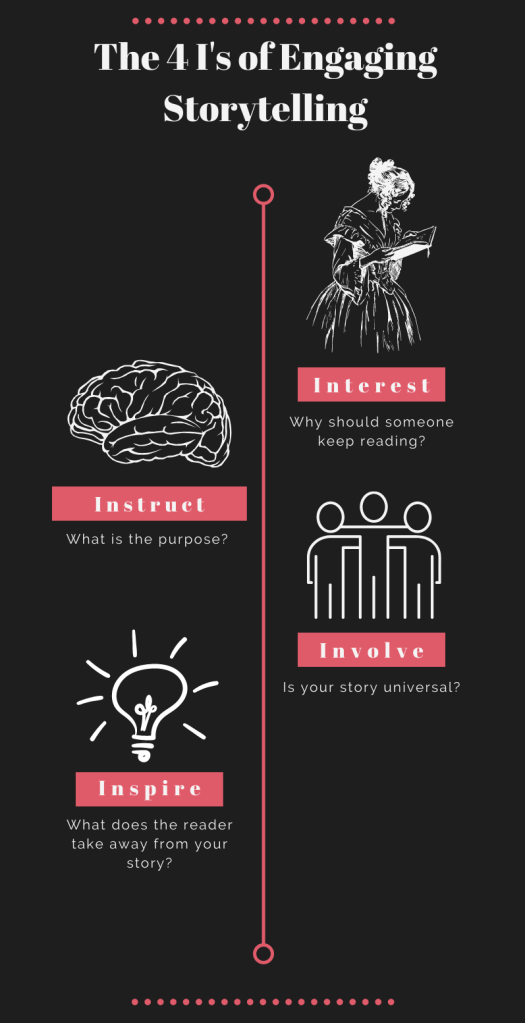
The 4 I’s of Engaging Storytelling

There’s a good chance you’ve heard of the journalistic 5 W’s of storytelling — who, what, where, when, and why (and sometimes how). However, have you ever heard of the 4 I’s of storytelling?

Ashley Fell’s TEDxUniMelb talk, “Why storytelling is so powerful in the digital era,” explores the idea of what makes an engaging story — and she uses a bit of a different lens.

#1: Interest

First of all, your story needs to capture the reader’s attention. Particularly in the digital world, where there is a barrage of information and texts available to every audience, your story needs to stand out in some way and hook the reader, lest they just keep on scrolling.

In order to ensure you’re provoking your reader’s interest, think of some of Pixar’s 22 Rules of Storytelling. Give your characters strong opinions that will ignite curiosity in the reader, whether or not they agree with the character. Also ask yourself the important question of “why must I tell THIS story?” This will help you get to the heart of the narrative, and a well-told story will hold a reader’s interest.

#2: Instruct

Ashley Fell’s job involves taking dense data and transforming it into something that is more engaging for a reader — and that process of instruction is something all stories do, even if there isn’t a spreadsheet filled with data to translate.

This is because good stories have meaning. They have a clear structure and purpose, and whether it’s sharing specific information or simply sharing a way to look at the world, they instruct the reader.

One thing to keep in mind is simplicity and focus, another key characteristic of good stories — in order to ensure your reader understands the purpose at the core of your story, you want to carefully curate the information you present so that everything is clear for the reader, and they aren’t left confused.

#3. Involve

Engaging stories are universal, which means they must involve the reader in some way. Don’t get stuck thinking that you need to write about a situation or experience that everyone would be familiar with, though — that’s not what’s meant by universal.

Ultimately, it doesn’t matter if the reader can relate to the specific, unique situation that is presented in the story — what matters is how they feel. An engaging story will provoke a particular feeling or emotion in the reader.

#4. Inspire

As Pixar’s principles of storytelling explained, good stories give you a character to root for — but it’s more about the journey than the destination. Readers are more interested in the intricacies of how a character does something, and what their journey was along the way, than in where they end up.

Whether you’re trying to get a reader to look at the world through a more optimistic lens, or trying to get someone to buy a product from your business, you want to inspire them in some way.

Today, more than ever before, there are a huge range of mediums through which stories can be told. Different platforms all have particular benefits and drawbacks, and it’s up to you to figure out the best way to tell your story. If you keep the 4 I’s of engaging stories in mind, you’ll snare a reader who simply can’t be torn away from your tantalizing tale!

Categories
Uncategorized

A Story of Betrayal and Seasonal Bandanas

There is one thing guaranteed to catch my attention no matter what I’m doing, whether I’m scrolling through Instagram and TikTok, or just strolling down the sidewalk — an adorable dog. Given the amount of social media accounts devoted to four-legged friends, I’m certainly not alone in this. So, for my live-tweet storytelling, I decided to focus on my dog Oliver’s trip to the groomer.

I always make sure to cut his fur short before true Edmonton winter hits. This way, he has a chance to grow back some of his coat by the time the snow falls, but I’m also not forced to deal with a tangled Chewbacca lookalike come February.

Telling the story from the perspective of the dog allowed me to play with some of the elements of suspense shown in the video we watched this week. As the video stated, the oldest and strongest kind of fear is fear of the unknown. To a dog, basically everything is unknown — though he knows that a car journey means we’re going somewhere, he has absolutely no clue where it will be.

I started by establishing stasis, and shared a picture of Oliver at his daily post — perched on the arm of the couch, snout nudging the curtains aside as he monitors what’s going on in the street in front of the house. From a car parallel parking to a woman pushing a stroller on a mid-day walk, there’s a lot to monitor!

I introduced the ‘trigger’ of the story by showing a close-up of his paws on an iPad, open to a calendar.

I was reminded of the concept that stories should be universal, and thought that the idea of a calendar invite would be something that a lot of people are familiar with. I mean, who isn’t overloaded with Zoom invites and meetings?

In order to mix things up a bit, I opted to include a short video clip to kick off the quest portion of the short story arc and show his excitement at heading down the deck stairs and towards the garage. I also introduced some tweets from Oliver’s perspective, implying that he strongly felt the plan was to head to the dog park. I felt this would be a way to highlight the surprise element of the story. There’s a tweet in which Oliver realizes something fishy is going on, and finally, he recognizes that the trip isn’t to the dog park after all.

The spot was bustling, with two other dogs there for lunch-time drop-off. They had a new display of different seasonal treats, including a frosted snowflake cookie. In order to respect the groomer’s social distancing rules, I didn’t take any pictures while I was actually dropping him off — it’s quite a small space and Oliver was busy sniffing around the big golden retriever nearby! Instead, I decided to get creative and look for a GIF that I felt would express his emotions at the climactic moment of realization. I quickly found one from The Office, which I obviously selected because who doesn’t want a little Michael Scott in their Twitter thread?

I also introduced the idea of bargaining for treats as a way to show Oliver navigating the critical choice. While the reader of the thread knows that the grooming appointment is inevitable — worst case scenario, a 12 pound dog is quite easily scooped up and carried in — from Oliver’s perspective, he’s making the choice of whether to go in or refuse and stay in the car.

I built to a climax with a tweet showing Oliver’s fear that he may never emerge from the appointment.

For the reversal component of the 8-point story arc, I included a picture of Oliver, post-haircut, and I resolved the treat-focused element of his critical choice by showing a picture of him sniffing the cookie.

Finally, I brought the thread to a close by returning to the scene of the first shot to establish his new stasis — he continued his favourite activity of looking out the window and watching what’s going on in front of the house, but he did so with a new ‘do

You can see the full Twitter thread here, including a picture that shows off a seasonal Halloween bandana that was removed approximately 15 seconds after the image was taken, hence the lack of wardrobe in the final image of the thread.

Categories
Uncategorized

Pride and Prejudice

“It is a truth universally acknowledged, that a single man in possession of a good fortune, must be in want of a wife.”

—Jane Austen

The first sentence of Jane Austen’s Pride and Prejudice is extremely well-known, and for good reason. It immediately captures the reader’s attention by making a bold statement, and also offers a concise summation of the entire plot. The book revolves around a group of sisters and their potential suitors, and highlights the centrality of advantageous marriage in the Regency era. It has managed to captivate readers for well over 200 years, and though different print versions all had their own style, the core story is what has people coming back, generation after generation.

“Netherfield Park is let at last!”

—Mrs. Bennet

As Ashley Fell explained in a TEDxUniMelb talk, good stories have colour, picture and movement. Given that so much of the novel is set indoors, in ball rooms and drawing rooms, it may seem as though the characters aren’t really going anywhere. However, there is in fact constant movement, with individuals calling on friends, attending events, gathering in the drawing room for conversations and more. Austen also peppers the story with visual details that allow the reader to truly immerse themselves in the world, documenting everything from the trim on a dress to the scathing look delivered across a dance floor. These rich descriptions mean the story lends itself well to adaptations, such as the 1995 miniseries or the 2005 feature film starring Keira Knightley as Elizabeth Bennet.

“To Elizabeth it appeared, that had her family made an agreement to expose themselves as much as they could during the evening, it would have been impossible for them to play their parts with more spirit, or finer success.”

—Jane Austen

As outlined in “The 22 rules of storytelling, according to Pixar,” good stories are universal. While the customs and courtship portrayed in the novel are from an earlier time, the concepts of love and family are themes that every human is impacted by.

There are several different models of marriage presented in the novel, from the passion-filled courtship between Elizabeth and Mr. Darcy to Charlotte Lucas’ decision to marry Mr. Collins, simply because the match would provide her with financial security. Every character navigates the expectations of the Regency period in their own way, deciding what they value most.

The family connections that characters have serve a tremendously important role in the process as well. Elizabeth often feels embarrassed by the behaviour of her family, from her younger sisters’ antics to her mother’s schemes, and must navigate those complications as she tries to make sense of her romantic feelings.

There’s a reason that romantic comedies remain popular to this day, and that there are still sitcoms revolving around zany families and their interactions — the themes of love and family are universal.

“I am no longer surprised at your knowing only six accomplished women. I rather wonder now at your knowing any.”

—Elizabeth Bennet

One of the reasons Elizabeth is such a beloved character is precisely because of how opinionated she is, particularly when contrasted against many of the other, more passive women in the novel. As the above quote demonstrates, she’s quick to point out that Mr. Darcy has unrealistic expectations of women, and through their interactions she proves time and time again that she considers herself his equal.

This is particularly notable when considering the stakes at play. The Bennet sisters were in a social class where an advantageous marriage was the only real way to achieve stability and independence, a fact underscored by Mrs. Bennet’s clear desperation to get all her daughters married off ASAP.

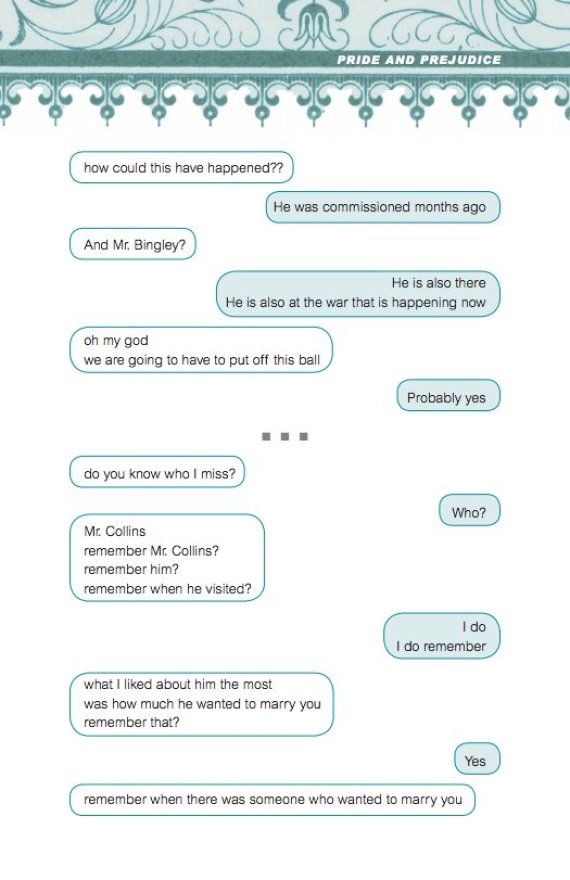
A page from Mallory Ortberg’s Texts from Jane Eyre: And Other Conversations With Your Favorite Literary Characters, in which she imagines a text conversation between Elizabeth Bennet and Mrs. Bennet.

This undercurrent amplifies the significance of Elizabeth’s bold nature — she is unwilling to compromise, as Charlotte Lucas did, and marry someone she doesn’t feel is the right match, even though it would promise her a life of comfort.

Elizabeth Bennet, 2.0

In a 2016 piece published for NPR, Alison Macadam urges her followers to look beyond the simple 5W’s of journalistic storytelling and ask an important question — “what will the audience remember when it’s over?” In the case of Pride and Prejudice, it is the characters that truly stand out, which is perhaps one of the reasons they have been at the centre of so many additional works. Readers were desperate for more about the characters, and there are countless new stories that explore the world through their eyes.

Design a site like this with WordPress.com
Get started