Going back to basics and our first module. We often think of a plot as a natural, linear progression. This leads nicely to a roadmap with clear checkpoints and objectives. A reliable guide is essential to ensure a captivating journey for both the storyteller and the reader. One such guide is the Story Spine, a powerful narrative tool that serves as a roadmap for crafting compelling tales.
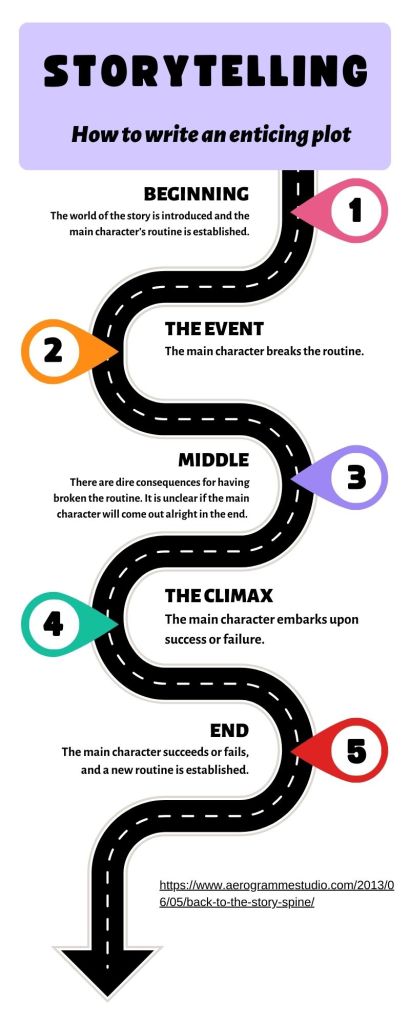
Storytelling can be a daunting task, and writers often stress about where to start. This simple infographic helps to ease the pressure involved with plot development. By following the roadmap of the Story Spine, writers can ensure a well-structured and emotionally resonant storytelling experience for their audience.
Of course, this guide is meant as a starting point, as many writing exercises end up like this:

Nonetheless, infographics are meant to be a simplified, digestible tool to relay often deeper and more complex ideas. Infographics should be used in short-form content and be complemented by longer takes that provide more insight into the problem and offer comprehensive solutions. Using an infographic is a great way to break up pedantic or heavy content.
In a visual-first digital environment, infographics, pictures, and visual elements are necessary to captivate an audience. They serve as a springboard to guide your audience to longer-form content or just stand out in the endless array on content available to users.
 EXSM 3989 - Digital Storytelling Class Blog