Act I: Innovation and Inspiration
In the vast expanse of storytelling, certain narratives transcend time, leaving an indelible mark on the collective consciousness. One such masterpiece that continues to captivate my imagination is Stanley Kubrick’s cinematic marvel, 2001: A Space Odyssey. Released in 1968, this sci-fi epic takes audiences on an interstellar odyssey, blending breathtaking visuals, a haunting musical score, and a narrative that challenges the traditional boundaries of storytelling.
In the annals of storytelling, 2001: A Space Odyssey stands as a beacon of innovation and inspiration, challenging conventional norms and inviting audiences on a cerebral expedition. The fusion of visionary visuals, narrative ambiguity, and a transcendent musical score creates a storytelling tapestry that continues to inspire and perplex.
Act II: The Subversion of the Story Spine
2001: A Space Odyssey is a testament to the power of visual storytelling. Kubrick’s meticulous attention to detail and groundbreaking special effects transport the viewer into a world where the line between reality and the surreal is blurred. From the awe-inspiring monolith to the iconic HAL 9000, every frame is a visual symphony that demands attention and contemplation.
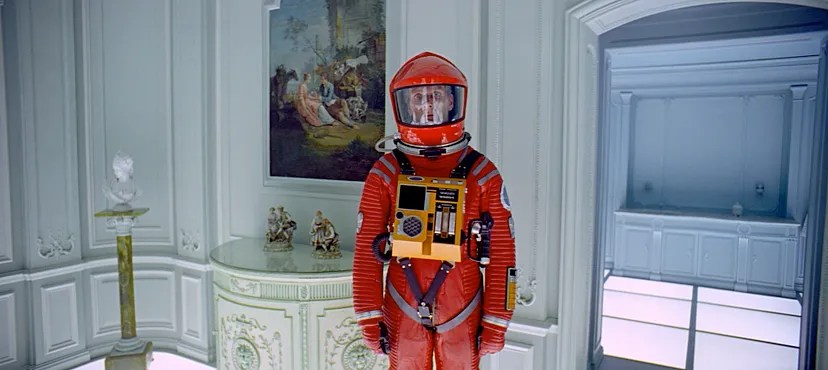
The film’s slow pacing, deliberate shots, and minimal dialogue defy conventional storytelling norms, immersing the audience in a sensory experience unlike any other. Kubrick’s mastery lies in his ability to communicate complex ideas without relying on exposition, inviting viewers to interpret the narrative through their own lens.
As discussed in “Back to the Story Spine,” a compelling story often follows a narrative structure that engages the audience from beginning to end. Kubrick, however, subverts these conventions. Instead of adhering to a traditional story spine, the film embraces ambiguity, weaving a narrative that beckons viewers into a realm of cosmic mystery. Kubrick’s departure from conventional storytelling principles is a testament to his avant-garde approach. The narrative unfolds like an enigmatic tapestry, challenging viewers to navigate the labyrinthine corridors of meaning and interpretation.
Cyriaque Lamar’s compilation of “The 22 Rules of Storytelling, According to Pixar,” echoes the story spine’s importance to compelling narratives: “Rule #4, “Once upon a time there was ___. Every day, ___. One day ___. Because of that, ___. Because of that, ___. Until finally ___,” serves as a foundation for many storytelling endeavors. Kubrick toys with this linear progression. The film is a departure from the conventional “once upon a time” narrative, opting for a non-linear odyssey that challenges literally and figuratively the fabric of time and space. This departure, rather than alienating the audience, adds to the film’s mystique, inviting viewers to participate actively in the construction of meaning. This is a great example of how traditional storytelling elements can be used in their subversion to create new narratives and innovative tropes.
Act III: Setting the Scene for Visual Narratives
Alison MacAdam’s NPR article, “Beyond the 5Ws: What Should You Ask Before Starting a Story?” encourages storytellers to delve deeper into the narrative process. While the 5Ws (who, what, when, where, why) provide a foundation, MacAdam prompts storytellers to consider the emotional and ethical dimensions of their narratives.

‘Open the pod bay door, HAL’ — here’s how AI became a movie villain
https://www.wusf.org/2023-07-31/open-the-pod-bay-door-hal-heres-how-ai-became-a-movie-villain
One of the key aspects that make 2001: A Space Odyssey unforgettable is its deliberate ambiguity. The narrative refuses to spoon-feed the audience, leaving ample room for interpretation and contemplation. This narrative openness aligns with the principles discussed in this week’s module, while emphasizing the importance of engaging the audience’s intellect.
The mysterious monolith, the enigmatic Star Child, and the existential journey of astronaut Dave Bowman invite viewers to ponder the meaning of human existence and evolution. This ambiguity sparks intellectual curiosity, prompting audiences to delve into philosophical discussions long after the credits roll.
In the realm of digital literature, the importance of visuals in storytelling is highlighted in “Reading Digital Fiction: History and Context.” Kubrick’s meticulous attention to visual detail in 2001: A Space Odyssey aligns with the idea that storytelling extends beyond words. The iconic monolith, the stark beauty of space, and the transformative Star Gate sequence are visual elements that etch themselves into the audience’s memory.
Epilogue: Unleashing Unbounded Narratives Across Time and Space
2001: A Space Odyssey stands as a testament to the limitless possibilities of storytelling. Kubrick’s departure from traditional narrative structures, incorporation of visual storytelling principles, and engagement with existential themes create a cinematic experience that transcends the boundaries of conventional storytelling, time and space.
Through the lens of 2001: A Space Odyssey, we are reminded that storytelling is not confined to the boundaries of words on a page but extends to the visual, auditory, and philosophical realms, beckoning us to explore the cosmos of narrative possibilities. Its cultural resonance and enduring source of artistic inspiration serve as the hallmarks of good storytelling: a memorable work.
 EXSM 3989 - Digital Storytelling Class Blog