
If you want your marketing efforts to have more impact, start telling stories.
Human beings are wired to respond to narratives. Stories appeal to our emotions, which in turn have a powerful effect on our actions.
If I tell you that 90% of a college’s graduates get hired from their internships, you might be mildly impressed. But if I tell you about a single mother named Paige who’d been stuck in low-level retail jobs for years until landing her dream job as a cartoon animator thanks to her experience at that college, you’re much more likely to remember the details—and much more likely to think of that college when it comes time to further your own education.
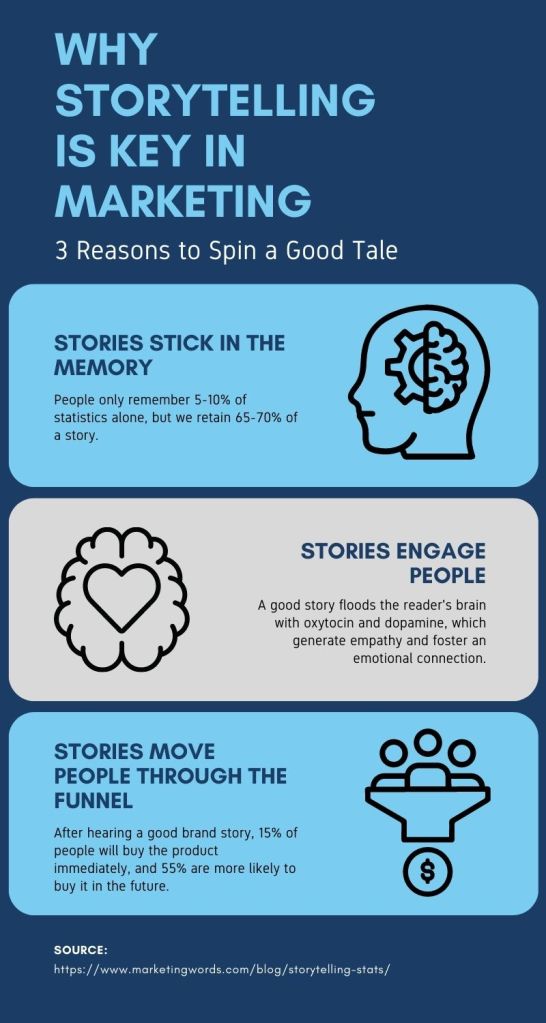
While statistics may be forgettable, we identify with the characters in a story and get swept up in what they’re feeling. As it turns out, there’s a biological reason for this. When we’re told a good story, our brains get a surge of the feel-good chemicals oxytocin and dopamine. That draws us in and creates an emotional bond between us and the storyteller.
A well-crafted story can engage your audience, help them remember your message, and most importantly, inspire them to buy what you’re selling.
Need some hard data on why storytelling should be central to your content marketing strategy? Have a look at the infographic below that illustrates some interesting statistics collected by Marketing Words.
 EXSM 3989 - Digital Storytelling Class Blog