O me! O life! of the questions of these recurring,
Of the endless trains of the faithless, of cities fill’d with the foolish,
Of myself forever reproaching myself, (for who more foolish than I, and who more faithless?)
Of eyes that vainly crave the light, of the objects mean, of the struggle ever renew’d,
Of the poor results of all, of the plodding and sordid crowds I see around me,
Of the empty and useless years of the rest, with the rest me intertwined,
The question, O me! so sad, recurring—What good amid these, O me, O life?
Answer.
That you are here—that life exists and identity,
That the powerful play goes on, and you may contribute a verse.
– Walt Whitman
What will your verse be? asks John Keating (played by Robin Williams) to a bunch of high school boys in the 1989 movie, Dead Poets Society.
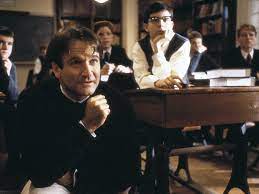
And as I watch the movie for the umpteenth time, I can’t help but wonder what will my verse be? And will I be brave enough to sing it out loud to the world? The worth of life lies in life itself, doesn’t it? This movie always leaves me with many questions to ponder over. Isn’t that precisely what a good story does? It poses questions that make you think differently.
Dead Poets Society is considered a coming-of-age classic about an unconventional teacher who turns around the life of his students. Such was the power of the movie that the profound verse O Me! O Life! by the great poet Walt Whitman is associated first and foremost with the movie, and not with the poem that it is. More than 30 years after its premiere, the movie remains an inspiration.
In brief, the movie is about a teacher named Mr. John Keating (Robin Williams) who comes to an all-boys school (Welton Academy) that is rooted in tradition with boys who are expected to follow the unbudging notions of their parents regarding their education. Keating’s unorthodox methods use poetry to help the boys honor their individual identity and desires. The story majorly follows the lives of four boys Neil, Todd, Knox and Charlie and highlights their search for happiness and purpose. It follows a traditional story arc and can be neatly framed into Kenn Adam’s Story Spine. The setting and characters are introduced. Todd is presented with an opportunity to change but sticks to his routine. Until one day he is challenged by Keating who leads him to perform shedding his inhibitions in one of the most poignant scenes of the movie.
The boys all set out on their own journey to find their purpose and meaning in life. Each of their stories is very different and they all try to ‘seize the day’ as put by Mr. Keating. Not giving away too much of the plot, all I’d like to say here is that everything in this movie is on point and brilliantly done! Mr. Keating not only showed what true education ought to look like, but also how we should lead our lives freely, choosing and believing in the beauty of our dreams.
The movie leaves me with questions that are not easy and seldom comfortable. Sometimes, it’s the fears that we have to face, sometimes it’s about the dreams that we dare to dream and sometimes it’s the reality that is painful, but has to be lived nevertheless. We tend to run away from what seems uncomfortable, but facing it is the only way to actually grow. Maybe, all we can do is hold the moment, and let our verse out and then wait for the magic to unfold!
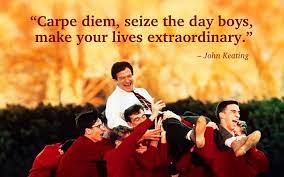
Or as Keating puts it: “Carpe diem. Seize the day, boys. Make your lives extraordinary.”

 EXSM 3989 - Digital Storytelling Class Blog