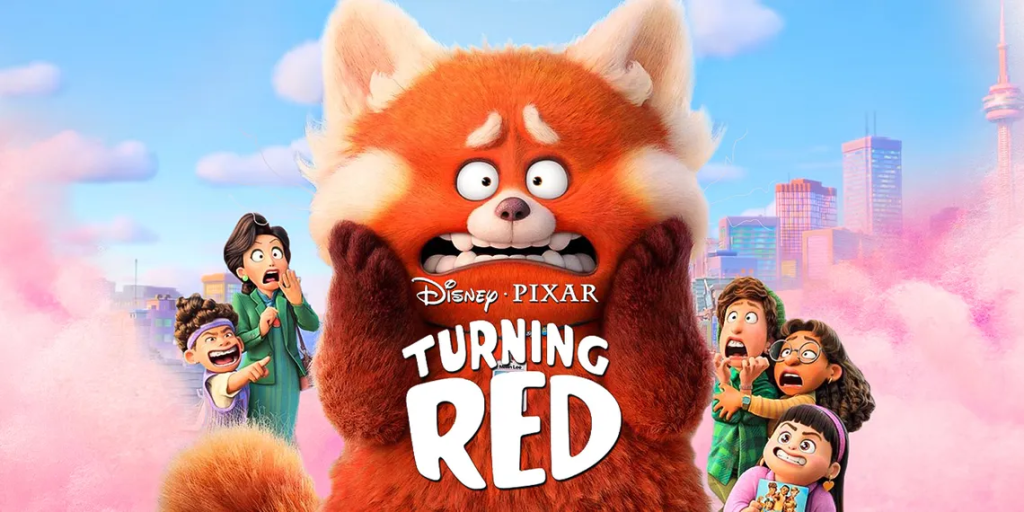
Turning Red is just one of many coming-of-age stories released by Disney and Pixar. However, it was a particularly memorable and a stand-out story for me as it fostered an emotional connection to the characters and their experiences – we will dive further into this shortly. For those who have not seen it, Turning Red follows 13-year-old Mei Lee’s journey from preadolescence to becoming a teenager amongst the heavy weight of parental expectations, personal desires, and uncontrollable biological changes.
Why I Loved It
While there are tons of Disney and Pixar movies that I have grew up on and have personally loved over the years, the 2022 release of Turning Red is just one of those movies that managed to creep its way into my heart for to easily become one of my favorite movies of all time:
- It is heartfelt: I know we’ve all experienced that awkward and stressful transition from preadolescence to the teenager years where puberty begins to hit. We watch Mei Lee go through the struggle of this throughout the movie. In her case, Mei Lee turns into a red panda whenever these emotions begin to rise. However, we see that she is not alone and has the love of friends and family to guide her through.
- It’s familiar: Throughout the movie, we can see that the movie takes place in Toronto – a familiar Canadian city that we all might recognize. It features the famous CN Tower, Chinatown, and even the transit system!
- It Represents: Mei Lee is a young Asian girl growing up in a big Canadian city. Throughout the movie, we can see visual references to aspects of Chinese culture. I think it is wonderful and important to see representation in stories and have this lens amplified to an audience.
- It’s Personal: For me, I could relate to a lot of what Mei Lee was experiencing and that was also what stood out. I myself am also a Chinese Canadian so I was able to identify with Mei Lee’s character. The movie features some nostalgic elements that I also saw in my childhood – like a Tamagotchi.
Why Turning Red is Good Storytelling:
In a TedTalk by Ashley Fell, on Why storytelling is so powerful in the digital era, she goes over a few key components: A good story is one you can identify with, they interest us, instruct us, involve us, inspire us in some way, and good stories are inherently visual. Turning Red does a good job at putting these principles into action, and thus managing to tell a memorable story.
Turning Red is Universal and Interest’s Us
As a coming-of-age story, I think most of us can identify with the aspect of ‘growing up’ and trying to find ourselves as we juggle a period of discovery regardless of age, gender, or culture – that experience is familiar. In the movie, we see Mei Lee even hide a journal from her mother. I’m not sure about you, but I definitely also had a journal when I was a tween that I tucked away.
It humanizes the experience of growing pains in a digestible way. And Turning Red does not shy away from showing the very real internal emotional and relational conflicts and what some might consider to be a more taboo topic such as puberty. This is also what makes the story so compelling: it’s relatability and confidence in telling a story that some may argue as uncomfortable to talk about. Some parents have critiqued this story in that it touches on topics that should be left out of childrens story.
And let’s not forget about the captivating visuals in this animation that help bring the story to life. The characters are fully animated, colorful, and expressive. Ashely Fell also mentioned that the three key components of a great story include: color, picture, and movement. As an animation – we get to see all of this unfold before our eyes. We see a girl transform not just figuratively, but literally into this giant red panda!
Turning Red Instructs Us
We get to see the development of a character. We get to see the impact of positive friendships as a core support. We get to see the very real aspect of a girl trying to meet her mother’s expectations. We get to see this character wrestle with these experiences and ultimately learn to accept them as part of who she is growing into. Turning Red teaches us that these things are normal, and not something to shy away from. It teaches us to embrace ourselves and that eventually we will figure it out.
Turning Red Inspires Us
This story is inspiring because it amplifies a topic that maybe mainstream society may find uncomfortable or challenging to talk about. Despite the criticisms that Turning Red has received, I think it challenges the narrative of just spewing out happy fairytales and opens the dialogue for maybe addressing other real and human topics and putting it at the forefront of a story as a learning experience.
Furthermore, if we take some time to delve into why the story was written by director Domee Shi, we can see that Shi actually was pulling from a lot of her own experiences growing up. In turn, Pixar also saw this universality in her story and chose to bring it to life for a larger audience. Perhaps this best serves as an example as to how our own stories can become something more as long as we give it a voice.
For me, Turning Red will always be a movie that if someone were to ever ask me what a ‘good story is’ – it would the first one I think of for these reasons listed above. If you have not watched it already, I highly suggest at least seeing the trailer to get a taste of what the story has to offer. And I hope that you find it as memorable as I did.
 EXSM 3989 - Digital Storytelling Class Blog