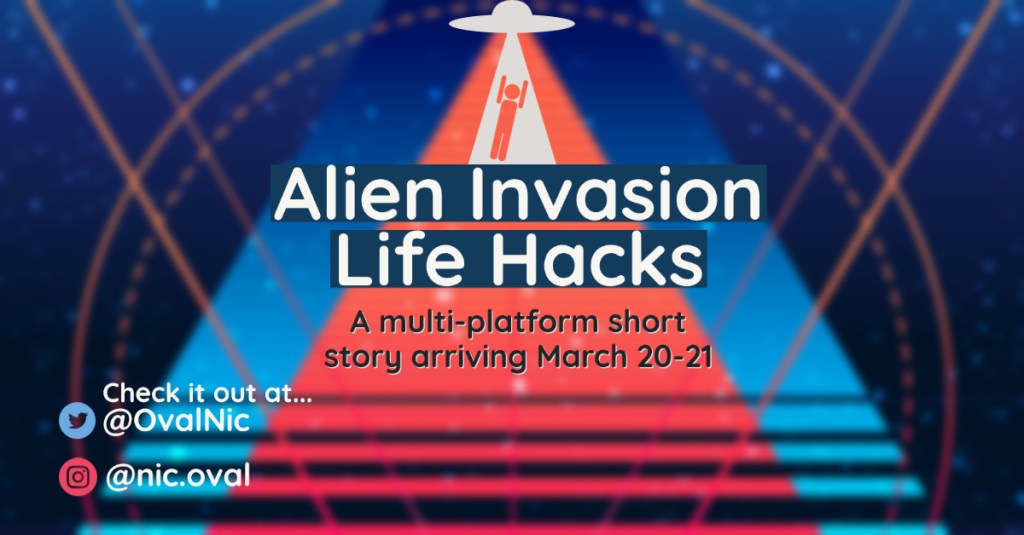
Still here after the alien invasion? Good.
For the final assignment of EXSM 3989, we were asked to use our knowledge of storytelling principles and create a multi-platform story. I wanted to lean into my silly, sci-fi side and write a piece of fiction on my Instagram and Twitter.
In her article “Distributed Narrative: Telling Stories Across Networks” (PDF here), Dr. Jill Walker discusses how some contemporary creators are breaking down traditional fiction “unities”. Instead of being told in one contained space, stories can be fragmented across time (for example, released serially like a podcast) and/or space (told on stickers around a city, or on multiple social media platforms). Although Walker’s paper was published in 2004, when internet creation felt transgressive and impossible to commodify, her proposed principles of distributed narrative are the foundation for multi-platform online storytelling.
Best Practices Across Platforms:
Keeping in mind that many of my regular readers don’t follow both my Twitter and my Instagram, I wanted to ensure that the plot on each platform was clear, but told a different side of the same story. Because Twitter snippet storytelling and Instagram visual storytelling require slightly different skill sets, I leaned into the strengths of each platform.
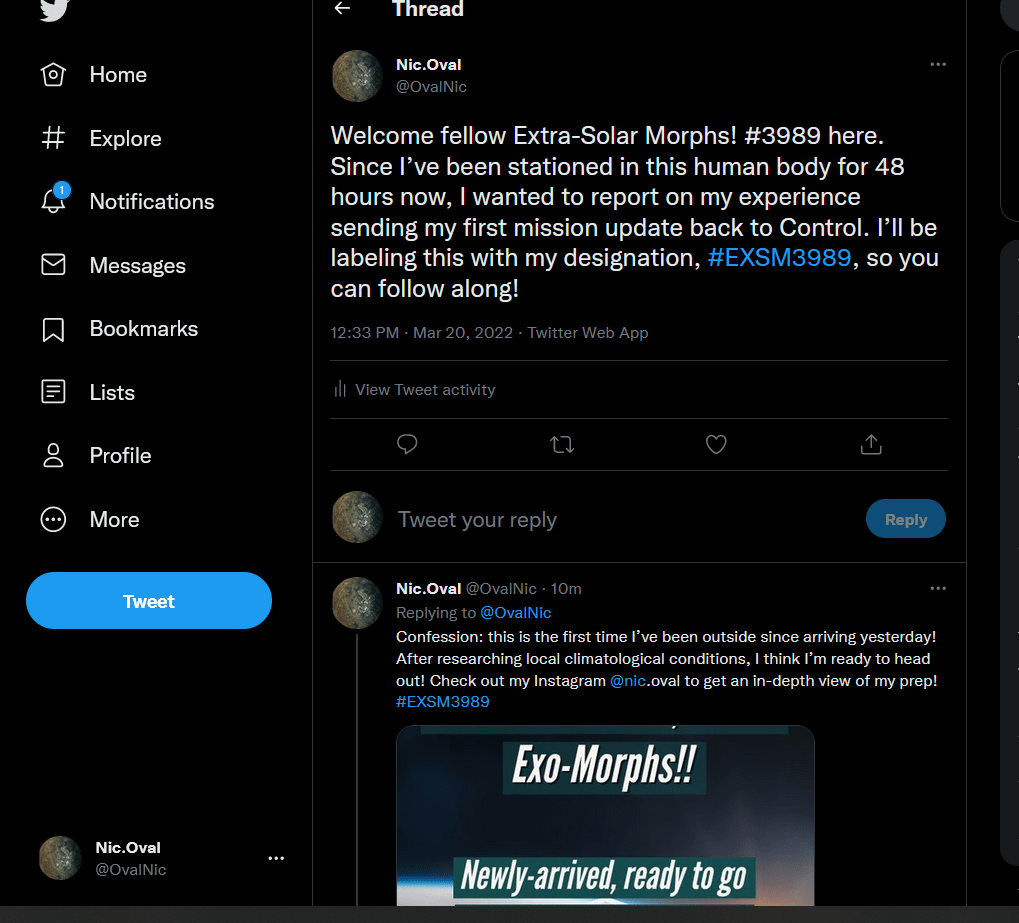
Due to Twitter’s focus on brief snippets of text, I tried to keep the narrative feeling raw and unpolished. Because videos are known to powerfully influence emotion and immerse viewers in a way text never can, I complemented my text entries with footage I shot on a walk near my neighbourhood (edited using TikTok’s free, user-friendly editing software). Side-note: my neighbours probably think I’m delusional now. You can see my Tweet thread here.
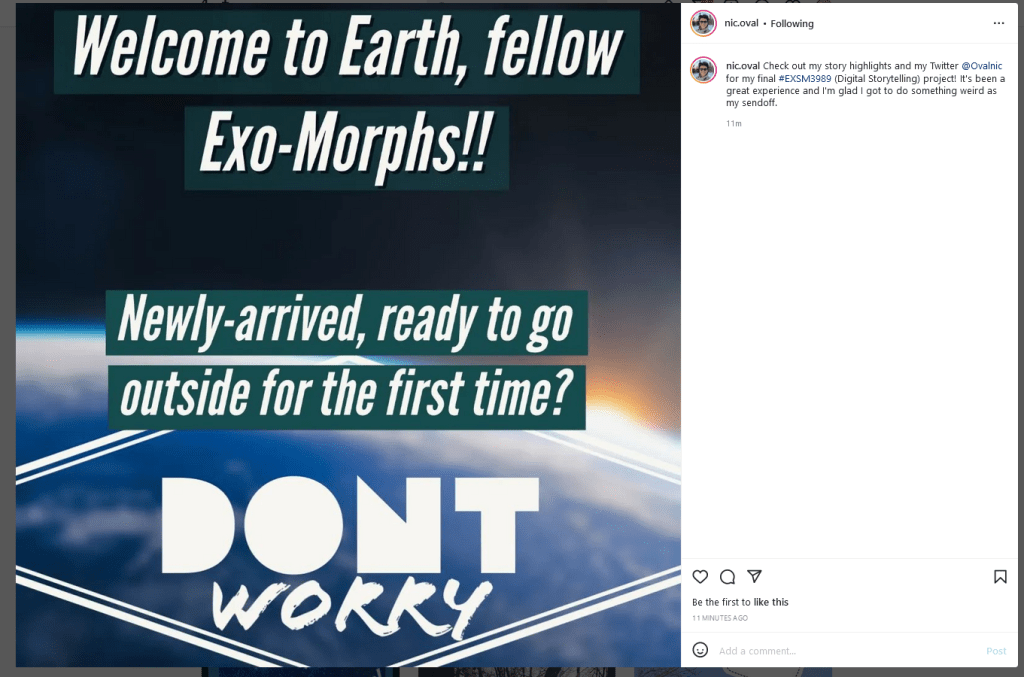
I have noticed that Instagram’s focus on visual storytelling tends, in general, toward users creating more polished-looking content. To mimic this style, I used storyboarding and the software Adobe Creative Cloud to create my comedic “how-to” as an Instagram story, preserving it to my highlights so viewers can watch it after the 24-hour expiration. And, because even Instagram users feel more connected to creators who write captions, I used the opportunity to provide some context for my audience.
Check out my Instagram post here.
Finally, I focused on my favourite medium—long-form writing—to compose this blog post!
Conclusions from an alien invasion
ESXM3989 (the course, not the alien invasion) has encouraged me to experiment with the many ways that we, creators, can tell stories in the digital age. Looking ahead, I would be incredibly interested to play with even more widely-distributed narratives and build up a fictional universe.
Walker concludes by asserting that digital, distributed storytelling asks readers to actively engage with, seek out, and interpret the full story. I look forward to seeing what kinds of interpreters we become as digital technology develops.
 EXSM 3989 - Digital Storytelling Class Blog