Storytelling is an art form that takes time, intention and practice to craft. When you add the digital sphere to the mix, it certainly adds to the complexity. What is “good” digital storytelling? How do you convey your message and keep your audience wanting more? Thankfully for you, I’ve done the research and am about to share the basic blocks to build your digital story!
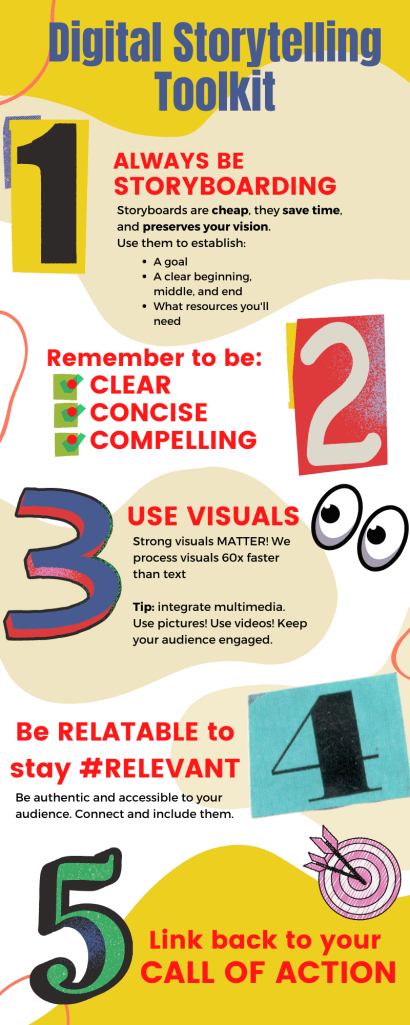
- Always, and I mean, ALWAYS Storyboard.
If you have even the teeniest tiniest of inklings to become a digital storyteller, you must have a handy dandy storyboard ready. Storyboards are an inexpensive way to map out your ideas, and to make sure your vision carries through. When storyboarding, ask yourself:
- What is the goal of this story? (Hint: Your goal should ALWAYS be your Call To Action.)
- What is my story’s concept? What is the beginning? The middle? The end?
- ^^ Do each of the above align with my story’s goals?
- What am I doing to increase my audience engagement through my story? (Consider using geotags, stickers, hashtags to increase your visibility.)
It’s important to remember that it’s okay to edit your storyboard. Ultimately, the goal of the storyboard is to help you plan and make note of which resources you’ll need, including the types of visuals you may need to create. Creating unique storyboards to cater to different social media platforms will help ensure that you are maximizing your reach.
2. The 3 C’s
A good story is clear, concise, and importantly, compelling. The author pays close attention to providing their audiences with the right amount of information– not too much, and not too little.
Introduce your character/brand/message, and spend time showing your audience why they should care. Compel them to care. Without audience buy-in, it’s unlikely your story will take off.
3. Use Visuals
Don’t underestimate the power of visuals AKA don’t forget to add the “Digital” in your storytelling.
In an ever increasing online world, an author is tasked with staying well-versed with the changing online platforms. While these platforms might change, what remains consistent is that humans are visual beings. In fact, 90% of information transmitted to the brain is visual, and we process visuals 60x faster than text.
When creating your story, consider which platforms you’re using and integrate multimedia where possible. Have pictures? Awesome. Videos? Even better! Using Instagram stories? Consider adding stickers or animated text to keep your viewers engaged. Attention to the visual details matters.
4. Be Relatable
Let’s face it, you can write the coolest story to ever exist, but if your audience can’t relate to it in any capacity, the likelihood of them remember it is slim. Of course, you want to stay authentic, but being authentic and being relatable are not two different things. A good story is a universal story, and universal stories are remembered. Universal stories are the ones that stick long after they’ve been read.
Look for opportunities to create engagement with your audience, whether that’s through comments, stories, or re-shares.
5. Connect it back to your Call of Action
Don’t be a sneaky Pete with your Call to Actions. It’s important to remind your audience what you’re asking them to do. Give them clear instructions and make the process easy. If you’re asking them to subscribe to your newsletter, embed that signup link where they can clearly find it.
If you found these tips helpful, drop a comment below!
 EXSM 3989 - Digital Storytelling Class Blog