When it comes to storytelling, visuals are the best way any brand can convey its message to its audience. Whether it’s in good graphic design online, videos that give step-by-step instructions on how to use their products, or photos that convey the emotions that they want their audience to feel.
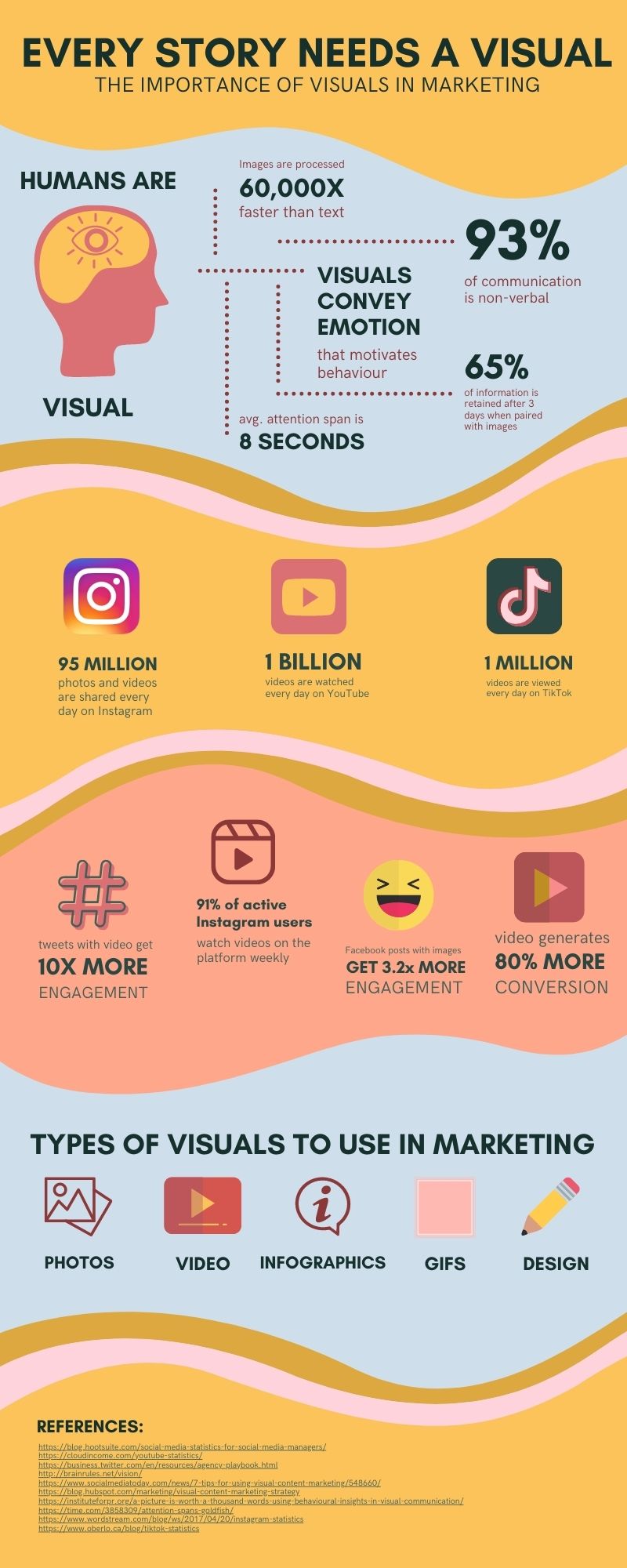
Humans are visual
As we learned in Ashley Fell’s TEDx talk, Why Storytelling is so Powerful in the Digital Era, stories are extremely powerful, even more so when visuals help tell the story.
We are living in times of information overload, but Fell tells us that 90% of information transmitted to the brain is visual and we process visuals 60,000 times faster than text.
Text is retained in our short-term memory whereas visuals go into our long-term memory. For example, when people listen to information, they may only remember 10% of that information three days later. However, if a relevant image is paired with that same information, people retained 65% of the information three days later.
Vision: Vision trumps all other senses (Brain Rules by John Medina) from Pear Press on Vimeo.
While stories are inherently visual, creating pictures in our minds, visuals help convey emotions that might not be comprehensible through just text.
Visuals Grab Attention

Mobile video use has increased 17 times since 2012. And that’s not all. Millions of videos and photos are being posted online to Instagram, Facebook, Twitter and TikTok every day. YouTube has a staggering number of 1 billion hours of video watched EVERY DAY.
That’s one in seven people IN THE WHOLE WORLD watching a whole hour of video on YouTube EVERY. DAY.
So it’s no surprise that social media posts with visuals tend to perform better. For example, tweets with video get 10 times more engagement than those without. More than 90% of Instagram users watch videos on the platform every week.
On Facebook, posts with images get 3.2 times more engagement than those without images. And, video on all platforms generates 80% more conversion than non-video.
Visuals for Marketers

For marketers, it’s no longer about having visuals, but having the right visuals, on the right platforms, conveying the right emotions.
If you want to stand out as a marketer, then having visuals are key. Readers expect quality, as they are inundated with information every second of the day. This could be a well-designed web page, photos that are visual markers of your brand, videos that are shot for the platform that they appear on, or the use of GIFs and memes in social media posts.
In a recent study by Vanngage, 40.8% of marketers found that stock photos did not help them meet their goals, likely because stock photos or footage is easily recognizable by readers today. The visuals don’t convey enough emotion or connection to the product, service or business shown.
Understanding the emotion you want to convey is very important when selecting visuals. You need to select the right visuals for your underlying message. An interesting study in 2018 showed that when presented with three different types of visuals – suffering, treatment or recovery – with a message about encouraging students to seek help for mental health, participants had more positive emotions with the recovery images, leading them to seek out supports more often.
Marketers need to think about the visuals as part of their campaigns as they hold just as much – maybe even more – value than the copy. Think of the visuals as the bread in the PB&J sandwich. The peanut butter is the story, the jam is the way it’s told and the bread is the visuals that package it all together.

 EXSM 3989 - Digital Storytelling Class Blog