“Seinfeld is a great show. It’s literally about nothing,” said my friend when I asked for a recommendation, and boy was she ever right! Making something out of nothing is the show’s appeal factor; Seinfeld chronicles the lives of four single friends; comic Jerry Seinfeld, hopeless George Costanza, frustrated working gal Elaine Benes and eccentric neighbor Kramer who are navigating the absurdities of everyday life. With a runtime of 9 seasons, the show cheekily dedicates 20 minute episodes to exploring mundane problems. Despite its comical nature, these stories are deeply relatable, keeping viewers tuned in decades after the last episode aired.
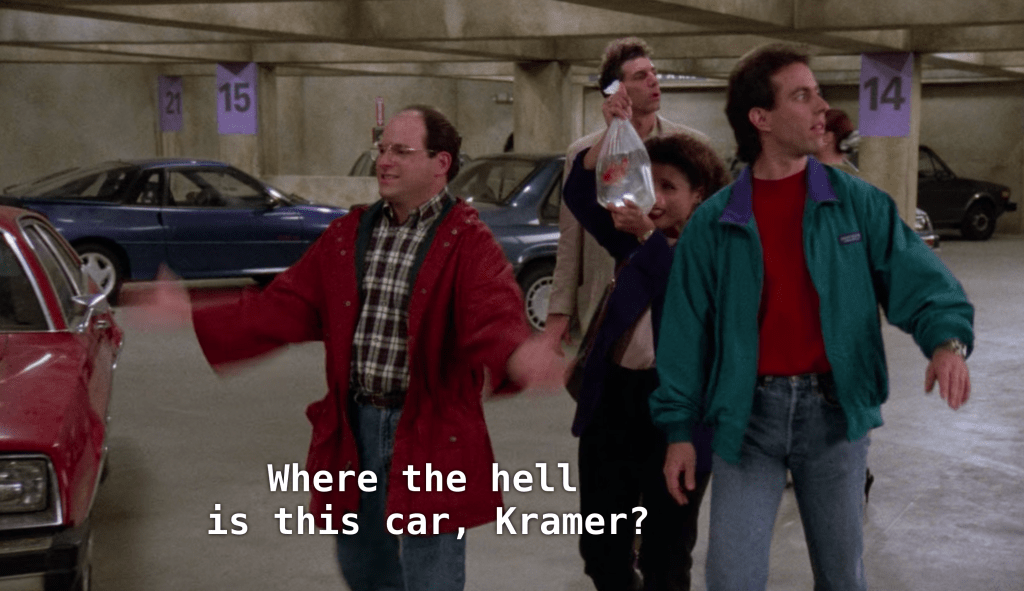
I recently watched an episode titled “The Parking Garage,” where the entire storyline is about getting lost in a parkade. As someone who (often) finds themselves lost in a parking lot, what makes this episode memorable is how relatable the situation is. You quickly empathize with each character as you watch them navigate through some hilarious– but very real – scenarios, like needing to pee really badly when there’s no public washroom, or running very late for an important event. The urgency keeps you hooked and hoping that they find the gosh darn car soon!
A Good Story Is: Building Something Out of Nothing
A good story is simple, focused and intentional. It doesn’t overwhelm the audience with questions and information they need to figure out themselves.
Adam Kens created the Story Spine in 1991 to help writers outline their stories without getting overwhelmed in the details. Here’s an outline of Seinfeld’s The Parking Garage:
| Once upon a time… | There were a group of friends named Jerry, George, Elaine and Kramer. |
| Every day… | The group would hang out and go shopping. |
| But, one day… | They forgot where their car was parked, and got lost in the mall’s parkade. |
| Because of that… | Jerry can’t find a washroom, and he really needs to pee. Finally, he gives in and relieves himself in the parkade. |
| Because of that… | Jerry gets caught and arrested by the mall cop for public urination. |
| Because of that… | Elaine, Kramer and George go searching for Jerry separately, and lose each other in the parkade. |
| Until finally… | Jerry is released and reunited with his friends. They eventually find the car. |
| And, ever since then… | They agree to write down where they park next time. |
At first glance, the story spine doesn’t scream “chaotic hilarity,” but as Kens notes, a story spine “is not the story” but rather the bare-boned structure upon which the story is built. It’s a powerful tool that allows a writer to look at the structural core and ensure that the basic building blocks are in the right place. The story spine helps focus the story, and establishes the 5 W’s: who, what, when, where, why and how. When you’ve got these narrowed down, you can start dabbling beyond the basics.
The Luring In
A good story is one that hooks you in immediately and keeps you attentive. As soon as you lose your audience, your story inherently fails in being heard. You have to be careful to add meat to your storyline without adding too much. Ask yourself: How will I engage my audience — and hold them? A storyteller has to teeter the fine line between delivering too much or too little without straying from the main message.
In her 2017 TEDX Talk on storytelling in the digital era, social analyst and communications expert Ashley Fell, explains that engaging stories embody the 4 I’s: interest, instruct, involve and inspire. Great stories:
- Create interest and maintain our attention;
- Instruct: they have meaning;
- Involve us;
- and most importantly, great stories inspire us.
This episode does an excellent job in delivering just enough chaos in a short span of time to keep you interested, but not overwhelmed with information. The episode stays focused on the gang trying to find their car, but introduces each character’s motivation to get home quickly.
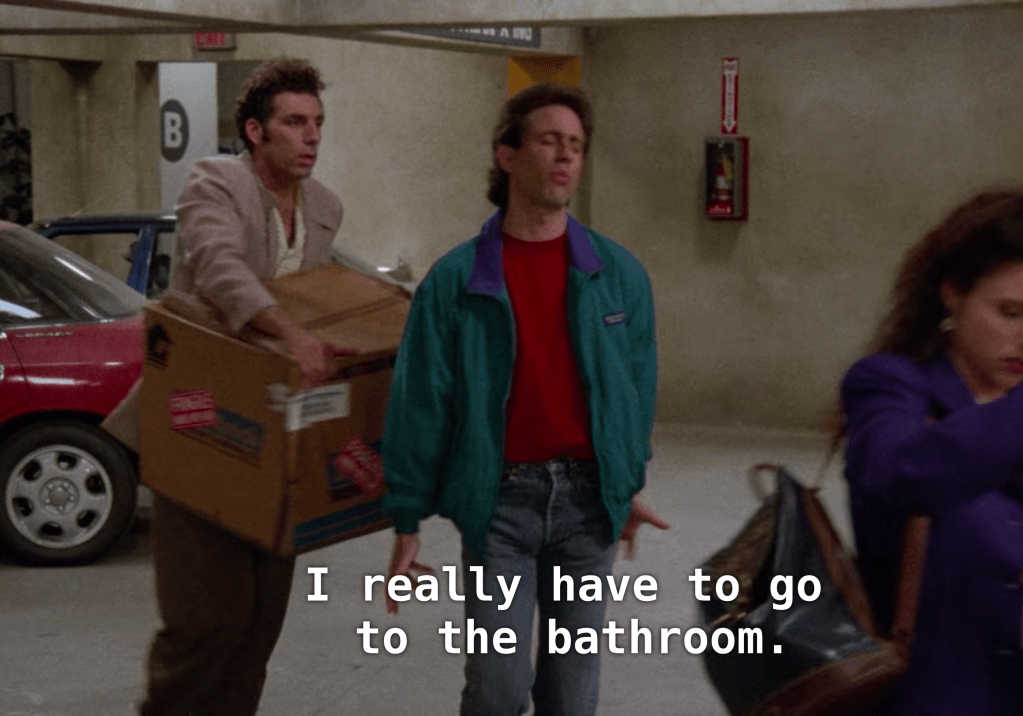
Jerry needs to go home and use the washroom:
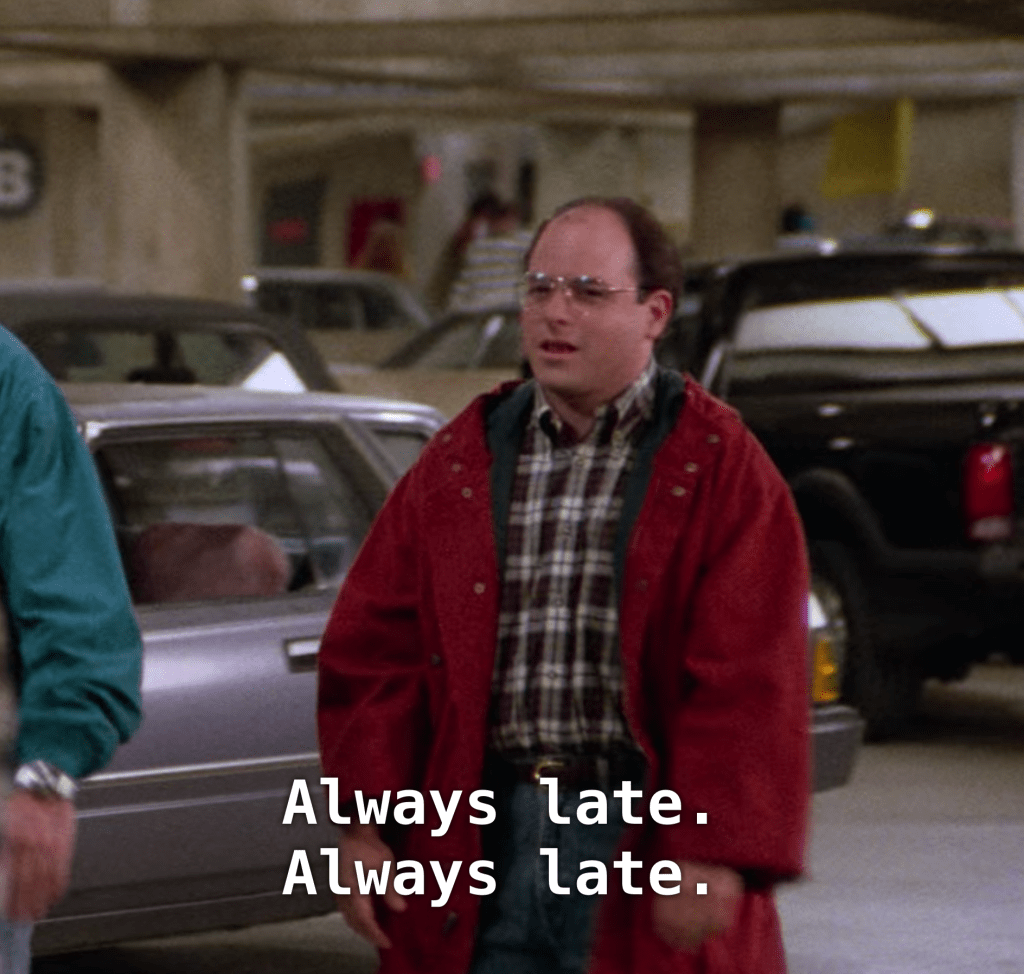
George needs to go home and meet his parents for their anniversary dinner:
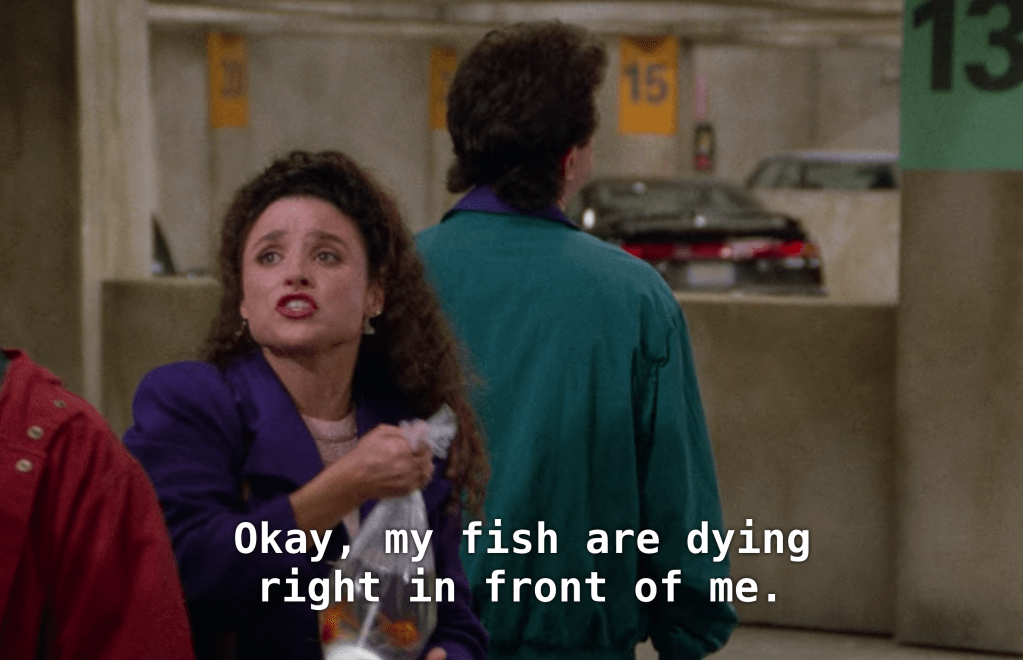
Elaine needs to go home and save her goldfish:
The Buy-In: I Care Because I Relate
The best storytellers look to their own memories and life experiences for ways to illustrate their message. Good stories create “sticky” memories by attaching emotions to things that happen. While I’ve personally never been arrested for public urination, I empathize with Jerry because I know the feeling of needing to go really really badly, but not being able to for whatever the reason may be. We’ve all been there at one point, and while the context might be different, the feeling is universal, and that is what makes this story arc brilliant.
You can’t help but extend your empathy to not only Jerry’s dilemma, but also George who promised his parents that he would meet them for their anniversary dinner, or Elaine, who needs to get her pet goldfish into a tank before they die.
The stakes are high for each character- and you’re invited to stay engaged and see what happens. When you feel connected, you start to care. When you care, you remember, and what is a good story if it’s not one that sticks with you long after you’ve finished it?
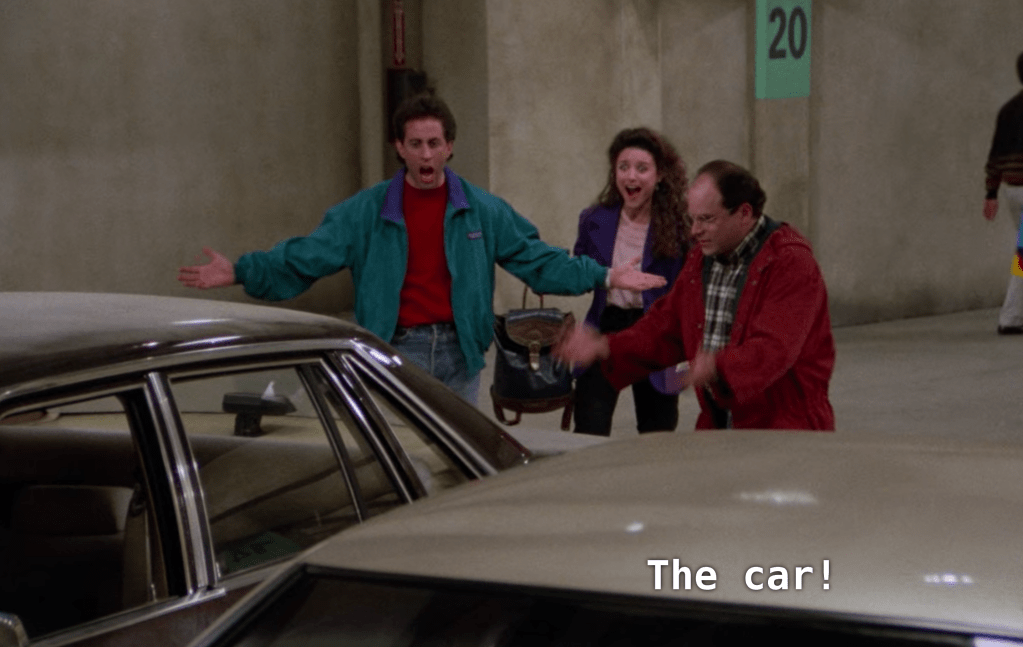
When the gang does eventually find their car, they agree to write things down next time. Unfortunately, it stalls in the parkade and the episode ends. Do they learn their lesson? Maybe! Maybe not. But the ending, while memorable, isn’t the reason why I gravitate towards this episode.
If you too need some comfort in the universality of your #FirstWorldProblems, I highly recommend watching Seinfeld. Let me know what elements of the episode captures (and keeps) you engaged!
 EXSM 3989 - Digital Storytelling Class Blog