
The real life story of Siddhartha Gautama, perhaps better known as the Buddha, has been around for centuries. Myself, I discovered it somewhat more recently than that, about 25 years ago while in my early 20s after seeking out a counselor on a desperate whim one winter’s night and speaking to her about the pointlessness and pain of my existence that felt like it had reached a tipping point. I didn’t know what might happen had I not made this choice. I only knew suffering in silence was breaking me.
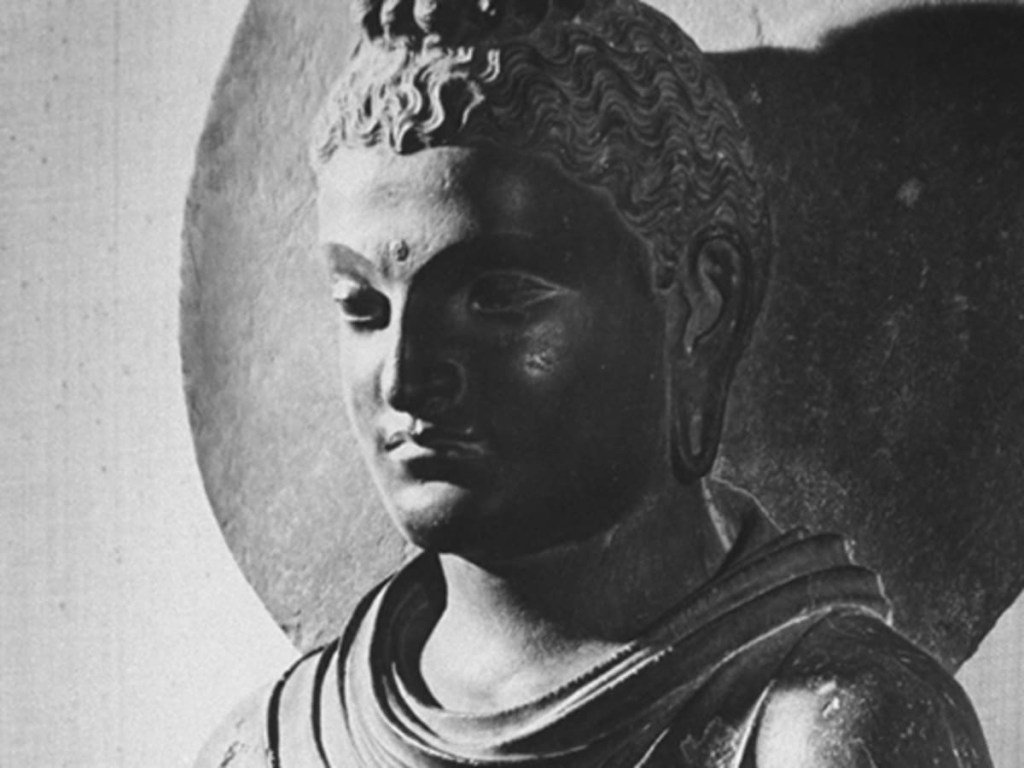
She spoke to me for a time about reframing my relationship to my suffering by being open to receiving the message or messages that my pain had manifested in order to communicate to me. While I wasn’t totally in sync or on board with whatever she was trying to convey to me at the time, I was certainly able to resonate with the faint sense of deeper meaning to my life that transcended any external circumstances that her words pointed to, and that I had credited for just barely sustaining me through those first two tumultuous decades of my own life journey. Just before I left her office, she directed me to two books. One was called The Buddha Within by Lama Surya Das. The other was the novel Siddhartha by Herman Hesse based on the Buddha’s life and it was here that I first learned the story of Siddhartha’s journey for liberation from suffering.

Siddhartha’s Story
The story began some time around 567 B.C.E. with the birth of a boy, Siddhartha Gautama. Siddhartha was born into royalty, a prince, prophesied several years prior to his conception to grow up to be either a powerful monarch or a great sage. Determined that his son would not become an ascetic, the king kept Siddhartha shielded from the world beyond the palace walls. Every day, the prince grew up surrounded by luxury, instructed by brahmins, and trained in archery, swordsmanship, wrestling, and athletics. As soon as he came of age, he married and fathered a son of his own. He had everything he could ever want.
However, one day, driven by curiousity and a calling too strong to ignore, he ventured out beyond the palace walls. There, he saw three things that would change his life forever. He saw a sick man, an old man, and a dead man and learned for the first time that all beings experience sickness, old age and death. Those sights, along with a fourth on his return trip to his palace, that of a wandering ascetic, a meditating monk, would forever alter his life and history.
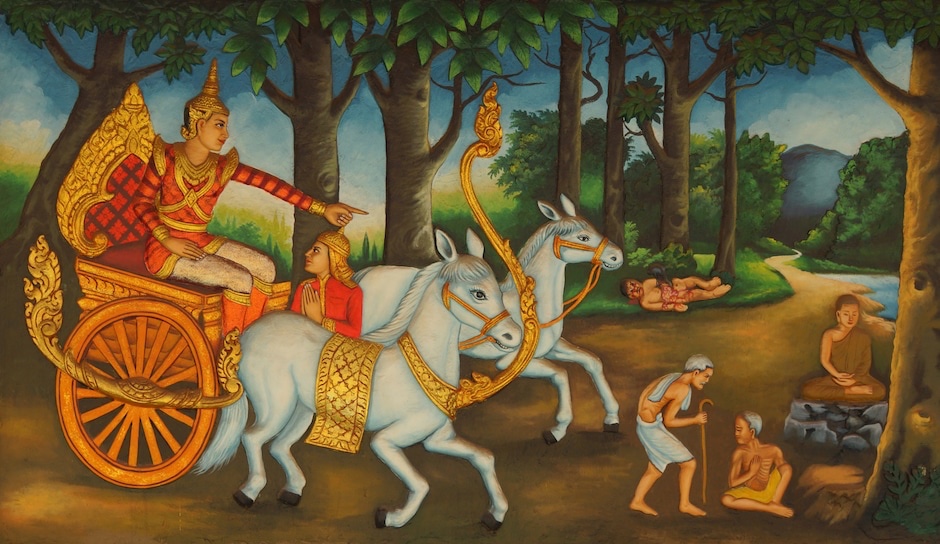
So profoundly moved by these sights and insights was Siddhartha that he embarked on a path that saw him renounce his life of luxury, his kingdom and his family to set off in search of an answer to the problem of suffering. He became an ascetic and joined an entire class of men who had left Indian society behind in search of liberation.
He thus began a spiritual journey to find the greatest spiritual teachers of his time. For some time, he committed himself to extreme asceticism, denying the flesh to strengthen the spirit. Near death from the practice of subsisting on one grain of rice a day, he finally realized this wasn’t bringing the liberation he sought, nor was it helping others. Abandoning the practice, he entered a village and begged for food. His strength soon returned and in a desperate state, he resolved to sit beneath the Bodhi tree, solid and unmoving until he attained enlightenment. Finally, he awakened, realizing that what he had been seeking had never been lost, nothing to attain and therefore no struggle to attain it.
Thus becoming the Buddha, the “enlightened one”, he could have transcended mortality and the karmic cycle of birth and rebirth but instead chose to stay in this suffering world to teach others the path by which they could attain liberation. He served mankind, teaching his four noble truths and the eightfold path that would form the tenets of Buddhism, until his death 45 years after attaining liberation from suffering.

The Buddha’s Lessons For Us
It’s themes of leaving behind the only life he’s known in search of deeper meaning and understanding reflect a universal story of growing up to find one’s self in the context of the larger world beyond our childhood homes. His story feeds off the belief that the nature of life is suffering and that opening one’s heart to their own suffering provides a direct path into knowing the nature of existence and of self. A lot of what my suffering was made up of back when I first learned the story of the Buddha was related to the dissonance I experienced between who I believed myself to be and what others reflected back to me about who I was and in the meaning of my own existence. Lost in that dissonance was the false belief that the truth of who I was must lay in either one extreme or the other, or even somewhere in the middle.

In the years and decades since beginning my own version of Siddhartha’s search for liberation, while being in no way comparable, I’ve come to gradually lean more into the curiousity and courage demonstrated in Siddhartha’s path of what my suffering can teach me rather than becoming identified with and consumed by it to the point of self annihilation. And yet, somewhat ironically, his journey of transcending his suffering and teaching an end to suffering is predicated on that very same annihilation of the self but in life, rather than through the taking of one’s own life which, as it turns out, does nothing to transcend suffering.

Inspired by his example of surrender, sacrifice, and selflessness, I’m coming to recognize what the truth of myself is not. It’s neither the ego, the “I” that navigates my own subjective experience of the world nor is it what others tell me it is based on their subjective experiences of who I appear to be to them. These are simply examples of some of the very illusions that Siddhartha encountered and transcended along his journey into the nature of suffering. The greater purpose of the story of how Siddhartha Gautama fulfilled his destiny of becoming the Buddha is to direct us all towards connecting with our own Buddha nature, inherent in each of us beneath the trappings of society and culture that conditions us from birth into false, limited versions of who we came here to be and express through our humanness.
 EXSM 3989 - Digital Storytelling Class Blog
