Writing a story, regardless of the field, can be nerve-wracking. There are so many elements to consider and developing an idea at times seems daunting. I created an infographic that identifies 4 principles of storytelling. The fundamentals address how to navigate the “prep” before storytelling takes place. Additionally, I included some statistics about storytelling and its relevance. For example, people’s neural activity increases when listening to a story; moreover, most consumers prefer advertisements that resemble stories. I invite you to take a look.
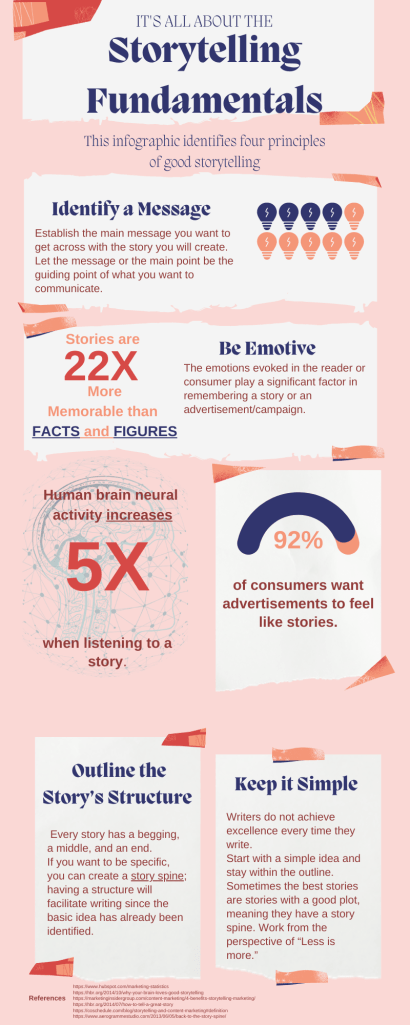
The ideas that I mention in the infographic can also be found below, where I develop the ideas even further.
- Identify a message– Establish the main message you want to get across with the story you will create. Let the message or the main point be the guiding point of what you want to communicate. This is a fundamental concept that can be adapted into many fields, from marketing to literature.
- Be emotive– Stories are 22 times more memorable than facts and figures; consequently, the emotions evoked in the reader or consumer play a significant factor in remembering a story or an advertisement/campaign. Writing the story from life experiences or considering the power of emotions can help to pull in the reader/consumer’s attention. The goal is to cause feeling.
- Outline the story’s structure– Writing is a subjective experience. For some people, it comes easily; for others, it can be more challenging. Sometimes writers also face the loathsome ‘writer’s block.’ Create an outline can help you keep on track and get started. Every story has a begging, a middle, and an end. If you want to be specific, you can create a story spine ; having a stricture will facilitate writing since the basic idea has already been identified. Side note: creating an outline also helps task-oriented people.
- Keep it simple– While it is understandable that you want to write the most fantastic story ever, sometimes writers do not achieve that excellence every time they write. Start with a simple idea and stay within the outline. Sometimes the best stories are stories with a good plot, meaning they have a story spine. Work from the perspective of “Less is more.”
I hope this short entry helps you “get going” in your writing or storytelling process. I am confident that these steps will help you write a great piece. Thanks for reading!
References:
O’Hara, Carolyn. 2014. Harvard Business Review. “How to tell a great story.” https://hbr.org/2014/07/how-to-tell-a-great-story
Neidlinger, Julie. CoSchedule. “How To Use Your Blog To Tell A Story.” https://coschedule.com/blog/tell-a-story/
 EXSM 3989 - Digital Storytelling Class Blog