For my live-tweet I chose to showcase a day in the life of my dog, Brooklyn — because why not? As we learned from Paris Zarcilla’s viral tweet thread “I just found a cat that is not mine and it has had babies under my bed,” readers love pet content. And a major takeaway from Kristin Tynskni’s article “Beyond Buzzfeed’s Juicy Headlines: Article Types and Themes that Earn Outstanding Shares and Insanely Valuable Links,” was that Pets/Animal content fared well in terms of social sharing.
Brooklyn’s day begins like any other day, with a rude wake up call from me. Then follows a morning walk and breakfast before she settles in for her big day of, well, sleeping. There’s a lot of sleeping frankly, then an afternoon walk, followed by the anticipation of Dad coming home, before finishing her jam-packed day.
The story spine
While my story has a beginning (waking up), middle (lots of napping), and end (Dad coming home), following a “proper” storytelling structure is much harder to do when your story isn’t pre-planned. However, if we apply the story spine more loosely, her day goes a little something like this:
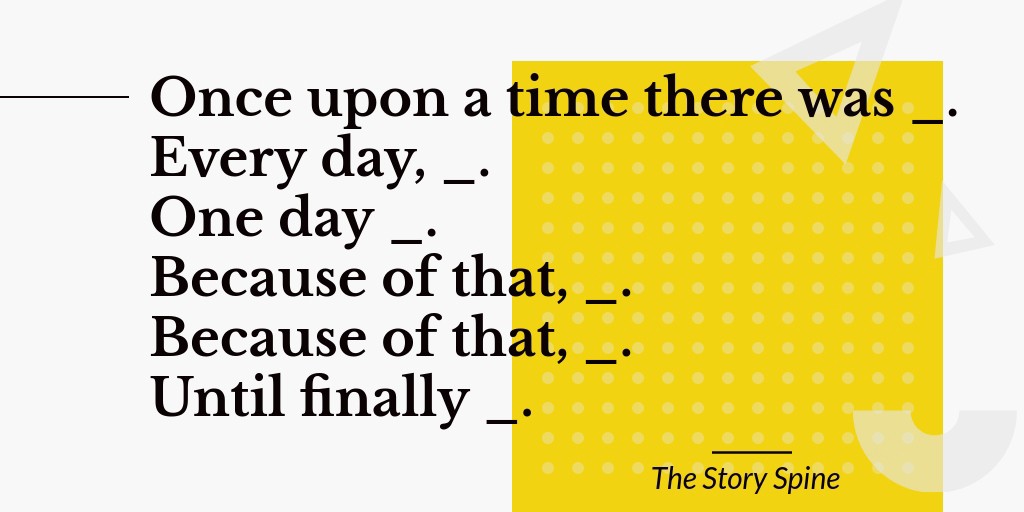
Once upon a time, Brooklyn begins another day by being rudely woken up by her parents.
Everyday, she is hugely unimpressed with this inconvenience.
Because of that, she continues to sleep all day.
Until finally, her Dad is home and she is happy to have her family reunited.
And, ever since then, all is right in the world and she stayed awake (well, for the rest of the evening!)
Storytelling principles for social media
While live-tweeting Brooklyn’s day I attempted to keep storytelling principles in mind, particularly those that work well for social media — I took a lot of my inspiration from how Paris Zarcilla told his story, too. Ultimately, I attempted to incorporate the following elements from this week’s learnings into my story:
- Write the way you talk: As someone who writes for professional audiences for a living, I found it challenging to write simply, and “less professionally” per se. I worked really hard to keep in mind my tone and choice of language, as Eric Goldschein explains in his article. I used slang that we use in our household daily, like “walkies” and “scritches.” I also wrote sarcastically, because I’m often a very sarcastic person.
- Maintain suspense: As we learned from Gary Vaynerchuk, “to tell a great story, the number one thing you have to do is evoke a reaction.” A reaction can often come from creating suspense, which I integrated into several of my tweets, including the very first one where I build suspense on what my tweet thread is going to be about. I carry this trend throughout the day when I tell readers to “stay tuned” for what’s next, followed by “losing” Brooklyn around lunchtime.
- Style choices: I often used all caps throughout my live-tweet to convey emotion, primarily excitement, to put emphasis on a particular word, or to showcase something from Brooklyn’s perspective.
- Add visual elements: I incorporated a photo, article or GIF into 18 of my 25 tweets because adding a visual element is more engaging for readers as we’ve learned we are more visual by nature. Plus, the more cute dog photos the better, right?
Document. Don’t create.
Lastly, my live tweet of Brooklyn’s day achieved Gary Vaynerchuk’s idea of “Document. Don’t create.” I simply told the Twitter-world what was happening in Brooklyn’s day. I did not create something out of nothing, or force her day to appear more exciting than a typical one is. This also helped me to feel less pressure as I was telling the story. As a result, I believe my story was more natural and authentic. It didn’t try to be something it wasn’t.
 EXSM 3989 - Digital Storytelling Class Blog