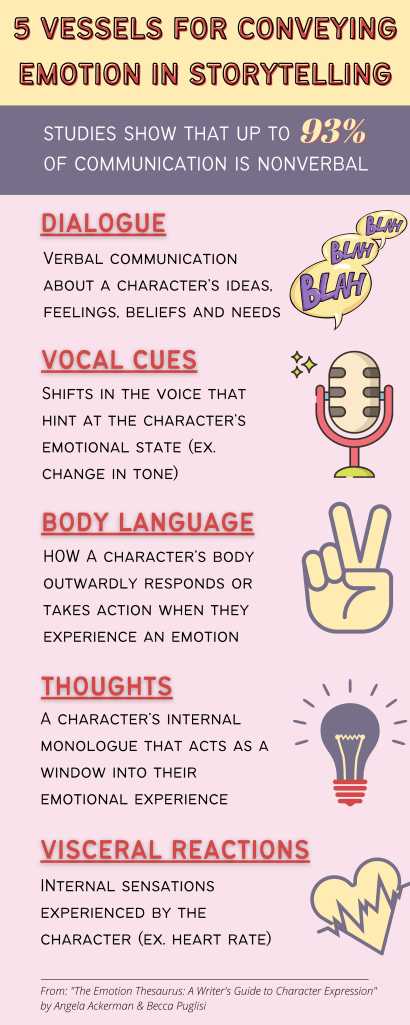
Great storytelling hinges on a storyteller’s ability to convey and evoke emotion. Emotion is at the forefront of a character’s journey, thus being an important aspect of propelling the story forward. There are no stakes in a character’s personal story without emotion. While we may perceive that verbal communication is the predominant method of communication, studies actually show that 93% of communication is nonverbal. Because of this high statistic, storytellers must ensure that their characters are expressing emotion in a multitude of recognizable ways. Below are 5 different vessels for conveying emotion in storytelling according to Angela Ackerman & Becca Puglisi in their writing handbook “The Emotion Thesaurus: A Writer’s Guide to Character Expression.”
5 Vessels for Conveying Emotion in Storytelling

Dialogue
Dialogue refers to the words a character uses to articulate their ideas, beliefs and needs. Dialogue is an effective method of revealing a character’s emotional state, but it should rarely be used on its own. Making use of verbal dialogue in conjunction with non-verbal communication is important when attempting to convey realistic displays of emotion.
Vocal Cues
Vocal cues are shifts in the voice that hint at a character’s emotional state. Examples of vocal cues are hesitations, changes in tone or pitch and words that are suddenly spoken faster. While dialogue can be manipulated by the character and words can be chosen carefully, vocal cues are harder to control.
Body Language
Body language is how a character’s body responds when experiencing an emotion. When a character experiences a strong emotion, the body’s reaction will be bigger and there will be less control over the body’s movement.
Thoughts
Thoughts refer to the internal monologue of a character where a mental process corresponds with an emotional experience. Thoughts are not necessarily always rational but they convey how certain people, places and events impact a character’s point of view.
Visceral Reactions
Visceral reactions are internal and instinctive sensations. Examples include heart rate, an adrenaline rush and light-headedness. These are the most powerful form of nonverbal communications as relying too much on visceral reactions can create melodrama and clichéd phrasings when describing them.
Further Resources
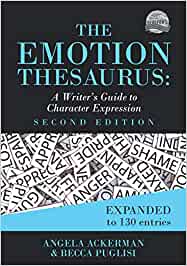
Check out Ackerman & Puglisi’s book and blog, “Writers Helping Writers”, for more great tips on character portrayal, conveying emotions, writing, and storytelling. And if you’ve got any tips for conveying emotion in storytelling, share them in the comments!
 EXSM 3989 - Digital Storytelling Class Blog