There’s a good chance you’ve heard of the journalistic 5 W’s of storytelling — who, what, where, when, and why (and sometimes how). However, have you ever heard of the 4 I’s of storytelling?
Ashley Fell’s TEDxUniMelb talk, “Why storytelling is so powerful in the digital era,” explores the idea of what makes an engaging story — and she uses a bit of a different lens.
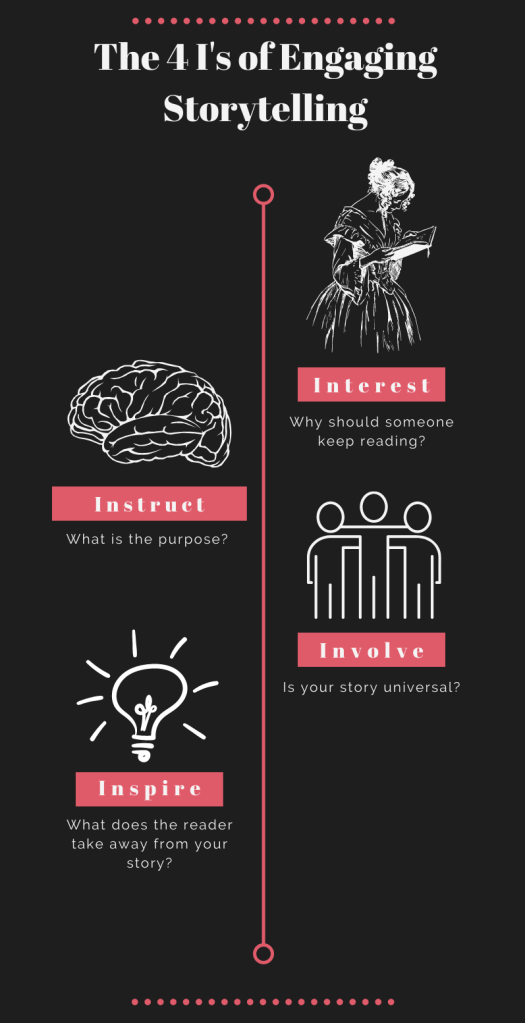
#1: Interest
First of all, your story needs to capture the reader’s attention. Particularly in the digital world, where there is a barrage of information and texts available to every audience, your story needs to stand out in some way and hook the reader, lest they just keep on scrolling.
In order to ensure you’re provoking your reader’s interest, think of some of Pixar’s 22 Rules of Storytelling. Give your characters strong opinions that will ignite curiosity in the reader, whether or not they agree with the character. Also ask yourself the important question of “why must I tell THIS story?” This will help you get to the heart of the narrative, and a well-told story will hold a reader’s interest.
#2: Instruct
Ashley Fell’s job involves taking dense data and transforming it into something that is more engaging for a reader — and that process of instruction is something all stories do, even if there isn’t a spreadsheet filled with data to translate.
This is because good stories have meaning. They have a clear structure and purpose, and whether it’s sharing specific information or simply sharing a way to look at the world, they instruct the reader.
One thing to keep in mind is simplicity and focus, another key characteristic of good stories — in order to ensure your reader understands the purpose at the core of your story, you want to carefully curate the information you present so that everything is clear for the reader, and they aren’t left confused.
#3. Involve
Engaging stories are universal, which means they must involve the reader in some way. Don’t get stuck thinking that you need to write about a situation or experience that everyone would be familiar with, though — that’s not what’s meant by universal.
Ultimately, it doesn’t matter if the reader can relate to the specific, unique situation that is presented in the story — what matters is how they feel. An engaging story will provoke a particular feeling or emotion in the reader.
#4. Inspire
As Pixar’s principles of storytelling explained, good stories give you a character to root for — but it’s more about the journey than the destination. Readers are more interested in the intricacies of how a character does something, and what their journey was along the way, than in where they end up.
Whether you’re trying to get a reader to look at the world through a more optimistic lens, or trying to get someone to buy a product from your business, you want to inspire them in some way.

Today, more than ever before, there are a huge range of mediums through which stories can be told. Different platforms all have particular benefits and drawbacks, and it’s up to you to figure out the best way to tell your story. If you keep the 4 I’s of engaging stories in mind, you’ll snare a reader who simply can’t be torn away from your tantalizing tale!
 EXSM 3989 - Digital Storytelling Class Blog
One reply on “The 4 I’s of Engaging Storytelling”
[…] again, I found all 4 I’s of Engaging Storytelling evident in my favourite children’s […]
LikeLike